
Trend-Driven Content Marketing: Why Timing Is More Important Than Ever

Cross‑border e‑commerce teams often spot a hot topic rising on Reddit, YouTube, or news platforms. The problem is that after the signal appears, the idea still has to go through market assessment, translation, rewriting, approval, and multi‑platform scheduling. By the time the content is finally published, the discussion may have moved from a growth phase to saturation, and the brand only gets delayed exposure.
The timing of trend content is usually not a fixed “optimal moment,” but rather the operational delay from signal detection to localized publication. Teams need to first confirm whether the topic, product, market, and audience are relevant, then compress the time spent on translation, rewriting, approval, and scheduling, rather than skipping brand safety and fact‑checking just to chase a hot trend.
This is the difference between trend‑driven content marketing and regular content marketing. Evergreen content published a few days later may have limited impact; real‑time trend content delayed by a few hours may already have a different cycle of engagement and search interest. Thus, timing is not merely a scheduling setting but part of content lifecycle management.
The Window for Trend Content Is First an Operational Delay Issue
A trending topic typically goes through emergence, heating up, diffusion, and saturation stages. The rhythm varies across platforms: a technical discussion on Hacker News may concentrate its spread within a few hours, YouTube search interest can last for days, and news platform topics are also affected by follow‑up coverage and regional time differences.
Cross‑border e‑commerce teams often get stuck after signal confirmation. The person responsible for topic selection first screenshots or forwards the link, the marketing staff assess suitability for the target market, copywriters wait for product information and brand guidelines, and after translation, they must rewrite versions for Instagram, TikTok, X, or Facebook. A half‑day delay at any step can consume the effective window for trend content.
A practical audit method is to break down and record the time from signal appearance to publication, rather than only looking at the final release time. Teams often find that the real time sink is not writing but waiting to confirm inventory, supplement local phrasing, find suitable images, or debating two nearly identical titles in the approval channel.
Not all content can be placed into the same timeliness model. Real‑time trend content requires hour‑level response, seasonal content is usually prepared on a weekly or monthly basis, and long‑term evergreen content is better scheduled according to search demand, page quality, and content update cycles. Mixing the three makes it impossible for teams to both respond promptly to hot topics and maintain long‑term pages.
For timing judgments, one can refer to a posting‑time analysis based on 9.6 million Instagram posts, but such studies only provide a background distribution and cannot replace a brand’s own audience data. Active periods, account sizes, content types, and interaction habits vary greatly across countries, so research conclusions must be considered alongside one’s own engagement and click‑through rates. Teams can also consult the Instagram posting‑time analysis, but should not treat the time slots as fixed rules.
Trend‑scanning tools can shorten discovery time but cannot replace relevance assessment. A highly popular consumer topic on Reddit may have nothing to do with the brand’s product; a YouTube video with massive search interest may involve unverified claims. Cross‑border teams truly need to optimize latency, not hand brand judgments over to hot‑topic rankings.
First Assess Whether a Trend Is Worth Pursuing, Then Decide on Timing
Trend selection should not start with “how hot it is,” but should consider four conditions simultaneously: whether the product can naturally enter the discussion, whether the target market understands the context, whether the audience is already engaged, and whether the topic is still rising. Satisfying only one condition is usually insufficient to support commercial content.
Global markets cannot simply copy the same hotspot. When U.S. users discuss a particular holiday, the U.K. and Australia may be in different seasons; consumer scenarios that interest Southeast Asian users may not be suitable for direct translation to German users. Cultural localization is more than swapping English for Chinese or Chinese for Spanish; it also includes units, prices, holiday contexts, slang, and consumer habits.
A common mistake among cross‑border e‑commerce teams is to turn a news headline directly into a promotional copy. When the news discusses a policy change, the brand immediately adds “limited‑time discount”; a sarcastic expression on a social platform, once translated, becomes a seemingly serious product statement. Such content may capture a few minutes of hype but leaves brand‑safety and factual‑accuracy issues.
Trend content can be managed in the following four stages, with each stage specifying an owner and a latest completion time:
- Discovery: Record the topic source, appearance time, region, and initial discussion direction.
- Verification: Market or category lead confirms relevance, factual basis, and brand risk.
- Rewriting: Localization staff handle language, platform structure, product information, and visual assets separately.
- Publication: Operations staff check inventory, links, permissions, time zones, and the final version before scheduling.
These four stages don’t necessarily require four separate people; a small team may have one person wear multiple hats, but responsibility cannot remain at “someone takes a look.” Without a clear latest time, approvals will naturally drag on until the trend is already saturated.
Stopping criteria are equally important. When the discussion starts repeating, audience reaction shifts from curiosity to annoyance, the topic sparks new controversy, or the brand cannot provide an accurate explanation, the team should stop publishing or switch to neutral observation. There is no permanent stable balance between speed and brand safety; some hot topics simply aren’t suitable to follow.
Social listening data also needs to be examined within a commercial context. High engagement does not equate to purchase intent, and rising search interest does not mean the target market is willing to accept brand involvement. For how SEO, AI video, and automated distribution can work together, see the Cross‑Border Content Stack Analysis; however, the tech stack can only shorten the process, not replace the team’s decision on what content should not be published. Teams looking to reduce repetitive work can refer to Low‑Cost Global Social Media Operations for another workflow, but lightweight operations still require human oversight.
Use Content Repurposing to Compress Time from Ideation to Multi‑Platform Publication
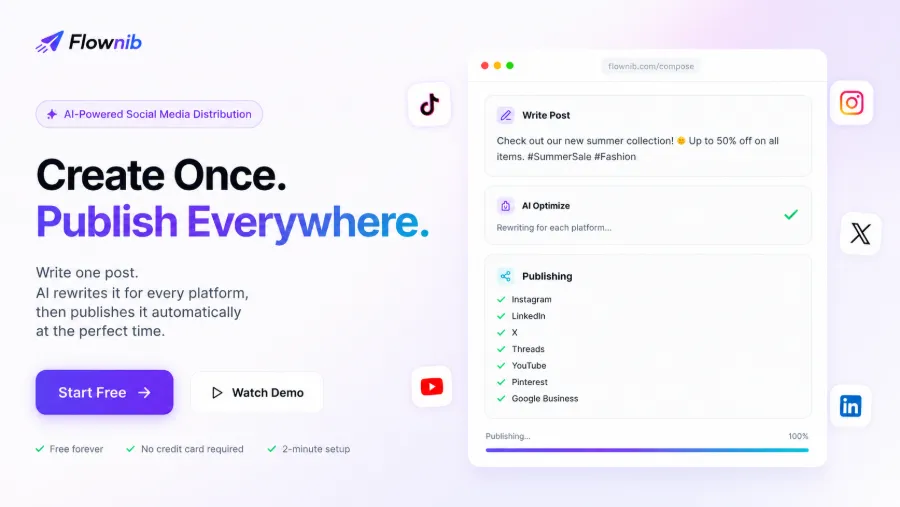
Once trend content passes selection, the next biggest time sink is duplicate production. Operations staff switch tabs between Instagram, TikTok, X, LinkedIn, YouTube, and Pinterest, copy the same text, and then adjust titles, tags, images, and scheduling per platform. When a piece of content has to be handled six or seven times, any product link or price may be mistakenly altered halfway through.
Content repurposing does not mean pushing the original text verbatim to every platform; it retains facts and brand tone while restructuring according to each platform’s content format. Instagram leans heavily on visuals and captions, TikTok usually needs a short video intro and conversational script, X is suited for compressed viewpoints, LinkedIn requires a more complete industry explanation, YouTube benefits from search‑friendly titles, and Pinterest is closer to image descriptions and long‑term discovery.
Amidst such workflow friction, teams may use Flownib as an operational example for multi‑channel publishing: first prepare a verified trend piece, then let AI rewrite it to meet each platform’s character limits and expression style, and finally have operations staff preview and schedule. It supports ten social platforms, and the documentation shows an average setup time of about two minutes, but this figure only reflects the speed of initiating the process and should not be interpreted as each trend piece being completed in two minutes.
Distributing via official APIs can reduce manual login and copy‑pasting, but it also introduces new checks such as permissions, media specifications, and API status. Meta’s developer platform documentation can help teams verify Instagram and Facebook API permissions; in practice, expired account authorizations, non‑compliant image ratios, or incorrect video encodings can still cause scheduling failures.
AI rewriting also has clear boundaries. It can adjust sentence length, structure, and tone, but should not independently change product specifications, discount deadlines, logistics promises, or legally relevant statements. Trend content is especially prone to factual drift: the model, aiming for smoother copy, may turn “being discussed” into “already confirmed,” or turn user opinions into brand positions.
Pre‑publish checks usually save more time than rewriting a piece from scratch. At a minimum, verify that links are functional, prices and inventory are synchronized, language matches local expression, time zones are correct, assets meet platform size requirements, and each account still has publishing permission. Multi‑platform adaptation reduces mechanical work but does not eliminate the need for a final human verification.
A more pragmatic approach is to separate platform adaptation from trend assessment. The content team confirms whether the story can be told, AI rewriting handles different formats, and operations staff confirm whether it can be published now. This reduces duplicated effort across roles and avoids mistaking “can be auto‑published” for “should be published immediately.”
Turn Timing into a Reviewable Cross‑Border Content System
After publishing, teams need to record more than just the number of posts; they should capture the timing, market, platform, version, engagement performance, and conversion signals. Otherwise, when a piece of content performs well a few days later, the attribution can only be to “the topic was hot,” without discerning whether timing, copy angle, platform distribution, or the product itself drove the result.
“Publishing early” and “publishing effectively” are often not the same. A piece of content that goes live two hours earlier may gain more exposure but receive no clicks due to insufficient inventory or incomplete landing‑page language; another piece published later may have lower reach but yields higher click‑through and conversion rates. Timing must be evaluated together with engagement, click‑through, conversion rates, and inventory status.
A content calendar can accommodate three types of content simultaneously: real‑time trend content, seasonal promotions, and long‑term evergreen content. Trend content occupies response space, seasonal content occupies preparation cycles, and evergreen content requires ongoing maintenance capacity. If hot topics continuously crowd out product education, customer Q&A, and search‑type content, short‑term engagement may rise while long‑term content assets develop gaps.
Automated scheduling should not be treated as unattended. Different market time zones can place the same timestamp in completely different daily contexts; breaking news can shift audience sentiment, inventory changes can invalidate planned promotions, and platform policy updates may affect links, music, or ad copy. Scheduling systems need to retain pause and rollback mechanisms rather than merely aiming to fill the calendar.
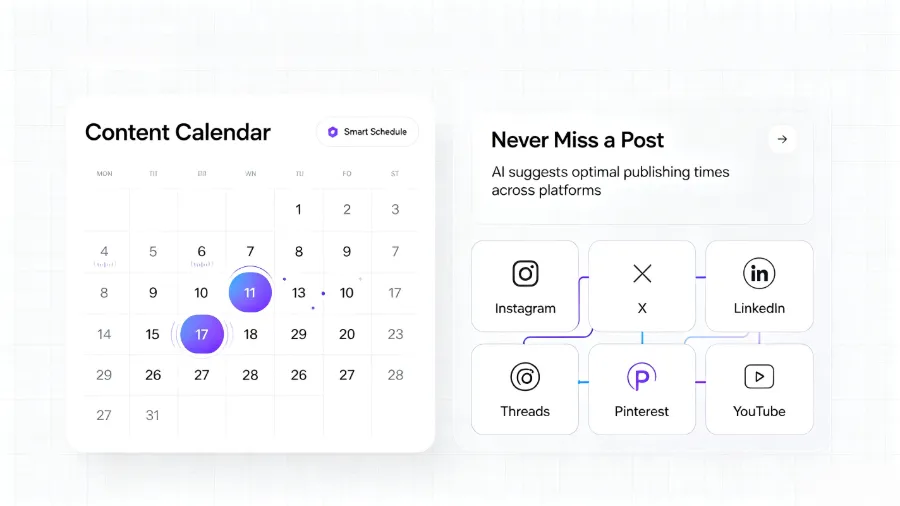
The scope of cross‑platform retrospectives can initially be limited to ten platforms, then recorded separately by market and platform, rather than looking at a single aggregate. Instagram saves and shares, TikTok completions, X replies, LinkedIn clicks, and Google Business action buttons each have different meanings. Aggregating them into a total engagement rate often masks truly useful differences.
Publish records should also retain content versions. Trend content often undergoes changes to titles, images, or prices before publishing; if only the final version is examined, the team cannot know whether an earlier version missed a better window. For critical product milestones, refer to the Product Launch Day Social Media Blitz Process to document the sequence of content, platform reactions, and follow‑up actions on launch day.
Only after a team records data for several weeks can it discern that one market is better suited for early explanation, while another should wait for the discussion to mature before entering. The outcome may not be a fixed publishing time but a set of rules allowing pauses, rewrites, and delays. Thus, timing becomes part of a controllable time‑management and review mechanism, rather than a “best‑time” button.
FAQ
How does trend‑driven content marketing differ from regular content marketing?
Trend‑driven content relies on a short lifecycle, typically requiring judgment and publishing within hours to a few days after the signal appears. Regular evergreen content can be prepared over weeks and gains long‑term traffic through SEO, updates, and continuous distribution.
How should cross‑border e‑commerce teams decide whether a hot topic is suitable to follow up on?
First confirm whether the topic, product, target market, and audience are related, then examine cultural context, factual basis, and brand risk. If the discussion is already saturated, audience reaction turns clearly negative, or inventory and landing pages cannot handle the traffic, the team should not continue publishing for the sake of speed.
Should the same trend content be published on multiple platforms at the same time?
It should not be assumed to be posted at the exact same second. Different platforms have varying audience active times, content contexts, and market time zones; the team can keep the same theme but schedule timing and expression separately.
Can AI rewriting replace human localization review for cross‑border content?
No. AI can adjust structure and tone within minutes, but price, inventory, cultural nuance, legal statements, and brand stance still require review by localization staff, especially for trend‑news content.
How to measure whether timing truly improves content performance?
At a minimum, compare timing, reach, engagement rate, click‑through rate, and conversion rate, and record them broken down by market and platform. After observing for 2–4 weeks, decide whether early publishing yields better results, rather than relying on a single piece’s view count.
Share Article


