Low‑Cost Global Social Media: AI Distribution System Enables Lightweight Matrix Operations for Emerging International Brands

Open the browser at 9 a.m.; six tabs are Instagram, X, LinkedIn, TikTok, Facebook, and YouTube Studio. You have to crop the same product image into four sizes, rewrite the same copy to fit the tone and character limits of six platforms, and then verify that each account’s posting time falls within the active window of the target time zone. After a morning, three posts are still not published. This is the daily routine of a fledgling overseas brand with a monthly budget under $2,000—manual matrix operation not only consumes labor hours but also, because of time‑zone mismatches and format errors, slows the accumulation of organic traffic far below expectations. This article does not discuss growth myths; it directly breaks down a low‑budget, reusable full‑funnel social‑media exposure process that relies on AI‑driven rewriting and lightweight distribution to reduce operational friction.
The reality of low‑cost overseas social media: why “multi‑platform scaling” in 2026 no longer relies on sheer manpower
Many early‑stage brands dump their limited marketing budget into Google Ads and Facebook paid campaigns, believing that organic social media is too slow and not worth the investment. This judgment misses a key point: natural content exposure across multiple platforms builds brand search weight that, during the cold‑start phase, is more durable than paid traffic. A post that continuously receives engagement on Instagram and LinkedIn will be indexed by two independent search engines and recommendation systems, and this cross‑platform signal stacking cannot be bought with ads alone.
The problem, however, is labor cost. A team with a monthly budget of $500–$800 that wants to manually cover five platforms needs at least 15 hours of operational work per week. Do the math: a part‑time operator earning $300–$500 per month spends about 60 % of her time on social‑media tasks, leaving the rest for customer support and product listing. Traditional outsourcing isn’t cheap either—hiring a freelancer to manage four platforms typically costs $600–$1,200 per month, and content quality varies.
In contrast, an AI distribution system can compress labor costs to one‑third of that. Using the mature mainstream social‑media management tool Hootsuite (https://www.hootsuite.com) as a benchmark, its professional plan costs about $99 per month for five accounts and does not include AI rewriting. Adding AI content adaptation requires subscribing to additional tools. The essence of a lightweight solution is not “spending less,” but “replacing repetitive work with automation,” freeing a person from pure execution to focus on topic selection and interaction strategy.
The most common pitfall at this stage is blind scaling. We have seen a team build a ten‑platform matrix in the first week, only to run out of content inventory the next week—original assets couldn’t keep up, and AI rewriting couldn’t rescue creative fatigue. Worse, three posts triggered content‑violation rules on different platforms: one on Facebook was throttled for click‑baiting, another on LinkedIn was collapsed for overly promotional language, and a third on TikTok was taken down for music‑copyright issues. The lesson is simple: deep‑operate 3–4 core platforms first; that is far more effective than a full‑funnel scattershot.
Four core actions for lightweight matrix operation
Account architecture does not aim for every platform. Based on typical target markets for overseas brands, the priority order is: Instagram (visual showcase + young‑user reach), X (industry conversation + customer service), LinkedIn (B2B partnership + brand trust), YouTube (long‑tail search traffic). If your product is visually driven, prioritize Instagram Reels and YouTube Shorts; if it’s a SaaS tool, LinkedIn should outrank Instagram. Do not register Threads or Bluesky on day 1 unless your target market has already proven user density on those platforms.
Content‑format adaptation is the most time‑consuming step in matrix operation. An Instagram post needs a square image plus dense hashtags; an X post is limited to 280 characters and requires a topic hook; a LinkedIn article’s first 200 characters must state the value proposition or it will be collapsed; a YouTube description must balance SEO keywords and viewer guidance. The principle for material reuse is: core information stays the same, presentation is re‑assembled according to each platform’s rules.
Posting frequency: the baseline is seven posts per week, totaling 28 across four platforms. To avoid gaps when a day’s draft is forgotten, keep a two‑week inventory of 56 posts. This means before launching the matrix, spend 1–2 days consolidating two weeks of topics and drafts, then move to rewriting and scheduling.
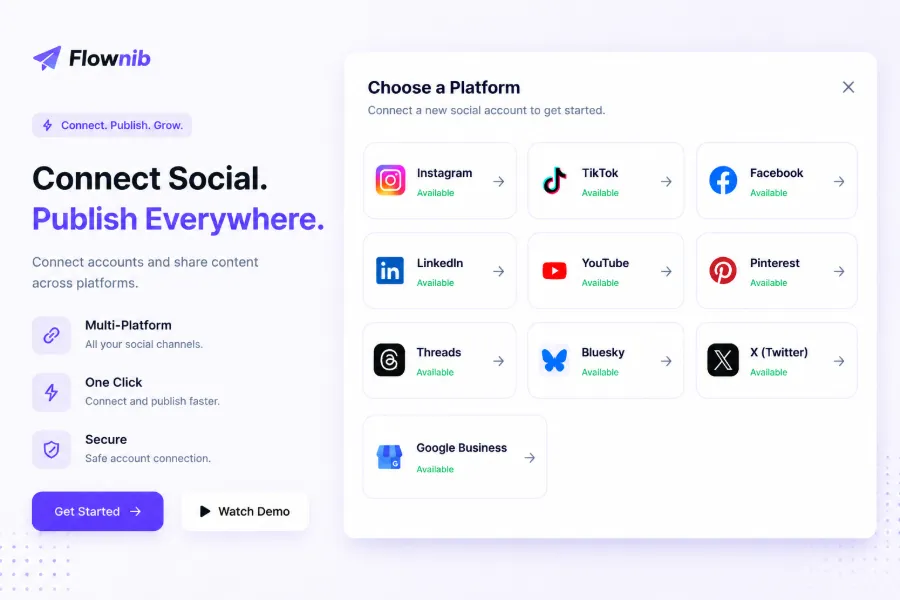
Multi‑account management is the last easily overlooked point. If each platform requires a separate login and you manually check publishing status, you’ll waste at least two extra hours per week “finding passwords and refreshing pages.” The value of a unified dashboard is evident here. For tool selection, see the comparison of FlowNib, Buffer, and Hootsuite for early‑stage teams (https://flownib.com/blogs/flownib-vs-buffer-vs-hootsuite-2026-global-brand-ai-scheduling-tools-comparative-review), which breaks down the number of steps and time differences for multi‑account scenarios.
How AI saves you an hour of repetitive work in the rewriting stage
Cross‑platform copy differences are more tedious than imagined. X’s 280‑character limit forces you to compress the core message into the first sentence; Instagram’s algorithm prioritizes visual quality, making the caption secondary, but hashtag density directly influences discovery‑page exposure; LinkedIn users expect industry insights, and overly colloquial content gets filtered out; YouTube’s description is an SEO battlefield where the first two lines must contain target keywords and timestamps. Manually adjusting each post requires re‑structuring language every time.
Flownib solves exactly this step. You write a raw piece—e.g., “We just launched our summer collection, all items 40 % off”—and the AI automatically generates 4–6 versions based on each platform’s character limits, tone, and content guidelines: an X version compressed to under 200 characters with a topic tag, an Instagram version preserving an emotional tone and suggesting five relevant hashtags, a LinkedIn version framed as an industry observation with an added data point, and a YouTube version expanded into a keyword‑rich, viewer‑guidance description. Humans only need to preview and fine‑tune; no need to rewrite from scratch.
Our test data: manually adapting five posts to four platforms took an average of 55 minutes, including repeated character‑count checks, punctuation adjustments, and link‑format verification—low‑value tasks. Using AI rewriting, the same five posts across four platforms took an average of 6 minutes—saving 49 minutes for topic planning, comment engagement, or simply resting, instead of copy‑pasting.
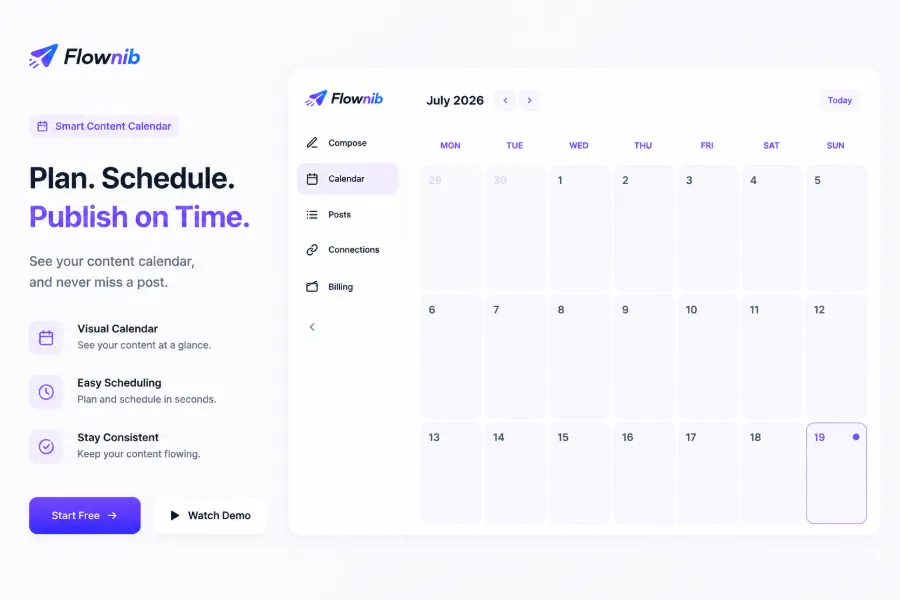
After AI rewriting, the next step is to slot the revised content into a calendar. Efficiency gains are equally striking here—you no longer set a separate posting time for each platform; you manage all platform rhythms on a single calendar. For concrete time‑saving data, refer to the empirical analysis of manual posting vs. AI distribution (https://flownib.com/blogs/5d90855d-57be-4a00-b32c-5ad9694a32d7), which records labor‑hour changes before and after workflow switches for teams of different sizes.
One fact must be clarified: AI rewriting solves format adaptation, not creative exhaustion. Many people mistakenly think “AI one‑click content generation” lets them sit back and wait for traffic, only to discover that AI‑generated text, while correctly formatted, lacks unique viewpoints and brand warmth. The real lever lies in the topic‑reservation stage—you must pre‑plan weekly themes, product selling points, and industry topics so AI can adapt them effectively. Dumping topic pressure onto AI is the most common misunderstanding in matrix operation.
From publishing to closed loop: data feedback determines the next content direction
Publishing is not the endpoint; it’s even not the midpoint. Without a feedback loop, you’re merely “blind posting”—you don’t know which content on which platform actually reached the target audience. Low‑budget teams don’t need expensive analytics tools; each platform’s native insights panel is sufficient: Instagram Insights shows post saves and profile‑visit sources, X Analytics displays impressions and deep‑engagement rates, and YouTube Studio provides detailed watch‑time and click‑through curves.
The key action is establishing a bi‑weekly content review cadence. Pull data from the four platforms into a single spreadsheet and compare performance of the same theme across platforms. For example, a product unboxing video may have high save rates on Instagram but a low completion rate on YouTube, indicating that the video length needs trimming or the YouTube title style should change. Adjusting topics and posting times based on data for six consecutive weeks can boost a single post’s average engagement rate by 40 %—a figure drawn from multiple overseas teams’ operational records, not theoretical calculations.
When content volume grows, manually exporting data from each platform and consolidating it becomes a new bottleneck. This is where Flownib’s data‑trace capability shines—it aggregates publishing records and interaction data into one interface, eliminating the hassle of cross‑platform screenshots. To see its performance in a cross‑border e‑commerce seller scenario, read the review (https://flownib.com/blogs/flownib-review-one-stop-ai-social-distribution-tool-cross-border-sellers-worth), which documents a standalone‑site team’s full transition from manual to automated workflow.
Another often‑overlooked point: multi‑platform organic exposure is slow‑burn, but compared with paid ads, its search‑weight accumulation in the target market is more durable. A YouTube video that ranks steadily continues to generate organic search traffic months later, whereas a paused ad campaign instantly drops to zero traffic. This long‑term effect is especially crucial during the cold‑start period—you don’t need to bid against big brands for keywords; sustained organic content gradually builds search visibility in niche categories.
FAQ
Q1: Will AI‑rewritten posts lose brand tone?
It depends on how you feed the original material. AI rewriting works within the content framework you provide; if the original copy lacks tone, the output will be bland as well. The key is to embed brand‑specific phrasing, viewpoints, and data points in the source; AI merely reorganizes those elements according to platform rules. In practice, brand‑tone retention is above 80 %; the remaining 20 % is fixed with manual fine‑tuning.
Q2: Which social platforms should an early‑stage team cover first?
Prioritize three: Instagram (visual showcase + organic reach), X (industry discussion + customer service channel), LinkedIn (B2B trust building). If your product has strong tutorial attributes, elevate YouTube to second place. Do not put TikTok in the first tier—its content rhythm and editing style differ too much from text‑based platforms and will dilute your creative focus.
Q3: Do these AI tools offer free plans? Are they sufficient?
Most AI distribution tools have free tiers, typically covering three social accounts and 10–30 posts per month. For a brand just starting out, a free plan is enough to run the first round of content testing—identify which two of four platforms deliver real traffic, then decide whether to upgrade.
Q4: Can multi‑account management cause publishing errors or content misfires?
The risk exists, especially when you bind multiple brand accounts to a single dashboard. Mitigate it by previewing each entry in the list before publishing, avoiding a single “publish all” click. Additionally, set up an independent content‑approval workflow for each account—at least review the AI‑rewritten version before release.
Q5: Can a full‑time employee sustain a four‑platform daily posting cycle?
Yes, provided topic selection and bulk rewriting are centralized. Spend two mornings a week on topic planning and raw copy creation; AI rewriting finishes in ten minutes per batch; the remaining daily fifteen minutes go to checking publishing status and responding to comments. Total weekly labor is about 8–10 hours, leaving a full‑time operator free for customer support and product optimization. The key is to treat “daily updates” as “weekly concentrated creation + daily automated distribution,” not “daily creation.”
Share Article