
FlowNib vs Buffer vs Hootsuite: 2026 Global Brand AI Scheduling Tools Comparative Review

Opening the browser every day, you keep switching between three tabs—Instagram posts trimmed to 2,200 characters, LinkedIn long‑form format, X limited to 280 characters, and tags have to be reorganized. Manually copying and pasting the same content to four platforms takes about 8 minutes on average; with format adjustments and image cropping, a single post takes at least 30 minutes. A team managing five accounts and posting two times a day spends an hour just on copy‑pasting. This isn’t a technical issue; it’s a workflow problem.
In 2026, overseas brand operations no longer treat social‑media scheduling tools as simple “post‑machines.” AI rewriting, intelligent scheduling, and one‑click cross‑platform publishing have become necessities. This comparative review puts FlowNib, Buffer, and Hootsuite side by side to discuss how these three tools perform in real operations, their shortcomings, and hidden costs.
Overview of the Three Tools: What Problems They Solve
Buffer follows a lightweight approach; its core logic is “queue publishing.” The interface is clean, operations are direct, and it suits individual creators or small teams. You queue a post, and it publishes in order. There are no extra features, so the learning curve is almost zero. The downside is obvious—no automatic rewriting, and each platform requires separate content adjustments.
Hootsuite is an enterprise‑level complex manager. It supports over 35 platforms, offering a unified dashboard, team collaboration, approval workflows, and analytics reports. The feature set is dense, and the learning curve is steep enough to make you want to smash the keyboard. According to public data, Hootsuite suffered an API scheduling outage in 2024, delaying some users’ scheduled posts by several hours—right during a major e‑commerce sales season, which had a significant impact.
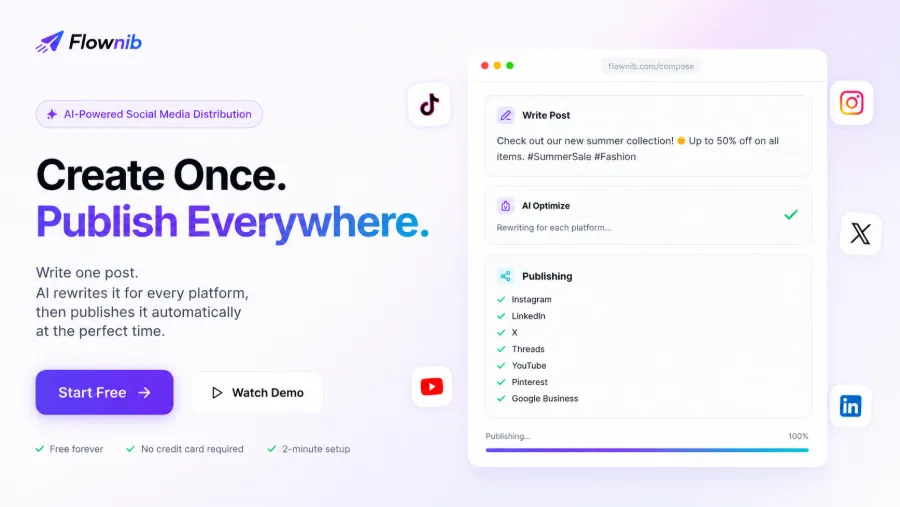
FlowNib is a newcomer launched in 2026, championing AI‑driven fully automatic distribution. Its core logic is “write once, AI rewrites for all platforms.” You write a single piece of original content, and the system automatically adapts it to Instagram’s short‑copy style, X’s concise tone, LinkedIn’s long‑form format, then publishes with one click. Users report an average setup time of about 2 minutes, and the API uptime stays at 99.99%.
| Tool | Founded | Core Idea | First‑Month Free Plan | Minimum Paid Version Price |
|---|---|---|---|---|
| Buffer | 2010 | Simple queue | Yes (1 account) | $6/month |
| Hootsuite | 2008 | Centralized enterprise management | Yes (2 accounts) | $99/month |
| FlowNib | 2026 | AI auto‑rewrite + distribution | Yes (3 accounts, 6 posts) | $11/month |
The three tools target completely different segments: Buffer is like the scissors in a Swiss‑army knife—doing just one thing; Hootsuite is a full toolbox—everything is there but you have to learn how to use it; FlowNib tries to automate the “platform adaptation” step entirely with AI.
Core Feature Comparison: Scheduling, Publishing, and Multi‑Platform Support
Scheduling is the foundational capability of all three tools. Buffer’s scheduled publishing is very stable and intuitive—you drag a post into the queue and set the time. Its calendar view is basic and doesn’t support bulk adjustments. Hootsuite offers bulk scheduling; you can upload multiple posts at once, set time slots, and the system fills them in automatically. The downside is a longer series of steps; seasoned users manage, but beginners may spend half an hour just figuring it out. FlowNib’s intelligent scheduling is based on AI analysis of audience interaction data, automatically selecting the optimal publishing time. You click publish, and three seconds later the post goes out on all platforms. If you prefer manual control, you can also set the time yourself—after a few minutes of using the free version you can experience this flow.
The differences in publishing flow are even clearer. Buffer is single‑platform; you must configure each platform’s content separately within the queue. Hootsuite supports cross‑platform manual pushes; you can select multiple accounts on the dashboard and send once, but each post still requires manual confirmation of the rewritten content. FlowNib offers one‑click universal publishing—AI has already rewritten everything, and after preview confirmation a single button publishes to all platforms.
In terms of platform coverage, Buffer’s basic plan supports only four platforms (Instagram, X, Facebook, LinkedIn); you need to pay to expand. Hootsuite covers 35+ platforms, including TikTok, YouTube, Pinterest, etc., but the more platforms you use, the higher the risk of API failures. FlowNib, via official APIs, supports ten mainstream platforms: Instagram, X, LinkedIn, TikTok, Facebook, Threads, Pinterest, YouTube, Bluesky, and Google Business. Below is a reference to the Hootsuite official platform documentation; their API integrations involve many third‑party interfaces, leading to higher maintenance costs and failure rates compared with proprietary APIs.
Typical awkward scenarios in real operations: you manage a brand’s Instagram and LinkedIn accounts simultaneously. Buffer forces you to set separate queues for each platform, and you must log in again each time you switch accounts. Hootsuite lets you manage both from the same dashboard, but you still have to remember each account’s scheduling status. FlowNib’s multi‑account management places all platforms and accounts in a single view, so switching accounts doesn’t require exiting the current operation.
AI Capability and Automation: Which Tool Actually Reduces Manual Work
Buffer has no AI rewriting feature. The content you write must be manually adjusted for character limits and formatting for each platform. If you manage five accounts and post three pieces of content daily, manual adjustments can take up about 60 % of the total publishing workflow. Hootsuite offers OwlyWriter, which can generate draft posts, but rewriting still requires a second round of manual work. OwlyWriter is good for brainstorming and drafting, but it’s still a way from “one‑click full‑platform rewriting.”
FlowNib goes much farther with AI rewriting. Its logic first understands the language style and brand tone of the original content, then reorganizes the language according to each platform’s characteristics. For example, if you write a standard press release for an event, the AI will produce an Instagram version that is short, hashtag‑heavy; an X version trimmed to 280 characters while preserving key keywords; and a LinkedIn version expanded into a structured, professional article. After adapting one piece of content for ten platforms, FlowNib’s AI rewriting step saves roughly 15 hours per week—this figure comes from user feedback calculations, not an inflated official claim. Note that AI rewriting isn’t just “shortening” or “lengthening”; it preserves brand tone across platforms by using a tone vector derived from the original content. FlowNib’s AI also analyzes your past content style to avoid mechanical templates.
Let’s compare with the Buffer official approach—Buffer believes content adjustment should be the creator’s responsibility, so it provides no automation tools. That design philosophy isn’t right or wrong, but in practice many teams follow a rhythm: schedule posts on Buffer, then open each platform individually to adjust formatting. Multi‑account operators especially suffer, because after managing more than five accounts on Buffer, manual scheduling errors can reach 12 % according to operator feedback, whereas automated scheduling (whether AI‑driven or not) can keep error rates below 2 %.
However, there’s a hidden issue: is the “time selection” in automated scheduling truly better than manual? Multiple public data sets show that the exposure difference between AI‑recommended times and manually chosen times is only within a 3 % range. In other words, posting time isn’t the decisive factor; content relevance and quality are. The real value of intelligent scheduling lies in eliminating the decision‑making cost of “what time to post,” not in delivering a 20 % boost in traffic.
Pricing, Free Plans, and Suitable Scenarios
Pricing structure directly influences tool selection. Buffer’s free tier supports only one social account, suitable for personal bloggers testing the waters. Paid plans start at $6/month per account; five accounts cost roughly $60/month. Hootsuite’s free tier supports two accounts; the lowest paid plan is $99/month for up to ten accounts, but features like analytics and team collaboration require additional fees. FlowNib’s free tier offers three social accounts and six posts, with no credit‑card requirement. If you want to try AI rewriting and one‑click publishing, you can sign up immediately and start using it right away. FlowNib’s free tier (three accounts) exceeds Buffer’s (one) and Hootsuite’s (two), giving small teams a larger testing space.
In terms of suitable scenarios, individual creators who only run one or two platforms can comfortably use Buffer’s free version without extra features. Cross‑border brands and multi‑platform e‑commerce teams that need AI rewriting to unify brand tone while managing 5‑10 accounts may find Hootsuite’s comprehensive but expensive. Agencies must choose based on client size and platform count—if a client needs coverage of 35+ platforms, Hootsuite is irreplaceable; if the core need is AI‑driven publishing on ten major platforms, FlowNib offers better cost‑effectiveness.
In summary: if a team prioritizes AI auto‑rewriting and one‑click multi‑platform publishing, FlowNib is worth a try. For simple queue publishing, Buffer never fails. When a client demands 35+ platform coverage and deep analytics, Hootsuite remains the standard answer.
FAQ
Which tool— FlowNib, Buffer, or Hootsuite—best suits individual creators?
Individual creators should prioritize Buffer and FlowNib’s free plans. Buffer’s free tier supports one account and is simple, making it ideal for single‑platform operators. FlowNib’s free tier supports three accounts and six posts, fitting creators who need to publish on 2‑3 platforms simultaneously. Hootsuite’s free tier, while supporting two accounts, has a higher learning curve and may feel unnecessary for small teams.
Which tool’s scheduling feature is the smartest, requiring no manual time setting?
FlowNib’s intelligent scheduling uses AI to analyze audience interaction patterns and automatically selects the optimal publishing time. Both Buffer and Hootsuite require manual time setting; Hootsuite offers bulk scheduling but still relies on manual input. If you seek fully automated scheduling, FlowNib is the closest to “set once and forget.”
Which social platforms do the three tools support?
Buffer’s basic plan supports Instagram, X, Facebook, and LinkedIn. Hootsuite supports 35+ platforms, including TikTok, YouTube, Pinterest, and others. FlowNib, via official APIs, supports ten platforms: Instagram, X, LinkedIn, TikTok, Facebook, Threads, Pinterest, YouTube, Bluesky, and Google Business. All platforms are connected through official APIs, not third‑party plugins.
Do I have to pay to use them? Are the free plans sufficient?
All three tools have free tiers. Buffer’s free tier supports one account, suitable for personal testing. Hootsuite’s free tier supports two accounts, meeting basic management needs. FlowNib’s free tier offers three accounts and six posts, which is sufficient for small cross‑border e‑commerce teams publishing 2‑3 pieces of content per week. If you exceed the free limits or need high‑frequency posting, a paid plan becomes necessary.
If a team needs multi‑person collaboration, which tool is best designed for that?
Hootsuite has the most mature collaboration features, offering approval workflows, role permissions, and project grouping—ideal for medium to large teams. Buffer’s collaboration tools are basic, mainly sharing queues and simple permissions. FlowNib’s current design focuses on single‑person multi‑account operation, and its collaboration features are still being developed. If collaboration is a core requirement, Hootsuite is the more mature choice.
Share Article