
Flownib + Seonib + Veonib: Practical Dissection of the 2026 Cross‑Border AI Traffic Closed‑Loop System

When you check the backend you notice something: the neighboring team’s Instagram Reels views last week were three times yours, their YouTube Shorts went live at the same time, and their LinkedIn article even had a CTA. Meanwhile you’re still manually copy‑pasting, adjusting copy length, tweaking hashtags, and after publishing you discover the link format on X is wrong. This isn’t a skill issue; it’s a process issue.
In 2026 the average cross‑border seller operates on 5.8 social platforms – that’s industry data, but most people still work with “one tab per platform, copy‑paste one by one.” Those who have truly streamlined think about something else: can we write content once, let the tool adapt it, schedule it, and publish it, and then have the data flow back to guide the next round of content?
This logic requires a closed loop: content creation → AI adaptation → one‑click distribution → data feedback. Few tools can implement this loop, but some people have assembled a complete pipeline using Seonib, Veonib, and Flownib. Below we break down what each does, how they collaborate, and the pitfalls you’ll inevitably encounter during setup.
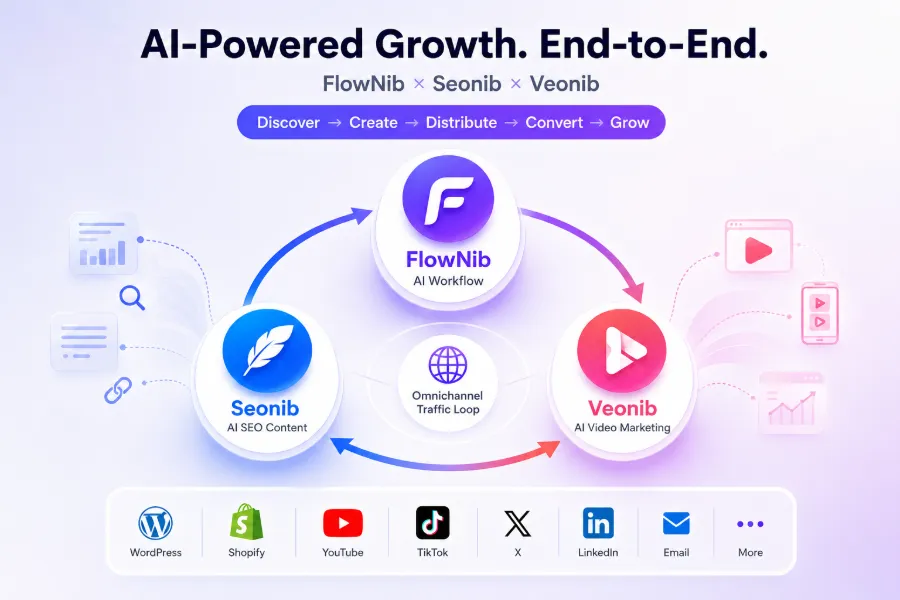
The Three‑Tool Set: Who Does What and Why All Are Essential
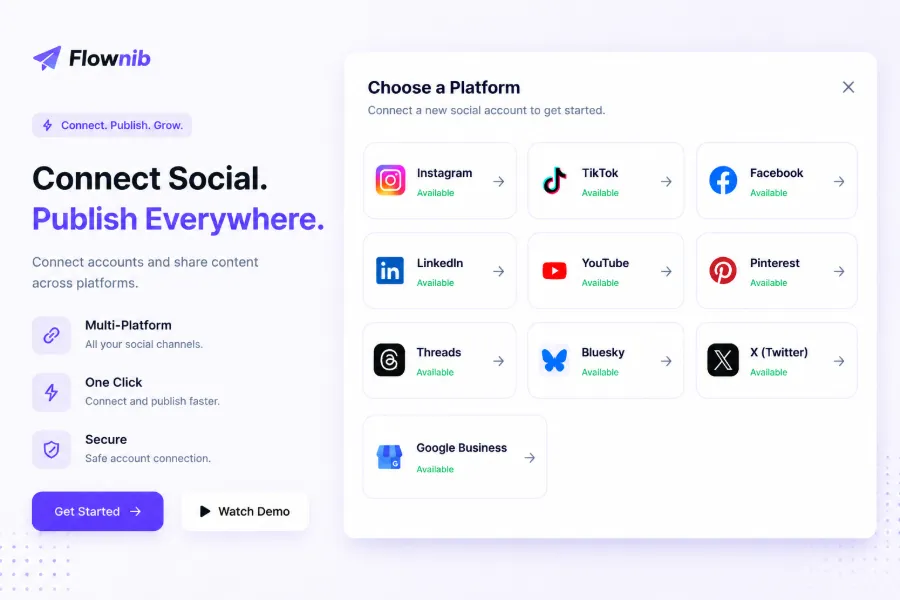
First, clarify the roles. Seonib handles the SEO content skeleton – it generates SEO‑ready articles based on long‑tail keywords, outputting titles, meta descriptions, H2 structures, and internal link layouts together. Veonib is an AI video‑creation tool that turns product links or images into short videos, automatically adding subtitles, background music, and scripts. Flownib handles social‑media distribution, rewriting content to fit each platform’s style, then publishing with a single click to Instagram, X, LinkedIn, YouTube, Pinterest, Google Business, and nine other platforms.
These three tools are not substitutes. Seonib solves “what to write” and “what Google likes”; Veonib solves “how to turn it into a video”; Flownib solves “how to make each platform’s audience feel it’s written for them.”
According to this architecture overview, they form a “produce → adapt → distribute → feedback” cycle. Without Seonib, content lacks an SEO skeleton; without Veonib, there’s no video traffic; without Flownib, there’s no social‑media traffic. Only by combining them can a single piece of content cover 5.8 platforms within 24 hours – the 2026 cross‑border industry average per brand, a number that’s still rising.
To understand how this loop differs from traditional single‑tool solutions, see this horizontal comparison of AI multi‑platform adaptation. Most scheduling tools only queue posts and never rewrite; Flownib rewrites first, then publishes, which is the key to a functional closed loop.
Flownib in Practice: One Creation, Automatic Multi‑Platform Rewrite & Publish
Let’s try it. Open the Flownib interface and write a piece of content – for example, “Summer new arrivals, up to 50 % off.” The AI automatically generates ten versions: an Instagram version packed with hashtags, kept under 2,200 characters; an X version compressed to 280 characters with an emoji; a LinkedIn version in a formal tone with an industry insight intro; a YouTube version with title and description; a Pinterest version turned into a pin description with image‑text pairing. You just preview once, confirm the tone is correct, then schedule or publish directly.
The whole process from writing to publishing across all platforms takes about two minutes. Flownib connects to ten platforms via official APIs and claims 99.99 % uptime. In practice, the API stability is indeed better than tools that rely on third‑party intermediaries – I haven’t encountered a case where a post failed to go out and required manual re‑sending.
Multi‑account management lives in the same dashboard. You can attach brand accounts, personal accounts, and regional sub‑accounts; the content calendar shows the global view. The data‑tracking feature feeds each post’s performance back for later optimization.
SEO and AI Video: The Content Engines of Seonib and Veonib
Where does the ammo come from? Seonib generates articles based on your keyword library. For example, if you sell cross‑border beauty devices, it can mine long‑tail terms like “Japan beauty device 2026 new model” or “Korea home skin‑care device,” then output a full SEO‑friendly article. Feed the product link to Veonib and it creates a 60‑second short video – automatically extracting key sentences for subtitles, adding BGM, and generating dynamic visuals. Veonib’s website shows more detailed demos; visit Veonib’s site for examples.
Video content still yields a strong advantage in 2026: social‑platform video engagement rates are 2.3 × those of image‑text posts. You can’t have a team shoot a video for every piece of content, but tools like Veonib can fill the gap.
For real‑world user experience, see this one‑stop review for cross‑border sellers.
Four Pitfalls When Building the Closed Loop (and How to Avoid Them)
I’ve seen many teams pledge to use all three tools, only to run for a month and see worse results. Here are the four most common failure scenarios.
Pitfall 1: AI over‑rewrites, brand voice gets lost. A cross‑border home‑goods seller let AI automatically rewrite without human review. After three months, Instagram captions started containing Japanese honorific errors – the AI over‑used honorifics, making Japanese users feel the tone was odd. Engagement dropped from 5.2 % to 1.8 %, and the platform throttled the account twice before they realized a “human review step” was needed. Solution: add a review checkpoint in Flownib’s rewrite preview, at least checking cultural sensitivity and tone consistency.
Pitfall 2: Ignoring local regulations, account gets penalized. EU GDPR requires consent for any person shown in images. A seller posted a US model photo directly to the German market and got a three‑month throttling after a complaint. In Saudi Arabia, content involving religious elements caused issues because the AI didn’t know what to avoid. Solution: create a “content restriction list” for each key market and manually vet AI‑rewritten content afterwards.
Pitfall 3: Focusing only on production, neglecting data feedback. Content volume grew but open rates fell. The simple reason: the content wasn’t what users wanted to see. Solution: monitor data promptly and identify correlations between content types and engagement rates.
Pitfall 4: Chaotic multi‑account management, duplicate posts or spam flags. You bound two accounts to the same platform, but scheduling wasn’t coordinated, resulting in two identical posts ten minutes apart; the platform flagged them as spam. I once woke up at 3 AM to delete posts. Solution: use the content calendar to avoid collisions. Compared with traditional scheduling tools, the Flownib vs. Buffer vs. Hootsuite comparison helps you understand why direct API connections are more stable – APIs avoid third‑party caching that can scramble timing.
2026 Traffic Closed‑Loop Checklist
Planning to build this loop yourself? Follow these five steps without skipping any.
- Define role allocation – What are you lacking most: content creation or distribution? If you need creation, start with Seonib and Veonib; if you have content but can’t publish, start with Flownib.
- Configure API connections – Bind Flownib and each platform account via official APIs. Double‑check parameters, especially permission scopes.
- Set content templates – Create a format template for each platform – how many hashtags for Instagram, LinkedIn intro style, YouTube title keyword placement, etc. Templates keep AI rewrites on track.
- Schedule cycles – Fixed production on Mon‑Wed‑Fri, distribution on Tue‑Thu‑Sat, data review on Sunday. Don’t blast everything at once; leave some for long‑tail traffic.
- Data‑feedback optimization – Every two weeks pull interaction data, identify which platform and content type yields the highest ROI, then use Seonib to generate similar topics.
The core of the loop isn’t content volume; it’s the structured data feedback. If data doesn’t flow back, you’re flying blind.
FAQ
Q1: What are Seonib and Veonib? Do I need them if I haven’t used them yet?
Seonib is an AI SEO content generator that helps you write long‑tail keyword articles. Veonib is an AI video‑creation tool that turns product links or images into short videos. If you only distribute text, you can start with Flownib alone; if you want video traffic and organic SEO, add Seonib and Veonib for better results. Using all three gives the highest closed‑loop efficiency.
Q2: Will Flownib’s AI rewrite cause me to lose my brand tone?
Yes, if you don’t review. The AI rewrites according to platform style but doesn’t automatically understand your brand’s language habits. When first using it, preview each rewrite, note any wording deviations, and feed that back into the template settings. After a week or two, the AI will learn about 70‑80 % of your preferences.
Q3: Is this closed loop useful for a beginner individual seller?
It’s useful, but start small. Individual sellers have limited resources, so begin with a single product line – e.g., Instagram + YouTube Shorts. Add more platforms once data stabilizes. Flownib offers a free tier (3 social accounts, 6 posts) sufficient for a two‑week test.
Q4: Do all three tools require payment? What’s the cost?
Flownib, Seonib, and Veonib each have free tiers. Overall cost is calculated per content piece; the tool cost per post ranges from a few cents to a couple of dollars, far cheaper than hiring a dedicated multi‑platform operator. Try Flownib’s free version first, then decide whether to add the other two.
Share Article