
New Content Workflow for Cross‑Border E‑commerce: Discover Trends, Create Content, and Publish Faster

Cross‑border e‑commerce teams often spot a hot topic before a promotion: product managers provide the selling points, marketers scour Reddit, YouTube, and news sites for discussions, designers prepare assets, and then the same piece of content must be rewritten for different markets and social platforms. The real time‑sink is usually not writing the first draft, but the subsequent copying, translating, reviewing, scheduling, and status checks.
Faster publishing isn’t about adding a few more publishing tools; it’s about linking trend discovery, content creation, platform adaptation, review scheduling, and result analysis into a single traceable workflow. This lets the team see which step a piece of content is stuck on, which errors originated during creation, and which issues only surface after publishing.
The cross‑border e‑commerce content workflow should first filter trends, then build a content skeleton, rewrite per platform and schedule uniformly, and finally record results by market, platform, and content format. The value of speed lies not in reducing reviews but in getting feedback faster for the next round of topics.
Start with Trend Signals, Not a Blank Document
Trend discovery should begin with product keywords and target‑market questions, not “what to post today.” The team can set keywords around product names, use cases, seasonal demand, competitor differences, and after‑sale concerns, then observe what users in different regions are discussing. For example, a thermos brand may care less about the word “thermos” itself and more about commuting leaks, summer outdoor drinking, or complaints about cleaning difficulty in a specific market.
Reddit is best for specific problems and user quotes; YouTube reflects tutorial, review, and search‑interest shifts; news sites capture industry events; Hacker News may surface early discussions among tech‑product and startup audiences. Marketers don’t need to turn every hot topic into product content. Trends are input signals, not replacements for product positioning, market judgment, or content review.
A quick initial filter can usually be done in about 10–15 minutes—this is a workflow goal, not a platform promise. An actionable filter looks at four aspects simultaneously:
- Relevance to the product, fit for the target market, discussion growth rate, and whether there is a clear conversion opportunity.
“Rising discussions” are good for rapid testing but may only last a few days; evergreen topics can become lasting content, such as sizing, delivery speed, and product maintenance. Content that only chases trends should have limited investment—don’t produce ten language versions for a fleeting news item. The team must first determine what users are asking before deciding if the product can provide a trustworthy answer.

A common mistake is to copy the phrasing of popular posts directly. This may be fast but can bring the original tone, cultural background, and controversies into the brand account. A safer approach is to distill the user’s question, use case, or angle, then reorganize it with the product’s facts. The team can also consult trend research and content inspiration, but should not treat external cases as conclusions already validated in the target market.
Break a Topic into a Cross‑Market Reusable Content Skeleton
The first draft of cross‑border content should not be rushed into a full post for a specific platform. The operations team can first define a core message, then split it into product benefits, use cases, evidence, calls to action, and variables that need localization. This way, when later versions change, the team knows which parts must stay fixed and which must be rewritten.

A core piece of content should be broken into three variable types: immutable brand facts, market‑adjusted information, and platform‑adjusted expression. Immutable parts include material, size, certifications, warranty scope, etc.; market variables cover currency, delivery promises, holiday context, return policies, and consumer concerns; platform variables involve headlines, body length, video scripts, and interaction prompts.
A brand archive should centrally store product info, target audience, brand positioning, and marketing goals. Otherwise, every time AI‑generated content is used, marketers must re‑explain “who this product is sold to,” “what cannot be promised,” and “the brand tone,” then manually verify that the model didn’t copy U.S. delivery conditions into the German version. The brand archive reduces background explanations and duplicate checks, not the responsibility for judgment.
Content reuse does not mean verbatim copying. A product review can be reshaped into an Instagram visual guide, a TikTok usage‑scenario script, a LinkedIn industry observation, or a FAQ on a product page. Facts and brand claims stay consistent; narrative order, evidence density, and calls to action should adapt to platform and market. For channel priority, the team can first consult the cross‑border e‑commerce platform selection guide, then narrow the list based on existing audience and conversion paths.
AI rewriting can cut first‑draft time, but it does not replace human review of localization. Machine translation often turns “estimated 3–5 business days delivery” into a definitive promise, or mishandles holiday names, size units, and currency symbols. The pain of cross‑market content usually lies not in grammatical fluency but in whether a fluent sentence changes the product’s liability boundaries.
Adapt to Platforms First, Then Enter the Review Queue
The same topic will almost never have identical final forms on Instagram, X, LinkedIn, TikTok, Facebook, Threads, Pinterest, YouTube, Bluesky, and Google Business. Instagram leans on visuals and short captions; X is sensitive to opening information and character limits; LinkedIn needs fuller background; TikTok and YouTube are close to video scripts and spoken structure; Pinterest focuses on images, titles, and long‑term search; Google Business must reflect local service context.
Coverage can reach ten platforms, but that doesn’t mean the team must operate all ten every day. The actual number should depend on target markets, account permissions, asset capabilities, and customer‑service capacity. A market without local comment‑response ability may quickly damage conversion even if the content is published successfully.
Review order should be fixed: first verify facts and compliance, then check localized expression, and finally confirm platform format, links, tags, and asset completeness. Character limits, video ratios, headline structures, tone, and interaction style should be handled during platform adaptation, not as a last‑minute tweak before submission. AI rewriting must preserve the brand’s core meaning, especially checking for exaggerated promises, mistranslations, and culturally inappropriate phrasing.
Platform commercial rules also evolve; the team can use the platform business communication guidelines as an external reference when checking X content. This does not replace the team’s own advertising compliance checklist, as product categories, target countries, and promotional copy still require separate judgment.
Choosing a scheduling tool should be part of the review process, not just a comparison of how many accounts it can connect. The team must confirm whether previews resemble native platform appearance, whether failure states are visible, whether permission expirations trigger alerts, and whether the original version can be traced after publishing. When multiple accounts are involved, the social‑media scheduling tool comparison can help the team organize these check dimensions.
Use a Unified Publishing Queue to Reduce Switching, Copying, and Waiting
Once content moves from draft into the queue, it typically goes through platform rewriting, preview, fact review, localization review, scheduling, and synchronized publishing. The value of a unified queue isn’t just fewer tabs; it places each market’s version, publish time, account permission, and publishing record on the same operation chain. When publishing manually per platform, the most common loss isn’t text but “which version has already been reviewed.”
| Item | Manual Per‑Platform Publishing | Unified Publishing Queue |
|---|---|---|
| Steps | Copy, rewrite, upload, confirm on each platform | Draft → adapt → preview → approve → schedule together |
| Platform adaptation | Relies on human memory and ad‑hoc edits | Save independent versions per platform |
| Scheduling management | Scattered across multiple back‑ends | Centralized via content calendar |
| Error exposure | Usually discovered after publishing | Detected during preview, permission, and status checks |
| Post‑publish record | Easy to miss or duplicate entries | Retains account, time, and status logs |
When operating multiple markets simultaneously, a content calendar can display regions, accounts, and time zones in a single view. Operators should still keep a batch of pre‑prepared evergreen content while reserving temporary slots for hot topics. Filling the queue completely may look efficient but leaves no room for urgent events and can cause expired holiday content to be auto‑published.
When the team started using a unified distribution tool like Flownib, the focus shifted from “one‑click publish?” to whether the official API could pinpoint account, asset, or permission issues after a failure. The product sheet states the tool supports Instagram, X, LinkedIn, TikTok, Facebook, Threads, Pinterest, YouTube, Bluesky, and Google Business—a total of ten social platforms—with an average setup time of about two minutes and an API uptime of 99.99 %. These numbers are product specifications, not industry benchmarks.
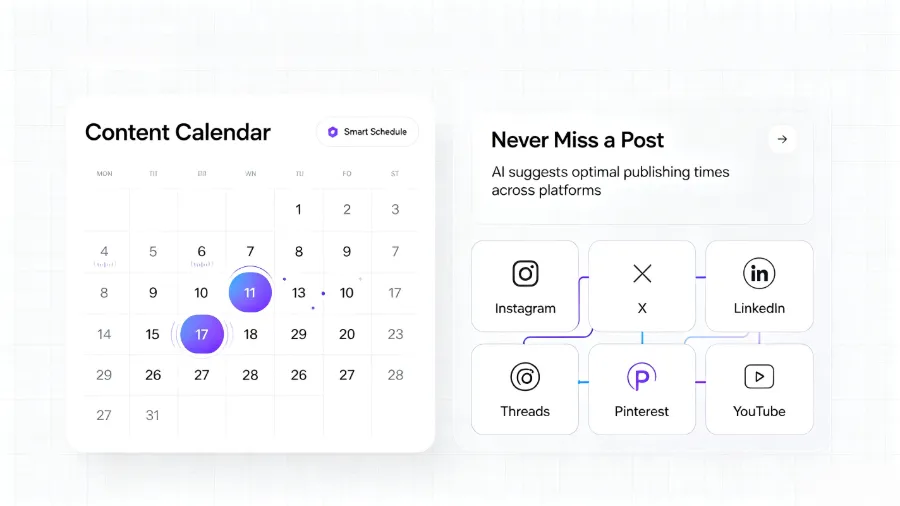
The more automated the publishing queue, the more important visible records of failure states, account permissions, and localized versions become. Automation reduces repetitive tasks but does not automatically fix expired tokens, deleted page permissions, asset upload failures, or video encoding mismatches. Without status records, speed can actually spread errors to more accounts.
The team once copied product content to multiple platforms just before a promotion. The first few minutes saved creation time, but within hours the English and German versions showed inconsistent pricing, one platform’s image ratio was off, and two accounts failed due to permission expiration. Reviewers had to rework each version, some markets missed their scheduled slots, and the publishing record didn’t fully reflect which accounts went live. The next day the team had to rerun the entire queue and manually verify each platform’s backend status.
This incident shows a clear trade‑off between automation speed and human review/permission maintenance. A unified queue reduces switching and copying, but review order cannot be omitted, and retrying failures is not the same as blind republishing. Discussions about social‑media scheduled posting methods can help teams further differentiate scheduling mechanisms from actual platform publish times.
Later, the team defined statuses such as “Generated,” “Pending Fact Review,” “Pending Localization Review,” “Scheduled,” “Publish Success,” and “Publish Failure,” and required each version to retain market and account tags. This added a few minutes of maintenance but saved far more time than refreshing multiple platform back‑ends at night and guessing which content missed publishing. The product sheet mentions Flownib’s average two‑minute setup, but account connections and permission upkeep still depend on each platform’s environment and cannot be treated as the total operational time.
Post‑Publish Review: Turn Speed into the Next Round of Topics
Publishing speed is an efficiency metric, not a direct proof of better content operations. Teams must also monitor click‑through rates, engagement, saves, conversion, comment quality, and content lifespan, recording results by “topic — market — platform — content format — publish time.” A single viral post can hide another fact: it may only work in one country, one time zone, or one video format.
Hot topics are suited for quick post‑publish checks; evergreen content should be compared weekly or monthly. Observe for at least 2–4 weeks before deciding whether to expand a topic; a single publish only serves as a hypothesis‑validation signal. Time‑analysis should not rely solely on global averages; teams can use Instagram best‑posting time data as a reference, then combine it with their own audience online patterns.
A low‑interaction sample doesn’t necessarily mean the topic is ineffective. A home‑goods piece had good saves in the UK market but almost no comments in the US; a review showed the US version turned “space‑saving” into an overly generic selling point and omitted a real storage‑scene demo at the video start. Another piece had normal click‑through but no orders because the landing‑page delivery promise didn’t match the social post, not because the topic itself was bad.
After review, content can be reshaped into FAQs, short‑video scripts, product‑page copy, or the next round of social topics. Specific questions in comments are often more useful than like counts for the next content input because they reveal information consumers still don’t understand. If content records only keep publish time and view count, you cannot tell whether market, platform, format, or product promise drove the result.
When the team accumulates these records, the next trend‑filtering round no longer relies on blank documents or personal memory. Faster publishing’s role is to obtain feedback sooner and feed that feedback back into topic selection, content skeletons, and review rules; it does not mean every piece of content should be rushed to market.
FAQ
What should be the first step in a cross‑border e‑commerce content workflow?
The first step is to define product keywords, target market, and the questions to validate, then start looking for trend signals. The initial filter should be kept to about 10–15 minutes, assessing relevance, market fit, discussion growth, and conversion potential.
How to tell if a trend is suitable to be turned into product content?
A suitable trend typically aligns with a user question, a concrete use case, and evidence the product can provide. If the discussion is rising but unrelated to the product, or cannot generate a credible call to action, it should not be pursued just because it’s hot.
Can the same piece of content be posted directly to all social platforms?
No. At a minimum you must differentiate platform format, audience expectations, character limits, and asset ratios. Even if you cover ten platforms, the operational team should first select channels they can sustain, then keep independent versions for each.
Which parts of cross‑platform content generated by AI need manual review?
Human review should first check facts, pricing, delivery, and compliance promises, then verify language, local holiday context, and platform format. In practice, spending an extra 5–10 minutes before publishing to verify the version usually saves more rework than fixing translation errors after the fact.
How to measure whether “publishing faster” really improves content operations?
Compare publishing time, number of review reworks, failed publishes, and subsequent click, engagement, save, and conversion metrics. A single result isn’t enough to judge a topic’s success; observe for at least 2–4 weeks and break down records by market, platform, format, and publish time.
Share Article