
Why High-Quality AI Content Needs New Trends and Brand Context

Cross‑border e‑commerce teams often encounter this scenario within a single workday: in the morning they spot a heating‑up topic on Reddit, YouTube, or the news; by the afternoon they have batch‑generated Instagram, X, and TikTok content; but in the evening they realize the posts don’t mention the real product and the tone isn’t their brand’s. The hot topic was captured, but the content left no brand trace.
For more insights on optimal publishing times, see Best Times to Post on Instagram in 2026: Data Analysis from 9.6 Million Posts.
High‑quality AI content requires two things to coexist: new trends provide topics worth discussing now, and brand context limits product facts, audience, stance, and expression style. These two cannot be split into isolated steps of “find a hot topic” or “apply brand material”; they should be part of the same content‑production pipeline, passing through judgment, generation, rewriting, review, and retrospection.
In short, trends answer “what to say now,” while brand context answers “how this brand should say it.” Only by placing trend signals together with structured brand information can AI content be timely, trustworthy, recognizable, and have a clear commercial direction.
New Trends Answer “What to Say Now,” but Can’t Decide “How the Brand Should Say It”
Content topics for cross‑border e‑commerce rarely can be fully covered by quarterly plans. Consumer discussions can shift abruptly, platform hot topics can change within hours, and regional holidays, policies, or usage scenarios can quickly affect purchase decisions. Real complaints on Reddit, search spikes on YouTube, industry reports in the news, and technical discussions on Hacker News can all become new trend signals.
However, a trend signal is not a publishable topic by itself. A topic that garners a lot of discussion only shows that people are paying attention; it does not prove relevance to a specific product, target market, or marketing goal. When a trend tool shows “92% trend match,” the number at most indicates that the keyword is closely aligned with current conversation, not that the brand fit is also 92%.
Teams that chase only the hot topics usually get a batch of short‑term relevant content first. The posts mention the words users are discussing but fail to explain what problem the product solves or the brand’s stance on that problem. Interaction rates may rise initially, but clicks don’t follow; worse, the team often discovers during retrospection that the content attracted an audience unrelated to the product.
Operations staff can break trend judgment into a short workflow:
- Confirm whether the trend is still rising and how long its window lasts.
- Verify its relationship to the product, target market, and audience.
- Decide whether the topic serves the current marketing goal and choose to continue, rewrite, or drop it.
For a more comprehensive set of social‑media scheduling tools, see 10 Best Social Media Scheduling Tools in 2026.
This step may seem slow, but it reduces later rework. A discussion about “low‑price alternatives” might suit a price‑focused brand but not one positioned on durability and after‑sales service. A trending topic about logistics delays could be a fit for a delivery‑explanation post but not for a hard‑sell new‑product ad.
Trend discovery should not be the responsibility of a single tool. Cross‑border SEO, AI video, and automated distribution are being placed into the same content‑technology stack, but collaboration does not mean the tool makes brand judgments automatically; teams still need to map the cross‑border content stack. Popularity provides a candidate pool; brand relevance decides which candidates deserve to enter the production queue.
Brand Context Determines Whether AI Output Sounds Like the Brand
AI content generation can only produce consistent output when it knows “who this brand is.” The minimal brand context should contain at least four core pieces of information: product details, target audience, brand positioning, and marketing objectives. Missing any one of these can make the output appear fluent but commercially off‑track.
Product details are more than the product name; they include specifications, use cases, constraints, pricing narrative, and un‑promised features. The target audience needs region, purchase motivations, common concerns, and familiar phrasing. Brand positioning decides whether the content should emphasize professionalism, durability, convenience, or caution. Marketing objectives differentiate whether the goal is awareness, traffic, conversion, or retention.

When only the product name is supplied, AI often fills the blanks on its own. It might turn a storage solution for small apartments into a “family‑size” proposal, or translate a UK‑market price expression directly for US users. The language looks correct, but the market positioning is wrong. A complete brand dossier constrains angles, wording, and calls‑to‑action, reducing factual errors, tone drift, and audience misinterpretation.
Cross‑border markets amplify these deviations. “Affordable” in English may stress price friendliness, while consumers in another region care more about long‑term cost; humor that feels natural in one market may appear flippant in another. AI needs to know regional differences, linguistic expressions, localization rules, and cultural sensitivities—not just replace Chinese sentences with English ones.
Brand context is not a one‑time prompt. Product revisions, inventory changes, campaign themes, audience shifts, and marketing goals all evolve, so the brand dossier must be maintained alongside operational assets. If a team updates only every six months, AI will still faithfully use outdated prices, selling points, and canceled promotion terms; faster generation means faster error propagation.
Put Trends and Brand Context into the Same Content Production Chain
A repeatable production chain usually starts with trend discovery, but does not generate ads directly at the discovery stage. The team first gathers discussions, judges brand relevance, injects brand data to produce a draft, then rewrites per platform, and finally conducts human review. Here “rewriting” is not merely shortening sentences; it reorganizes the opening, evidence, interaction style, and call‑to‑action.
AI is better at extracting the underlying user problem behind a trend. Users may not be saying “this product type is popular,” but rather “why does using this product type still waste time?” Brand content should first answer that question, then link to the product information or viewpoint the brand can provide. Directly turning a hot discussion into an ad usually loses the original user context.
The same theme across Instagram, X, LinkedIn, and TikTok cannot be a single copy‑paste text. Instagram leans on visual storytelling and save‑value; X needs a quick hook or conflict point; LinkedIn benefits from industry background; TikTok often requires scene setting within the first few seconds. Content repurposing reduces duplicate work, but platform adaptation still needs human confirmation, especially for pricing, promises, and regional rules.
When a team must handle ten social platforms, copy‑pasting and repeated rewrites quickly become a publishing risk. A “create once, publish everywhere” workflow can reduce tab‑switching and duplicate editing, but it should still retain preview and review steps. When operations use Create Once, Publish Everywhere as a workflow backdrop, the focus is not on the “one‑click” itself but on whether each platform’s version has undergone the necessary adjustments.
In a real multi‑platform publishing workflow, Flownib sits between AI content rewriting and publishing: the original draft retains shared brand facts, then platform‑specific versions are generated. This cuts a few manual copy cycles but cannot replace the team’s decision on whether a trend is worth pursuing, nor can it replace human judgment on sensitive expressions.

Platform rules are part of the production chain, not an exception handled after a publishing failure. X’s commercial‑account posting requirements, media formats, and account permissions can affect the final version; teams can directly consult the X Business Platform Guidelines to verify adaptation boundaries. Other platforms also have character limits, video ratios, link handling, and API permission differences. The broader the multi‑channel publishing coverage, the higher the importance of brand context and manual checks.
After Publishing‑Improvement, Still Retain Review, Scheduling, and Retrospective
Trend update speed and brand review speed naturally conflict. Hot topics may give a team only a few hours, while reviews must confirm product facts, brand tone, regional version, and platform rules. The more a team pushes for instant publishing, the more likely they are to skip these checks; automation reduces execution time but also amplifies unreviewed errors across more accounts.
A cross‑border e‑commerce team once captured a hot trend in the morning, generated multi‑platform versions before noon, and batch‑published in the afternoon. That evening they discovered the English version overstated the product’s applicability, the German version reused a price expression unsuitable for the local market, and Instagram’s opening didn’t match the original visual asset. The content went live on schedule, but the next day the team had to take each post down, rewrite, and audit the comments and clicks that had already accumulated. The rework lasted two days, and the trend window had already passed.
Such failures aren’t always caused by the publishing system. The team’s API connections were intact, and the publishing logs showed success; the problem lay in incomplete brand data and unclear review responsibility. Automation truly amplifies not just capacity but also data gaps, false promises, and tone inconsistencies. The more stable the system, the easier it is for teams to mistakenly assume content judgments are also reliable.
Therefore, before publishing, retain several checkpoints: product information accuracy, trend relevance at scheduling time, compliance with platform rules, and whether language versions preserve the original meaning. Content calendars, scheduled publishing, and publishing logs help teams track trend windows, but “scheduled” should not be equated with “validated.”
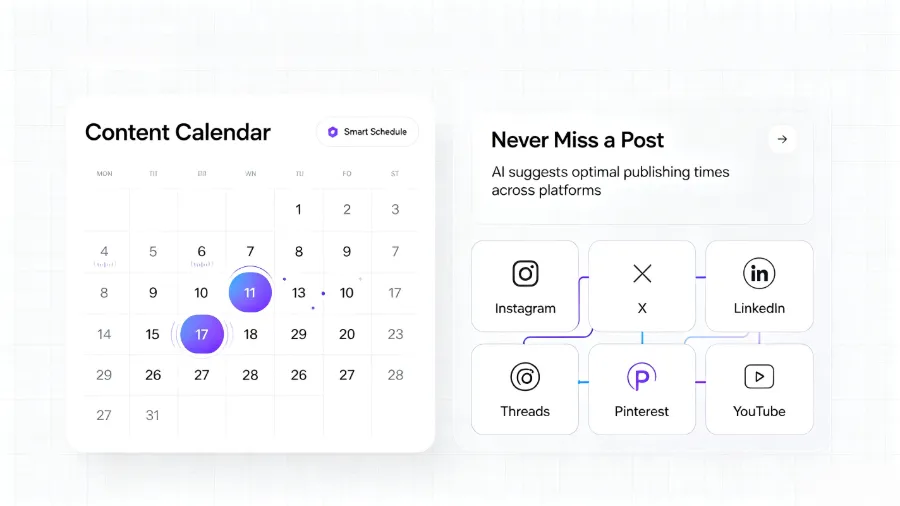
Platform publishing times should not be chosen by feel. Teams can combine publishing time, interaction rate, click‑through rate, and conversion rate to observe performance and refer to Instagram Publishing Time Analysis to adjust scheduling, but high interaction periods do not always equal high purchase‑intent periods. Some content receives many comments at night, while clicks concentrate during the next day’s work hours; this discrepancy only becomes apparent after matching publishing logs with internal data.
From an execution perspective, automated publishing infrastructure can achieve an average 2‑minute setup and provide 99.99% API uptime; this shows that connectivity and scheduling can be stable, but it does not guarantee factual correctness. When auditing multiple accounts, Flownib’s content calendar and publishing records can pinpoint which platform, version, or schedule experienced an anomaly, but final decisions on whether to retract, keep, or re‑publish still require human confirmation.
An Executable Judgment Framework for Evaluating AI Content Quality
In cross‑border e‑commerce content operations, quality judgment should go beyond “does it read smoothly.” A piece of content may be grammatically natural and cover trend keywords yet lack brand stance or misapply a platform’s expression habits to another platform. A five‑point pre‑publish checklist can serve as a minimum review framework:
- Trend Relevance – Is the content derived from a genuine, still‑valid trend, or was it selected merely because of keyword similarity?
- Brand Consistency – Do product facts, brand positioning, tone, and pricing narrative align with the current brand dossier?
- Audience Fit – Does the content address the specific problems of the target audience in the given market, rather than a generic discussion of a hot word?
- Platform Adaptation – Have the opening, length, media format, interaction style, and platform rules been adjusted accordingly?
- Content Retrospective – Are publishing time, interaction, click, or conversion signals recorded, and does brand identification persist?
When trends and brand don’t match, abandoning the hot topic is usually cheaper than forcing a product into it. If the brand lacks reliable data, do not first ask AI to expand; instead, fill in product facts, audience boundaries, and non‑promisable content. This may add a few hours to publishing but prevents two days of rework after launch.
High‑quality AI content ultimately must satisfy several seemingly conflicting requirements simultaneously: timely but not short‑sighted, unified but not monotonous, automated but accountable. Trends provide change; brand context provides boundaries; review and retrospection determine whether the content remains trustworthy amid change.
FAQ
Why does AI that only references hot trends still produce subpar content?
Because a trend only proves that people are paying attention to a topic; it does not prove the topic fits the brand. Even if a tool shows a 92% trend match, teams should still verify product relevance, target audience, and marketing objectives, or else they’ll get higher interaction without any click growth.
What information should brand context provide to AI?
At minimum, product details, target audience, brand positioning, and marketing objectives. Cross‑border teams should also add regional, language, pricing expression, and cultural boundaries, and keep the brand dossier updated as products and campaigns evolve.
How to avoid brand content looking outdated when trends shift quickly?
After spotting a trend, first confirm its validity window before deciding to generate or schedule. For topics with only a few‑hour window, shorten the review chain, but never skip product‑fact and language‑version checks; otherwise, two days of rework will cause you to miss the trend altogether.
Should a single cross‑border e‑commerce piece be published directly to all platforms?
No. Instagram, X, LinkedIn, and TikTok have different openings, lengths, and interaction mechanisms. The larger the number of platforms covered, the more essential it is to retain platform‑specific rewriting, preview, and human review.
What is the most critical human check before publishing AI‑generated content?
First verify product facts, pricing, and applicability; then check brand tone, regional expression, and platform rules. After a batch publish, teams should also compare publishing logs with click, interaction, and conversion signals to determine whether issues stem from content judgment or publishing execution.
Share Article