
How to Turn Hot Trends into Social Media Content

Once a trend emerges, the golden window left for the operations team is usually only 2–6 hours. The team can refer to the practice of Global Team Multilingual Automation, but most teams actually do this: a few people discuss in a chat whether to hop on, then each opens a different platform backend, manually rewrites the copy, switches tabs and copy‑pastes line by line. By the time the first version is finally posted, the buzz has already passed its peak and engagement drops sharply.
The bottleneck in chasing trends is never the creative idea, but the workflow from discovering a trend to publishing the final product. Who monitors it, how quickly a draft can be finalized, and whether it can be distributed to all platforms with one click—these steps determine whether the content can capture the buzz. In 2024, a cross‑border e‑commerce operations team chased a high‑traffic topic; the copy for eight platforms was all manually rewritten, taking about six hours from selection to publication. By the time they posted, the buzz had already faded, and the reach was only about one‑third of a normal piece from the same batch. The problem was not content quality but a process that was too long.
Trends Don’t Wait: Build a Continuous Trend Signal Source
Relying on scrolling the homepage and hoping to stumble upon a trend is inefficient and unstable. From a topic’s emergence to its fermentation, the golden window is usually only 2–6 hours; after six hours, engagement drops noticeably as the buzz wanes. Waiting for team members to each happen upon the same piece of content before discussing often means the optimal posting time has already been missed.
A structured trend‑monitoring mechanism is more reliable than inspiration. Reddit is good for capturing deep discussions within a community; the topics are high‑quality but ferment slowly. The 2026 Brand AI Scheduling Review provides the latest comparison of AI scheduling tools, helping teams choose the right automation solution. Hot topics on YouTube usually accompany rising search interest, making them suitable for early positioning; news sources cover industry events with strong timeliness but also a lot of noise; Hacker News leans toward technology and product topics, which are highly valuable for tech brands. Additionally, topics on Threads ferment quickly, making it a useful extra observation window; you can monitor topic fermentation on the Threads platform as well. More information can be found on the veonib official website.

Filter First, Then Follow: Determine Whether a Trend Is Worth Pursuing
Most trends are unrelated to a brand; chasing the wrong trend can be more damaging to an account than not chasing at all. Forcing a brand‑inconsistent topic onto the audience only creates confusion and can even harm the existing account image.
To decide if a trend is worth following, use a three‑question filter: Does the topic match the brand’s tone? Is the target audience discussing it? Does the brand have a unique angle? Only when all three answers are yes should resources be invested. Evaluating a trend should usually be completed within five minutes; more than 70% of trends should be actively abandoned. This isn’t conservatism but a resource‑allocation issue—reserve effort for topics that truly fit.
Buzz metrics are only a reference; the quality of interaction and the direction of discussion determine whether content can go viral. A topic may have high discussion volume, but if the discussion direction is unrelated to the brand, or the participants are not the target audience, the trend holds no value for the brand. Metrics like discussion‑heat percentages and trend direction on platform dashboards only indicate that a topic is heating up; they don’t indicate whether the topic is suitable for you.
“Speed” does not equal “recklessness”. While launching quickly, the brand’s baseline must still be upheld to avoid mishaps. Compressing the trend‑assessment process to within five minutes is a skill the team can deliberately train. Once the decision framework is fixed, decision speed naturally improves.
Same Idea, Different Platform Expressions
The same topic requires different tone, length, and format on each platform; manual rewriting is a time black hole. Content on X must be concise and immediate; LinkedIn calls for a professional analytical tone; Instagram leans toward visual expression; Threads is more relaxed and casual. Platform differences mean the same idea usually needs to be split into 4–6 content variants to maximize reach.
| Platform | Content Form | Character/Length Limit | Tone Requirement | Trend Lifecycle |
|---|---|---|---|---|
| Long post/graphic | ~3000 characters | Professional analytical tone | Several days | |
| X | Short post | 280 characters | Concise and immediate | 2–6 hours |
| Image/video (Reels) | ~2200 characters | Visual and friendly | 1–2 days | |
| Threads | Conversational short post | 500 characters | Light and engaging | Several hours |
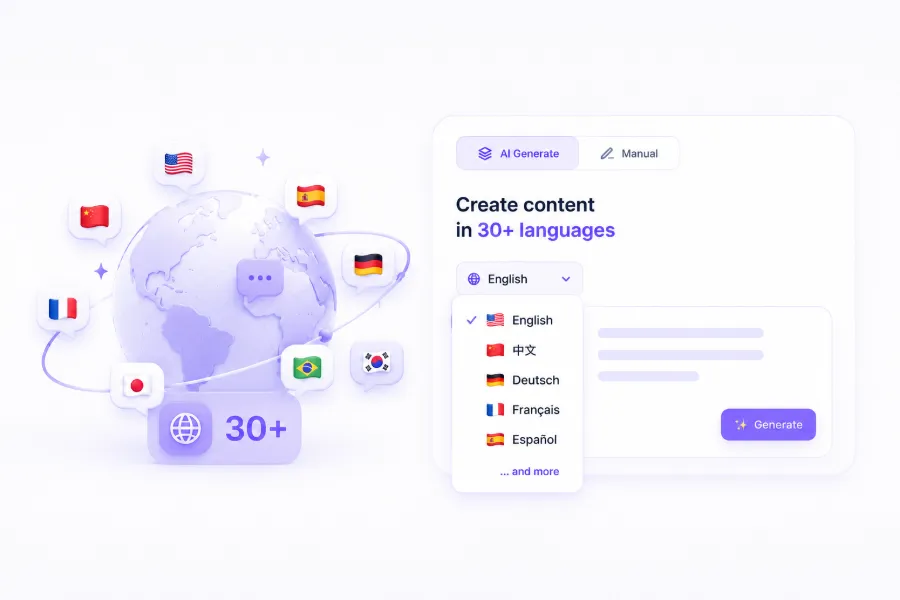
“Consistent idea, diversified expression” is a more efficient approach—keep the core message unchanged and only adjust the presentation. Manually editing each variant can take half a day per trend. This is why many teams are turning to AI‑assisted rewriting: automatically adapting source content to each platform’s style, eliminating the need for manual per‑variant edits. In cross‑border scenarios there’s also the extra cost of language adaptation; multilingual markets require producing multiple versions at once—English, Chinese, Japanese, German, French, etc.—which multiplies the workload. There are many operational details worth expanding on when creating once and distributing across multilingual markets.
Timing and Review: Don’t Let the Buzz Expire
Buzz is time‑sensitive; the publishing window determines reach more than the content itself. Platform algorithms favor “cold‑start” for timely content, so posting quickly often secures recommendation slots more easily than posting a polished piece. However, this also means that a mis‑post’s negative spread can be equally fast—its decay rate is as rapid as that of a viral hit.
Balancing scheduled publishing with real‑time grabbing is necessary. While reserving a schedule, keep a fast lane so the team can bypass regular approval processes and publish directly when a trend appears. After publishing, record and track performance across platforms to promptly repost or adjust strategy. Managing multiple accounts and platforms creates a clear administrative burden; scattered accounts lead to missed posts and duplicated effort. Consolidating the fragmented multi‑tool workflow into a unified dashboard can reduce such errors.
A unified calendar view directly controls publishing rhythm—All platform schedules are in one view, showing which content is posted, pending, or needs reposting at a glance. Platform management and tracking stability also have baseline references; official API integrations typically offer 99.99% uptime as a reliability benchmark. Tools like Flownib’s approach to managing multi‑platform publishing records on a unified dashboard are worth emulating for operations teams.
Turn Trends into Long‑Tail Content Assets
The lifespan of trends varies greatly across platforms. Hot topics on X and Threads fade within hours, while related content on YouTube and Pinterest can sustain weeks of search traffic. Repurposing short‑lived trends into long‑term assets is often more cost‑effective than a one‑off rush.
A dual strategy of “short‑term exposure, long‑term asset” maximizes trend value. Review metrics such as engagement rate, shares, and long‑tail search traffic to determine which trends truly merit repurposing. Validated topics can be organized into a long‑term content library as material for future creations. Comparisons of mainstream AI content‑scheduling tools reveal significant differences in long‑tail content management. Cross‑border teams can also refer to the 2026 cross‑border content stack collaboration methods to integrate trend assets into a more complete content system.
The ability to chase trends is essentially a reusable workflow, not a flash of inspiration. Trend monitoring, filtering, multi‑platform adaptation, publishing review, and long‑tail consolidation—when this process runs smoothly, every trend can be captured; when it stalls, even the best ideas will expire while waiting.
FAQ
How often should hot topics be refreshed?
Trend monitoring is recommended at a fixed 2–3 times per day—once in the morning, midday, and evening. The golden window for a hot topic is usually only 2–6 hours, so multiple daily scans can cover most sudden topics. If resources are limited, ensure at least one scan in the morning and one in the afternoon.
How many platforms should a hot trend be posted to?
It depends on the topic’s fit with each platform; generally, 3–5 core platforms are recommended. Not every platform is suitable for a given trend—professional topics on LinkedIn may not translate well to X. Start with the 2–3 best‑matching platforms, observe the data, then decide whether to expand to others.
Is it still worthwhile to publish after missing the golden window?
It depends on the topic type. For highly time‑sensitive topics, publishing after six hours is essentially meaningless; however, topics that can be archived as searchable content on YouTube or Pinterest may still be valuable even if posted a few days later. The criterion is: does this topic still get searched a week later?
How to determine if a trend fits your brand?
Use the three‑question filter: Does the topic match the brand’s tone? Is the target audience discussing it? Does the brand have a unique angle? Only when all three answers are yes should you proceed. Keep the assessment within five minutes; actively abandon more than 70% of trends.
Share Article


