
AI Scheduling vs Manual Publishing: Which Method Truly Saves Creators Time?

Open the backend, copy a piece of copy, switch to another platform, paste, adjust formatting, then move on to the next—how many times does a creator repeat this sequence each day? Manual publishing of social media content may seem simple, but the cumulative time loss far exceeds most people’s intuition. I’ve seen many teams treat “posting” as a five‑minute task, only to discover at year‑end that copying and pasting alone has consumed hundreds of hours. This article breaks down the real time differences between manual scheduling and AI‑automated scheduling based on actual workflows, helping you make a more pragmatic tool choice.
Bottom line: For creators who publish more than five times a week across three or more platforms, AI scheduling tools can save an average of 4–6 hours per week and reduce error rates from 5%–8% to below 1%. The savings aren’t just operational—more importantly, the “decision‑offloading” lightens cognitive load. Let’s unpack this step by step.
The Real Time Accounting of Manual Scheduling: From Copy‑Paste to Publish Check
Let’s calculate the details. A standard cross‑platform manual publishing workflow looks like this:
- Write a copy in a note or document
- Copy the entire text
- Switch to Instagram, paste, adjust formatting (line breaks, emojis, @mentions)
- Crop and upload an image or video
- Preview and verify that links work
- Click Publish
Completing this set of actions takes an average of 8–12 minutes. If you cover five platforms (Instagram, X, LinkedIn, Threads, Pinterest), each round of publishing costs at least 40–60 minutes. Assuming five posts per week, that adds up to 35–50 hours a year—equivalent to a full week of paid vacation spent on copy‑pasting.
A more hidden cost is “context switching.” Every time you move from one platform to another, your brain must readapt to the UI layout, operation logic, and formatting rules. This fragmentation of attention drains creative energy far more than the raw operation time. Many creators can’t keep up with daily posts, not because they lack content, but because the publishing process overwhelms them.
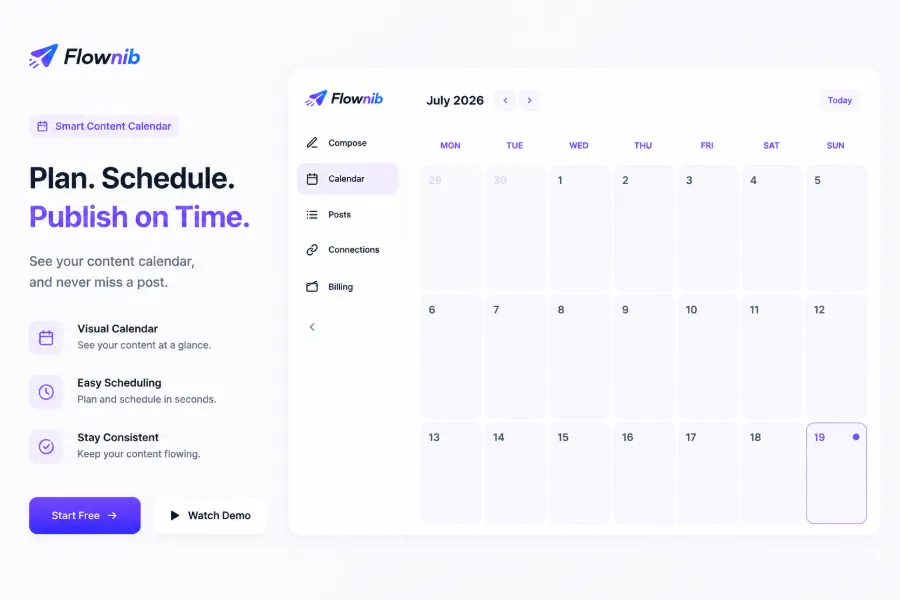
Manual scheduling also requires maintaining a content calendar—either an Excel sheet or a Trello board. Before each post you must verify the date, platform, and account; missing any step can scramble the publishing schedule. I’ve seen someone forget to switch from a personal to a business account and accidentally post promotional content to a private profile, resulting in an awkward deletion.
If you’re still publishing manually, try tallying your own time: write down each step of your publishing process, time it for a week, and you’ll be surprised by the total. This is why more teams are seeking a workflow upgrade that says goodbye to manual social publishing.
How AI Scheduling Compresses the Publishing Flow
The core logic of AI scheduling tools is simple: create once, adapt to multiple platforms, publish with one click. Compared to the six manual steps, AI workflows usually compress to three steps:
- Write the original copy
- AI automatically rewrites it for each platform (adjusting character limits, tone, hashtag format)
- One‑click distribution to all connected accounts
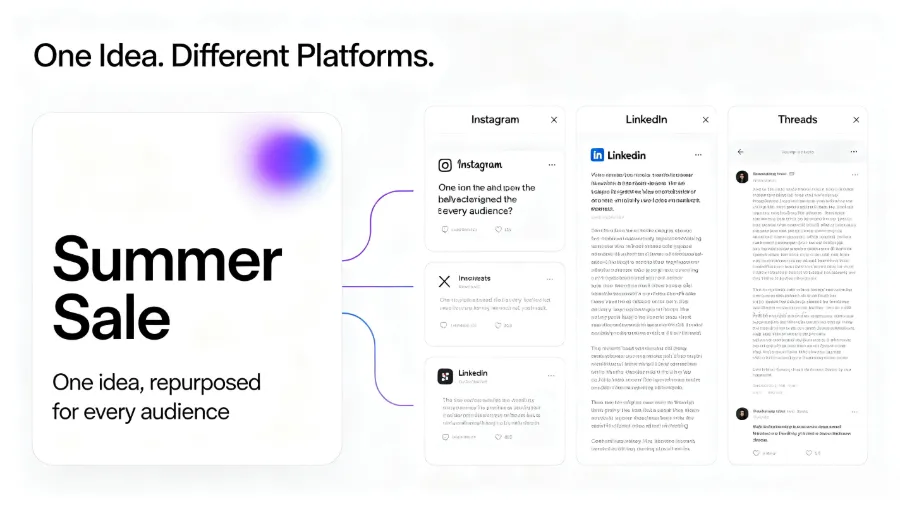
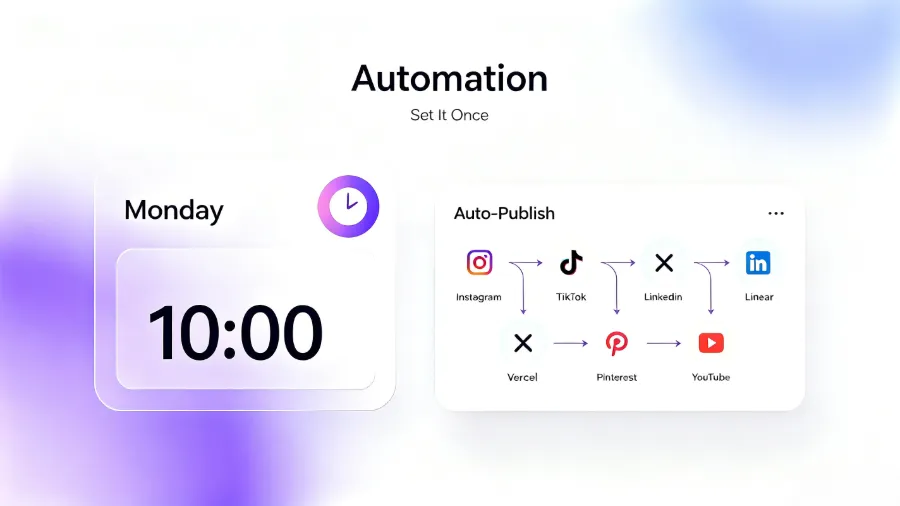
For a five‑platform release, manual publishing takes 40–60 minutes, whereas using an AI scheduler reduces the entire process—from writing to publishing—to just 2–3 minutes per piece of content. The savings aren’t only operational; they also include “decision offloading”—you no longer need to pick a publishing time or platform adaptation for each post. Smart scheduling features automatically recommend the optimal posting time based on audience activity, handing the decision to the algorithm.
AI rewriting is another key step. Platform styles differ dramatically: LinkedIn prefers professional depth, X demands concise impact, Instagram thrives on casual, hashtag‑rich posts. Manual rewriting is time‑consuming and can drift tone. AI tools keep brand voice consistent while automatically adapting to each platform’s nuances. For example, a promotional copy might be rewritten as an industry‑insight tone on LinkedIn and condensed into a hashtag‑rich short sentence on X.
In AI scheduling workflows, tools like Flownib excel at “write once, publish everywhere”—you write a piece, AI generates optimized versions for each platform, then publishes directly via official APIs, eliminating all switching and pasting steps. If you’re considering migrating from Buffer or Hootsuite, check out this in‑depth review of Buffer alternatives to see how AI distribution performs in 2026.
Hidden Costs Beyond Efficiency: Learning Curve, Error Rate, and Maintenance Overhead
Manual scheduling’s error rate isn’t low. Industry surveys show a 5%–8% error rate for cross‑platform manual posts, with common issues such as missing parts of the copy during paste, posting to the wrong account, or setting the wrong publish time, causing content order to be scrambled. These errors may require a simple delete‑and‑repost or, in severe cases, damage brand reputation.
AI scheduling tools connect directly to platforms via official APIs, dropping error rates below 1%. However, this doesn’t mean AI tools are completely hassle‑free. There is an initial learning cost: linking accounts, configuring templates, tweaking AI rewrite parameters—all require experimentation. When I first used AI scheduling, I didn’t preview the rewritten output carefully, and a promotional copy appeared overly colloquial on LinkedIn, prompting comments like “Did AI write this?” Since then I’ve made it a habit to glance at the preview before each publish. AI tools save repetitive labor, not the responsibility of thinking.
Long‑term maintenance also differs. Manual scheduling demands continuous repetitive actions, whereas AI scheduling requires periodic quality checks—AI rewrites can sometimes omit key information or over‑simplify content. You’ll need to spend 15–20 minutes each week reviewing AI‑generated versions to ensure brand tone stays on point. Additionally, while AI tools unify the dashboard for multi‑account management, you still need to monitor account permissions and API token expirations.
If you’re evaluating different platform management tools, consider traditional schedulers like Loomly. Their feature focus differs markedly from AI‑driven tools—traditional solutions excel at calendar management and collaboration, while AI tools shine in automatic rewriting and distribution efficiency.
Choosing a Scheduling Method Based on Your Workflow
There’s no universally correct choice, only the one that fits your current workflow. The following four criteria can guide your decision:
| Decision Dimension | Suits Manual Scheduling | Suits AI Scheduling |
|---|---|---|
| Posting Frequency | < 5 posts per week | > 10 posts per week |
| Number of Platforms | 1–2 platforms | 3 or more platforms |
| Tolerance for Content Consistency | High (each post independently created) | Medium‑Low (requires unified brand tone) |
| Team Size | Solo creator | Teams of 2+ or multi‑account management |
If you post only 1–3 times a week and cover just Instagram and X, manual scheduling is sufficient—learning an AI tool may cost more time than it saves. But if you publish over 10 times a week across 4–5 platforms, AI scheduling can save 4–6 hours weekly, not counting reduced decision fatigue and error risk.
A hybrid approach is also pragmatic: manually fine‑tune important content (product launches, brand campaigns) before AI distribution, and let AI batch‑process routine content (industry news, daily updates). Tools like Flownib allow preview‑then‑publish, letting you tweak each piece without fully trusting AI rewrites.
Three self‑check questions help you decide quickly:
- Do you spend more than 3 hours per week on manual publishing?
- Does a cumbersome publishing process cause you to reduce posting frequency?
- Do you need to manage more than three platform accounts simultaneously?
If you answer “yes” to at least two, an AI scheduler is worth a try. For a side‑by‑side comparison of mainstream tools, see the 2026 Global Brand AI Scheduling Tools Comparative Review, which details Buffer, Hootsuite, Flownib, and others. The Later blog also offers many practical articles on scheduling strategies for supplemental reading.
FAQ
Q1: Do AI scheduling tools really save more time than manual publishing?
Yes, but only if your posting frequency and platform count exceed certain thresholds. For creators publishing more than five times a week across three or more platforms, AI scheduling can compress a single post’s time from 40–60 minutes to 2–3 minutes, saving 4–6 hours per week. If your frequency is low, the learning curve may offset the time saved.
Q2: Will AI‑rewritten content make all platform posts look the same?
No, provided you configure appropriate rewrite rules. Good AI tools adjust tone and format according to each platform’s characteristics: LinkedIn stays professional, X stays concise, Instagram stays casual. If your original copy is overly templated, the differences after AI rewriting will be smaller. It’s advisable to preview each platform’s version before publishing and make manual tweaks when necessary.
Q3: Is a free version of an AI scheduler sufficient?
For solo creators or testing phases, free tiers are usually adequate. Most AI schedulers offer three social accounts and 6–10 posts per month for free, which suits low‑frequency publishing or tool evaluation. If you need more platforms or higher frequency, a paid plan becomes more cost‑effective.
Q4: What’s the biggest hidden cost of manual scheduling?
It’s not the copy‑pasting itself, but the “context switching” that fragments attention. Each platform switch forces you to readapt to a new UI and workflow, significantly reducing creative stamina and content quality. The 5%–8% error rate of manual scheduling is also a hidden cost—mistaking the wrong account can have consequences far beyond the effort of a simple fix.
Q5: If I only use two platforms, do I still need an AI scheduler?
Only if you publish more than 15 pieces of content per week. For two platforms, manual publishing’s time cost is low, and the learning curve and subscription fees of AI tools may not be justified. However, if you plan to expand platforms or increase frequency in the future, getting familiar with AI scheduling now can be beneficial.
Share Article