
How to Choose Social Automation AI Agent Tools: Three Solutions and an Implementation Evaluation Framework
Cross‑border e‑commerce operation teams face almost the same scenarios every day: Instagram, TikTok, LinkedIn, Facebook, sometimes also YouTube and Pinterest. One account per market, one set of content guidelines per account. A single operations specialist spends a lot of time each week copying and pasting, switching tabs, and reformatting and scheduling per platform. Manual processes waste not only time but also the most valuable attention of the team.
The market is flooded with tools that claim to be “social automation,” yet most articles stop at listing tools and rarely answer a more practical question: What layer of work does an AI Agent actually replace for you? Does it just schedule posts, or does it truly understand the content and adapt it to each platform’s style? This article does not rank tools; it simply categorizes existing solutions into three types and provides a framework that cross‑border teams can directly apply for evaluation and selection.
The fundamental difference between an AI Agent and traditional scheduled‑posting tools is the shift from “point‑in‑time sending” to “understanding content and autonomously adapting it.” Traditional tools (Buffer, Hootsuite, Later, etc.) solve “when to post,” while an AI Agent solves “what to post, how to post, and where to post.” For cross‑border teams, the latter is the real efficiency lever—each platform has its own character limits, image ratios, hashtag rules, etc. Turning a single product copy into an Instagram short post, a LinkedIn professional article, and a TikTok spoken script manually costs far more time than creating the original content.
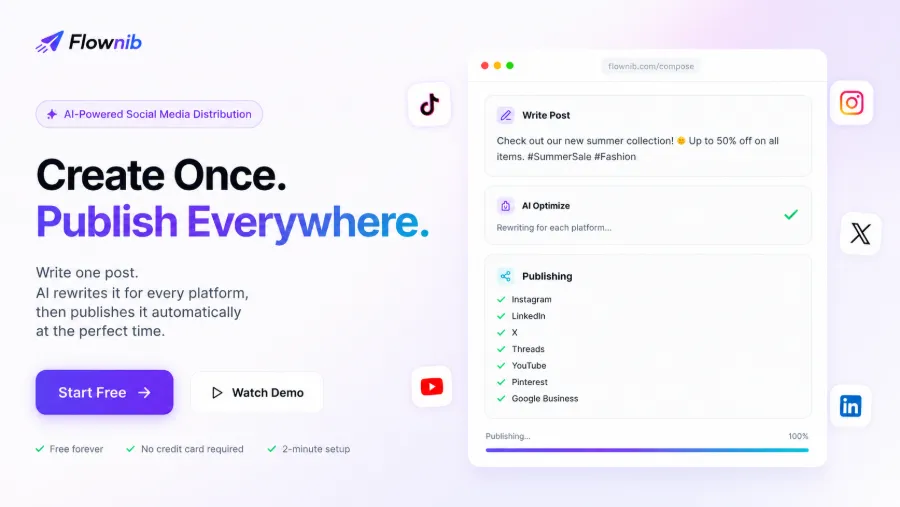
A key distinction must be made: publishing via official APIs versus using unofficial proxy interfaces are two completely different paths. Unofficial interfaces may appear to work, but if a platform changes its policy, the risk of throttling or account bans falls directly on the operations team. This is why compliance of the publishing channel should be evaluated before the feature list. One category of tools on the market are specialized social distribution platforms, such as Flownib, which combine AI rewriting, scheduling, and one‑click distribution using the official API route—these will be discussed separately later.
Core Dimensions for Evaluating AI Agent Social Automation Tools
Don’t jump straight to feature lists; cross‑border teams should map the tools onto their own account matrix. The following dimensions cover most selection scenarios.
Platform coverage – does it match the target market’s account matrix? Some tools focus on Instagram and TikTok and have weak LinkedIn support; others prioritize Western professional platforms. If a team runs TikTok, YouTube, and Google Business, the depth of support for each must be verified—“supported” and “well‑supported” are different things.
Depth of AI rewriting and platform‑style adaptation – not just simple template filling. A straightforward test: give the same product copy to the tool and ask for an Instagram version and a LinkedIn version. Are the differences genuine, or merely punctuation and emoji changes? Effective adaptation adjusts tone, sentence length, and even the order of information.
Publishing stability and API compliance – publishing channel stability is usually benchmarked at 99.99 % API uptime; anything lower could mean almost an hour of downtime per month. For teams that rely on scheduled posting, this figure directly impacts whether content reaches the audience on schedule.
Multi‑account management and team collaboration support – a team typically maintains multiple accounts for different markets. Whether the tool allows managing all accounts from a single dashboard, supports multi‑user collaboration, and offers permission tiers determines if it can be embedded into existing workflows.
Ability to integrate into existing automation pipelines – if a team already uses n8n or Zapier for content production, the tool must provide APIs or webhooks to avoid becoming an isolated island. For an in‑depth discussion, see the Later blog on social automation research, which contains many practical observations on publishing cadence and content adaptation.
Pricing model and scalability with account growth – does the cost scale per account or per volume of posts? Teams need to calculate how expenses will change as the account matrix expands, rather than adjusting after the fact.
Three Main Solution Types: General Agents, Orchestration Platforms, and Specialized SaaS
When we break down market offerings, they essentially fall into three categories. Each has clear use cases and hidden costs.
Category 1: General AI Agents – tools like ChatGPT, Claude, Codex, Cursor, etc., which gain publishing capability through skills or plugins. Their advantage is flexibility; theoretically, any workflow can be assembled. The downside is that “assembly” itself requires technical expertise. You must handle API credentials, platform‑specific adaptation logic, and retry mechanisms. For operations teams without development resources, the learning curve is steep.
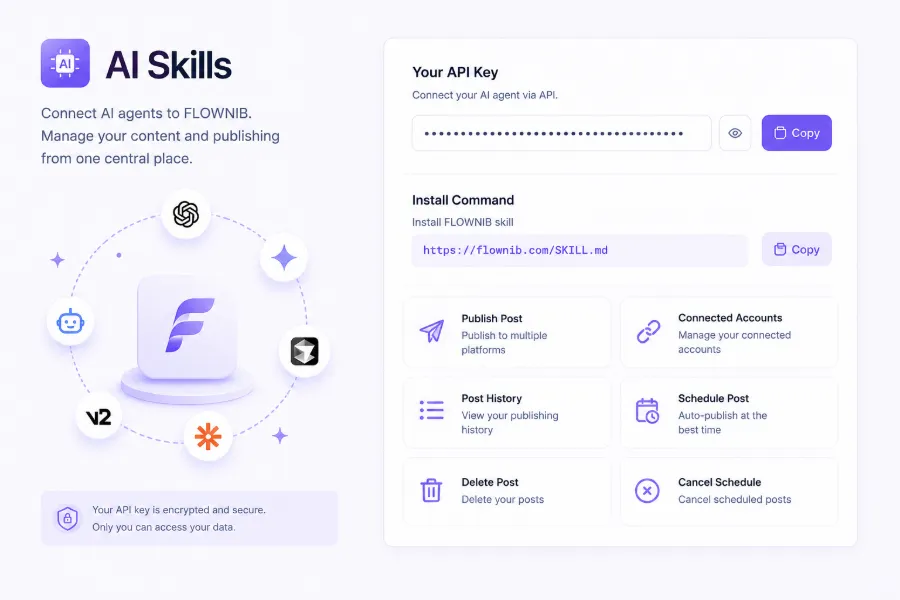
Category 2: Automation Orchestration Platforms – tools such as n8n, Zapier, Make, which let you build complete social publishing workflows with transparent logic at each step. However, maintenance is also non‑trivial: when a platform’s API changes, you must manually adjust nodes; you have to write multi‑platform adaptation logic yourself, and design retry and alert mechanisms for publishing failures. Suitable for teams with technical backgrounds, less so for pure operations teams.
Category 3: Specialized Social Automation SaaS – solutions that integrate AI rewriting, scheduling, and one‑click distribution out of the box. They typically claim coverage of ten major platforms and an average setup time of about two minutes. For most cross‑border teams, this offers the highest ROI—no need to understand APIs or maintain nodes; just connect the accounts and start publishing.
A clear comparison table makes the trade‑offs obvious:
| Solution Type | Typical Examples | AI Content Rewriting | Multi‑Platform Publishing Stability | Setup & Learning Barrier | Best‑Fit Teams |
|---|---|---|---|---|---|
| General AI Agent | ChatGPT, Claude, Codex | Strong, but requires self‑integration | Depends on your assembly quality | High | Teams with development resources |
| Automation Orchestration Platform | n8n, Zapier, Make | Moderate, requires configuration | Controllable but high maintenance cost | Medium‑high | Technically inclined operations teams |
| Specialized Social Automation SaaS | Flownib, Buffer, Later | Plug‑and‑play | High, official API direct connection | Low | Most cross‑border operations teams |
For authoritative guidance on enterprise‑level publishing, see the LinkedIn Official Marketing Solutions, especially the account‑operation strategies for B2B markets.
End‑to‑End Workflow for Cross‑Border Teams Implementing AI Agent Social Automation
After selecting a tool, the real challenge is embedding it into existing operations. A typical pipeline looks like: Trend discovery → AI generation → Platform adaptation → Scheduled publishing → Data tracking.
In the trend‑discovery stage, if the tool can scan Reddit, Hacker News, YouTube, etc., in real time, the team can intervene before a topic peaks instead of chasing a fading trend. The AI generation stage turns the trend angle into a draft; the platform adaptation stage rewrites format and tone according to each platform’s rules; scheduled publishing ensures the content reaches the audience at the optimal time in the target timezone; data tracking feeds back into the next round of topic selection.
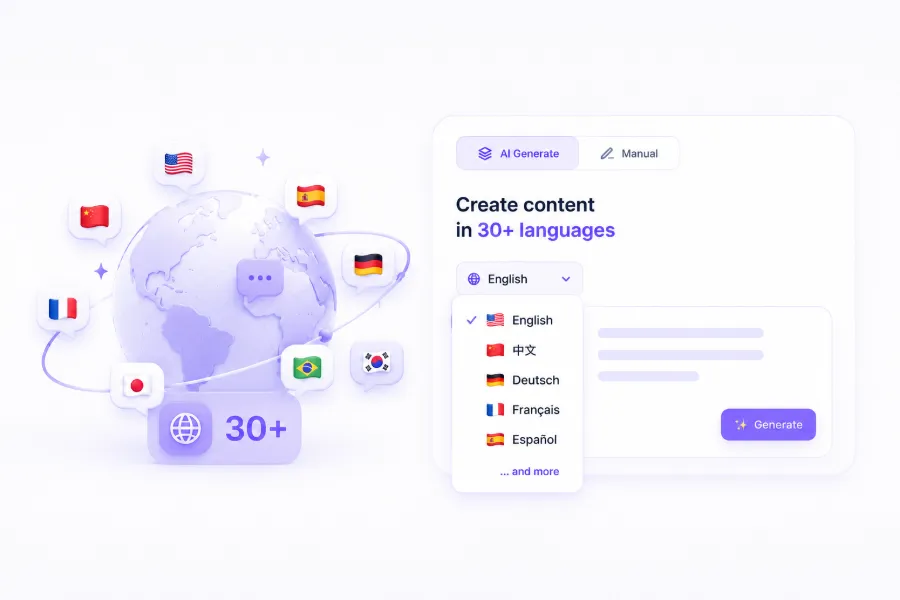
Multilingual adaptation is unavoidable for cross‑border teams. English, Chinese, Japanese, German, French—each market needs localized content, but localization does not mean starting from scratch. Rewriting the same brand voice into multiple languages is far more efficient than independent creation per market. Most specialized tools support five or more major languages and allow a unified brand file to keep the voice consistent across platforms.
A practical decision point: continue using the existing publishing stack or adopt a specialized platform. Many teams already have content pipelines built with n8n or Zapier; the question is integration, not replacement. If a specialized platform offers an API or webhook, it can serve as the publishing endpoint of the existing pipeline rather than supplanting the whole workflow. For a detailed analysis of why social media often gets missed in automation pipelines, read “Why Automation Workflows Keep Missing Social Media.”
Migration Pitfalls: Over‑Automation and Platform Compliance
Automation isn’t always better when faster—this lesson comes from a real case. A cross‑border e‑commerce team introduced an automation tool, connected all accounts at once, and used unofficial interfaces for bulk publishing to chase efficiency. Initial results were dramatic: posting volume multiplied, and operating time shrank. However, a few weeks later, several platform accounts faced throttling, and some were temporarily banned. The team had to revert to a compliant official‑API solution, reconfigure all publishing logic, and spent nearly two weeks restoring normal cadence.
Two takeaways: first, automation speed should be secondary to stability—pilot on a small scale, verify reliability, then expand gradually; this is far safer than a full‑scale switch‑over. Second, short‑term gains from unofficial interfaces do not outweigh the long‑term risk of account loss. Compliance is non‑negotiable—it’s a baseline.
Another risk of over‑automation is “format drift.” If AI rewriting only swaps surface elements without truly grasping each platform’s context, the output may feel off—over‑casual on LinkedIn, overly formal on TikTok. Such drift harms the brand more than not publishing at all because it’s visible to the audience.
After automation, team collaboration and account permission management also require new definitions. When multiple operators share a publishing account, who can edit schedules, add new platform accounts, or trigger pre‑publish reviews? Without clear rules, the efficiency gains from automation can be nullified by permission chaos and mistakes. For a concrete example of cross‑platform collaborative publishing, see the Practical Workflow Record of Cross‑Platform Collaborative Publishing.
FAQ
What’s the difference between AI Agent social automation tools and traditional scheduled‑posting tools?
Traditional tools solve “when to post”; AI Agents solve “what to post, how to post, and where to post.” The former requires you to manually prepare platform‑specific content; the latter automatically rewrites and formats before publishing. For multi‑platform teams, this translates into saving 10‑15 hours per week of repetitive work.
Can general AI Agents (e.g., ChatGPT, Claude) directly publish to multiple platforms?
They can generate content but cannot publish directly. General AI Agents excel at text generation; publishing requires additional API or skill integration. That means you must handle platform adaptation, credential management, and retry logic yourself—technical overhead is high. For teams without development resources, a specialized SaaS is a more realistic choice.
What should cross‑border teams focus on most when choosing such a tool?
Publishing channel compliance. Tools that use official APIs are safer for long‑term operations; unofficial interfaces may seem convenient but become riskier as volume grows. Next, ensure platform coverage matches your account matrix, and verify that AI rewriting depth is genuine.
Are free plans sufficient for a team’s initial use?
Adequate for validation. Most free tiers support a limited number of accounts and posting volume, which is fine for testing the workflow and confirming tool fit. However, free plans usually impose posting caps, and paid plans are typically needed for full‑scale operation. Treat the free period as an evaluation phase, not a long‑term solution.
How can we avoid content being flagged as violating platform policies or being throttled?
Publish via official APIs only; avoid any unofficial interfaces. Control posting frequency—don’t push identical content to all platforms simultaneously. Have a human review AI‑generated content before publishing to catch any sensitive wording. Tighten account permissions to prevent abnormal behavior caused by multiple operators.
Share Article


