
How to Provide Sufficient Brand Context to AI and Write Brand‑Appropriate Content

Cross‑border e‑commerce teams often give the same promotional message to AI, only to receive several pieces of content that don’t look alike: the English version emphasizes discounts, the Japanese version highlights product features, the German version sounds overly formal, and the social‑media version feels like it was written by a different brand. The problem is usually not that the prompt is too short, but that the AI lacks the brand context needed for judgment.
Providing brand context to AI isn’t about piling on product descriptions, keywords, and “write it elegantly” requests. It’s about organizing product facts, target audience, market differences, brand tone, marketing goals, and prohibited boundaries into actionable material. Only then can the AI consistently apply the same judgment criteria during creation, rewriting, review, and publishing.
In a cross‑border e‑commerce scenario, brand context must answer four questions: what is being sold, who it serves, which market it communicates in, and what action the user should take. Missing any of these makes the generated content sound fluent but fail to represent the brand.
First Clarify What AI Really Lacks: Not Word Count, but Brand Judgment Criteria
Product descriptions and brand context are not the same. A product description tells the AI “what this item does,” keywords tell it “which words must appear,” and writing requirements tell it “what format to output.” Brand context, however, tells the AI which selling point to prioritize when multiple are valid, which information to drop for different users, and which expressions would cross the brand’s promise boundaries.
For example, a cross‑border product might have four selling points: durability, lightness, eco‑friendly material, and a limited‑time discount. For first‑time buyers, the content might first explain the usage scenario; for repeat buyers, the focus could be a new color or restock. Without brand judgment criteria, AI easily puts “the biggest discount” first because promotional language is easier to recognize, even though it may not be the memory point the brand wants to build.
Tone drift is the most noticeable result. One market version may use restrained, concrete sentences, while another throws in exaggerated promises like “change your life” or “must‑not‑miss.” Multilingual content can also suffer from incorrect selling‑point ordering, identical copy across markets, and using promotional phrasing meant for landing pages on social media.
Platform differences amplify these biases. A brand may need to adapt the same theme to up to ten social platforms: Instagram relies on visuals and short captions, X is sensitive to information density and character limits, LinkedIn emphasizes industry context, and TikTok usually needs a more direct opening. The same brand facts can be retained, but the order of expression, sentence length, calls to action, and audience expectations cannot be copied verbatim.
Therefore, brand context should run through AI writing, content rewriting, and distribution processes, not just be pasted the the first time an article is generated. If a team still copies material between multiple tabs and repeatedly confirms platform requirements, start by addressing the friction described in Reducing Social Media System Silos and observe which information is frequently lost during handoffs.
Organize Brand Information into a Reusable Context Document
A usable brand file should not be a few‑thousand‑word introduction that must be repasted each time. It is more like a set of independently updatable judgment modules. Cross‑border e‑commerce teams should cover four core dimensions: product information, target audience, brand positioning, and marketing goals.
The product information section must clearly state what the product is, what problem it solves, how it differs from alternatives, and which specifications must never be altered. The target audience section should go beyond “young people” or “quality‑focused consumers” and describe purchase scenarios, concerns, budget ranges, familiar terminology, and decision processes. Brand positioning should explain what the brand is willing to emphasize, what it refuses to imitate, and how the tone may vary across markets. Marketing goals should differentiate awareness, interaction, product‑page visits, add‑to‑cart, and purchase, so AI does not guess the call‑to‑action.
Words like “premium,” “young,” “professional” lack sufficient boundaries on A more actionable formulation is: “For first‑time buyers, first explain the usage scenario, then introduce the material; each paragraph no more than three sentences; avoid absolute promises; use informational calls‑to‑action without creating urgency.” This lets content reviewers judge compliance and enables the model to reuse the guidance across tasks.
Cross‑border brands also need to add target market specifics, local user concerns, price and promotion limits, prohibited promises, and sensitive expressions. The US market may require delivery‑time details, the German market may focus on specifications and return policies, and the Japanese market may need a softer command tone. These are not translation issues but differences in audience expectations and purchase risk.
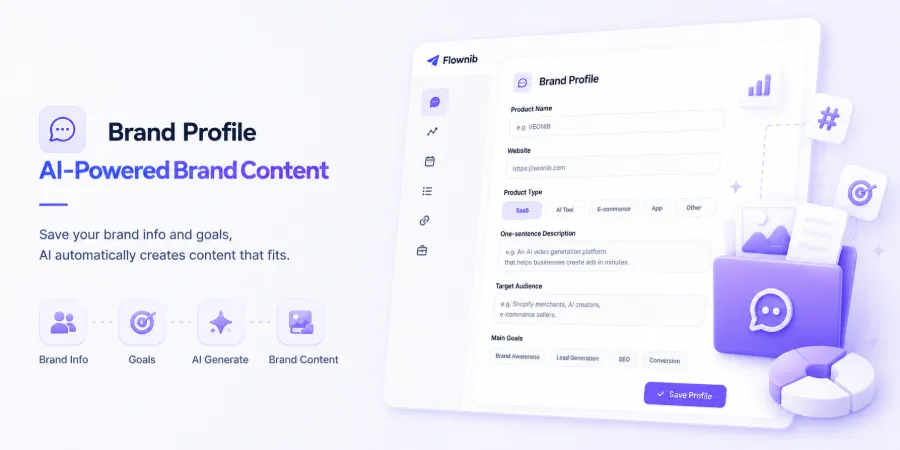
Brand files are best split into permanent and temporary information. Permanent information includes brand positioning, product facts, tone, and prohibited expressions. Temporary information covers a specific holiday campaign, seasonal discount, inventory status, target country, and the conversion goal for that campaign. Writing “the promotion ending this Friday” permanently into the brand file will turn it into outdated content after a few weeks.
A practical structure example: start with brand overview and product facts, then audience and market fields, followed by tone rules, positive/negative examples, marketing goals, and action boundaries, and finally a separate section for current campaign info. This structure works for product descriptions, ad variants, and social content, not just a one‑off article.
Turn Brand Context into Executable AI Instructions
Prompts should distinguish at least five types of information: background material, task objective, platform requirements, output format, and review rules. Background material answers “what AI needs to know”; task objective states “what needs to be done”; platform requirements specify “which channel”; output format limits “how the result is delivered”; review rules tell “what content cannot pass.”
“Maintain brand tone” cannot stand alone as a review standard. Teams can rewrite it into several checkable requirements: keep sentences short and specific, prioritize usage scenarios over exaggerated results; order product selling points by durability, convenience, then appearance; avoid absolute promises like “100 % effective” or “permanent solution”; calls‑to‑action should only invite users to view details or learn specs. The rules need not be many, but they must enable editors to point out exactly which sentence violates them.
Each task must clarify three platform constraints: platform style, character limits, and audience expectations. Character limits are not merely technical; Instagram’s visual captions, X’s information compression, LinkedIn’s professional backdrop, and TikTok’s conversational opening all reshape content organization. Changes in YouTube’s official content formats can be tracked via YouTube Official Content Observations as a daily reference, rather than treating every channel as the same publishing slot.
A single brand file does not equal copying the same copy to every platform. A safer approach is to retain product facts, promise boundaries, and brand judgment standards, then generate platform‑native versions separately. Brand consistency does not require identical phrasing across platforms; if Instagram and LinkedIn sentences are exactly the same, it may indicate that adaptation didn’t happen.
Multilingual localization also requires hard boundaries. AI may adjust metaphors, sentence order, politeness, and call‑to‑action style, but it must not change price, product specs, delivery promises, after‑sale policy, or target audience. Repeated corrections by translators or operators should be recorded because these edits often reveal the actual way the brand speaks better than the original “brand tone” description.
Teams can keep a small set of real examples, some positive and some negative. After each campaign, classify human edits as factual errors, missing data, improper platform adaptation, or temporary campaign changes, then decide whether to rewrite the file. This is more effective than endlessly lengthening prompts, because context quality evolves with real‑world feedback.
Integrate Context into Cross‑Platform Creation and Publishing, Not Just Prompts
When the brand file is ready, the workflow should start from a single theme input, not from opening separate editors for each platform. A cross‑border team typically defines the product, market, and goal for the campaign, generates a draft, rewrites per platform, previews, schedules in the content calendar, and finally publishes while recording feedback. This order reduces repeated pasting without eliminating review.
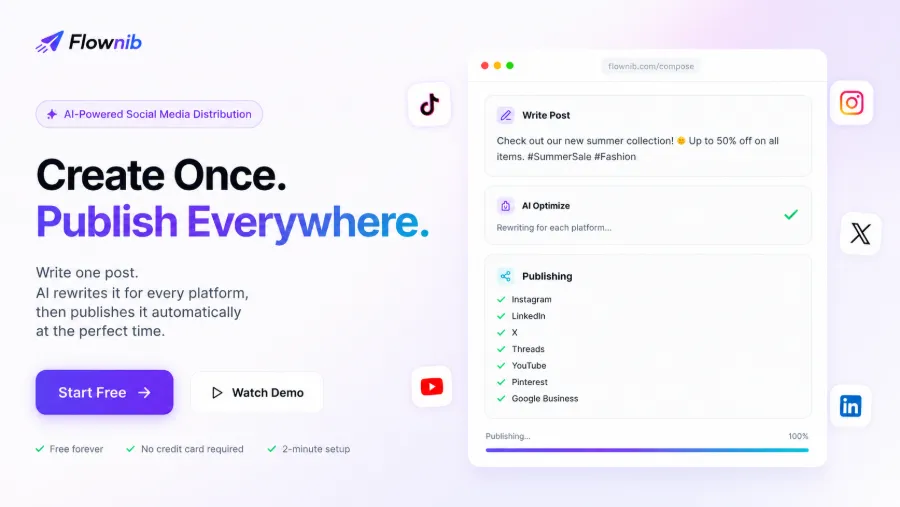
In the publishing process, the toolset presented by Flownib shows that account connection and basic setup take about two minutes, support up to ten social platforms, and handle multi‑platform sync via official APIs. For operators, such tools solve account switching, duplicate scheduling, and version搬, but they do not decide what a market should emphasize, nor replace the brand file or human preview.
A compact execution sequence can be:
- Input the brand file and current campaign information.
- Generate a platform‑agnostic draft.
- Rewrite per platform according to style, character limits, and audience expectations.
- Preview multilingual versions and verify facts, links, and promotion limits.
- Schedule publishing, record versions and feedback.
Operators still need to individually confirm price, inventory, discount end time, image‑text matching, and correct market selection for each account. Automation is great for repetitive actions, not for final responsibility judgments. Teams needing a detailed cross‑platform rewriting workflow can refer to the Cross‑Platform Content Adaptation Tutorial and focus on how input data flows into each channel rather than just the generated output.
The context that tools should read includes brand tone, product fields, target market, prohibited expressions, current campaign, and platform rules. Account permissions, API status, multi‑account management, and publishing times belong to the publishing layer and should not be mixed into brand positioning. Mixing the two leads to a single campaign change contaminating the long‑term file and makes error tracing harder for operators.
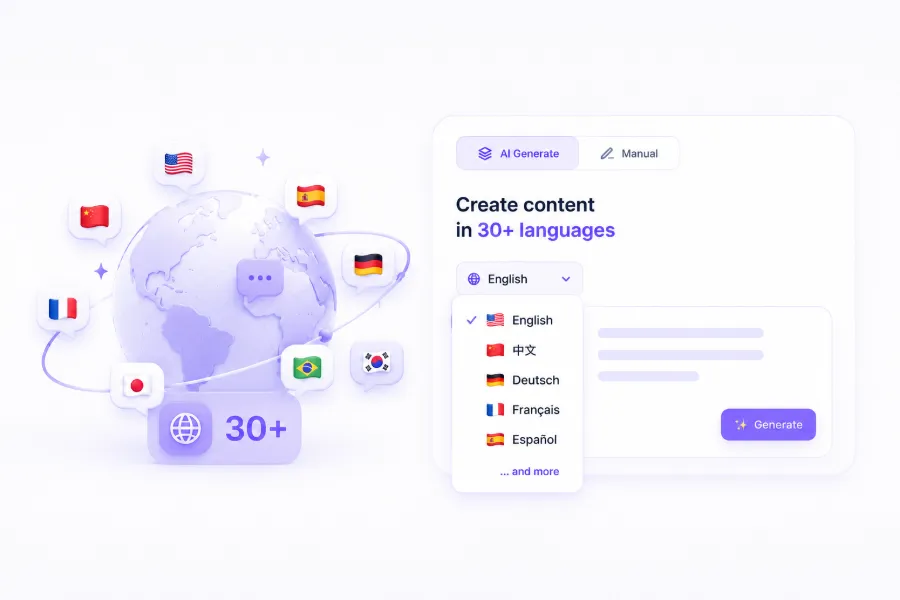
When publishing multilingual content, teams can keep a “fact master” and then generate English, Chinese, Japanese, German, French, etc. The fact master locks price, specs, promises, and market; platform versions only adjust expression. This may sacrifice a few minutes of generation speed but prevents translated versions from unintentionally altering commercial terms in the pursuit of naturalness.
Use Review Records and Feedback to Maintain Context, Not Just Set‑and‑Forget
The most underestimated risk of automated publishing isn’t a clumsy sentence; it’s that errors can be synchronized and spread. One cross‑border e‑commerce team, after launching a promotion, reused an unorganized brand file to speed up publishing. AI mixed expired discounts, market‑specific selling points, and platform tones, resulting in inconsistent promotional information across accounts almost simultaneously.
By the time the team noticed, a publishing round had already gone out. Some members re‑checked the content calendar, others compared market product pages, and some kept refreshing platform back‑ends to see which versions were live. Ultimately they had to roll back unpublished content, delete published versions, rewrite copy, and re‑review—recovering the time they thought they saved. The failure wasn’t the model itself but the lack of separation between temporary campaign data and the long‑term brand file, plus the absence of a visible preview before bulk publishing.
Pre‑publish checks should cover factual accuracy, market and language matching, brand tone, platform format, promotion limits, and call‑to‑action. Every human edit should be categorized: if it’s a rule issue, update the brand tone; if it’s missing data, add product fields; if it’s a platform‑adaptation issue, adjust channel requirements; if it’s a temporary campaign change, only update the campaign module.
That’s why teams need to keep content calendars, version control, and publishing records within the same workflow habit. The Cross‑Platform Operations Case Study on system silos and copy‑paste costs can help teams see how many manual handoffs occur from generation to launch. Another often‑overlooked step is retaining an editable version after scheduling; when a scheduled piece needs changes, operators should confirm the modification only affects the target platform and does not accidentally overwrite other markets. See the Method for Editing Scheduled Content for details.
The 99.99 % API uptime commonly advertised for automation tools only guarantees connection and publishing infrastructure stability; it does not guarantee brand‑correct content or higher conversion rates. Platform metrics also depend on publishing time, asset quality, audience activity, and landing‑page speed. Content calendars should record these variables to avoid mistaking a single exposure spike for successful context setup.
A counter‑intuitive observation is that the most valuable brand rules often aren’t in the initial file but emerge from human‑edit logs. Operators repeatedly delete exaggerated words, move a selling point to a second paragraph, or repeatedly add delivery conditions—these actions reveal judgment criteria the file hasn’t yet captured. Another practical point: automation reduces repetitive work but also reduces the chance of accidentally spotting errors, so preview and scheduling are not inefficient steps but the last observation window for the team.
Brand files also need regular cleaning. Stale product info, expired prohibited terms, outdated campaigns, and changed market strategies should be removed from the context; AI will not automatically know they’re obsolete. Teams can review permanent fields monthly, delete temporary fields after campaign end dates, and compare click, interaction, and conversion metrics across markets to determine whether issues stem from content, platform, or commercial conditions.
FAQ
What information should be prepared first when giving AI brand context?
Start with product facts, target audience, brand positioning, and marketing goals—the four categories. Lock down product specs, audience purchase scenarios, and action boundaries before adding price and deadline details for a specific campaign to avoid reusing expired promotion info.
Should brand context be a long paragraph or split into multiple modules?
Split it into multiple modules, not a single long paragraph. Keep permanent and campaign information separate so AI can call only the relevant fields, and the team can replace market, price, or prohibited expressions in minutes.
How to keep brand consistency across languages and platforms?
Fix product facts, promise boundaries, and selling‑point priority, then set language‑ and platform‑specific requirements. Before publishing, check each version line‑by‑line for price, specs, and call‑to‑action, especially comparing different market versions to avoid unintentionally changing commercial terms for naturalness.
How often should the brand context be updated?
Permanent brand information can be reviewed monthly; campaign information should be updated before each campaign starts and after it ends. Any change in product specs, pricing policy, target market, or prohibited expressions should trigger an immediate update rather than waiting for a scheduled cycle.
Does AI‑generated cross‑border e‑commerce content still need human review?
Yes, especially for bulk scheduling and multi‑market publishing. Human review should at least cover facts, language market, promotion limits, and platform format; even with a stable publishing pipeline, errors can still spread across accounts in a single sync operation.
Share Article