
One Creation, Five Platforms Distribution: The Right Way to Reuse Content

You spent three hours polishing a post, then published it on only one platform. If this scenario sounds familiar, you are probably wasting 80 % of the traffic potential of that content. A piece of content has a completely different lifecycle on each platform—on Instagram it sinks after 48 hours, on LinkedIn it may still get interactions a week later, and on Pinterest it can theoretically drive traffic for months. This article doesn’t explain “why you should reuse content,” but instead breaks down “how to create once and distribute across multiple platforms, while making each piece look native to its platform.”
Content reuse isn’t about copying the same paragraph five times; it’s about letting a core idea grow different “skeletons” on five platforms. Anyone who has done it knows the real challenge isn’t “writing,” but “adapting”—changing format, tone, image size, hashtags, so that each piece looks like it was tailor‑made for that platform.
Why “Copy‑Paste” Is Not Content Reuse
You’ve probably done this before: write a post in Notion, then paste it to Instagram without cropping the image, with all hashtags glued together, and only later realize the format on LinkedIn is a mess, with line spacing turned into a wall. Worse, the character limit on X truncates the post, and the final “click the link for details” disappears completely.
This “pseudo‑reuse” problem treats every platform as the same container. Instagram is visual‑driven, with an average dwell time of about 15 seconds; LinkedIn users may spend 45 seconds reading a professional insight—the performance gap for the same content across these two platforms can be up to threefold. Simply copying and pasting assumes all user behavior patterns are identical, which is clearly false.
A B2B brand once tried manually copying the same product description to four platforms. Within a week they received an Instagram community guideline warning (image size violation), a LinkedIn format mess reported as spam, and an X short link flagged as suspicious. All four platforms demoted their accounts. A strategy that was supposed to reach 500 k potential users actually reached fewer than 100 k, losing over 50 % of traffic. The lesson is clear: platform rules are not optional; manual copy‑paste gambles your account weight.
True reuse requires adapting to each platform’s rules—character limits, content format, delivery algorithm, image aspect ratio—every detail must be handled individually. This isn’t “overkill”; it’s a prerequisite for the content to be displayed properly.
Dissecting Platform Rules: Where a Piece of Content Dies in Five Places
If you plan to distribute a piece of content to five platforms, first understand each platform’s core rules. The table below lists key differences among five major platforms; ignoring any one of them can cause your content to be demoted or blocked.
| Platform | Character Limit | Recommended Image Ratio | Hashtag Limit | Content Style |
|---|---|---|---|---|
| 2 200 characters | 1:1 / 4:5 | 30 | Visual‑driven | |
| 3 000 characters | 1 200 × 627 | Unlimited | Professional insight | |
| X | 280 characters | 16:9 | 2‑3 recommended | Concise dialogue |
| 500 characters | 2:3 | 20 | Inspirational guide | |
| Threads | 500 characters | 9:16 | Unlimited | Casual chat |
Wrong image ratios on Instagram cause the post to be cropped in the feed, so users never see the full picture. On Instagram, posts with appropriate hashtags have over 50 % higher engagement than those without, but exceeding 30 hashtags triggers spam detection. X’s 280‑character limit forces you to compress long sentences into short ones, and using more than three hashtags noticeably reduces post exposure. Pinterest’s recommended ratio is 2:3; landscape images receive almost no natural traffic because its feed is vertical.
LinkedIn is an exception. Its headline line limit (first three lines) determines whether users will click to read the full article. If your opening three lines don’t create enough information gap, users scroll past, and even the best long‑form content won’t help. Threads leans toward everyday conversation; long‑form posts feel out of place, while a lighter tone is more welcomed.
Three‑Layer Workflow for Content Reuse
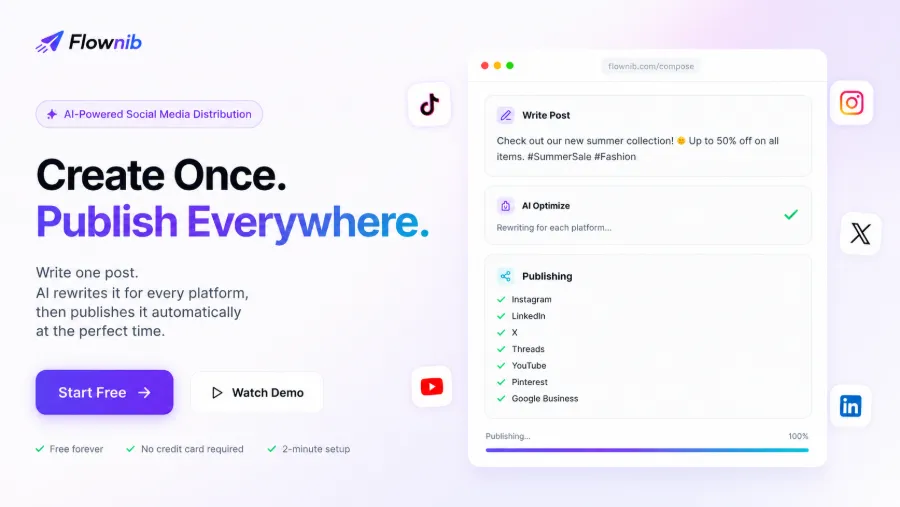
Many people only have two layers for content reuse: decide what to write, then publish to each platform. The missing middle layer is precisely what determines effectiveness.
Layer 1: Content Planning
Identify a core idea, then think about how it will appear differently on each platform. The same product launch could be a high‑quality product image with a short caption on Instagram; a deep industry‑trend analysis on LinkedIn where the product is just a case study; a discussion‑prompting question on X; and an inspirational image with a purchase link on Pinterest. The core idea stays the same, but the “story” on each platform is completely different.
A B2B hardware brand used this planning approach to cut its weekly social‑media operating time by 75 %. Instead of writing separate drafts for each platform, they set a weekly core theme and let designers, marketers, and copywriters adapt it from their own perspectives. The result outperformed the previous siloed effort. See the detailed process in How a B2B Hardware Brand Reduced Social‑Media Operating Time, which describes how they went from “writing 20 pieces per week” to “writing 4 pieces per week, adapting for 20 platforms.”
Layer 2: AI Rewriting and Adaptation
This is the layer most people miss. Manually rewriting a piece for five platforms takes 30‑40 minutes on average and is error‑prone—forgotten hashtags, wrong image sizes, missing links. Using a tool like Flownib, the core logic is: input the original content, the AI automatically identifies each platform’s style requirements, then generates the corresponding version. It keeps the visual focus on Instagram, switches to a professional tone on LinkedIn, compresses into concise dialogue on X, and rewrites into an inspirational guide style on Pinterest.
Industry data shows that AI‑rewritten content, when distributed across platforms, achieves about 30 % higher average engagement than manually copy‑pasted versions. The boost isn’t because the AI writes better, but because it never misses any adaptation detail—it automatically checks character limits, image ratios, hashtag counts, which are easy to overlook when you’re rushed.
For teams that collaborate, this step is especially critical. When creators, marketers, and designers all work on reuse, version chaos is the biggest pain point. A viable collaborative method is described in the Veonib+FlowNib Collaborative Workflow. The core idea is that each person handles the part they excel at, then a unified distribution channel publishes everything.
Layer 3: Publishing and Maintenance
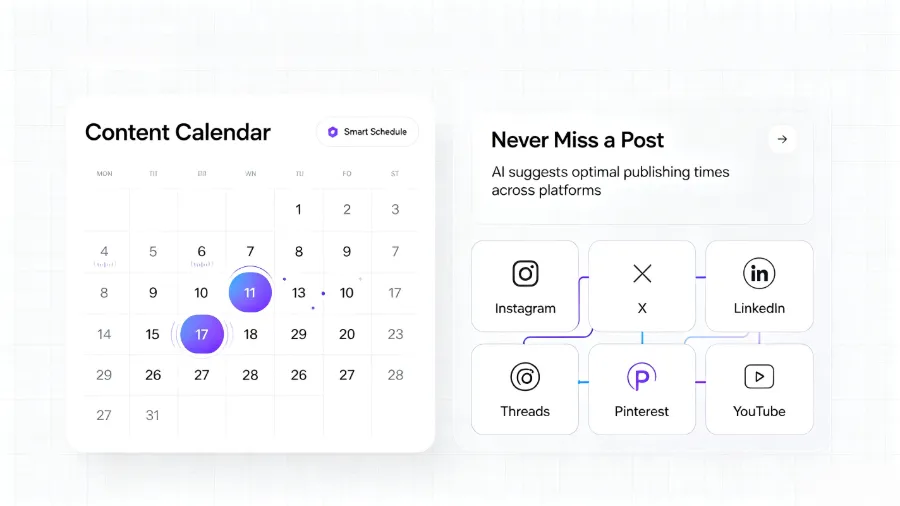
Scheduled publishing is not the end point; it’s the starting point. After publishing, you need to track performance differences across platforms—high engagement on Instagram may mean nothing on LinkedIn, which is normal. The key is to reverse‑engineer the next round of planning from the data: if a topic sparks a lot of discussion on X, the next round can dive deeper into a LinkedIn article; if a Pinterest post continues to drive traffic, consider turning it into a YouTube tutorial.
A common overlooked observation is that content reuse is not “repetition” but “voice reconstruction”—each platform requires a different tone and context to tell the same story. The casual, emoji‑rich tone that works on Instagram looks unprofessional on LinkedIn; conversely, a LinkedIn deep dive transplanted to Threads feels stiff. This isn’t about content quality, but about voice selection.
Another subtle insight: most content operators underestimate the value of “choosing not to publish on a platform.” Sometimes dropping a platform lets you perform better on another. For example, if the audiences on Instagram and Pinterest overlap heavily but the formats differ, it’s better to choose the platform where the visual presentation shines, rather than forcing the same content on both and diluting its impact. Not publishing isn’t a failure; it’s optimal resource allocation.
Collaborative Workflow: When Content Reuse Requires Team Coordination
When content reuse shifts from an individual task to a team activity, complexity doubles. Creators write the original material, marketers adapt it for each platform, designers produce images and videos, and someone else handles publishing and data tracking—without a clear workflow, version chaos, duplicated work, and missed posts become inevitable.
A real‑world example: a B2B software company with a five‑person content team, each responsible for a different platform. Their old process was: copywriter writes a piece, manually sends it to the marketer, who adapts it and sends it to the designer for visuals, then the designer returns the assets to the marketer for publishing. Each communication took at least two days, and version mismatches were common—the marketer’s revised copy didn’t reach the designer, who used an old image.
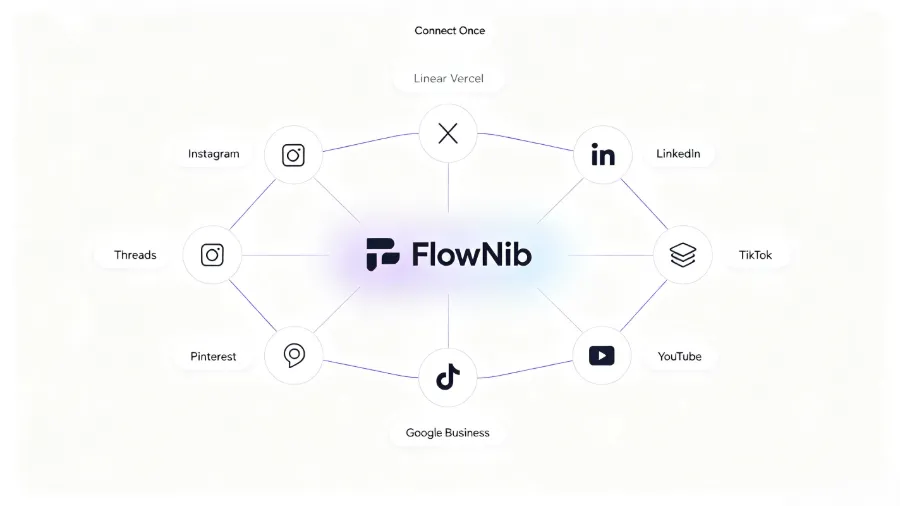
The optimized workflow: every Monday they set a core theme, the copywriter creates the original piece in Flownib, AI automatically generates five platform‑specific versions, the designer uploads images in the same interface, and the marketer previews and schedules publishing. The whole process shrank from two days to two hours, saving roughly 15 hours of weekly operational time. That time, previously spent on endless back‑and‑forth, is now freed for higher‑level content strategy analysis.
When choosing tools, refer to the 2026 Top 10 Social Media Scheduling Tools Deep Comparison, which outlines how different tools perform in collaborative workflows. For general cross‑platform content strategy, the Later Blog’s Cross‑Platform Content Strategy Guide offers useful frameworks, especially for content calendar management and platform prioritization.
FAQ
Q1: Will content reuse cause platforms to flag my posts as spam?
Yes, but only if you use a “copy‑paste” approach. If each piece is adapted—different image sizes, tones, hashtag strategies—platforms won’t treat it as duplicate. The real trigger for demotion is identical text and images posted multiple times. AI rewriting ensures semantic consistency while making each form visually distinct.
Q2: Do I have to write a different version for every platform?
Not necessarily. If your target audience is concentrated on two platforms, just publish there. The core of content reuse is “adaptation,” not “everywhere.” Skipping some platforms can actually improve performance on your core platforms. Start with 2‑3 platforms, master the process, then expand.
Q3: What types of content are suitable for reuse?
Almost all types, but the biggest gains come from “evergreen content”—tutorials, product introductions, industry analyses, inspiration lists. Time‑sensitive news has a very short reuse window, maybe only a few hours. Product launch content benefits from multi‑platform “touchpoints,” increasing the chance users see it in different contexts.
Q4: If my content gets demoted, will my reuse strategy make it worse?
If the reuse strategy itself is correct (each piece is properly adapted), demotion is usually not caused by reuse but by the content’s own quality. Check for violating hashtags, copyrighted images, or malicious links. Fix those issues, and continuing a proper reuse strategy won’t exacerbate demotion.
Q5: How much time can content reuse actually save?
For a team publishing 10 pieces per week, manual adaptation for each platform typically takes 5‑8 hours weekly. With AI rewriting and automated distribution, that can drop to 1‑2 hours. Savings increase with volume—higher publishing frequency yields larger time gains. One team, after workflow optimization, saved about 15 hours per week, which were reallocated to content strategy and data analysis.
Share Article