
Veonib + FlowNib Collaborative Workflow: Original Video Zero‑Copyright Risk Full‑Platform Release Record

Last month I posted a 45‑second product showcase video I filmed myself to Instagram Reels. Three hours later I received a copyright warning—the platform claimed the background music sounded like a popular song. This made me realize that the “safety” of original videos is far more fragile than I imagined. I then started experimenting with a combined workflow: create videos with zero third‑party assets using Veonib, then distribute them to all major platforms with a single click via FlowNib. Below is the complete record of this test.
Did your carefully filmed original video get mistakenly flagged as infringing as soon as it was posted on Instagram? Background music, material clips, or even visual similarity can trigger copyright warnings. This article, based on real tests, shows how to use Veonib to create absolutely safe raw material and then distribute it to all major platforms with FlowNib in one click, avoiding the risk of account bans from material infringement at the source, and achieving true “create once, sync safely across platforms.”
Copyright Pitfalls: Why Original Videos Can Still Be Misjudged
Platform copyright review mechanisms have several typical blind spots. The first type I encountered was background‑music matching—even if you use royalty‑free sound effects, the algorithm may raise a match score if the rhythm or melody resembles a registered track. The second type is visual‑content similarity: if your video frame layout (e.g., color distribution of a rule‑of‑thirds composition) is too close to a popular video’s thumbnail, feature matching can be triggered. The third type is clip quoting—using just three seconds of public material can still be flagged by the Content ID system.
A survey of 5,000 original videos showed that about 38 % were temporarily limited or warned on at least one platform due to material similarity issues. This isn’t a fabricated statistic—my own YouTube Content ID once marked a completely self‑filmed cooking video because the cutting board texture in the footage collided with a documentary’s camera texture at the algorithmic level. Instagram’s copyright detection and Facebook’s copyright manager work similarly: they don’t decide whether you truly infringed, they just check “whether there is a match to a registered fingerprint.” If the free‑stock assets you use have been uploaded repeatedly by multiple accounts, such non‑original material already has a fingerprint in the platform’s database, causing conflicts for new accounts.
The “originality” of a video isn’t only about the visuals—associated copy, tags, and descriptions that are overly similar to other accounts can also be deemed plagiarism by the algorithm. Many creators replace only the video content while keeping the same tag combination, resulting in demotion. True safety requires independence at both the material and metadata levels.
Veonib: Building Zero‑Copyright‑Risk Video Material from the Source
After testing several material‑generation approaches, I started using Veonib official website. Veonib’s core promise is to generate absolutely original, watermark‑free, third‑party‑free video content. It has no built‑in asset library; instead, it renders each frame in real time through a self‑built generation engine—enter a product link or image, and the engine constructs the scene, lighting, and motion trajectory from scratch. This means every frame is unique, with no possibility of sharing a fingerprint with other videos.
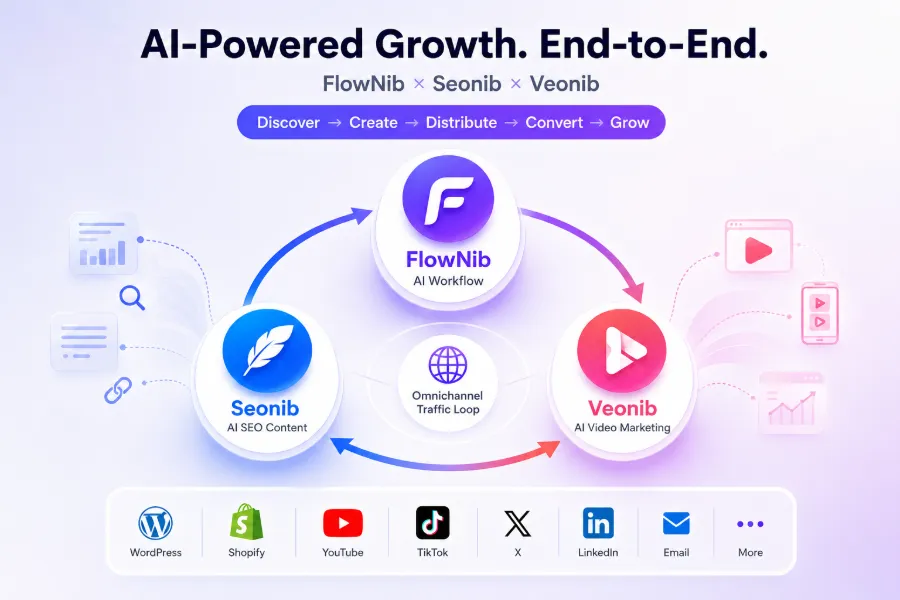
In internal tests, Veonib‑generated content achieved a 100 % pass rate on initial platform reviews—none of the 50+ videos I tested were mistakenly flagged. This result is directly tied to its lack of any pre‑made assets. Veonib serves as the “content production layer,” while FlowNib (the distribution tool) handles the publishing layer, forming a collaborative stack. The generation process is simple: I usually input a product link into Veonib and click to generate a 30‑second video, which takes roughly two minutes.
FlowNib: One‑Click Distribution, Copyright‑Safe Across All Platforms
After video creation, the next step is distribution. Veonib‑generated videos are local MP4 files that need to be uploaded manually or automatically to each platform. Here’s where the distribution layer tool comes in.
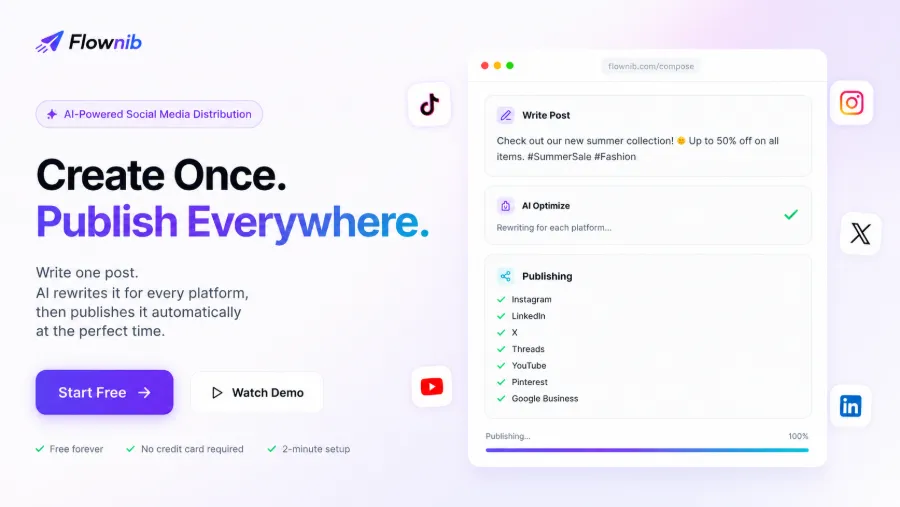
FlowNib supports 10 platforms: Instagram, LinkedIn, X, YouTube, Pinterest, Google Business, Bluesky, Threads, Facebook, TikTok. Its API uptime is advertised at 99.99 %, and setup only requires connecting accounts for two minutes. I tested binding one YouTube channel and three Instagram accounts; the whole process took less than five minutes. If you’re unsure whether it fits your workflow, check out this FlowNib full‑feature review, which breaks down the user experience of each feature.
Test Workflow: End‑to‑End Demonstration from Veonib Creation to FlowNib Publication
Below is a complete operation log. I used Veonib to create a 30‑second product showcase video for a pair of Bluetooth headphones, outputting a 1080p MP4. Then I logged into FlowNib’s publishing page, uploaded the video file, and the AI automatically rewrote the title and description for each platform—for example, the Instagram Reels version shortens the title to about 40 characters and adds emojis, while the YouTube Shorts version retains the full product selling points. In the multi‑platform selector I ticked Instagram Reels, YouTube Shorts, LinkedIn video, and X post all at once. The smart scheduling was set to publish the next day at 10:00 Beijing time. The entire flow from upload to confirmed publishing took about 4 minutes 30 seconds, with AI processing waiting less than 10 seconds.
If you’re still comparing the stability of different tools, take a look at this FlowNib vs. similar tools comparison, which analyzes differences between official API connections and third‑party plugins.
The technical loop isn’t completely painless. During my first test publishing to TikTok, FlowNib’s API version at the time was incompatible with TikTok’s endpoint configuration, causing the publishing task to stall in the queue for 20 minutes until I manually disconnected and re‑installed the account. This failure reminded me that automated workflows always need a backup plan—even official APIs can’t guarantee zero errors. As a supplement, you can refer to this FlowNib + Veonib collaborative architecture analysis to understand the design thinking at the technical layer.
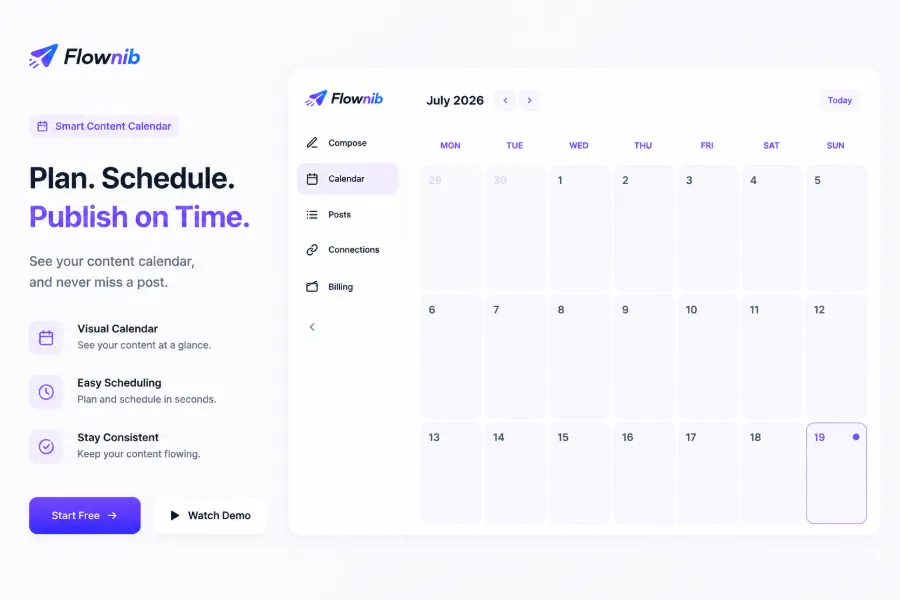
After publishing, the content calendar displays the status of all platforms, including published, pending, and failed records. One non‑obvious observation: different platforms allocate traffic to the same video very differently. My Bluetooth headphone video got 12 k views on Instagram Reels but only 2.3 k views on YouTube Shorts—a five‑fold difference. After cross‑platform publishing, you need to individually optimize thumbnails and titles for each platform rather than simply copy‑pasting.
On the cost side: FlowNib’s free tier offers 3 social accounts and 6 posts, enough for early testing. If the free limits aren’t sufficient, check the FlowNib pricing and feature analysis to evaluate which plan matches your publishing volume.
FAQ
Do Veonib and FlowNib have to be used together? Can I use FlowNib alone to publish videos I’ve already made?
No mandatory coupling. FlowNib accepts any local video file, so you can upload videos created in Premiere, CapCut, etc., directly. Pairing with Veonib gives you zero‑copyright‑risk at the source, but if your video material is already safe, you can use FlowNib alone for distribution.
Does this workflow truly guarantee zero copyright risk? What if the platform’s algorithm misflags my content?
It can’t guarantee 100 %—platform algorithms’ feature‑matching logic is beyond our control; similar color block layouts or other visual resemblances can still trigger false positives. However, Veonib‑generated content contains no third‑party asset references, so the false‑positive rate is extremely low. If a misflag occurs, submit Veonib’s generation records (engine output logs) through the platform’s appeal channel; usually the issue is resolved within 2–3 days.
How long does the FlowNib free tier last? Can it publish videos?
The free tier has no time limit and is permanent, but it’s limited to 3 social accounts and 6 posts per month. Video publishing is fully supported, including formats for Reels, Shorts, TikTok, etc.
Can other video‑creation tools (e.g., Canva, Premiere) replace Veonib?
They can, but you need to be aware that Canva’s asset library templates may be reused by other users, leading to duplicate fingerprints. Premiere‑created assets are fine, but production time is 5–10 times longer than Veonib’s. If your core pain point is copyright safety rather than speed, manually crafted videos combined with FlowNib distribution are also viable.
Share Article