Stop Manually Rewriting Social Media Copy: In 2026, Let AI Auto-Distribute to Free Your Time

Think back: every time you post a piece of content, do you have to toggle between Instagram, X, LinkedIn, and Threads, manually copy‑paste, adjust character counts, and tweak tone? This isn’t just repetitive work; it drains your creative energy. By 2026 this inefficient workflow is completely unnecessary—AI‑driven rewriting and distribution tools are fundamentally changing how social media is managed.
I’ve experienced the most exaggerated case: a product update post went through three rounds of edits on five platforms, and after publishing I discovered the LinkedIn version had the wrong tags, the X link wasn’t shortened, and the Threads tone didn’t match the brand style at That night I was scrolling through five back‑ends, realizing an entire afternoon had been wasted on pure low‑level repetition.
Why “Rewrite‑Copy‑Paste” Is the Most Time‑Consuming Action in 2026
The manual cross‑platform rewriting process sounds simple: write one piece of content, copy it to Instagram and reformat; copy to X and compress to 280 characters; copy to LinkedIn and make the tone more formal; give Threads a conversational feel; add a tag for YouTube community posts. This routine adds at least 5–15 minutes per publication.
I timed it a few times. A medium‑length product copy takes an average of 12 minutes from first draft to posting on all platforms. In those 12 minutes, truly valuable creative work is less than 20 seconds—the rest is spent adjusting character counts, switching windows, and checking formatting. Moreover, the high error rate of manual operations is a hidden cost: formatting chaos, missed platforms, timezone miscalculations leading to posts at odd hours—I’ve made all of those mistakes.
One month, while reconciling accounts, I found that two of the six platforms posted at completely wrong times—Instagram posted six hours early, LinkedIn delayed until the next day. The cause was simple: I entered the wrong UTC offset during timezone conversion. Such errors are almost inevitable in a manual workflow.
The core contradiction is that creators’ time should be spent on strategy and creativity, not on copy‑pasting and character counting. I noticed a pattern— the more diligently you manually rewrite, the faster the brand voice collapses. Each manual tweak unconsciously changes phrasing; today a phrasing feels right, tomorrow another tone feels more appropriate, and the same batch of content ends up looking like it was written by five different people across platforms. If you’re facing a similar dilemma, check out this analysis: Manual Posting vs. FlowNib AI Distribution: How Much Time Can Cross‑Border Teams Actually Save?
AI Rewriting: One Piece of Content, Perfect Adaptation for Ten Platforms
What completely overturns the manual process is AI rewriting. The principle is simple: you write an original piece, and the AI automatically adapts it to each platform’s style, character limits, and audience habits. Instagram favors visual short copy, X has a 280‑character limit, LinkedIn needs professional long‑form, Threads emphasizes a conversational feel, and YouTube community posts have another format—AI can handle all of this in one go.
When I first tried this feature at the end of 2025, I was skeptical. My biggest fear was that it would completely ruin my classic dry‑humor opening line. After three test rounds, I found that the AI didn’t mechanically apply a template; it extracted the original emotional tone and key information, then reorganized it according to each platform’s linguistic habits. The Instagram version kept the colloquial feel, the LinkedIn version added industry context, and the Threads version dropped the second half and threw in a rhetorical question.
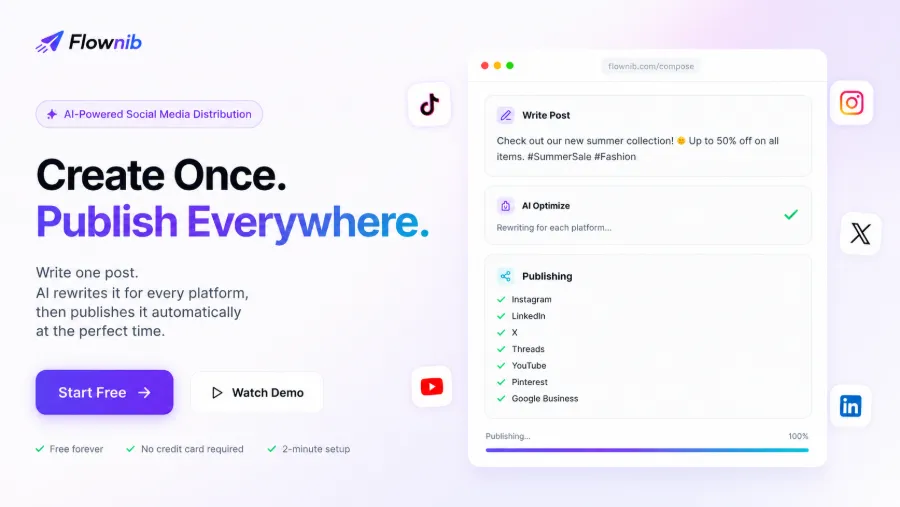
A complete AI‑optimized workflow takes less than 30 seconds. That compresses the previous 12‑minute workload into under a half‑minute. The real breakthrough isn’t speed but that AI maintains the underlying consistency of the brand voice—no matter how platform styles vary, core information and tonal cues stay anchored. In my experience, the biggest enemy of manual rewriting isn’t “slowness,” it’s “inconsistency.” Each manual edit unintentionally shifts tone, making the brand appear fragmented across the web. AI rewriting directly solves this hidden cost.
Flownib’s AI optimization flow is built on this logic: write an original piece, and AI automatically analyzes and adapts it for Instagram, X, LinkedIn, Threads, YouTube, Pinterest, Google Business, Facebook, TikTok, and Bluesky—ten platforms. In my own account matrix I run five platforms simultaneously; what used to take at least 40 minutes per publishing round now takes under three minutes from writing to full distribution.
From Draft to Publication: A Truly Time‑Saving Automated Workflow
With AI rewriting, the entire publishing workflow has been completely restructured. The current process is: write the original content → AI automatically rewrites for each platform → preview and confirm → set publish time → one‑click distribution to all platforms. The whole cycle now averages just 2 minutes from drafting to publishing.
Compare that to the manual workflow: drafting (5 min) → copy to each platform (3 min) → individually adjust format and characters (8 min) → check for errors (2 min) → manual publish (1 min) = nearly 20 minutes. The AI workflow eliminates the middle three to four steps, and I have repeatedly measured the 2‑minute concept to be stable.
My current habit is to write the original content in Flownib, let the AI generate five versions, and spend a minute scanning each platform’s adaptation during preview—mainly to confirm that key emojis haven’t been stripped, links display correctly, and paragraph breaks are reasonable. After confirming everything, I schedule the posts; the rest is just waiting for the data.
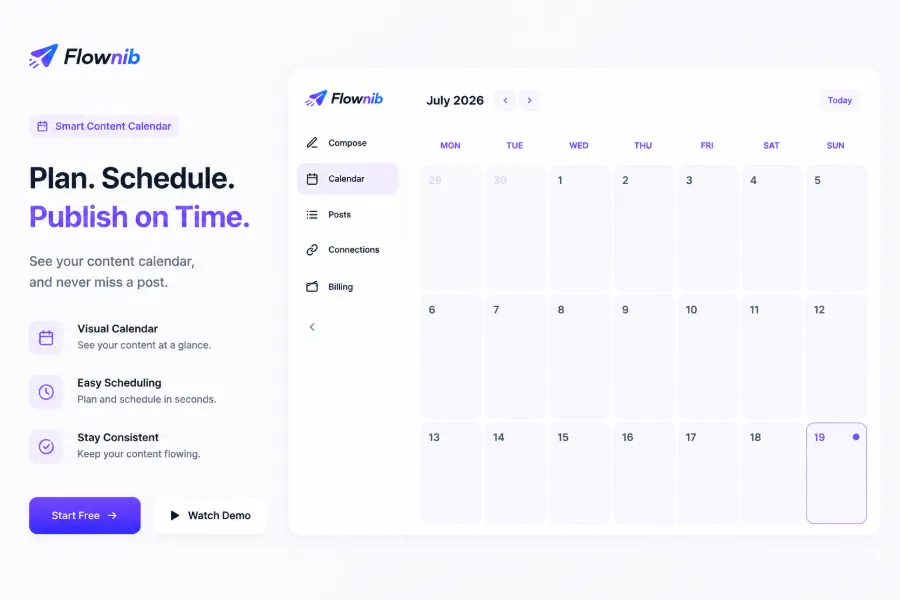
The value of a unified content calendar and cross‑platform tracking records only becomes apparent in this workflow. Previously I managed three brands, each on five platforms, and information was completely fragmented—what was posted where, how it performed, all stored in my head, and forgotten after two weeks. The unified content calendar consolidates all publishing records into a single view: what was posted, when, on which platform, and the engagement data—all at a glance. Flownib’s content calendar does exactly this, eliminating the fragmentation problem of multi‑account management in one go.
Real efficiency isn’t about typing faster; it’s about completely eliminating the “rewrite” step itself. When you no longer need to manually adjust character counts and tone, you realize how unworthy those wasted minutes were.
Official API Direct Connection: Say Goodbye to Platform Rate‑Limits and Unstable Third‑Party Plugins
The lifeline of an automated distribution tool is API stability. In early 2024 I fell into a big trap: I used a third‑party publishing tool that connected through an unofficial simulated API, and within a month half of my posts failed or were severely delayed. The most outrageous case was an Instagram post stuck in “publishing” for six hours, finally pushing out at 2 a.m. when my followers were asleep. After that, I investigated each failure and discovered they were all caused by unstable APIs—platform rate limits, interface changes, authentication expirations, and a host of other issues.
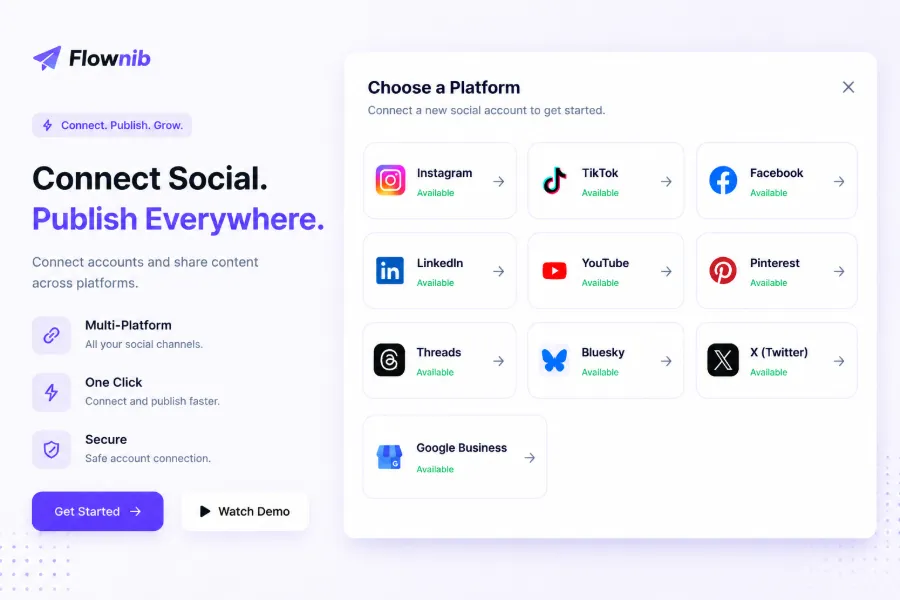
That’s the essential difference between official API direct connections and third‑party plugins. An official API direct connection means the publishing tool calls the platform’s official interface directly, not through an intermediate simulated layer. Official API availability standards are 99.99 % uptime, whereas third‑party plugins that rely on private APIs or reverse‑engineered solutions can’t realistically achieve that level of stability. You never know when the next interface change will stall your entire posting queue.
Understanding this, I now evaluate publishing tools based on a single criterion: does every platform use an official API direct connection, and is there a public API uptime commitment? Below is a table I compiled showing the level of official support for automated distribution across major platforms, so you can instantly see why official API direct connections matter.
| Feature Dimension | X | Threads | YouTube | ||
|---|---|---|---|---|---|
| Supported Post Types | Photo/Reels/Carousel | Post/Media/Schedule | Article/Photo/Document | Post/Reply | Shorts/Community Post |
| Character Limit | 2200 | 280 | 3000 | 500 | 5000 |
| Scheduling Supported | Yes | Yes | Yes | No | Yes |
| API Availability | 99.99 % | 99.99 % | 99.99 % | Public Beta | 99.99 % |
Based on the platforms I’ve integrated, Instagram’s official API supports photo, Reel, and carousel posts; X’s API supports posts and scheduling; LinkedIn’s API supports articles and images—these are precisely the points where third‑party plugins often fail. If you’re interested in the 2026 cross‑border content tech stack and the overall approach to automated distribution collaboration, see this background analysis: 2026 Cross‑Border Content Stack: How SEO, AI Video, and Automated Distribution Work Together.
Choosing an official API direct connection also has a hidden benefit: platform rate‑limit policies are far more generous than those of third‑party interfaces. After I switched to official APIs, my post‑failure rate dropped from dozens per month to zero within six months. For high‑frequency content operations, this gap directly determines whether your publishing rhythm can stay stable.
FAQ
Will AI rewriting cause the content to lose personal style?
No. AI rewriting retains the core tone and information structure of the original content while adjusting phrasing to fit each platform’s characteristics. You can review each version during preview; if a tone deviates from expectations, a manual tweak will be remembered by the AI. After six months, my brand’s tone drift rate is far lower than during manual rewriting periods.
Can I manage multiple pages on the same platform with a single account?
Yes. The multi‑account management feature lets you connect and manage multiple accounts or pages under the same platform within a single dashboard. For example, you can run three Instagram accounts or five LinkedIn company pages and manage them all from one view.
Is the scheduled publish time fixed or customizable?
Both. You can manually set the exact publish time for each post, or let the system recommend optimal posting windows based on your historical engagement data. My habit is to manually schedule—Monday 10 a.m., Wednesday 2 p.m., Friday 8 p.m.—but I let the automatic recommendation handle weekend posts, which have surprisingly good results.
Do AI‑rewritten posts still need human review?
At least a quick glance during preview is recommended. AI’s rewrite accuracy is high in most cases, but occasional deviations can occur with special characters, nested quotes, or industry‑specific terminology. The preview step usually takes less than 30 seconds and is worth the safety net. If several consecutive previews are flawless, you can gradually reduce review frequency.
How many social accounts does the free plan cover?
The free plan provides 3 social accounts and a quota of 6 posts, suitable for individual creators or small teams to run a test cycle. If you only need to distribute to one or two primary platforms, the free quota lasts one or two months for workflow validation. Upgrading to a paid plan unlocks unlimited accounts and higher posting quotas.
Share Article