How to Automate Social Media Publishing: From Manual Copy‑Paste to Full‑Platform Automatic Distribution
A typical day for a cross‑border e‑commerce operator starts like this: log into five platforms, paste the same copy into each one, adjust hashtags per platform, repeatedly compress image sizes, and then tweak according to each platform’s character limits—by the time everything is posted, half a day has already passed. If the team also manages multiple accounts and audiences across several time zones, this process has to be repeated daily, and each additional platform adds another layer of error risk. To see which platforms are worth prioritizing, refer to Which 4 Platforms Should You Prioritize in 2026?.
This article’s take on automation isn’t just “find a tool to click publish for you.” What truly matters is turning “create once, distribute everywhere” into a reusable pipeline: rewrite, preview, schedule, publish, record. It frees operators from copy‑paste work and lets them focus on the content itself. Below, using a cross‑border e‑commerce scenario, we provide a practical path that can be implemented by that afternoon. For more resources on social media management, visit Social media management for everyone.
Why Manual Publishing Can’t Sustain Ongoing Operations
The cost of manual cross‑platform publishing is often underestimated. On the surface, each post only takes a few extra minutes to copy‑paste, but stretched over a week or a month, the total adds up. Operators lose an average of 10–15 hours per week due to manual copying, pasting, and platform‑specific adjustments. This doesn’t even account for the attention‑fragmenting actions of switching tabs, reformatting, and repeatedly checking character counts. For detailed Instagram best‑time data, see Best Times to Post on Instagram in 2026.
Cross‑border e‑commerce teams face even more complexity. Multiple languages mean the same content must be adapted to different linguistic habits; multiple time zones spread publishing windows across the day; and each platform often has more than one account. When the number of platforms exceeds three and each platform has more than two accounts, manual processes become unmanageable. A common scenario: an operator keeps Instagram, TikTok, LinkedIn, and X (Twitter) tabs open, and a slip of the finger sends a draft to the wrong platform; by the time it’s noticed, engagement data have already started, and the post must be deleted and reposted.
Version chaos is the most typical failure in manual workflows. Wrong image ratios, hashtags exceeding character limits, posting a formal LinkedIn tone on X (Twitter)—these incidents occur almost weekly. To understand the real time gap between manual and automated publishing, see this comparative analysis: manual publishing vs. automated publishing time difference.
The automation discussed here isn’t “set it and forget it.” It’s a controllable pipeline with preview and approval: after the content is written, the system automatically adapts it to each platform’s specifications, and the operator confirms before a unified release. Buffer’s resource center also notes that many teams mistakenly think automation means “set it and walk away”; mature processes retain human review, delegating repetitive work to the system.
Building an Automated Publishing Workflow: One Creation, Multi‑Channel Distribution
A complete automated workflow consists of five stages: writing, platform adaptation, preview, scheduling or instant publishing, and tracking. The first two address “what to write” and “how to adapt”; the last three address “when to publish” and “how it performed.”
After a single piece of content is written, the automatic rewrite logic consumes each platform’s differences: Instagram has generous character limits but emphasizes hashtags, X (Twitter) demands brevity, LinkedIn favors a more formal tone, and Threads is more conversational. The system handles these variations, leaving the operator to maintain only the original content.
One‑click distribution replaces the old “copy‑paste and switch tabs” workflow. Average setup time is about 2 minutes, with official API uptime at 99.99 %. For cross‑border e‑commerce teams, this means the saved daily time can be reallocated to product selection, customer service, or content planning.
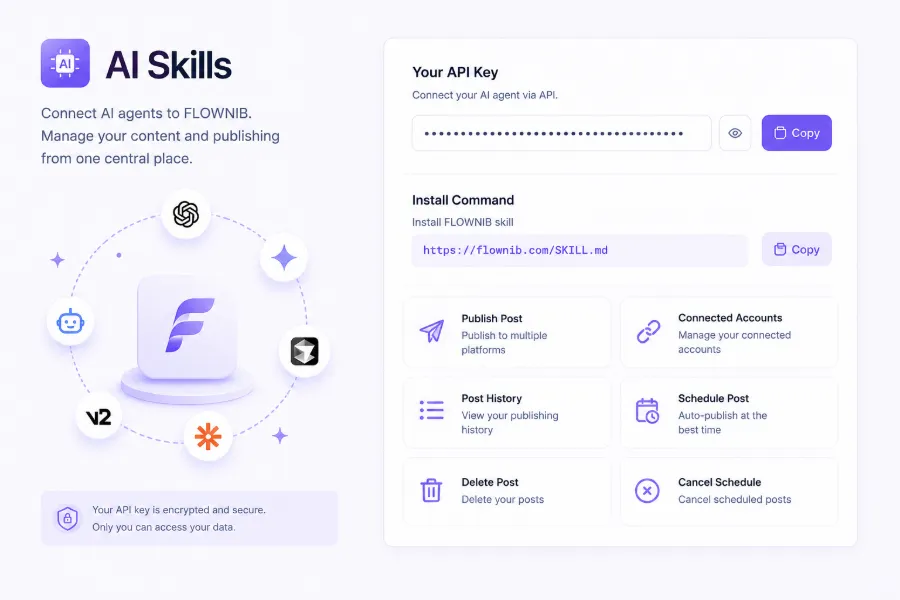
Going further, AI agents and toolchains (such as Codex, Claude Code, Cursor) can continue automating content operations. By connecting publishing workflows to an AI agent via AI Skills, operators can let the AI directly manage social accounts, publish content, view history, and schedule posts without complex configuration.
When selecting tools, an often‑overlooked principle is to choose the right platforms first; focusing on a few core channels amplifies automation benefits more than spreading thin across all platforms. Not every platform suits every product category; it’s better to master two or three core channels before expanding. The 2026 e‑commerce social platform priorities are already clearly indicated by data.
Cross‑Platform Rewriting and Brand Consistency: Handling Content Differences Across Platforms
Content specifications vary widely across platforms—character limits, image ratios, and format requirements (image/video/carousel) differ. The value of automatic rewriting lies in preserving the core information while adapting the style to each platform. Information stays the same; expression changes.
| Platform | Character Limit | Primary Formats | Rewriting Focus |
|---|---|---|---|
| 2,200 characters | Images, Reels, Carousel | Hashtags, visual description | |
| X (Twitter) | 280 characters | Short text, images | Concise, direct, hashtags |
| 3,000 characters | Long text, documents | Professional tone, industry insights | |
| YouTube | 5,000 characters | Video, Shorts | Description, tags, community post |
| Threads | 500 characters | Short text | Conversational, engagement prompts |
A brand archive is crucial here. Centralizing product information, target audiences, and brand positioning ensures that while rewriting adapts to each platform’s style, the tone remains consistent. Without this constraint, AI rewriting can easily produce content that says the same thing but sounds like different brands.

Automatic multilingual adaptation is a hard need for cross‑border e‑commerce. Supporting English, Chinese, Japanese, German, French, and other major languages for content generation and publishing means a single product description doesn’t need to be recreated for each market; the system generates language‑ and platform‑specific versions. YouTube’s official blog regularly updates platform‑specific publishing changes, worth monitoring.
Automation does not equal loss of control. Brand voice drift is a real risk—repeated AI rewrites can gradually shift expression away from the original tone. It’s recommended to audit each platform’s published posts every few weeks, compare original and rewritten versions, and adjust the brand archive descriptions promptly when deviations appear.
Scheduled Publishing, Content Calendars, and Multi‑Account Management
There are two ways to schedule publishing: manually pick times, or let the system automatically choose based on audience activity. The former works when operators already have a clear sense of audience habits; the latter suits teams still figuring out optimal rhythms. Instagram’s best‑time data is based on analysis of about 9.6 million posts, which can serve as an initial scheduling reference.
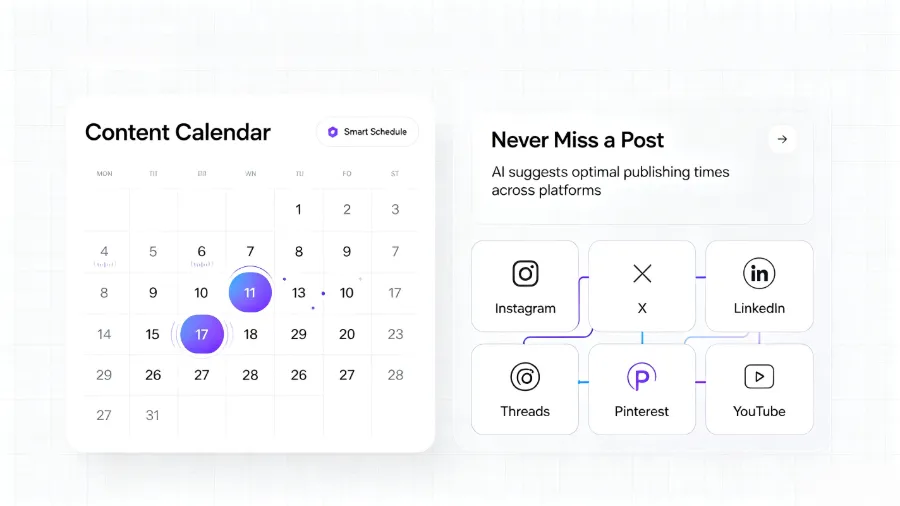
A content calendar’s value lies in a unified visual view of all platforms’ schedules and publishing records. Operators can instantly see what each platform posted this week, what’s planned, and which time slots are free. For multi‑account teams, this global view is far more efficient than checking each platform individually. Instagram’s 2026 best‑time analysis provides finer‑grained slot data for schedule adjustments.
Multi‑account management solves another pain point: handling multiple accounts per platform from a single dashboard. Brand matrices, sub‑brands, and regional official accounts can be switched within one interface without repeated logins. SaaS social‑media‑management tools typically provide this capability; Flownib’s multi‑account dashboard is built on this concept.
Automation is not laissez‑faire. Scheduled publishing is only half the automation—without a content calendar and post‑mortem review, errors multiply as the number of accounts grows. Spend ten minutes each week reviewing calendar data: which slots yield high engagement, which platform posts need tweaking, and whether next week’s schedule has conflicts. Doing scheduled publishing without review essentially automates the errors as well.
FAQ
Will automated publishing affect account safety or trigger throttling?
Publishing via official APIs does not trigger throttling because API calls are treated the same as manual actions by the platforms. However, pushing large volumes to many accounts at once may activate risk‑control mechanisms; new accounts should start with small batches and gradually increase frequency.
Do scheduled posts receive less traffic than instant posts?
Not necessarily. If the timing is right, scheduled posts usually perform as well as, if not better than, instant posts. The key is basing the slot on audience activity data rather than arbitrary choices. Compare two weeks of scheduled vs. instant post performance to find your optimal windows.
What if I run out of content ideas? How can I maintain a steady output?
Start with trending topics: scan Reddit, YouTube, News, etc., and turn high‑interest subjects into posts. Build a content asset library—categorize product selling points, user feedback, industry data—so you can pull from it when needed.
Which platforms do typical automation tools support?
Mainstream tools usually cover Instagram, X (Twitter), LinkedIn, TikTok, Facebook, Threads, Pinterest, YouTube, Bluesky, Google Business, and others. When choosing a tool, verify that it connects via official APIs; this impacts publishing stability and account safety.
For a small team, which workflow stages should be automated first for the best ROI?
Start with cross‑platform rewriting and scheduled publishing—these yield the most noticeable time savings. First nail down two or three core platforms, then gradually expand accounts and platforms. A content calendar can be added later, but develop the habit of recording publishing data early.
Share Article