2026 Content Marketer's AI Toolkit: How to Choose Each Step from Ideation to Publishing

At 3 p.m., you have five or six tabs open, copying and pasting the same piece of content into each platform one by one. You delete extra line breaks on Instagram, adjust the title format for LinkedIn, and re‑pick hashtags for TikTok. You look up and half a day has vanished. The content‑marketing tools in 2026 are so abundant they can dazzle the eyes, yet most people’s daily work is still filled with this repetitive labor.
This article breaks down the process into five stages—topic discovery, AI writing, image/video creation, multi‑platform distribution, and data review—providing a side‑by‑side comparison of tools for each stage. The goal isn’t to equip you with every tool on the market, but to help you assemble a practical stack that fits your team’s reality.
Conclusion first: The value of a toolchain lies not in the strength of a single tool, but in how smoothly the stages connect. Only when ideation, creation, distribution, and review form a closed loop does a 2026 content team spend its time wisely.
Step 1: Topic Discovery – Don’t Let Inspiration Stall in a Blank Space
Topic selection is the most easily skipped yet most critical link in the chain. Many people open an editor and start writing, only to realize halfway through that no one is reading—often because the starting point was wrong.
The core value of topic tools comes in three parts: keyword popularity, audience interest, and competitor trends. Google Trends shows trend direction, Ahrefs provides search volume and difficulty, BuzzSumo reveals how content spreads on social platforms, and SparkToro helps you understand what your target audience is actually watching. Internal site‑search reports are the most underrated—what users have already searched on your own site is closer to true intent than any external tool.
The gap between free and paid tools isn’t as large as you might think. The free version of Google Trends is enough to tell whether a topic is rising or falling; Ahrefs’ paid features let you quantify “whether it’s worth doing.” In cross‑platform content creation in 2026, topic selection accounts for about 15%–20% of total work time but determines the conversion rate of all subsequent stages. Time spent on topics is the highest‑ROI investment in the whole chain.
A common mistake is treating “hot keywords” as content angles. High keyword popularity doesn’t mean your audience is interested, nor that you can produce differentiated content. To turn a hot keyword into an actionable angle, layer in a scenario: for example, “AI writing tools” is popular, but “cross‑border e‑commerce teams using AI to write multilingual posts” is a concrete angle. Topic tools tell you where the audience is; the angle conversion relies on your industry and audience understanding.
Step 2: AI Writing and Content Generation – Turn Drafts into Usable Copy
AI writing tools have diverged clearly over the past two years. One class generates first drafts—ChatGPT, Claude, and other general large models; another class focuses on rewriting and optimization—Jasper, Copy.ai for marketing contexts; Grammarly for grammar, DeepL for translation. In 2026, mainstream AI writing tools typically take 3–5 minutes to produce a first draft, but proofreading and tone adjustment still average 10–15 minutes. This gap shows that an AI draft “usable but not brilliant” is the norm; don’t expect a one‑step finish.
From my own practice, AI‑generated drafts can save about 60% of the time it takes to start from scratch, but the remaining 40% often demands more mental effort. Maintaining a consistent brand voice is the biggest pitfall. The same brand should have tone variations across platforms—more formal on LinkedIn, more relaxed on Instagram—but variations should not become fragmentation. If you let AI run free on every piece, after a month you’ll find your brand voice completely altered.
The cost of switching languages and platform tones is also often underestimated. It’s not just a matter of translating once; each platform has its own stylistic habits, character limits, and hashtag rules. AI rewriting can help, but human proofreading remains essential. Bulk‑generating a week’s worth of content can boost efficiency, provided you first feed the tool with your brand’s own material rather than letting it improvise. For a concrete workflow on bulk generation, see the “One‑Command Batch Generation of a Week’s Content” article (https://flownib.com/p/local/en/ai-batch-generate-social-media-content/index). The core idea is: set the tone first, then generate, then proofread.
For visual scheduling and content rhythm, Buffer’s resource library (https://buffer.com/resources/) offers useful frameworks that can help you calibrate your publishing cadence.
Step 3: Images and Videos – Don’t Let Visuals Hold You Back
Great copy means nothing if the visuals lag behind. The 2026 trend is “visuals are content”—the same copy paired with high‑quality images or video determines whether people stop to watch it.
Among text‑to‑image tools, Midjourney produces the highest quality but has a steep learning curve; DALL·E is easier to start with but offers weaker style control. For text‑to‑video, Runway leads in controllability, while CapCut shines in templates and editing speed. Choosing between a template‑based design tool like Canva and a custom tool like Figma is practical: if the team lacks a dedicated designer, Canva’s templates set a baseline; with design capability, Figma can create truly distinctive visuals.
A often‑overlooked issue is cross‑platform size adaptation. The same content on Instagram, LinkedIn, and YouTube each has its own dimension and aspect‑ratio requirements; posts that ignore these specifications see an average engagement drop of over 20%. Portrait videos, square images, landscape covers—each platform has its own temperament. No matter how many tools you stack, inconsistent output will dilute visual recognizability.
Copyright risk is another easy‑to‑miss pitfall. The ownership of AI‑generated images for commercial use varies across platform policies. Before bulk‑producing images, verify whether your tool permits commercial use; don’t wait months only to receive an infringement notice.
Step 4: Multi‑Platform Distribution – One Creation, Publish Everywhere
Distribution is the most underestimated yet most worthwhile stage to study. Many people focus all their effort on ideation and creation, only to have the content “die” at the publishing stage—no matter how polished the music or copy is, if it can’t be posted, it’s zero. Distribution stability is more valuable than the number of platforms, a truth that still holds in 2026.
Manual distribution time is easy to calculate: one piece of content to five platforms, each copy‑paste and format adjustment takes at least 10 minutes; five pieces a day is nearly an hour. Over a month, that’s over twenty hours of pure repetitive work. Automation saves not just time but also frees human energy for creation and strategy.
However, automation has a critical dividing line: direct official API connections vs. browser automation. I’ve seen multiple teams rely on third‑party distribution plugins that lack official APIs, only to experience massive publishing failures during a major live‑stream event, even triggering platform risk controls and account bans. I remember the timeline clearly: batch push started at 9 a.m., by 11 a.m. some platforms hadn’t posted, a retry at noon flagged the account as abnormal, and the whole window was missed. The root cause was the plugin using unofficial endpoints; once the platform tightened policies, everything crashed.
A direct official API connection’s one‑click publish matters more for long‑term experience than “how many platforms you can connect.” API stability determines whether you can trust the tool at critical moments. For example, Flownib (https://flownib.com) supports Instagram, X, LinkedIn, TikTok, Facebook, Threads, Pinterest, YouTube, Bluesky, and Google Business—ten platforms—with 99.99% uptime and about two minutes to connect an account. Such metrics should be hard criteria when evaluating tools, not just the number of platform logos on a marketing page.
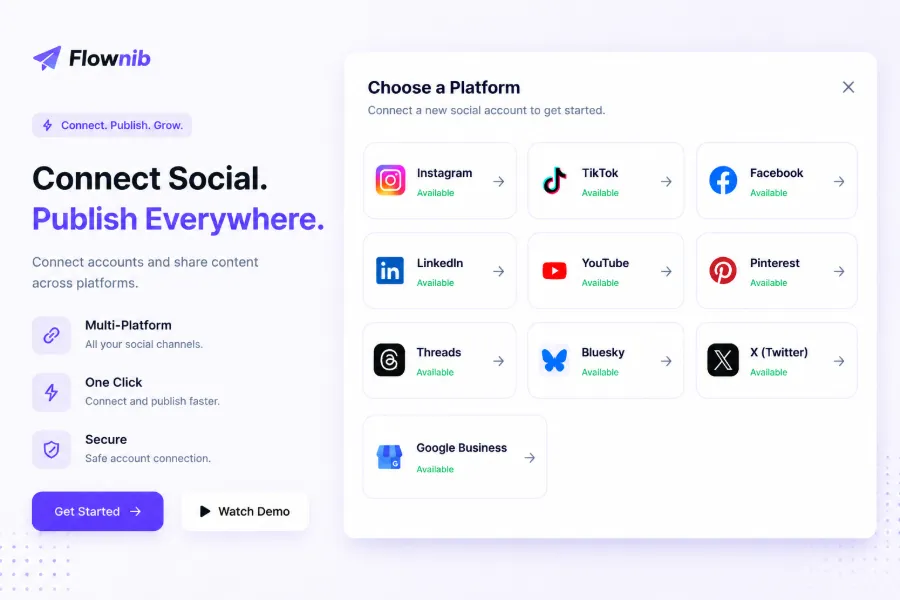
The main differences among mainstream distribution tools lie in platform coverage, AI rewriting capability, and API stability:
| Tool | Number of Platforms | AI Auto‑Rewrite | Direct Official API | Ideal Use Cases |
|---|---|---|---|---|
| Buffer | Medium | Partial | Yes | Basic scheduling for small‑to‑mid teams |
| Hootsuite | Many | Partial | Yes | Large teams managing many accounts |
| Later | Medium | Weak | Yes | Visual‑first content |
| Flownib | 10 platforms | Supported | Supported | Small‑to‑mid teams and content creators |
When choosing, first clarify whether your core need is “scheduling” or “one‑click publishing.” If you only need to schedule a week’s worth of content, Buffer and Later suffice; if you want one‑click, cross‑platform publishing with stability, a direct official API is non‑negotiable. For a detailed comparison of API support among FlowNib, Publer, and Planoly, see the article “FlowNib vs Publer vs Planoly Official API Comparison” (https://flownib.com/blogs/flownib-vs-publer-vs-planoly-official-api-support-battle-who-is-true-all-in-one). Also, the “Create Once, Publish Everywhere” workflow (https://telegra.ph/Create-Once-Publish-Everywhere–Meet-FlowNib-07-19) can serve as a starting point for building your own distribution process.
Step 5: Data Review – Turn Publishing into a Closed Loop
Publishing isn’t the end; review is. Many teams publish and move on, starting the next piece from scratch, wasting all the data accumulated earlier.
Each platform’s native analytics show basic metrics, but cross‑platform comparison still requires third‑party tools or custom spreadsheets. Google Analytics 4 tracks traffic and conversions; Notion or Airtable can hold content logs and review templates; Socialbakers suits teams that need a unified cross‑platform view. Keep the metric list lean: engagement rate, traffic, and conversion are enough. Likes look good but don’t drive traffic; engagement rate reflects true content quality.
Monthly review is the baseline. Teams that consistently conduct monthly reviews usually see average engagement rates rise after three months, outperforming teams that never review. This isn’t mysticism—review tells you which topics, formats, and publishing times truly work for your audience, then feeds that insight back into the ideation stage, completing the content loop.
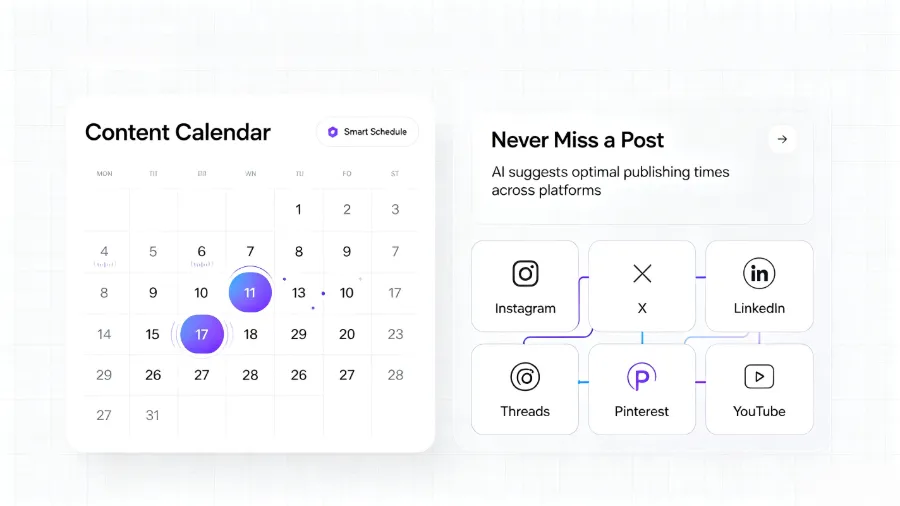
High‑frequency copy‑pasting not only wastes time but also leads to tone fragmentation across platforms. The real value of AI rewriting for tone unification is often underestimated—expressing the same idea with LinkedIn’s formal tone versus Instagram’s casual tone yields dramatically different results. Direct official API connections provide a more stable publishing chain, which is essential for reliable data review.
When review results feed back into topic selection, the whole chain becomes a true closed loop. For a deeper dive into the closed‑loop concept, see “Content Closed Loop Is the New Standard” (https://flownib.com/p/insights/content-closed-loop-is-the-new-standard-a-look-at-seonib-veonib-and-flownib/index), which describes using three independent tools for SEO, video, and distribution, then linking them via data. A toolchain should form a closed loop, not isolated segments that don’t communicate—this is the core standard for judging whether a stack is worth long‑term investment. The integration ideas for a 2026 cross‑border content stack can also be referenced in the article “How SEO, AI Video, and Automated Distribution Work Together” (https://seonib-blog.blogspot.com/2026/07/the-2026-cross-border-content-stack-how.html).
FAQ
Do I need to assemble the entire end‑to‑end stack at once?
No. Prioritize bottlenecks: first address the most time‑consuming stage, usually distribution, then gradually add topic and review tools. Doing everything at once is costly and often leads to idle tools.
Do platforms actually recognize AI‑generated content?
Platform algorithms care about content quality, not its source. AI drafts are usually “usable but not outstanding”; the key is human proofreading and feeding the model with brand‑specific material. Publishing raw AI text typically yields poor engagement.
Which capability is most important in the distribution stage?
Direct official API connections. Even if a tool supports many platforms, an unstable publishing pipeline will cause failures at critical moments. API uptime and connection speed matter more than the feature list.
How often should I conduct data review?
Monthly review is the minimum; weekly is ideal. Too infrequent, and you lack enough data; too frequent, and you risk data fatigue. The important thing is that each review produces actionable adjustments, not just numbers.
Share Article