
Stop Guessing What to Post: Use AI to Find Topics That Truly Matter to Your Audience

Cross‑border e‑commerce brands often discover a potentially viral topic on Monday morning: a certain product class suddenly appears on Reddit, people discuss it repeatedly on YouTube, and news platforms highlight a new consumer trend. But the team quickly runs into more practical questions: Which country are these discussions coming from? Are they related to the purchasing barriers of the target buyer? Who will rewrite, verify prices, and schedule time zones when publishing to Instagram, X, and LinkedIn?
The value of AI here is not just to generate a few visually appealing posts. It is better suited to first extract signals from real discussions, verify that the audience truly cares, and then adapt the same issue into content appropriate for different channels. This does not replace marketing judgment, but it reduces the time spent by the team on intuition‑driven topic selection and repetitive copy‑pasting.
A direct method for AI topic selection is: collect discussions by keyword, then examine the discussants, market, sentiment, and growth direction, and finally narrow the topic to an angle that relates to a purchasing barrier or usage scenario and can be supported by brand facts.
First Distinguish “Trending Topics” from “Issues the Audience Really Cares About”
Cross‑border e‑commerce teams tend to post around their product catalog, discount events, and generic trends. When a new product launches, they introduce its features; when a holiday approaches, they tweak a promotional copy; when a word suddenly spikes, they shove it into a headline. This work looks stable but often just repeats what the brand already knows instead of responding to the questions buyers are discussing.
“Trending” includes at least four different signals: exposure volume, discussion intensity, search interest, and audience relevance. A topic may receive massive views on a news platform but be unrelated to a brand’s target country; a Reddit thread may have few comments yet precisely reveal consumer concerns about returns, sizing, customs, or after‑sales. High discussion momentum does not equal that the brand should follow up directly.
Therefore, the AI topic‑selection judgment chain should start with keywords, move through real conversations, land on specific problems, and finally form a verifiable content angle. Keywords are an entry point, not a conclusion. AI needs to identify who is speaking, why they are speaking, whether the issue is expanding, and whether the brand has enough facts to participate.
Public sources can first be observed by four categories: Reddit, YouTube, news, and Hacker News. The user structures differ across these sources, and the signals should not be mixed together. Reddit more often contains detailed complaints and comparisons, YouTube comments commonly feature usage feedback, news platforms reflect industry events, and Hacker News leans toward technical professionals and early adopters.
Global markets further alter topic value. The same “eco‑friendly packaging” topic may relate to regulations and recycling systems in Germany, delivery experience in the United States, and price concerns in Southeast Asia. Translation alone does not achieve market localization; platform culture and consumption scenarios determine whether an angle can continue to spread.
Use AI to Filter Usable Content Opportunities from Real Discussions
In practice, teams can input product categories, user pain points, and market keywords, letting AI scan heated discussions. The input should not be just a product name; for example, “water‑proof shoes” is too broad. You can add “UK autumn commuting”, “rainy‑day return reasons”, or “wide‑foot sizes”. The closer the keywords are to the purchase scenario, the easier the trend results will generate executable candidate topics.
Trend cards should not be judged by a single percentage. Operators usually need to read the topic angle, source, popularity or search interest, and discussion growth direction together. For example, one card may show “92% discussion momentum”, another “78% growing search interest”, and another “64% timely industry conversation”. These are example signals on the interface, not universal industry benchmarks, and they cannot be directly used to predict conversion rates.
When reading a card, the team can follow a short sequence:
- First confirm the discussants and specific problem, then verify the target country, contextual sentiment, brand facts, and a testable content angle.
If the discussion revolves around a broad buzzword, it is usually not worth publishing immediately. More useful angles correspond to concrete purchasing barriers, usage scenarios, or comparison questions, such as “Why do European buyers still worry about water entering shoes even when they’re labeled waterproof?” rather than “Water‑proof products are becoming more popular.”
Human review must answer four questions: Are the people in the discussion target buyers? Do their countries or regions belong to the current market? Are the comments expressing genuine needs, sarcasm, or short‑term debate? Does the brand have reliable product data, logistics information, or after‑sales policies to respond? AI can compress the reading scope but cannot assume the brand’s factual responsibility.
Trend discovery is only a candidate pool. When inventory is low, a hotspot may generate orders that cannot be fulfilled; when logistics cycles are long, higher content interaction raises customer‑service pressure; when local seasonal timing is off, search interest may not translate into purchases. Google Search Console performance data can also have a delay of about 48 hours or more, so not seeing clicks on the day of publishing does not mean the topic has failed.
Turn an Audience Insight into Cross‑Platform Content, Not a Copied Post
Suppose AI discovers a specific issue from multiple market discussions: consumers want to know whether a lightweight jacket is suitable for “short‑distance commuting with sudden rain” rather than simply looking for a “spring new arrival”. This insight can be retained, but the content rewrite should not mechanically copy the same paragraph to Instagram, X, LinkedIn, and Threads.
Instagram is better for establishing intuitive understanding with wearing scenarios, images, or short videos; X’s opening needs to jump quickly to the controversy or user question; LinkedIn can connect supply chain, product testing, or retail observations; Threads’ expression can be closer to a continuous conversation. TikTok may need to turn the question into a demonstration understandable within the first few seconds. Different platforms have different effective formats; the truly reusable element is not the original text but the problem itself, evidence, and user language.
| Platform | Typical Audience Intent | Content Focus | Suitable Call‑to‑Action |
|---|---|---|---|
| View scenes and appearance | Visual demo, before‑after comparison | View details or save | |
| X | Join discussion and judge | Direct opinion, data, reply | Comment opinion or click link |
| Learn industry and methods | Background, evidence, business impact | Read analysis or contact team | |
| Threads | Continue lightweight dialogue | Conversational supplement, follow‑up question | Reply or share experience |
If a brand covers 10 platforms, the content team faces not 10 copies but 10 sets of platform‑specific adaptation logic. Adaptation can change the opening, information density, media format, and call‑to‑action, but cannot alter facts, price, product promises, or brand stance. After AI rewriting, it is easy to turn “≈ 7 days delivery” into “fast delivery” or expand a region‑limited offer into a global one; such changes must be intercepted before publishing.
The approach described in the Cross‑platform AI social media automation method is suitable for understanding how a single insight enters a multi‑platform rewriting workflow, but it should not be interpreted as keeping identical copy across all channels.
Localization boundaries for multilingual markets also need control. Teams can translate keywords, replace local examples, adjust tone and measurement units, but should not create a non‑existent user demand just because a word has high local search volume. LinkedIn’s handling of professional and industry contexts differs from consumer short‑video platforms; teams can refer to LinkedIn marketing resources for platform context before deciding whether a more formal evidence presentation is needed.
Small‑scale releases are easier to evaluate than flooding all accounts at once. Test one market, two openings, and one media format first, then observe comments, saves, clicks, and conversion rates; subsequent versions can be adjusted based on those results. High likes but no clicks indicate the topic may be good for discussion but not for driving purchases.
Integrate Topic Judgment into the Publishing Workflow to Reduce Manual Friction from Discovery to Launch
A complete workflow usually starts with trend discovery, then generates a draft, rewrites per platform, conducts a manual preview, schedules publishing, and finally records results. Each step should retain the original keywords, target market, and test hypothesis; otherwise, after publishing you only know “this post performed poorly” without knowing whether the issue was the topic, expression, or timing.
Manually switching tabs, copying and pasting, and adjusting per platform can cause a time‑sensitive discussion to lose its window before going live. One cross‑border e‑commerce team once discovered an upward trend in the same publishing cycle, spent several hours rewriting and scheduling for multiple platforms, and ended up with Instagram using an old price, X’s link with wrong region parameters, and LinkedIn scheduled according to headquarters time zone—resulting in a roughly 9‑hour delay for the target market. The team only noticed the problem the next day when checking click data, then pulled the content and re‑checked inventory and landing pages.
Automation shortens the process but does not eliminate failure. Official APIs may return 4xx errors, platform formats may reject the same media file, time zones may shift due to daylight‑saving changes, and AI may insert brand‑unprovided features into copy. Pre‑publish preview and factual verification must still be retained, especially for price, discount period, delivery promises, disclaimer, and link parameters.
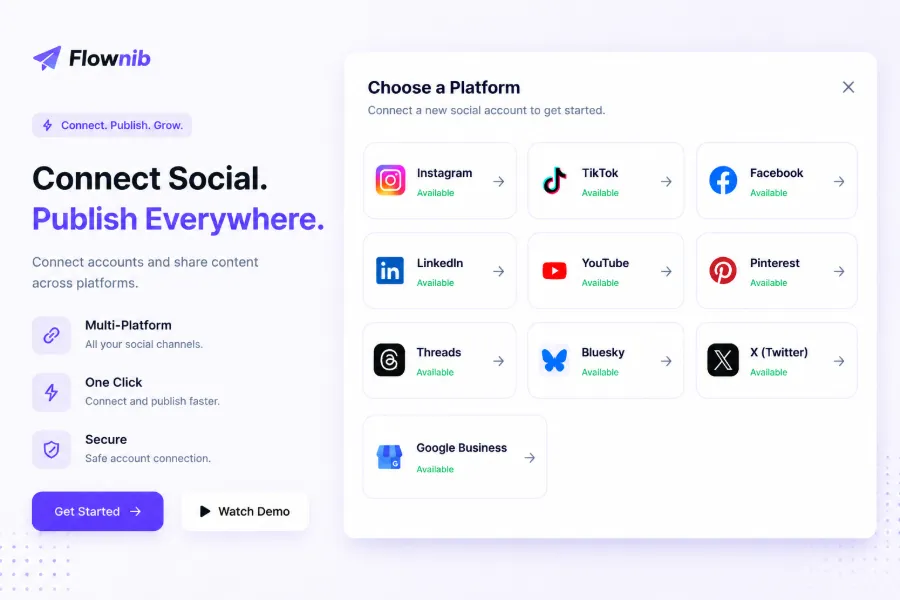
In such friction scenarios, the Flownib workflow is to complete a creation once, then let AI adapt per platform, followed by preview, scheduling, and publishing to multiple connected accounts. Product documentation shows an average setup time of about 2 minutes, supporting 10 social platforms, with a listed 99.99 % API uptime. These numbers are specific to the tool’s documentation and should not be taken as industry benchmarks or replace a team’s own result checks.
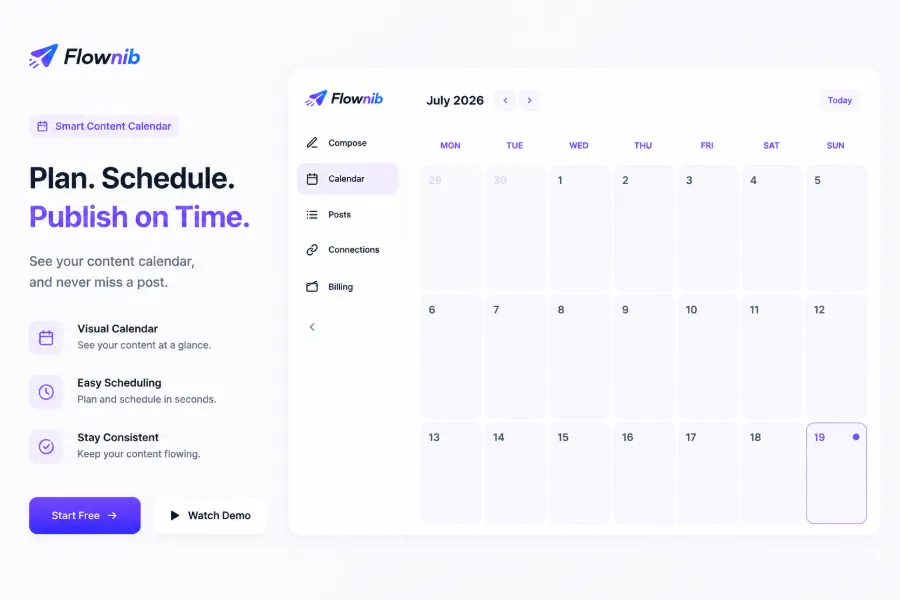
The content calendar here is more than a schedule. It must simultaneously display target market, language version, original topic, publishing platform, time zone, link version, and publishing record. Shopify sellers handling multiple markets can refer to the Seller social media distribution workflow to incorporate product inventory and promotion cycles into the schedule rather than queuing solely by each platform’s optimal posting time.
When a team manages multiple brand voices simultaneously, the issue shifts from “whether to post” to “who has permission to change what”. Brand archives, account permissions, and manual approvals are best kept separate; multi‑brand collaboration for agency teams can draw on the multi‑brand voice management approach. Automated publishing can handle repetitive work, but publishing records must still be traceable to specific versions and reviewers.
Feed Post‑Publish Feedback Back into the Topic Library, Instead of Chasing Hotspots Once
Topic selection should not end when content goes live. A more durable process is “discover → publish → observe → adjust”: record the trend source and hypothesis, publish a small‑scale version, then write the results back into the keyword library to decide whether to continue, re‑express, or stop. This way, you accumulate a searchable record of target‑market issues rather than a pile of old posts.
Each review round should retain three types of signals: content interaction signals, on‑site behavior signals, and commercial outcome signals. Comments, shares, and saves belong to the first class; click‑through rate, landing‑page dwell time, and add‑to‑cart belong to the second; conversion rate, order value, and refunds belong to the third. Looking only at likes can mask a common situation: content sparks debate but generates no effective traffic.
Different countries, language versions, and platforms need the same observation criteria. An English version may have a high save rate in the United States, while a French version shows average clicks in France but comments reveal more specific sizing issues; this does not mean the French content failed. The problems raised in comments may be more suitable for generating the next piece of content than surface interaction metrics.
Failed topics should not be deleted outright. The content calendar can retain the original keyword, target market, test hypothesis, and next steps, marking the mismatch reason: topic error, expression error, timing error, or insufficient landing‑page handoff. If discussion volume is high but click‑through is low, the team should check promises and pages; if click‑through is high but conversion is low, the issue may have shifted from content to price, delivery, or trust information.
The multi‑market operational perspective in the Social Media Automation Trends Across Markets helps teams place platform differences and regional rhythms into a single review record. Social media data also suffer from attribution windows, short links, and cross‑device behavior, so publishing results are best cross‑checked with internal order records rather than relying solely on platform dashboards.
Teams can supplement their understanding of publishing frequency and channel management with the Social Media Ops Resource Library, but frequency itself cannot replace topic validation. A topic that receives moderate feedback across three channels may be more reusable than a sudden spike on a single channel, because the former likely corresponds to a stable audience problem rather than a one‑off platform event.
When the topic library reaches a certain scale, the reusable element should be the problem structure and evidence, not the original sentences. Teams can keep “who encountered what problem, in what scenario, missing what information, and what action was finally taken,” then generate new versions for different markets based on that. Topic judgment thus shifts from guessing hot words to continuously checking whether audience problems exist, are changing, and have been accurately addressed by the brand.
FAQ
How does AI determine whether a topic is worth publishing for a cross‑border e‑commerce brand?
The short answer: AI can only pre‑filter candidate topics; the final judgment must combine discussants, target market, purchasing barriers, and brand facts. Teams should complete a human review before publishing and revisit the judgment after 24–48 hours using comments, clicks, and conversion records.
What’s the difference between a trending topic and a target‑audience need?
A trending topic indicates that a subject is gaining exposure or discussion, while a target‑audience need shows that the relevant people have a concrete problem or purchase intent. A topic with high discussion momentum may still be unsuitable for direct publishing if it does not align with the consumption scenario and product promise of the target country.
Should cross‑border e‑commerce brands create different content for every platform?
Keep the same insight, but do not copy the same post. Platforms usually require different openings, information density, and media formats. Teams can start with two platforms for a small test, then decide whether to expand based on save rate, click‑through, and conversion.
After AI finds a topic, which elements still need human review?
Facts, price, inventory, delivery time, regional restrictions, link parameters, and brand tone must be reviewed. Pre‑publish preview can catch formatting issues but cannot guarantee that AI hasn’t turned “available in some markets” into “available worldwide”.
How to decide from to continue or stop a topic based on publishing results?
If comments keep raising specific issues and clicks and commercial outcomes move in the same direction, you can test new expressions or markets. If interaction is high but clicks and conversions do not improve over two consecutive rounds, first check the landing page, price, and timing before deciding whether to drop the topic or just the current expression.
Share Article