
From Hot Conversations to Publishable Content: AI Workflow for Cross‑Border E‑Commerce

Cross‑border e‑commerce teams often aren’t lacking topics; they discover them too late. A market may already be discussing real use cases for a product, while the team is still confirming tone, translation, image format, and publishing time across Reddit, YouTube, and social accounts. By the time the content finally makes it onto the calendar, the discussion’s momentum may have shifted.
From trend to publication, you can’t rely on generating a single post. A more reliable approach is to first filter whether the discussion is relevant to the target market and purchase scenario, then constrain the claim with a brand dossier, rewrite for each platform, and finally go through preview, review, scheduling, and tracking. AI reduces repetitive editing but does not replace the team’s judgment on facts, context, and risk.
First Filter Worthwhile Content Opportunities from Hot Conversations
Trend discovery usually starts with a few keywords, not “what’s hottest today.” Cross‑border e‑commerce teams need to clearly define the target market, product category, and the problem users are solving, then feed those keywords into at least four sources such as Reddit, YouTube, News, and Hacker News. Each candidate topic must retain a heat or growth signal—like discussion volume, comment velocity, or search interest change—rather than relying solely on popular tags on a page.
The same keyword can map to completely different content opportunities. Real‑time spikes have a very short publishing window and are suitable for responding to an ongoing event; topics with sustained growth usually stem from repeated user questions and are better suited for explanatory or purchase‑decision content; some discussions are highly active but unrelated to the brand’s product, target market, or purchase scenario. The third type wastes team time because it looks like traffic but cannot naturally translate into product facts.
During filtering, operators can break the discussion into four questions: Who is the target market? What recurring questions does the audience ask? From which specific scenario can the product be introduced? Which platform will be used? This turns a trend into an actionable content opportunity rather than a link saved in a spreadsheet. The value of spotting a trend is not just finding a hot keyword but recognizing the concrete problems repeatedly expressed by users in different markets and turning them into verifiable content claims.
Manually opening multiple sources, copying comments, translating snippets, and then organizing everything into a spreadsheet is often the first bottleneck. The discussion about Marketing Team Social Media Process Upgrade illustrates how this organization work gradually eats up real judgment time. Teams don’t need to automatically track every hot word, but they do need candidate topics, sources, timestamps, and relevance reasons to stay within a single workflow.
A cross‑border team experienced a typical mistake in November last year: a discussion about winter outdoor storage heated up in the target market. The operator spent almost a day confirming the English phrasing and manually reformatted it in three account back‑ends. By the time the content was published, it was about 36 hours late; the comment section shifted to price promotions, and the angle that would have suited product education missed its window. The team later kept a record of this failure and added two fields to each candidate topic: “estimated effective window” and “latest review deadline.”
This also shows that a trend workflow cannot replace relevance judgment with a simple heat ranking. A topic must pass four checks—market match, product relevance, user problem, and growth momentum—simultaneously. If it only satisfies “lots of discussion,” it should go into an observation bucket, not directly into the creation queue.
Turn the Trend Angle into a Draft Aligned with Brand Positioning
Original sentences in hot discussions often feel very on‑the‑ground, but they can’t be turned directly into brand copy. A user might say, “Can this thing last a whole day?” The brand’s answer may involve battery life, usage limits, and applicable scenarios, not a verbatim copy of the complaint. Operators need to identify the underlying question first, then decide what claim the brand is willing to make.
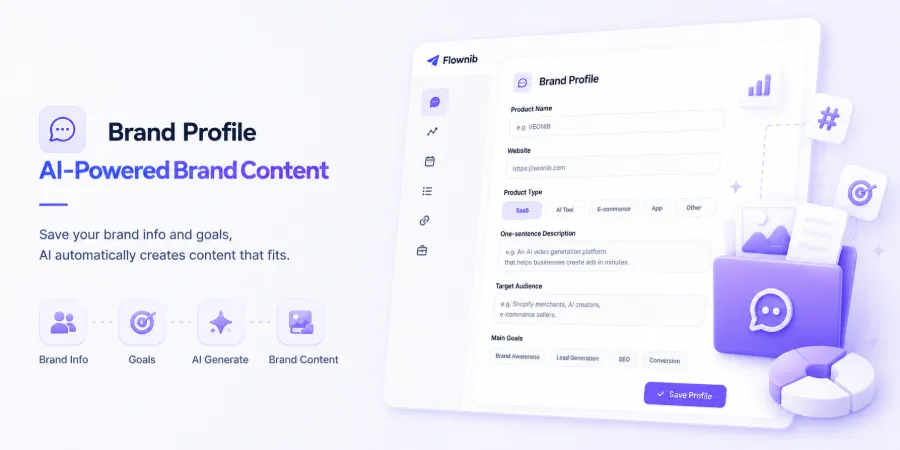
A brand dossier should at least record product information, target audience, brand positioning, and marketing goals. For cross‑border brands, it should also include product specs, applicable markets, after‑sales boundaries, and results that cannot be promised. AI content generation without these constraints easily turns user speculation into product facts, “might improve” into “guaranteed to solve,” or adds features the brand doesn’t offer just to chase a trend.
Flownib can serve as a bridge between content generation and distribution in this workflow: operators provide the trend angle and brand data, then review the generated draft instead of feeding the raw discussion straight to an automated publishing system. The draft’s purpose is to form an editable claim that still requires human verification of product relevance, market language, and factual basis.
When organizing input from a trend angle, at least four items should be retained: audience question, content claim, product link, and target platform. A more complete brief can also include source summary, market language, action background, prohibited expressions, and publishing window. This structure prevents AI from merely echoing “what everyone is talking about” and instead asks it to explain why the brand should join the conversation.
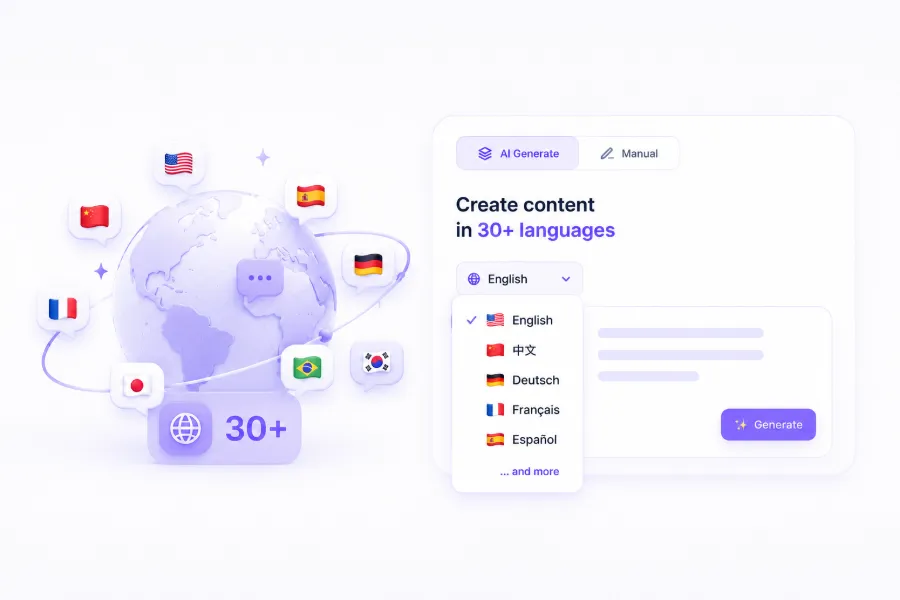
Different markets can share core benefit points, product facts, and action background, but they don’t need identical sentences. The German market may focus on specs and reliability; the Japanese market may care about usage order and details; English‑speaking social content may be more direct about personal experience. Brand consistency means keeping product facts and attitude consistent, not forcing every language to use the same phrasing.
Multi‑brand or multi‑market teams also need to manage the boundaries between brand voices. The practice of One Content Covering Multiple Brand Voices reminds operators to maintain shared facts, brand‑specific wording, and market‑prohibited expressions separately. Otherwise, a single brand dossier update could unintentionally alter another market’s tone.
After the draft is finished, reviewers should not only check grammar. The more troublesome errors usually involve a tone that sounds natural but omits product applicability conditions, or an accurate translation that uses a purchase scenario the target market’s users would never say. Teams can set the threshold for a draft entering the adaptation stage as: “facts verifiable, claim not excessive, language like a local user, action path clear.”
Adapt the Same Theme to Different Platforms Instead of Simple Copy‑Paste
The same content claim on Instagram, X, LinkedIn, TikTok, Facebook, Threads, Pinterest, YouTube, Bluesky, and Google Business should not just have its character count changed. Short‑text platforms need to quickly state the conflict or problem; image and short‑video platforms require text to match media rhythm; professional platforms are better for adding background and rationale; community and local business platforms need to address questions, locations, and service info.
Platform adaptation includes tone, character limits, content structure, media type, and audience expectations. AI can generate different versions first, but “rewriting completed” does not equal “ready to publish.” The number of tags allowed, link presentation, or video aspect ratio on one platform may be completely unsuitable on another; a promise in a video caption may be taken as a formal product guarantee more easily than a regular text post.
Materials on Social Media Content Practices can be used as a reference for common content reuse patterns, but cross‑border teams still need to calibrate rules with their own account data. Public recommendations rarely cover market‑specific prohibited words, customer‑service promise boundaries, or historical account tone—information that can only be accumulated from actual reviews and comments.
Switching between multiple tabs can hide errors: an operator may change the price on Instagram but forget it on X; or they may think they have published to all accounts when only one was actually posted. To reduce such duplicate work, see Stop Manually Publishing Social Content, but automated distribution must still retain status confirmation.
| Workflow Stage | Main Input | Platform Adaptation Action | Manual Checkpoint |
|---|---|---|---|
| Short‑text platforms | Claim, facts, action background | Compress opening, adjust characters and tags | Preserve limiting conditions |
| Image & short‑video platforms | Images, videos, product scenarios | Rewrite description to match media rhythm | Ratio, subtitles, promises |
| Professional content platforms | User questions, background info | Add explanations, cases, structure | Fact sources, professional tone |
| Community & local business platforms | Region, service, comment issues | Add location and interactive phrasing | Account, location, reply path |
In practice, teams can let AI first produce initial adaptations for ten platforms, then manually check tone, format, and media requirements per platform. At least five things must be confirmed: fact consistency, natural market language, retained brand tone, correct platform format, and no unintended promises. This review is lighter than rewriting ten separate pieces but still cannot be skipped.
A test of automatic rewriting once changed “suitable for light daily use” to “all‑day applicable.” The translation had no grammatical errors and the product name was correct, but the usage scope was exaggerated. The team only noticed after receiving return‑product inquiries in the comments, realizing the problem lay not in generation speed but in the lack of a unified fact‑verification field across platform versions.
Therefore, “one claim, many expressions” is more suitable for cross‑border operations than “one copy, ten copies.” The facts, core benefits, and brand boundaries stay the same; what changes are the opening style, length, tags, media pairing, and interaction mechanics.
From Review Approval to Multi‑Platform Scheduling and Publishing Records
The post‑approval publishing process can be broken into six steps: writing, AI adaptation, preview, scheduling, publishing, and tracking. Basic account connections and settings take about two minutes, but the real time sink is usually account permissions, time zones, media specs, and approval status—not the click of “publish.”
In multi‑market operations, launching all accounts simultaneously is often not ideal. Audience active periods differ across North America, Europe, and Southeast Asia, and language versions may need verification by local customer service or market leads. The content calendar should record region, language, account, target time slot, and reviewer to avoid treating a single piece of content as a global event.
Flownib can serve as an operational example in the publishing workflow, taking the approved version into preview, account selection, scheduled publishing, and record back‑write. It supports official API connections to multiple platforms; the 99.99 % API uptime reported in its documentation should be understood as a reliability discussion point, not a guarantee of “never failing.” Permissions can expire, platforms can throttle, and media uploads can fail, so failure retries and status logging must exist independently.
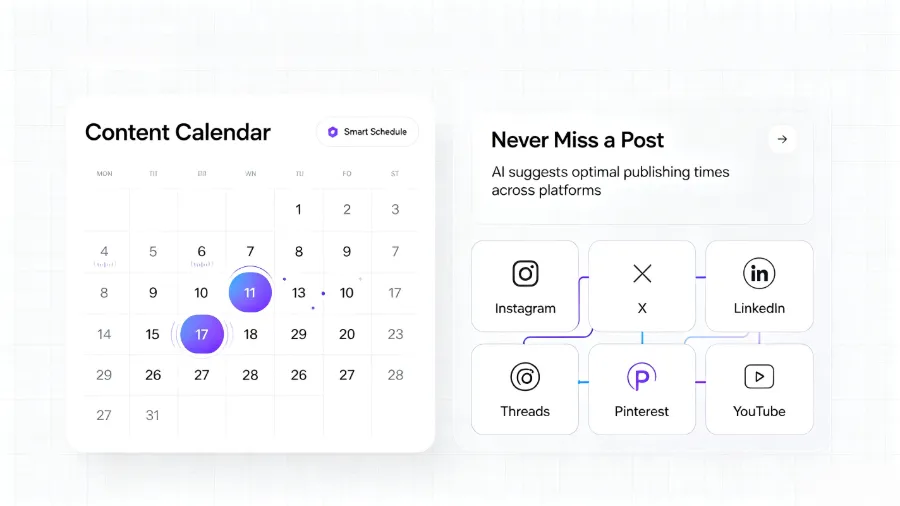
Pre‑publish preview must show the final rendered result, not just the editor’s text. Image cropping, link cards, line breaks, tags, and video thumbnails may vary across platforms; multi‑account management also needs to ensure the selected account is the live one, not a test account. Some teams have refreshed dashboards at night and saw one market marked “published” while another remained at “awaiting authorization.” Without publishing records, it’s hard to know whether a manual repost is needed.
Workflow automation and publishing records often become disconnected, leaving the content calendar with only plans and no accurate back‑write results. When adding the Automation Process for Social Media to the design, at least four statuses must be defined: success, failure, pending retry, and manual handling. Each retry should also save the timestamp and reason; otherwise, the same content could be published repeatedly.
The often‑overlooked part is handling exceptions. When a platform fails, the team should not immediately push all platforms again; they need to confirm which accounts succeeded, which media were uploaded, and which versions remain queued. If necessary, pause the remaining schedule, fix permissions or assets, then re‑publish according to the records—this is far more controllable than deleting duplicate content after the fact.
Use Review Results to Improve the Next Round of Trend Content
After publishing, teams should review three layers: topic relevance, platform performance, and business outcomes. Relevance looks at whether comments still revolve around the original problem; platform performance examines engagement quality, clicks, and content dwell time; business outcomes track whether users visited product pages, made inquiries, added to cart, or moved along the conversion funnel. High likes but comments full of price disputes cannot simply be labeled a success.
Comments in different markets are often more useful than a single interaction metric. New issues appearing in comments can become the next round of keywords; a market that repeatedly asks about size, shipping, or compatibility indicates the original claim didn’t address purchase friction. Content review isn’t just scoring a post; it updates the audience question pool and brand dossier.
Performance differences between platforms can’t be directly blamed on copy quality. A version may get massive views on TikTok but almost no clicks because users treat it as entertainment; LinkedIn may have lower interaction volume but generate clearer bulk‑purchase inquiries. Teams should feed clicks, inquiries, and conversion paths back into the content calendar, avoiding decisions based solely on exposure and likes.
When automation scales, boundaries become clearer. Trend relevance decays, translations may lose context, and unified publishing can amplify a single factual error across ten platforms. Operators can keep effective topics weekly, retire low‑relevance ones, update brand info, and refine review checklists. This simple routine helps the next trend filtering avoid many repeated missteps.
When the content process stabilizes, trend discovery, brand constraints, platform rewriting, human review, scheduling, and result tracking form a traceable chain. The chain’s value isn’t in eliminating humans entirely but in letting them focus on relevance, context, and business judgment.
Cross‑border e‑commerce teams ultimately need to maintain a set of working rules that evolve with market feedback, not a pile of automatically generated posts. Each comment, failure status, and conversion path left by a publish influences the next content brief; this reduces delays and rework more effectively than merely chasing the next hot keyword.
FAQ
How to determine if a hot conversation is suitable for a cross‑border e‑commerce brand to follow?
A suitable topic must simultaneously meet target market, audience question, product relevance, and growth momentum. Teams can record signals from four source types and confirm within 24 hours whether it can form a concrete content claim; topics with high heat but no purchase scenario should stay in the observation bucket.
Can AI directly publish the same piece of content to all markets?
AI can generate versions for multiple markets and platforms, but they should not be published without review. Each version must at least be checked for natural language, product facts, character limits, and local expressions. Mature teams usually sample each of the ten platforms before scheduling publication.
At which stages should human review be placed from trend discovery to publishing?
Human review should occur at trend filtering, draft confirmation, platform adaptation, and final preview. If a hot window is only 12–24 hours, a tiered review mechanism can be used, but factual and promise‑related content must not skip the final preview even when time‑pressed.
Which content elements must stay consistent across multiple platforms?
Product facts, price conditions, core benefits, applicability scope, and prohibited brand expressions must remain consistent. Opening sentences, length, tags, media descriptions, and interaction styles can be adjusted per platform (Instagram, X, LinkedIn, etc.) and should be recorded in the publishing log.
How to avoid publishing after a hotspot has already cooled down?
Teams should record the estimated effective window and latest review deadline during the discovery phase, and compress writing, adaptation, preview, scheduling, publishing, and tracking into a continuous flow. If a topic exceeds 36 hours without completed review, the discussion’s heat should be re‑checked rather than mechanically pushing the old angle to all markets.
Share Article