
From “What to Post” to “What Readers Really Want to See”: Decision Process for Content Topic Selection in Cross‑Border E‑Commerce

Cross‑border e‑commerce teams often linger in front of the content calendar: should we post a new product today or a discount? Should the English market and the German market use the same theme? The article last week received no comments—was the topic wrong, or was the title unclear? Repeatedly debating “what to post today” is usually not a lack of ideas, but a failure to organize the problems readers have already voiced into demand signals.
Topic selection is not about finding inspiration; it is about bringing together search behavior, platform conversations, product issues, and historical feedback to judge whether a theme is worth investing in. An actionable topic must correspond to a clear problem, a purchase decision, or an action a reader is willing to take; if it only describes what the brand wants to promote, it usually cannot be written directly.
Independent sites in cross‑border e‑commerce are especially prone to mistaking “what the brand wants to say” for “what readers want to see.” A brand may want to launch a summer collection, while readers might be searching “how long does a European summer order take to arrive.” A brand may want to emphasize material, but customers care more about “will it shrink after a few washes.” Both relate to the product, but the content tasks are completely different.
First Distinguish “What the Brand Wants to Say” from “What Readers Are Looking For”
“Having no topic” is usually not a lack of creativity, but a missing mapping between brand information and reader problems. Product selling points belong to brand expression; user tasks are what readers want to accomplish; purchase barriers explain why they hesitate to order; after‑sale questions appear after the transaction. Mixing these four types of content together quickly turns the content calendar into a schedule of promotional slogans.
Cross‑border e‑commerce teams can start by asking four questions: What task is the reader trying to complete now? Which purchase risk are they worried about? What solutions have they already tried? If the content solves the problem, will the reader next search, compare, bookmark, or directly contact customer service? For example, “water‑proof jackets use three‑layer fabric” is a product selling point; “should I wear an extra layer when commuting in light rain?” could be an article angle.
Whether a theme is worth writing cannot be judged solely by keyword search volume. It must also map to a clear search intent, customer review, internal search record, or social media comment. Differences across markets, languages, and purchase stages also change the shape of the problem: U.S. consumers may first ask about return time limits, Japanese consumers care more about size specifications and packaging details, German consumers often repeatedly confirm logistics, taxes, and compliance information before buying.
In the content calendar, at least four types of demand signals should be retained:
- Search questions, customer inquiries, competitor reviews, historical content feedback.
These four signal types do not need to have a large sample right away. A question that appears in five consecutive customer support tickets is often more worth handling than a term with thousands of searches but little relevance to the product. Reader needs often hide in repeated specific phrasing rather than the numbers given by keyword tools. When a customer writes “Why does my package show as shipped but hasn’t moved for three days,” the article title should not be a vague “Cross‑border logistics knowledge.”
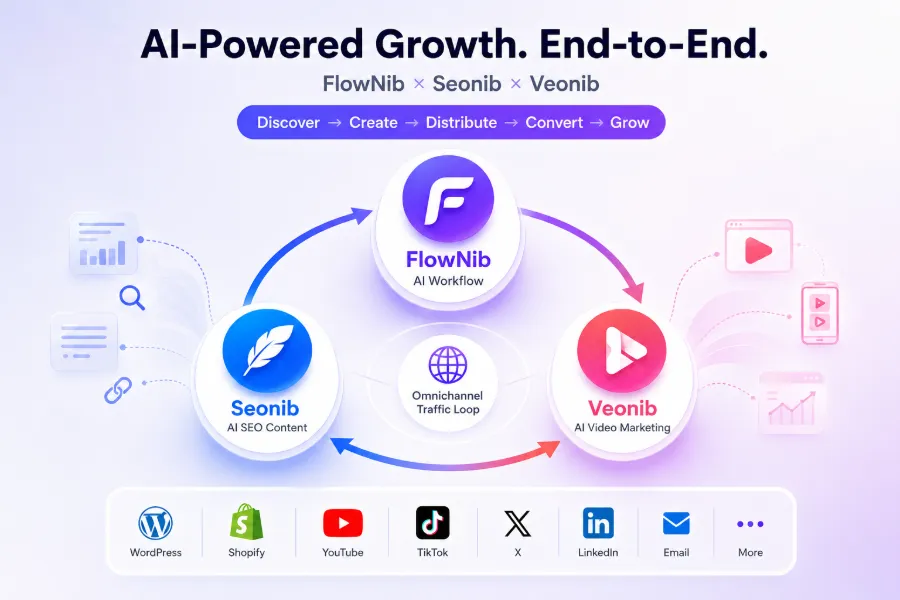
If the team plans to evaluate a social‑media distribution tool, it should first confirm that the tool can retain these sources of questions, market tags, and feedback records, rather than just checking if it can publish with one click. For trade‑offs in actual workflow, see the Cross‑border seller social‑media distribution tool evaluation, but tool evaluation cannot replace demand judgment. Platform distribution strategies themselves also change with account type and audience; refer to the Social media content strategy guide.
Turn Vague Demands into Writeable Content Angles Using Real Conversations
Original problems are usually scattered across search suggestions, Reddit posts, YouTube comments, news discussions, Hacker News topics, support tickets, and competitor Q&A. Their expressions are messy—some are complaints, some are half‑sentences—but that is exactly where useful topics arise. Keyword tools can tell the team “what people search for,” while real conversations more easily reveal “why they search.”
Broad topics must be further broken down. For example, “cross‑border e‑commerce returns” is not a complete topic; it can be rewritten as: “A consumer buying clothing from the UK for the first time, how to assess whether returning a mismatched size is worth the cost?” This sentence already contains the audience, context, problem, and expected outcome, allowing the article to decide whether to cover logistics policy, cost calculation, or size chart explanation.
Keywords alone should not decide a topic. Use a three‑layer filter during execution:
- Relevance: Is the problem related to the product, market, or purchase stage?
- Problem clarity: Does the reader clearly describe the difficulty encountered, rather than just a broad term?
- Brand answerability: Does the brand have data, policies, cases, or expertise to provide a credible answer?
Popularity does not equal worthiness. A news topic may generate high discussion volume in a day but cannot be linked to the brand’s purchase scenario; a size issue with only a few dozen discussions may directly affect add‑to‑cart and return rates. Teams that chase only hot topics often get exposure but lack reusable customer problem records.
From signal to article, the conversion chain can stay very concrete:
| Demand Signal | Reader’s Original Question | Transformable Article Angle | Validation Action |
|---|---|---|---|
| Search question | “Why are overseas orders split into two packages?” | Reasons and handling methods for cross‑border order splitting | Check internal search and support records |
| Customer inquiry | “Does this size work for layering in winter?” | Size and layering choices for different climates | Have support confirm high‑frequency phrasing |
| Social discussion | “Low‑price items are too hassle to return” | How to decide if returning a low‑value item is worthwhile | Observe specific contexts in comments |
| Competitor review | “The page doesn’t explain taxes” | How to estimate taxes and net price before purchase | Compare competitor pages and abandoned‑cart feedback |
Each row must include a validation action; otherwise, the content team can easily package its own guess as a reader demand. After the article title is set, paragraphs can be written as a set of reader questions, each backed by evidence: order data, policy pages, support cases, customer reviews, or test photos. This ensures the content is not just opinion.
In a cross‑border AI traffic project, the content team processed search topics, social discussions, and feedback in a single workflow; see the Cross‑border AI traffic closed‑loop case. The value of such a process lies not in automatically generating more titles, but in letting the team know which signal each title originated from.
Validate Before Publishing Whether Readers Are Willing to Read
After a topic is finalized, there’s no need to immediately invest in a long article. The team can first prepare two or three title variants, create a short post with the same opening question, and test them in English, Chinese, or other market versions. The observation is not just click‑through rate, but whether readers understand the problem, continue reading, and leave comments related to their own situation.
A minimal validation standard can be three items: can the reader state within a few seconds what problem the article solves; does the opening keep the target audience reading; does the content trigger comments, saves, clicks, or inquiries. A/B title testing shows packaging differences, while completion rate is closer to whether the content delivers on its promise; comment and save rates often expose whether the problem is specific enough. Conversion rates should be observed over a longer period; a single social post’s data should not be used to draw conclusions.
A failed launch once proved typical. A cross‑border e‑commerce team released content for several weeks following an internal promotion rhythm, increasing production speed each week, but never recorded reader problems, platform feedback, or market differences. By the fourth week’s review, social exposure had not improved, completion and comment rates remained flat, and the next week they were still debating “what to post today.” The team later looked at the data and discovered that content for several markets was merely a translation of discount information and did not answer local consumer questions about shipping and returns.
This outcome cannot be simply blamed on topic selection. Poor content performance may stem from at least four reasons:
- The topic lacks demand; even a clear title doesn’t attract interest.
- The topic has demand, but the title fails to convey it clearly.
- The content suits a long‑form piece but is compressed into a short post unsuitable for the platform’s native format.
- The topic and format are fine, but the publishing time or market timezone is inappropriate.
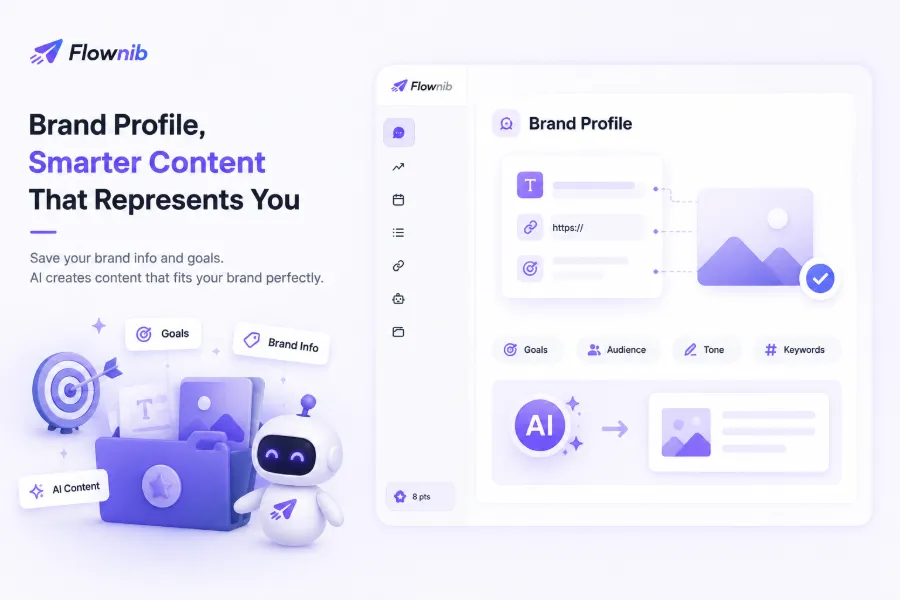
Automation can reduce copy‑pasting, tab switching, and repetitive rewriting time, but it cannot replace demand validation. When using a workflow like Batch‑Generate One‑Week Content, the team can complete a content distribution preparation in about 2 minutes, but this only shows faster execution, not a more worthy topic. In practice, Flownib fits best in the rewrite, preview, scheduling, and publishing‑record stages; topic sources and validation conclusions still need human retention.
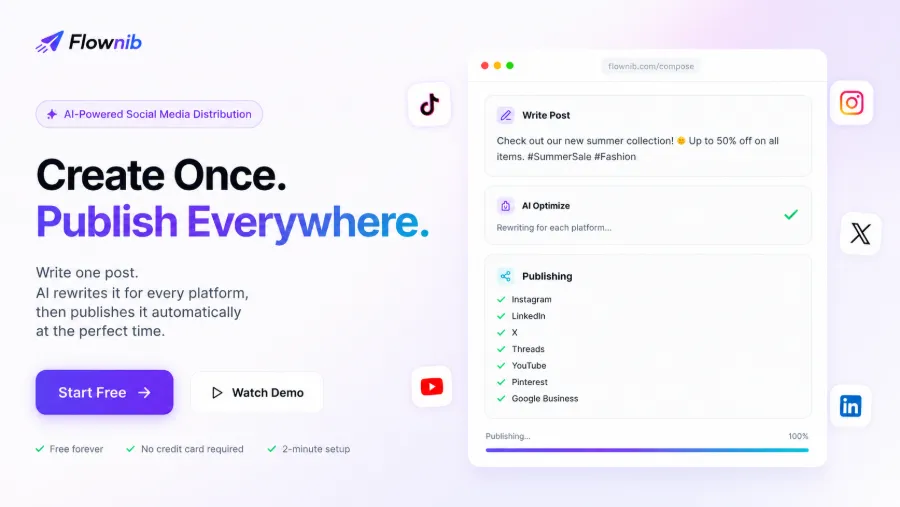
Multilingual content should not be just sentence‑by‑sentence translation. The same logistics issue may require different currency, delivery time, tax explanations, and platform conventions across markets; the same purchase barrier may need an illustration on Instagram, a test video on YouTube, or a discussion on supply‑chain decisions on LinkedIn. Flownib can reduce duplicated effort when rewriting for multiple platforms, but the team must still check examples, tone, character limits, and proof methods for suitability to local readers.
After publishing preparation, it is recommended to write back the title version, platform format, market language, and initial results into the content calendar. Google Search Console data is not real‑time; on public platforms, crawling, processing, and indexing may take days to weeks; social comments may appear within hours after publishing. These two data types should not be compared within the same time window, otherwise the team may mistake indexing delay for topic failure. Differences in format across platforms can also refer to the Multi‑Platform Content Operations Reference.
Turn One Topic into a Reusable Content Feedback Loop
Topic selection should not end after article publication. A sustainable process must at least go through: collect signals, propose angles, create content, distribute across platforms, record feedback, and update the topic library. Each step should retain its original basis so that during the next review the team knows whether results came from the theme, title, platform, or timing.
A content topic library is best tagged by market, platform, theme, and purchase stage. For example, “UK—Instagram—Shipping—Pre‑purchase” and “Japan—Internal Search—Size—Comparison stage” are two distinct tasks. This way, a well‑performing short post in the U.S. market does not automatically lead to copying the same title across all language versions.
Content reuse also has boundaries. Core problems can be reused, but titles, tone, length, and examples should not be mechanically copied. A high save rate on one platform may stem from a list format; on YouTube readers expect demonstration and evidence; on Reddit, an overly polished brand voice may reduce discussion willingness. The same cross‑border e‑commerce issue often manifests as different content tasks on different platforms.
The team once tried to turn a well‑performing logistics article into identical copy for ten platforms, but clicks did not increase with the number of platforms. Later they kept only the core insight “how to reduce delivery uncertainty” and rewrote it as Q&A, short video script, comment reply, and long‑form case, making feedback comparable. For actual records on cross‑platform reuse, see One Piece of Content Covering Ten Platforms; if the team needs to reorganize the collaboration from content to publishing, refer to the Content Closed‑Loop Collaboration Architecture.
Whether to stop a topic should not be decided by a single hit or miss. If a topic has been tested with at least two title variations, two platforms, and one target market and still shows no reading, comment, or click signals, while support and internal search also lack corresponding problems, it can be temporarily shelved. If comments keep surfacing with specific follow‑up questions, even if the first article’s data are average, it can be broken down into sub‑topics such as size, logistics, returns, or usage scenarios.
A weekly topic review is enough to keep the process fresh; there is no need to redo strategy daily. Each topic should retain at least one validation record, including the original question, title versions, publishing platform, market, data window, and final judgment. After a few weeks, the content calendar becomes more than a scheduling tool—it gradually turns into a demand archive grouped by market. The team will still encounter cold starts and data delays, but they won’t have to guess from a blank page each time.
FAQ
How can a cross‑border e‑commerce team decide what readers want to see when they lack enough data?
Start with at least four low‑cost signal types: search suggestions, customer questions, competitor reviews, and historical content feedback. Even with only 10 relevant records, if several use similar specific phrasing, you can run a short post test and observe comments, saves, and clicks within 24–72 hours.
What is the difference between a popular topic and a content theme truly suitable for the brand?
Popular topics have discussion volume; a brand‑suitable theme must also align with the target market, product scenario, or purchase barrier. A hot topic can bring exposure in a day but cannot support purchase decisions; conversely, a narrow issue about taxes or returns may generate sustained inquiries and search traffic for two weeks.
How to break a broad keyword into a concrete article angle?
Rewrite the keyword as “who, in what situation, encounters what problem, and wants what result.” For example, “cross‑border logistics” can be broken into new‑customer waiting time, order splitting, taxes, package anomalies, or return costs—each angle should be validated with support records or comment‑section questions.
Should multilingual content be directly translated, or rewritten for each market?
Keep the core problem, but rewrite for each market. Currency, delivery time, taxes, platform habits, and examples may differ. Translated articles can be initially distributed in a small range for testing, and usually after 1–3 publishing cycles, decide whether to expand.
After publishing content, which feedback is most suitable for updating the next round of topics?
Specific comments, repeated questions, saves, internal search terms, and clicks that lead to inquiries are usually more suitable than a single exposure metric. The team should record feedback by market, platform, and purchase stage, and during the weekly review decide whether to expand the original theme or adjust title and format.
Share Article


