AI Agent Takes Over Social Media Operations: The Real Process Changed by a “Fourth Employee” in a Marketing Team
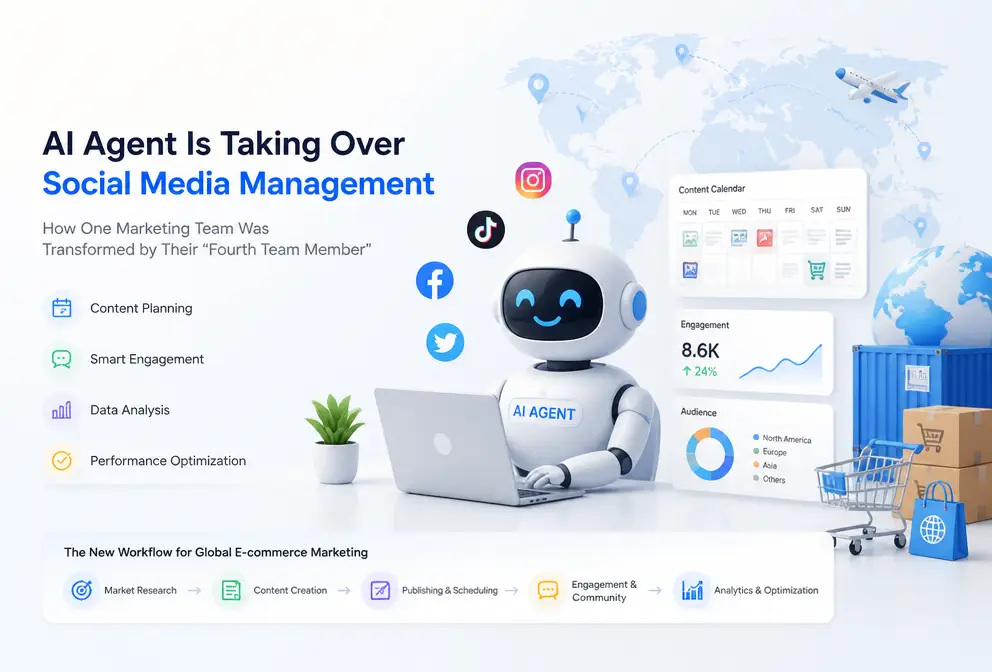
At 9 a.m., a message popped up on the operations group chat of a cross‑border e‑commerce team: the consolidated post data from three platforms yesterday, today’s publishing schedule, and two comments that needed manual confirmation. Three months ago this workflow looked completely different—back then the team spent nearly two hours each day copying the same product content and pasting it onto Instagram, Facebook, LinkedIn, and X, then manually adjusting character counts, hashtags, and posting times.
The change happened after they deployed an internal AI Agent they called the “fourth employee.” The name isn’t a metaphor; it’s a real automation system in the team: it handles content rewriting, scheduled publishing, cross‑platform distribution, and data tracking, like a colleague who never asks for a salary or a day off. Similar signals are emerging across the industry—Nectar Social just secured $30 million in funding, SOCi has already rolled out 300,000 agents. A direct question now faces every social‑media operations team: which actions can be safely handed over to AI, and which steps will cause trouble if left unattended.

When the “Fourth Employee” Joins: What the AI Agent Actually Does for the Team
First, clarify what the “fourth employee” is. It isn’t a virtual assistant; it’s a deployed automation system integrated into the team’s social‑media workflow, executing four fixed types of tasks each day.
Content rewriting – The same product selling points need a short, snappy caption with hashtags on Instagram, a more formal tone and paragraph structure on LinkedIn, and a concise version on X due to character limits. Previously, the operator had to write each version manually; now the AI Agent takes the original content and automatically generates platform‑specific versions.
Scheduled publishing – The system selects the optimal posting time for each account based on historical interaction data, instead of the operator guessing a round‑hour slot.
Cross‑platform distribution – Posts are sent directly via each platform’s official API, eliminating the need to switch tabs manually.
Data tracking – After each publish, the post is automatically archived in the marketing calendar and a publishing record is generated.
The team’s experience: the two‑hour daily distribution task shrank to under twenty minutes, and the error rate dropped noticeably—no more forgotten hashtags or long LinkedIn posts being pasted into X and getting truncated. This is the embryonic stage of “unmanned social media”: repetitive execution is taken over by a system, while humans move to review and decision‑making roles.
Automatable Steps: From Rewriting and Scheduling to Distribution, Which Actions Should Be Handed to AI
If a team decides to introduce AI automation, the first batch of replacements should be the highest‑frequency, most rule‑clear tasks. Based on this cross‑border team’s practice, the following four steps can be safely delegated to the system.
- AI content rewriting – Adjust copy automatically according to platform style and character limits; Instagram emphasizes visual pairing and hashtags, LinkedIn retains a professional tone, Threads uses a more conversational style.
- Smart scheduling – The system automatically selects posting times based on when followers are most active, removing the need for daily manual timing.
- One‑click cross‑platform publishing – Directly via official APIs, a single piece of content is distributed to all connected accounts simultaneously.
- Publishing record tracking – Each post is automatically archived in the calendar, eliminating manual report compilation.
Setting up these functions takes about 2 minutes, and the official APIs maintain a stability level of 99.99 %. The table below shows the time comparison before and after automation, making the impact on each step obvious:
| Step | Estimated time before automation | Estimated time after automation | Manual intervention needed |
|---|---|---|---|
| Content rewriting | 60 min per platform (separate writing) | AI rewrite 2 min | Minor human polishing |
| Smart scheduling | 30 min manual timing per platform | Automatic optimal selection 0 min | None |
| Cross‑platform distribution | 40 min copy‑paste | One‑click publish 1 min | Initial configuration |
| Publishing tracking | 20 min manual report compilation | Automatic archiving 0 min | Spot checks |
The team finally chose Flownib because it connects directly to the official APIs of Instagram, X, LinkedIn, Threads, YouTube, Pinterest, Google Business, etc., offering far more reliable stability than third‑party plugins. For a deeper look at the rewriting and distribution mechanism, see the breakdown of “How One Creation Is Distributed to Ten Platforms”. Also, the actual performance data of scheduled posts is worth noting in the discussion “Do Scheduled Tweets Get Fewer Views?”.
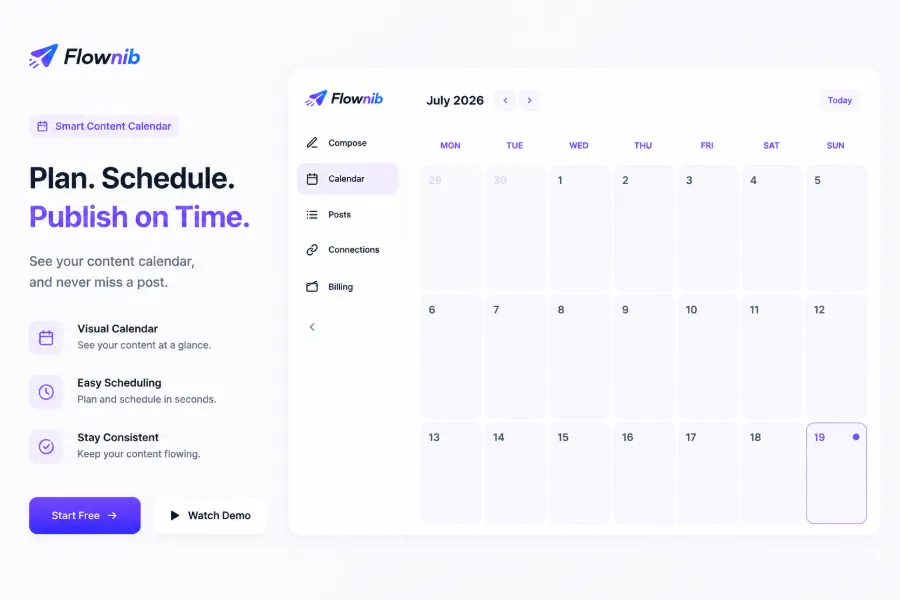
One easily overlooked point: the true value of automation isn’t the few minutes saved per post, but the freedom it gives the team to shift from repetitive work to strategic judgment. If the saved time is spent just scrolling phones, the efficiency gain is illusory; only when that time is invested in content planning and data analysis does genuine productivity soar.
Steps That Must Remain Human‑Handled: Brand Tone, Crisis Management, and Strategic Judgment
Automation has clear boundaries, which this cross‑border team learned the hard way after a costly failure.
After launching the AI Agent, they also handed over all comment replies and crisis handling to the system. When a wave of negative reviews arose from shipping delays, the AI‑generated replies were stiff and lacked empathy, further angering customers. It took the team three weeks to gradually restore the brand’s reputation, and several long‑time customers were lost in the meantime. This lesson forced them to redefine four categories that must involve human input.
- Final calibration of brand tone – AI‑rewritten copy may sound generic; a human must confirm it aligns with the brand’s consistent voice.
- Crisis PR and comment handling – Emotional judgment can’t be delegated to algorithms, especially for complaints, negative reviews, and sensitive topics.
- Cross‑platform strategic trade‑offs – Deciding which platform receives heavy investment and which merely maintains presence is a resource‑allocation decision, not an execution task.
- Strategy adjustment after data interpretation – Translating reports into next steps requires business understanding.
In other words, behind every successful “unmanned” post there’s still a human review node. The real shift is that human involvement moves from the execution layer to the strategic layer. For a thorough analysis of information fragmentation caused by juggling multiple tools, see the article “Deconstructing Social‑Media System Silos and Tool Fragmentation”. If the team wants to compare scheduling capabilities across major platforms, refer to the comparison on “Social‑Media Management Platforms’ Scheduling Features”. Practical content‑strategy advice for each platform can be found at “Platform Content Strategy Playbook”.
From “Fourth Employee” to Full Automation: A Replicable Implementation Process
If a team wants to replicate this workflow, they don’t need to do it all at once; following these four steps is a safe approach.
- Identify the most repetitive actions in the current workflow, usually content rewriting, scheduled posting, cross‑platform distribution, and report compilation.
- Replace the most time‑consuming parts with AI rewriting and scheduling. The real‑world impact of tools like Flownib can be seen in “Cross‑Border Sellers Review This Distribution Tool”.
- Retain human review nodes, especially for brand tone and crisis handling.
- Manage multiple accounts with a unified dashboard and continuously track data.
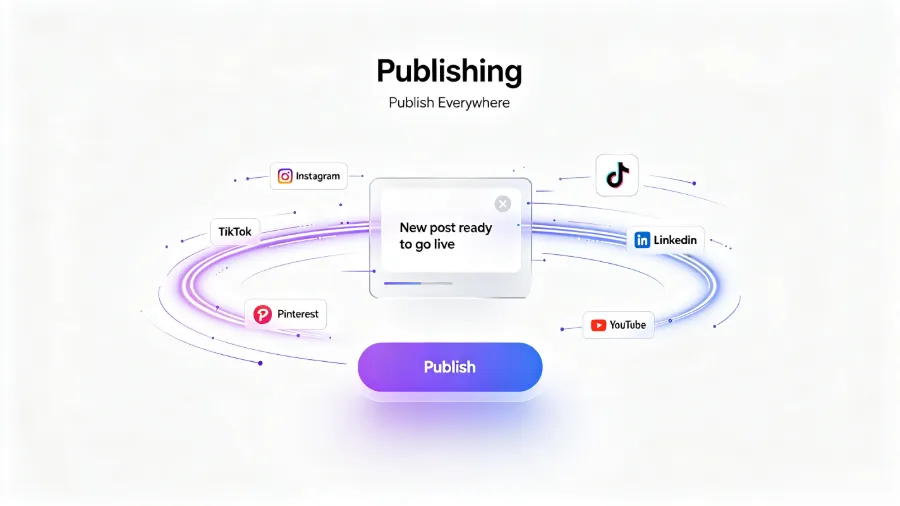
Following this path, the cross‑border team saved roughly 15 hours of repetitive work each week. That time was reallocated to content planning, competitor analysis, and comment‑section interaction strategies. TikTok and Facebook short‑video production now has dedicated staff instead of sharing a single asset pool across all platforms.
An interesting observation: as automation deepens, the team’s sensitivity to each platform’s performance actually increases. Higher publishing efficiency raises the content volume ceiling, making it quick to see which platform yields good feedback and which wastes effort. This feedback loop didn’t exist in the purely manual era—publishing itself was the bottleneck, leaving no bandwidth for such comparisons.
FAQ
Q1: Can AI social‑media operations truly be “unattended”?
No. Execution‑level repetitive work can be automated, but brand tone, crisis handling, and strategic judgment still require human involvement. The team mentioned earlier handed comment replies to AI and responded sluggishly during a negative‑review surge, taking three weeks to recover their reputation.
Q2: Which platforms are best to automate first?
Start with high‑frequency, format‑diverse platforms such as Instagram, X, LinkedIn, and Threads. Their differing content formats and character limits make AI rewriting most beneficial. YouTube and Pinterest have longer production cycles and can be added later.
Q3: Will AI‑rewritten content lose the brand’s style?
Yes, if there’s no human review. AI‑generated copy may sound generic; a human should verify that it matches the brand’s consistent voice. Keep a lightweight review step that checks tone and key information without requiring word‑by‑word edits.
Q4: Will existing social‑media roles be eliminated after introducing AI automation?
Execution‑level roles will shrink, but strategic roles will expand. Once the team is freed from copy‑pasting, they need people for content planning, data interpretation, and platform strategy. In this cross‑border team, the headcount stayed the same while output more than doubled.
Q5: Is automation worth it for very small teams?
If the team consists of one or two people, the benefits are even more pronounced because repetitive tasks take up a larger share of limited manpower. Free tiers are usually sufficient for small teams to trial; run a two‑week pilot, measure actual time saved, then decide whether to upgrade.
Share Article