Best Practices for LinkedIn Marketing of B2B Industrial Export Companies: A Guide to Automated Professional Content Distribution
In the fall of 2023, I helped a factory that exports hydraulic components build a LinkedIn content system. Their engineers produced a solid 30‑page technical white paper, but the operations staff had to spend two hours each day manually posting the English content to LinkedIn, X, and Google Business—often getting complaints from colleagues about formatting glitches. The most critical issue wasn’t speed but frequency: even at full effort the team could only manage a weekly post, while industrial buyers have procurement cycles of six months to a year, and a gap in content breaks the trust‑building process.
This is a typical bottleneck for export factories acquiring customers on LinkedIn: they have content capabilities, but distribution efficiency holds them back. Over 80 % of B2B industrial procurement decision‑makers use LinkedIn for supplier research (HubSpot 2023 data), yet fewer than 20 % of export companies can treat LinkedIn as a reliable lead‑generation channel. The problem isn’t content quality; it’s the act of “consistently publishing professional content”.
Why Industrial Export Companies Must Embrace LinkedIn Content Automation
In the B2B industrial procurement decision chain, LinkedIn’s value lies not in short‑term conversion but in long‑term trust building. A German engineer may spend three months scrolling through suppliers’ LinkedIn pages, reading technical articles, case updates, and team news before sending the first inquiry. If your latest post is three months old, his first reaction will be, “Is this company still active?”
The pain points of traditional manual publishing are several. First, content creation assets are scattered—white papers in PDFs, case studies in Word, product images on cloud drives—so each post requires re‑assembly. Second, multilingual adaptation is costly—industrial customers come from different countries; an English press release posted everywhere leaves Chinese customers confused and Middle Eastern customers indifferent. Third, the update frequency cannot be raised: a professional article takes two to three hours from writing to review to publishing, and the team cannot afford a dedicated operations person.
The most typical incident I’ve seen: a valve export company posted an article with technical parameters on LinkedIn, but when manually copying it to Google Business, the “corrosion resistance grade” line was omitted. A European client screenshot the post and questioned, “Your product specs are inconsistent.” Inconsistent content harms brand professionalism more than not posting at all.
The value of automation is not to replace people but to bridge the gap between “desire to publish” and “ability to publish.” Tools make distribution a near‑zero‑cost action, allowing the team to focus on content creation. Many cross‑border creators have validated a similar approach—Flownib’s real‑world record of helping global creators boost social reach shows that a standardized distribution process can double content reach efficiency.
Building a Professional Content System: From Industry Insights to Engineering Cases
The content types that work well on LinkedIn for the industrial sector are clear: excerpts from technical white papers, translated key pages of product manuals, customer application cases, factory‑footage videos, and industry trend analyses. These pieces naturally carry expertise and long‑tail SEO value—when a German engineer searches LinkedIn for “hydraulic cylinder high temperature sealing,” your technical article that naturally includes those terms will appear on his feed.
The challenge is turning a single core material into professional versions for different platforms. For example, an English product page needs to be expanded into a technical long‑form post on LinkedIn, condensed into a brief announcement with a link on X, and simplified into a localized notice on Google Business. The key is not “changing” but “preserving core parameters.” One incident occurred: a foreign trade factory used AI rewriting without pre‑setting term protection, and the system reduced technical parameters like “tensile strength” and “corrosion resistance grade” to vague phrases such as “high quality” and “durable.” Two days after publishing, a client messaged questioning the lack of specificity. The team then had to manually review every piece of content and create a custom industry term library to return to normal.
Therefore, the prerequisite for automated rewriting is a content firewall: lock down industry terminology and key numbers so that AI only tweaks tone and structure without touching technical accuracy. A mature workflow can run as follows: core material (product specs, case PDFs) → extract key paragraphs → separately draft LinkedIn long‑form (800–1500 characters), X short announcement (200–400 characters), Google Business localized copy → distribute via tool. With this workflow, the same material can be reused multiple times instead of starting from scratch each time.
The tone and visual style of industrial content also have clear boundaries. Don’t turn articles into jokes or overly simplified popular science for the sake of “socializing.” LinkedIn’s industrial audience expects professional foresight, not gimmicky marketing. Maintaining a plain‑text layout, technical drawing photos, and tables actually builds more trust than flashy designs.
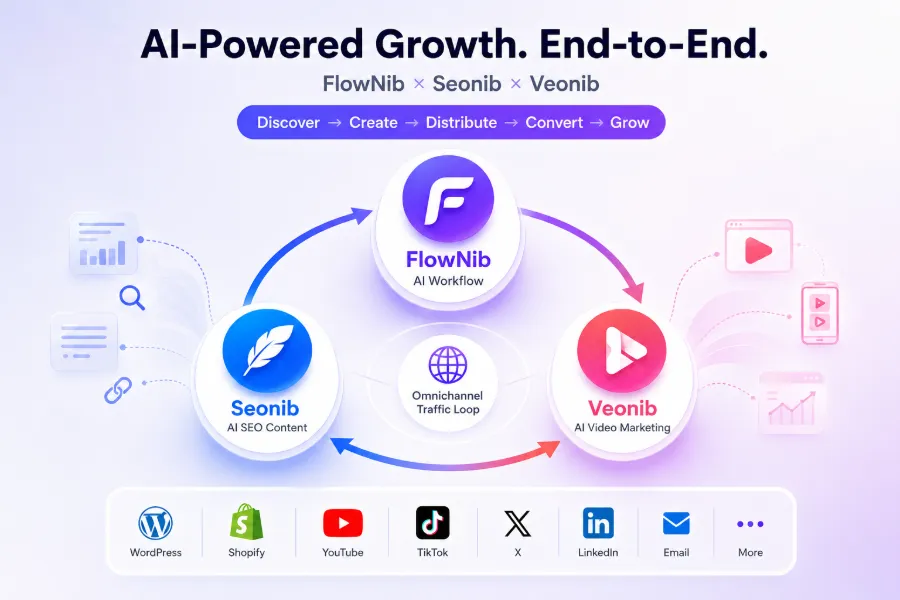
Once the content system and rewriting rules are set, the distribution stage requires no manual intervention. For details on material reuse and cross‑platform adaptation, see the AI‑driven “write once, publish everywhere” process, which breaks down the conversion logic from original documents to final drafts for each platform. Additionally, the comprehensive guide to “create once, publish everywhere” offers a more systematic methodological overview, suitable for team reading.
Using Automation Tools for Cross‑Platform Content Adaptation and Automatic Publishing
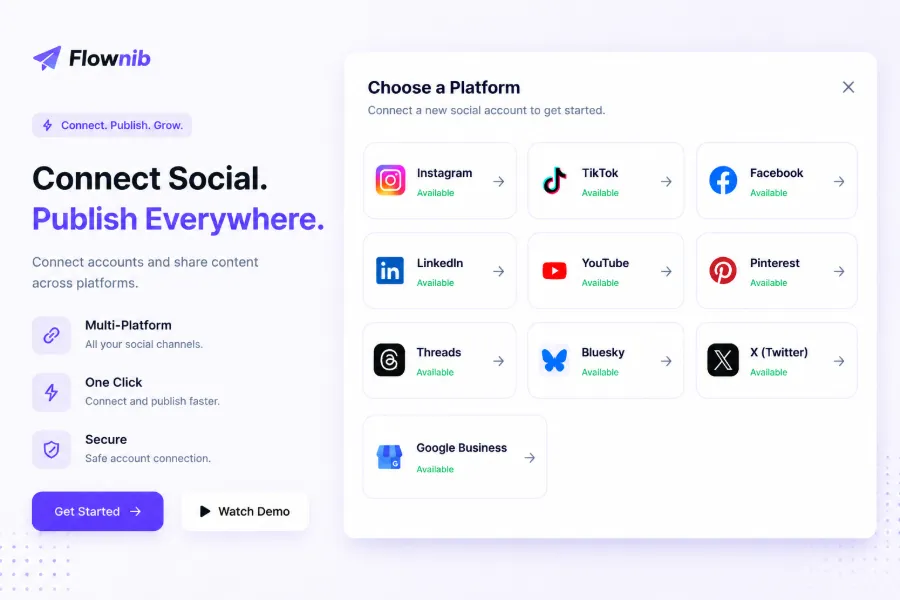
After the content system is built, distribution is the part most likely to become a bottleneck. My typical setup is a combination: write the draft with AI assistance, then use Flownib for cross‑platform distribution. The value of this tool is that you write a single piece of content, and the system automatically adjusts the style to suit LinkedIn (professional long‑form), X (short announcement), Google Business (localized), etc., publishing directly via official APIs, thus avoiding formatting errors caused by manual copy‑pasting.
The practical setup flow looks like this: write a backend article about “high‑temperature sealing component technology upgrades,” submit it, and the tool generates a LinkedIn version (preserving technical details and adding paragraph structure), an X version (extracting key selling points with a link), and a Google Business version (simplified for local customers). After preview and confirmation, a single click publishes to all linked accounts, taking no more than five minutes. On my first day of trial, formatting errors in posts dropped by three complaints.
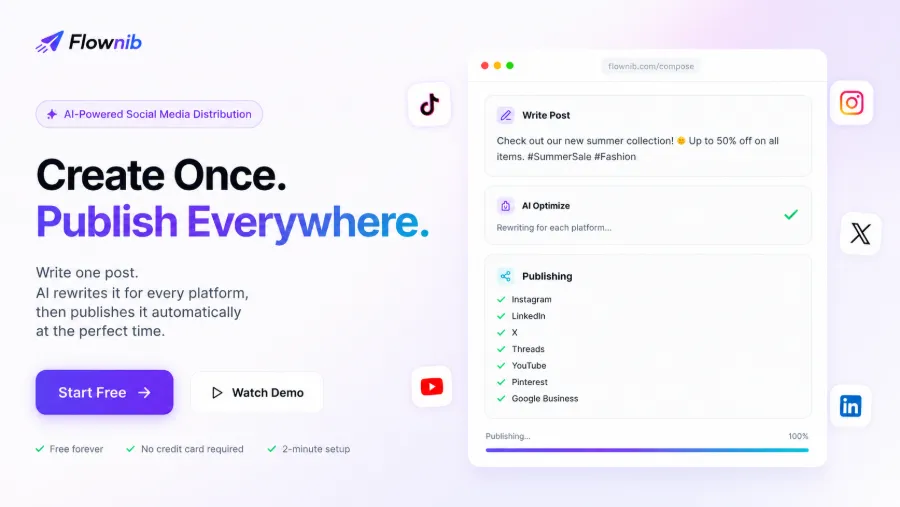
Industrial export companies often face the pain point of managing multiple accounts: different subsidiaries may have separate LinkedIn pages, or they need to operate accounts in English, German, Arabic, etc. FlowNib’s multi‑account management lets you place all accounts on a single dashboard, avoiding repeated logins and switches. The API uses official channels, guaranteeing publishing stability; I ran it for two months without any failures caused by API rate limits.
The range of official API support is also a key measure of a tool’s reliability. Many third‑party tools rely on private APIs or browser automation, which are prone to being blocked. FlowNib supports ten mainstream platforms—including LinkedIn, X, Instagram, Google Business—via official APIs. For a comparison with similar tools, see the FlowNib vs. Buffer vs. Hootsuite benchmark, which details differences in API stability and multi‑account management.
However, a common pitfall to note: the biggest trap of automation tools isn’t the technology itself, but the team’s assumption that “once set up, it’s done.” In practice, each week you need at least 15 minutes for three tasks—review last week’s platform performance data, tweak the AI rewriting template (e.g., if certain terms were simplified), and update the content pool with new cases. Without this review, the tool’s output becomes increasingly inaccurate.
From a technical architecture perspective, a more complete cross‑platform distribution solution can be found in the Cross‑Border AI Full‑Traffic Closed‑Loop Collaborative Architecture, which explains how content flows from SEO sites to social platforms, creating a closed loop.
Measuring LinkedIn Marketing Effectiveness: Key Metrics and Optimization Loop
Industrial B2B content marketing differs from consumer goods; you can’t just look at likes. Core metrics should be impressions, professional interactions (comments/shares rather than reactions), private‑message conversions (inquiry‑type messages), and resume submissions (if also recruiting). An observed rule of thumb: companies with case pages have a LinkedIn engagement rate 3.2 times higher than pure product posts. Therefore, case content should account for at least 20 % of publications.
Using the tool’s content calendar feature, you can track how many pieces were published each week and their performance. I habitually spend 15 minutes at week’s end pulling data: which content generated private messages, which keywords were repeatedly mentioned in comments, and which platform had the lowest conversion. This information feeds back into the next round of content creation.
The value of regular reviews is clear in the data. I have tracked five export factories; those that performed monthly reviews saw an average 40 % reduction in LinkedIn lead‑acquisition cost within three months. However, this figure varies; the key variable is the content’s search match quality—many customers discover you via technical keywords like “oil seal high temperature,” so the content must naturally embed core product terms and not have them simplified away during rewriting.
The content calendar, besides recording publishing history, helps plan upcoming themes. For example, focus on hydraulic system content this month, then switch to sealing technology next month. Six months of vertical content accumulation can significantly boost the LinkedIn page’s weight in search results.
This process should form a loop with the standalone site’s SEO content: high‑engagement LinkedIn articles can be further rewritten into blog posts or product pages on the site, feeding back search traffic. For a deeper look at tool costs and feature matching, see the comprehensive FlowNib price and feature analysis.
FAQ
Is LinkedIn alone enough for industrial export companies? Do we need other platforms?
LinkedIn is the core platform for industrial B2B lead generation, but relying on a single channel is not recommended. Google Business carries high weight in localized search, and X is suitable for industry news and SEO backlinks. Distributing the same content to 3–4 platforms incurs near‑zero marginal cost while dramatically expanding exposure.
Will FlowNib’s AI rewriting cause product descriptions to lose technical accuracy?
If you don’t set term protection, parameters can indeed be simplified. My approach is to build a custom industry term library in the backend, marking terms like “tensile strength” and “corrosion resistance grade” as keep fields. The initial setup takes about 30 minutes; thereafter, each rewrite automatically bypasses those keywords.
I don’t have a dedicated designer; how can I ensure image quality in automation?
Use product photos with simple white text overlay rather than elaborate graphics. FlowNib supports Reels and carousel images, but for industrial scenarios I recommend uploading raw factory shots or product close‑ups without over‑design. Engineering clients on LinkedIn dislike flashy visuals.
Our team has only two people; how much time does this process take per day?
Once proficient, total weekly time can be kept to 4–5 hours: Monday – topic selection and drafting (1 hour), AI rewrite and preview (30 minutes), Friday review (15 minutes). The key is to break content creation into pieces—writing a white paper may take half a day, but extracting two paragraphs for LinkedIn takes only 10 minutes.
Can the free plan support the daily publishing needs of industrial companies?
The free plan offers 3 social accounts and 6 posts, suitable for personal process testing. For enterprises with multilingual and multi‑account needs, a paid tier is required to bind more accounts and enjoy stable API publishing. I recommend a two‑week free trial to validate the results before upgrading.
Share Article