How to Turn One Content Idea into a Whole Week of Social Media Content

On Monday morning, I opened the content calendar and saw the whole week was blank. At 3 p.m., to fill the gap I hurriedly drafted a post, using a picture from last week and just tweaking the copy tone before publishing. This scenario repeats over and over in cross‑border e‑commerce teams and is usually labeled “creative burnout,” but the real bottleneck isn’t a lack of ideas—it’s the absence of a systematic method for breaking down a single asset, rewriting it, and scheduling it. This article explains exactly that process: produce on Monday, auto‑publish for the whole week, no inspiration needed, just deconstruction and reuse.
The marginal cost of a high‑quality asset is far lower than most people intuitively think. The content you post on Instagram reaches a completely different audience from the content you post on LinkedIn. Cross‑border sellers have audiences spread across multiple time zones; after adapting a single asset, it can be published on 8–10 platforms, extending the total exposure window of that asset to 3–5 days. Reusing assets isn’t cutting corners—it’s re‑expressing something that’s already been validated.
Why Use One Idea to Support a Week’s Content – The Underlying Logic of Asset Reuse
The marginal‑cost logic of content distribution is simple: the audience overlap for a single asset across different platforms is far lower than common perception. A cross‑border seller’s consumers on Instagram are different from the industry buyers on LinkedIn, often completely distinct groups. This means that publishing the same asset after platform‑specific adaptation does not cause repetitive fatigue among your own audience.
Differences in content formats across platforms dictate that rewriting is not copy‑pasting but “re‑expressing.” Instagram needs image‑plus‑text, X (Twitter) needs short sentences and hashtags, LinkedIn is suited for long industry insights, Threads works for short opinion statements, Pinterest for image‑based tutorials, and TikTok and YouTube Shorts require video scripts. These differences are not just formatting issues; they are fundamentally different ways of expression.
Content Repurposing and Multi‑channel Publishing are the core of this method. For cross‑border sellers, audiences in different time zones see the content at different times, naturally extending an asset’s exposure window. For example, a promotional message aimed at the North American market, when posted during Asian hours, will still reach new audiences in Europe later.

Trend scanning is the starting point for assets. Enter a keyword, and the system instantly scans Reddit, YouTube, news sites, and Hacker News for hot discussions, identifies rising topics, and turns them into publishable posts. This step solves the “what to post today” decision problem, not the “how to write it” creative problem.
Step 1: Break One Inspiration into Seven Pieces – Content Decomposition Checklist
A core asset, such as “Summer New Arrivals 50% Off,” can be broken down into many expressions. Each expression matches the optimal format for a specific platform, resulting in a seven‑day content calendar draft.
Product pages, detail pages, and FAQs are already asset libraries. Sellers don’t need to create content from scratch; existing product information, customer Q&A, and review data are ready‑made asset sources. After deconstructing an asset across seven dimensions, you can generate 7–10 differentiated posts.
| Sub‑content Type | Corresponding Platform(s) | Example Content (Summer Sale Scenario) |
|---|---|---|
| Product Announcement | Instagram, Facebook | New arrivals + 50% limited‑time discount, with product image |
| Customer Pain Point | Threads, X | Sweating a lot in summer, clothes feeling stifling? This dress solves it |
| How‑to Tutorial | Pinterest, YouTube Shorts | 3 steps to style a summer commuter look |
| Interactive Question | Instagram Stories, X | What color do you wear most often in summer? |
The key to decomposition is giving each sub‑content an independent angle, not just reposting the same sentence on different platforms. Product announcements focus on information delivery, pain points on emotional resonance, tutorials on practical value, and interactive questions on engagement. These four expressions serve different purposes and match different platform characteristics.
Step 2: Rewrite for Each Platform – The Right Way to Use AI Rewriting
Manually rewriting for each platform is time‑consuming. Different platforms have character limits, hashtag habits, and tone differences. A 200‑word promotional copy must be transformed into an Instagram image‑plus‑text caption, a LinkedIn industry insight, a Threads short opinion, etc., each requiring a fresh expression.
AI content rewriting is an efficiency tool, not a fully automated solution. The practical workflow is: input the core asset, generate platform‑specific versions. For example, input “Summer New Arrivals 50% Off,” then generate an Instagram caption, a LinkedIn industry insight, and a Threads short opinion. This reduces rewriting time from an hour to a few minutes.

The human review step after AI generation cannot be skipped. The generated content must be previewed and checked against brand guidelines before publishing. Brand names, discount levels, and product selling points are critical details that AI may misstate, requiring human validation. This step is also a good opportunity to familiarize yourself with platform guidelines such as LinkedIn’s official marketing solutions, ensuring compliance with each platform’s publishing rules.
When you need to publish more than five cross‑platform posts per day, manual processes become clearly inefficient. This is where tools like Flownib shine—they turn “create once, adapt everywhere” into an executable workflow rather than a concept. AI handles rewriting, humans handle review, and the tool handles distribution, each doing its part.
Step 3: Scheduling, Automation, and Weekly Execution – Let Content Go Live on a Pre‑Set Rhythm
The core value of scheduling (Social Scheduling) is “peak‑shifting.” Cross‑border sellers face global, across time zones, and publishing timing directly impacts exposure. Produce content on Monday night, then auto‑publish from Tuesday to Sunday, with 1–2 posts per day; schedule different times for North America and Europe on weekends.
A practical lesson: one week the team reused the same asset repeatedly without sufficient platform adaptation, and from the fourth day after publishing, traffic on multiple accounts dropped noticeably, with some posts flagged as duplicate content by the platforms. This illustrates the importance of “strong adaptation, not hard repurposing”—scheduling tools won’t solve content‑quality issues; they only publish at the right time.
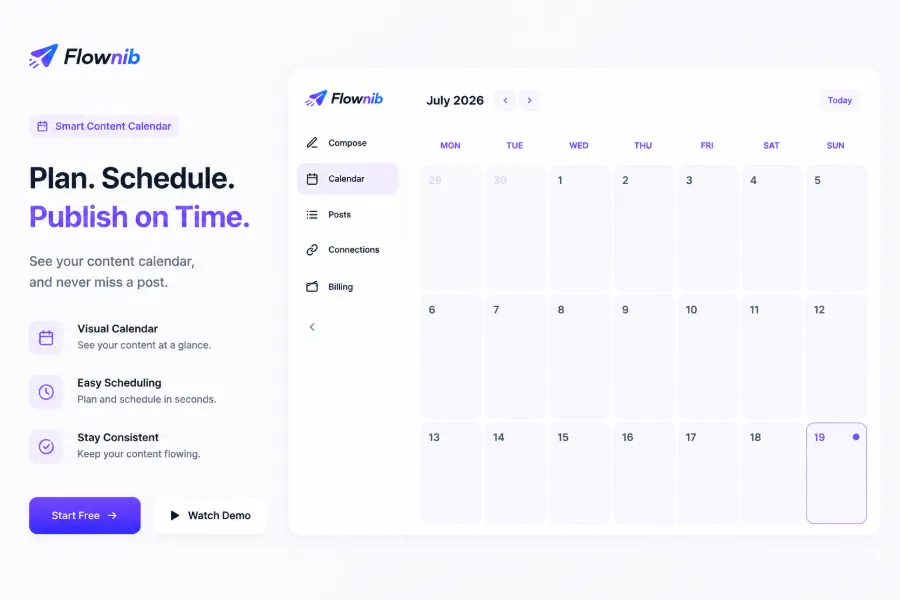
Social Media Automation handles the “publish” step; humans handle the “review” step. A content calendar tool visualizes the upcoming week’s schedule, avoiding duplication and gaps. Some tools also automatically select optimal publishing times and support multi‑account management—Flownib, for example, consolidates scheduling, multi‑account handling, and publishing records into one dashboard, eliminating the hassle of switching between multiple back‑ends.
The hidden value of scheduling is reducing decision fatigue. A fixed workflow means operators don’t have to decide “what to post today” every day; that’s the real lever of automation for a team. When publishing becomes routine, human effort can focus on content quality and platform adaptation—those truly impact results.
Step 4: After the Week – Review, Reuse, and Iterate
After the week ends, pull the data to see which platforms and which posts generated engagement. The best‑performing posts become the next week’s “new assets,” feeding back into the decomposition process and creating a content loop. Cross‑border sellers should pay attention to market‑specific response differences— the same content may perform very differently in North America versus Europe, and those insights guide future placements.

Content distribution is not the endpoint. Combining SEO, AI video, and automated distribution creates a complete cross‑border e‑commerce content stack. The full operation of the cross‑border e‑commerce content stack is worth a read: The 2026 Cross‑Border Content Stack – How It Works. The long‑term value of this method is that it turns content production from “starting from zero each time” into “continuous iteration”—each week’s review supplies better assets for the next week.
The combination of tools in the collaboration ecosystem is reshaping content operations. Understanding how the content loop works with three tools can give you the full picture: Learn How the Content Closed Loop and Three Tools Work Together. If you’re still manually copy‑pasting and switching tabs to publish, checking out the AI content creation and distribution engine intro is a worthwhile starting point: AI Content Creator & Publishing Assistant.
FAQ
How many posts per day is appropriate? Will it look like too many?
For most small‑to‑medium teams, 1–2 posts per day is a reasonable range. Exceeding three posts noticeably raises the risk of quality decline, and each platform has different tolerance for frequency—X can handle many, while LinkedIn’s exposure drops after more than two posts per day. The key is a stable rhythm, not sheer volume.
Will AI‑rewritten content make the account look robotic?
If you simply repost the same paragraph across platforms, it will feel mechanical. The correct use of AI rewriting gives each platform version a distinct angle—Instagram emphasizes visual pairing, LinkedIn focuses on industry insight, Threads on opinion output. Combined with human review, the account appears multi‑dimensional rather than robotic.
How many times can a single piece of content be reused?
It depends on the level of adaptation. Breaking one asset into 7–10 differentiated posts is reasonable, but the more you hard‑reuse without adaptation, the higher the risk of being flagged as duplicate content. It’s advisable to use a weekly cycle; after a week, decide based on performance whether to continue reusing or to create new assets.
Which time zone should cross‑border e‑commerce content be scheduled for?
Target the audience’s time zone, not your own location. If most of your audience is in North America, schedule according to EST/PST active hours; if you cover Europe, consider CET. For multi‑time‑zone operations, split the publishing plan by market—post one piece during Asian hours on Monday, another during European hours on Tuesday, and a third during North American hours on the weekend, ensuring each market sees the content during its peak activity.
Share Article