
From Trend to Brand-Ready Content: A New Generation AI Content Workflow for Cross‑Border E‑Commerce

Cross‑border e‑commerce teams often complete a sequence of actions in a single day: they spot a rising overseas discussion on Reddit or YouTube, verify the background through news sources, hand the keywords to AI to rewrite into English, Japanese, or German copy, and finally schedule posts on Instagram, TikTok, LinkedIn, and X. What really slows the process is usually not the inability to write a post, but the loss of original context, product constraints, or market information each time the workflow switches.
The focus of an AI content workflow is not to automatically generate a post, but to turn trend signals into brand content that is assessable, reviewable, localized, and sustainably distributable. It must handle topic evidence, brand archives, language versions, platform rules, and publishing records simultaneously, rather than compressing every step into a single “generate” button.
For cross‑border e‑commerce teams, a runnable process should first save the trend source and target market, then let AI generate a draft; afterward, conduct factual, brand, and market reviews, and finally rewrite, schedule, publish, and record feedback per platform. This reduces duplicate work without removing human judgment from the workflow.
First Turn Trend Signals into Assessable Content Opportunities

When a cross‑border brand discovers an overseas topic, it cannot rely on a single hot‑word search volume. A Reddit discussion may stem from real user complaints, a YouTube spike may be driven by a single review video, news sources may reflect policy, supply‑chain, or consumer‑environment changes, and Hacker News discussions often focus on technical audiences, not ordinary consumers who would buy related products.
Therefore, content teams usually need to build an initial signal pool covering at least four source types: community discussions, video content, news sources, and tech communities. Each signal should retain the keyword, original link, timestamp, discussion momentum, target market, and preliminary commercial relevance. AI can help merge similar expressions, but it cannot replace the team’s judgment on whether a topic truly fits the product and audience.
A repeatable screening process can proceed by “keyword → discussion momentum → audience relevance → commercial relevance.” Keywords locate the topic; discussion momentum indicates whether it’s heating up; audience relevance answers “who is talking”; commercial relevance ties to product use cases, purchase barriers, or brand‑solved problems. Without the last two, the so‑called trend is often just information noise.
Cross‑border teams also need to distinguish three types of signals:
- Real‑time trends: Highest content timeliness, suited for quick responses, but also highest brand risk and fact‑checking pressure.
- Sustained topics: Heat does not disappear within a day, suitable for series content with high reuse value.
- Seasonal demand: Linked to holidays, weather, back‑to‑school, or shopping cycles; publishing can be predicted, but rhythms differ across markets.
Trend discovery is not automatic hot‑spot chasing. An overseas consumer discussing “lightweight travel gear” does not mean the brand should instantly post a promotional tweet; the team must also confirm target market, price tier, inventory status, and market language. If “lightweight” in the discussion refers to weight, but the product page emphasizes compact volume, AI’s direct rewrite could misrepresent the selling point.
Before bulk production, the team can generate a week’s worth of candidate topics, then have operators label each as “follow‑up,” “awaiting evidence,” or “irrelevant to product.” For brands that need continuous publishing, this batch‑generated weekly content approach only makes sense when each topic includes its source and rationale; otherwise it merely creates a faster stream of hard‑to‑review drafts.
Trend data should also preserve the original context. Sarcasm, rhetorical questions, regional slang, and negative feedback in comments may become seemingly positive after translation. If the content team only keeps a keyword and an AI summary, later reviewers will struggle to confirm whether the brand misread the topic.
Use Brand Archives to Turn Outputs into Brand‑Ready Content
A brand archive should not be just a few tone descriptors like “young, reliable, professional.” For cross‑border e‑commerce brands, it functions more like an operational document that is continuously referenced, containing at least product selling points, product information, target audience, marketing goals, price or promotion boundaries, brand tone, prohibited expressions, and market‑specific sensitivities.
The easiest to overlook is dynamic information. Delivery times, return policies, inventory, discount deadlines, and applicable regions can all change. If these details are placed in the brand archive without an owner and update schedule, AI’s rapid generation will spread outdated information even faster. Governance must precede bulk generation.

After AI generates a draft, each trend piece must undergo three review dimensions: factual accuracy, brand consistency, and local market suitability. Fact‑checking verifies that price, specifications, inventory, delivery commitments, and discount terms have not been altered; brand review checks tone, product claims, and prohibited language; market review examines language, cultural context, currency, size, and call‑to‑action.
These three layers of review are not three reads of the same text. Fact review compares against product and operations data; brand review ensures expressions do not exceed claim boundaries; market review requires familiarity with how local users interpret “free shipping,” “limited‑time offer,” or “buy now.” A statement that works in one market may appear harsh, vague, or even regulatory‑risk in another.
Translation and localization are not the same. Translation handles language conversion; localization also adjusts currency symbols, date formats, size units, delivery promises, holiday contexts, and calls‑to‑action. For example, the Chinese phrase “现在入手” can be directly translated to “Buy now,” but in markets that emphasize rational comparison, it may need to be rephrased to a more specific product benefit and usage scenario.
Brand consistency versus platform‑native expression involves trade‑offs. Product facts, discount terms, and brand claims should stay stable, but opening style, narrative pacing, paragraph length, and interaction design can vary. The brand archive’s role is not to make every platform say the same thing, but to delineate what cannot change and what can be adapted.
Content teams can split archive fields into fixed and variable categories. Fixed fields include product specs, compliance commitments, and prohibited words; variable fields cover platform tone, current campaigns, audience slices, and content format. This adds initial maintenance work but reduces the time operators spend re‑explaining background during each review. The three‑type tool framework for content closed‑loops provides a reference framework for teams.
Adapt a Core Narrative for Multiple Markets and Platforms
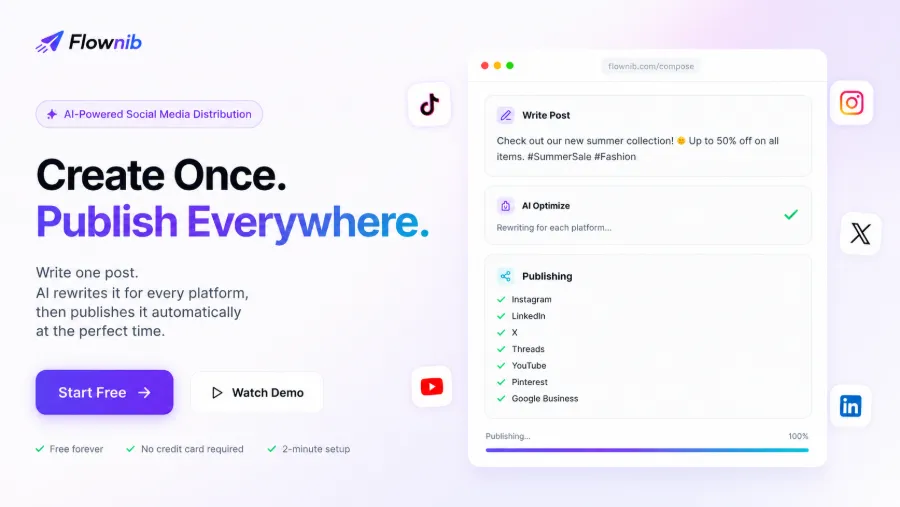
Multi‑platform content should not start from six blank editor boxes. A more robust approach is to define a core narrative first, e.g., “This lightweight jacket is perfect for short commutes in changing weather,” then rewrite it for Instagram, TikTok, LinkedIn, X, Pinterest, and YouTube according to each platform’s format.
Instagram leans heavily on visual presentation and captioned images; TikTok usually requires a faster hook and video actions; LinkedIn’s audience expects a more professional background and judgment; X is sensitive to short sentences, replies, and real‑time; Pinterest suits title organization around search intent; YouTube needs video titles, descriptions, and watch‑time considerations. Different native expressions do not give the brand free rein to alter product facts.
When AI rewrites, it should lock product specs, discount terms, applicable regions, and brand claims, then adjust title, hook, paragraph length, tags, and call‑to‑action. For example, a “free shipping over $X” offer for one product cannot be changed to “site‑wide free shipping” on a platform where that is inaccurate; using pounds in an English version for a U.S. market is not a style issue but a factual error that must be intercepted before publishing.
For professional platforms, the content team must also assess whether sufficient industry background and data support the piece. LinkedIn’s marketing resources can help operators understand the platform’s content environment, but they cannot replace the brand’s own judgment about buyer personas and purchase cycles. A consumer‑focused discount short post rewritten into corporate procurement language typically loses its original purchase driver.
When the team stops manual copy‑pasting, the real reduction is in publishing actions and tab switching, not in review responsibility. Typical initial connection flows for multi‑platform tools take about two minutes; some workflows can adapt to ten social platforms, but account permissions, image cropping, and market versions still need individual verification. Using Flownib as an example, the tool can sit in the “generate → rewrite → preview → review → schedule → publish → archive” pipeline, with operators still confirming final content at the preview and review stages.
Each step should leave distinct records: the generation stage saves trend source and prompt context; the rewrite stage saves platform version; the preview stage records images and links; the review stage logs approvers; the scheduling stage records time zones and campaign validity; the publishing stage logs API responses; the archiving stage saves the final version and publish time. Without these records, when an anomaly occurs the team can only rely on chat logs and browser history to reconstruct what happened.
The most error‑prone part is not generation but publishing checks. Cross‑border teams must sequentially verify language version, links, time zones, inventory, promotion validity, image text, and official API permissions. As manual scheduling shifts toward automated distribution, the manual‑to‑smart scheduling process can be used to audit whether the team missed approval or archiving steps.
Use Publishing Records and Feedback to Refine the Next Workflow Cycle
After publishing, the content calendar should not only show “published.” Publishing records must include market, language, platform, account, publish time, content version, link, interaction feedback, and any anomalies. For multiple versions of a core narrative, records should also retain which sentences were edited and which market used a different call‑to‑action.
Teams need to separate content performance issues from distribution issues. Low engagement or click‑through may stem from irrelevant topics, weak hooks, or unnatural localization; missed publishing may be due to expired permissions, API errors, scheduling mistakes, broken links, or time‑zone misconfigurations. Mixing these issues leads operators to mistakenly rewrite content when the fault lies in the publishing pipeline.
Platform permission checks should start with official response messages, not by regenerating content. Meta account authorizations, page permission changes, and asset‑API limits can cause publishing failures; teams can verify interface status and permission docs on the Meta Developer Platform. A 99.99 % API uptime metric is an engineering reliability reference, not a guarantee that content will receive exposure.
There was an instance where a cross‑border promotion trend was rapidly turned into English, German, and Japanese versions and scheduled across multiple platforms. After publishing, the team discovered that the brand archive’s delivery promise had not been updated: one market still said “standard delivery 3‑5 days,” while logistics had shifted to 7‑12 days, and another market’s promotion conditions didn’t apply. Operators withdrew several versions, re‑checked product data, delivery pages, and image text, missed the trend window, and incurred extra customer‑service and troubleshooting costs.
The failure exposed a version‑governance issue, not a generation quality problem. Automation reduced publishing actions but pushed the same error to more accounts, languages, and markets. The team later made delivery promises, discount deadlines, and inventory status required fields before publishing and mandated re‑confirmation for dynamic fields after a certain time limit; this slows scheduling but is far more controllable than pulling back each version after the fact.
Review cycles can be fixed to every seven days rather than only at month‑end to total interactions. Weekly, teams should compare content reuse rates, review time, publishing success rates, market‑specific content differences, and retry counts. A high click‑through for a version does not necessarily mean the topic was excellent; it may simply have been posted at a peak audience hour. Low engagement in a market does not automatically imply language failure—broken link redirects can also cause apparent content issues.
Feedback should be fed back into three places: trend‑screening criteria, brand archives, and platform‑rewrite rules. A topic that brings high clicks but low conversion for three weeks may prompt a reassessment of commercial relevance; a term that consistently causes misunderstanding in a market should be added to prohibited expressions or localization notes; recurring image‑text cropping issues on a platform should trigger preview‑check adjustments rather than asking AI to re‑describe the product.
Content reuse can expand reach but cannot erase market differences. Cross‑platform case studies help teams see how the same core narrative is recorded across channels, such as the creator’s cross‑platform content case that still requires validation against one’s own inventory, audience, and review outcomes.
FAQ
Should cross‑border e‑commerce teams do trend research first or build the brand archive first?
Build a usable minimal brand archive first, then start trend research. If product facts, delivery boundaries, and prohibited expressions are not confirmed, AI may spread errors in the first round of content; after the initial version, the team can continue enriching the archive during the weekly review cycle.
Which parts of cross‑market AI‑generated content need human review?
Human review must cover at least three areas: facts, brand, and market. Fact review checks price, inventory, and delivery info; brand review checks claims and tone; market review verifies currency, size, cultural context, and call‑to‑action. Actual review time should be recorded separately and not replaced by the few minutes AI takes to generate.
When adapting a single piece of content to multiple social platforms, which information must stay consistent?
Product facts, discount terms, applicable regions, link targets, and brand claims must stay consistent. Titles, paragraph length, tags, video hooks, and interaction styles can be adjusted per platform, but each language version should retain a content version number to avoid mixing old promotion information during scheduling.
How to determine whether a publishing failure is a content issue or a technical issue?
First check publishing records, API responses, permissions, scheduling, and time zones before evaluating content performance. If the content never went live, it is usually a distribution problem; if it is live but click‑through or engagement is abnormal, compare links, market versions, and historical data, and observe at least a seven‑day period before adjusting topic rules.
Is an AI content workflow suitable for chasing daily hot topics?
It is not advisable to make daily hot‑topic chasing the default strategy. Real‑time trends can be tested quickly, but sustained topics and seasonal demand usually yield more reusable content; only when a trend has clear relevance to product, audience, and target market, and the brand archive information has been verified, should it enter the publishing pipeline.
Share Article