
How AI Integrates Real‑Time Trends into Cross‑Border E‑Commerce Brand Strategy

Cross‑border e‑commerce teams often spot a warming topic on Reddit, TikTok, or regional news. By the time the idea passes brand review, translation, image adjustments, and multi‑platform scheduling are finished, the discussion window may already be gone. Even worse, if the team rushes to publish, they risk misreading the context, deviating from the brand tone, or copying an expression that fits only one market to global accounts.
AI can discover trends earlier, compare different signals, generate multiple language versions, and rewrite content to fit platform formats; but it cannot decide audience boundaries, commercial goals, or which topics are worth the risk. Real‑time trends solve discovery speed, not brand judgment. Cross‑border teams must first translate the trend into an expression the brand can tolerate and the target user is willing to accept before entering the publishing workflow.
Identify Trend Signals First, Don’t Chase Hotspots Directly
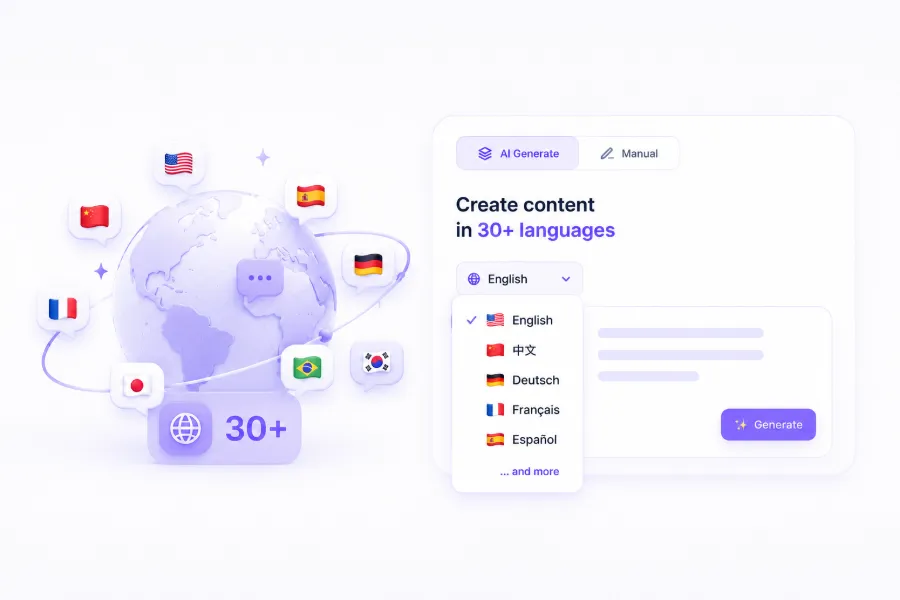
Real‑time trends rarely originate from a single place. Social discussions reflect what users are talking about, video searches reveal what users are actively looking for, news points public events and industry changes, and Reddit and Hacker News often host more niche product discussions or technical contexts. A rise in YouTube search interest does not necessarily appear in news media; conversely, a highly news‑driven topic may have nothing to do with an e‑commerce brand’s actual audience.
Therefore, cross‑border teams should not simply ask “Is this keyword hot now?” A more practical judgment order is: first look at trend velocity, then target‑market relevance, then product relevance, and finally public‑opinion risk. Trend velocity tells you how much window remains; market relevance tells you who is discussing it; product relevance tells you whether the brand can naturally join; public‑opinion risk decides if legal, PR, or local teams need to be involved.
For example, after AI ranks different signals, it might assign trend scores of 92 %, 78 % and 64 %. A 92 % topic could come from Reddit with strong discussion momentum; a 78 % topic might come from YouTube with sustained search interest; a 64 % topic could come from news, clearly time‑sensitive but with weak user engagement. Such ranking is useful for allocating human attention but should not be taken as a commercial‑value ranking. High‑score trends sometimes cluster around controversial events, and a brand’s rash entry can increase explanation costs.
Another often‑overlooked situation: the trend itself may be more valuable than the product. While tracking a discussion about “how to reduce repetitive work in small teams,” a team might initially plan to turn it into a product post, only to discover that users are actually complaining about long approval chains, not too many tools. This insight changes the content angle and prompts the team to re‑examine the target users’ work problems. Real‑time monitoring’s role is not just to publish first, but also to reveal how audience problems evolve.
Publishing time must also consider market behavior. Teams can refer to the public analysis in “Using Data to Determine Publishing Times” (based on 9.6 M Instagram posts) but should not apply the overall pattern directly to every country or account. Content that performs well during a German lunch break may need to wait several hours for a North‑American audience; trend windows, audience online times, and content‑review timelines often conflict.
Bring Trends Within the Brand Strategy Boundary
Before AI starts generating content, the brand file must provide at least four types of context: brand positioning and product information, target users, market differences, and current marketing goals. Without these, AI typically writes the trend as a generic industry comment—fluent sentences that fail to explain why the brand is joining the conversation. For cross‑border e‑commerce, product selling points are insufficient; usage scenarios, price sensitivity, after‑sales promises, and local restrictions can also affect expression.
A feasible translation process usually starts with the raw topic and narrows down layer by layer. The raw topic might be “consumers are paying attention to reusable travel accessories.” Audience pain points are luggage space shortage and cleaning hassle; product relevance can be folded into foldable design or material maintenance; the final expression becomes a usage tip that a specific market’s users can understand. AI can generate several angles, but the brand team must still judge which angles avoid over‑promising and which words could cause misunderstandings in the local context.
When the same trend enters different countries, tone, examples, and calls‑to‑action may change. Instagram suits visual scenes and short prompts; X (formerly Twitter) fits a reply to a specific discussion; LinkedIn may need industry background; TikTok must consider whether the first few seconds convey the conflict. Maintaining a consistent brand voice does not mean using identical copy on every platform; consistency lies in stance, promise boundaries, and word habits, while narrative pace and information density vary.

A brand review process should give AI a traceable modification space, not just retain the final draft. Teams need to know which version came from which trend, market, and language, who adjusted the product wording, and who approved the publish. When dealing with official APIs of platforms like Instagram, teams must also verify whether media formats, permissions, and publishing limits have changed; the social‑platform developer resources provide official API references, but a successful API call does not guarantee the content is ready for launch.
When review gets stuck on copy‑pasting and account switching, teams can look to “Automating Social‑Media Workflow Upgrades” as a reference. The focus here is not to let AI auto‑approve content, but to reduce scattered versions across chat tools, spreadsheets, and multiple browser tabs. Human checks must still be retained, especially for price, inventory, environmental claims, health statements, and sensitive public events.
Build a Workflow from Real‑Time Trends to Multi‑Platform Publishing
Once a trend enters the operating system, the process should be standardized. Otherwise, every new hotspot forces the team to renegotiate who finds topics, who translates, who confirms account permissions, and the result is often not poor content quality but a wasted window due to internal delays.
- Input keyword → discover trend → choose brand angle → generate draft → platform rewrite → human preview → schedule publish → record results.
The initial keyword should not be only a product name; it can also be an audience pain point, usage scenario, or industry controversy. After discovering a trend, first tag its source, market, language, and time before deciding whether to add it to the candidate pool. The draft only needs to validate the angle; there’s no need to create ten full versions initially. After the brand confirms the participation method, AI can rewrite according to platform style, character limits, and audience expectations.
In the actual publishing stage, workflow tools like Flownib place content rewriting, content calendars, account connections, and multi‑platform distribution into a single operation chain. For cross‑border teams, the average of about 2 minutes for initial setup and support for roughly 10 platforms mainly reduces account‑linking and duplicate distribution tasks; it does not replace brand review. Account permissions, media ratios, and scheduled publishing rules may still differ by platform.
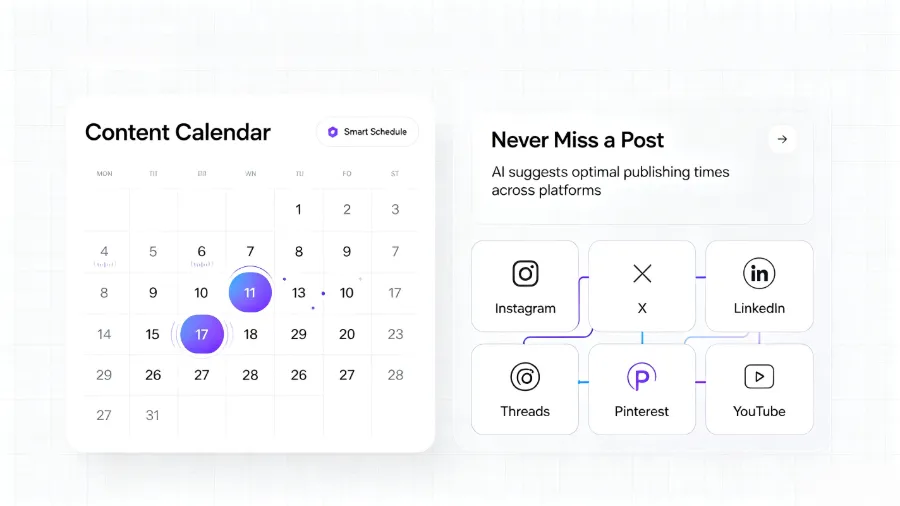
A core message aimed at multiple platforms may be rewritten as an Instagram short caption, an X viewpoint reply, a Threads supplemental discussion, a YouTube community post, a Pinterest scene description, or a Google Business local update. When adapting content across platforms, teams must check not only word count but also whether the tone still fits the brand, whether the call‑to‑action suits local users, whether links are truncated, and whether images and videos display correctly on the target platform. Differences among tools and adaptation methods can be referenced in “Cross‑Platform Content Adaptation Comparison,” but no comparison can replace real account testing.
Multi‑market operations also need to maintain three version relationships: language version, account version, and publishing‑time version. If a team only saves the final published text, it becomes hard later to determine whether a market’s poor performance was due to an unsuitable trend, a tone‑changing translation, or a platform format that prevented users from finishing the content. A content calendar’s value is not just scheduling dates; it should retain the original angle, edit history, approval status, and publishing outcome to enable quick rollback of unpublished versions before a hotspot expires.
Use Feedback to Judge Whether a Trend Really Serves the Brand
After publishing, teams should review a chain of metrics: trend response time, market reach, interaction quality, click‑through or conversion rate, comment sentiment, and brand consistency. Views only indicate that content was distributed or seen; they do not prove that target users took action. A hotspot post that garners 100 k views but no internal search, product‑page visits, or valid inquiries likely only captured topic traffic.
Interaction rates must be broken down. An increase in likes does not guarantee product understanding; abundant comments like “What does this mean?” or “Irrelevant to the video” indicate language adaptation or context judgment issues. Teams can refer to “Social Media Operations Data Analysis” for metric explanations, but in cross‑border business they must split data by market, language, and content version; otherwise, a global average will mask a sharp decline in a specific country.
A real publishing failure occurred the morning after a trend emerged: the team first confirmed the angle in English, then translated the content into German and Japanese, scheduling all three markets for the same afternoon batch. The German version missed the local discussion window due to review delays; the Japanese version retained the English wordplay, leading to semantic corrections in the comments; the English version got high exposure but no corresponding product‑page clicks. The team only realized during the next‑day review that the problem was not a wrong trend selection but the translation, review, and scheduling being treated as a single step.
The more automated the multilingual adaptation, the more important version records and human approvals become. Publishing records should answer three questions: which market had an issue, which platform had an issue, and which version was published. Using Flownib to log multi‑platform publishing history, teams can first filter by account and date, then compare click and comment‑sentiment metrics for each version; this troubleshooting is faster than searching chat logs but still cannot explain every platform‑distribution discrepancy.
Infrastructure availability should not be mistaken for content success. A 99.99 % API uptime can serve as a reference for publishing infrastructure, but it does not guarantee correct trend judgment or guaranteed exposure. A piece of content may fail to publish due to API permission or media‑format errors; another may publish successfully yet not reach users because of timing, audience interest, or platform recommendation mechanisms. Teams can use “Automating Multi‑Platform Distribution Workflow” for troubleshooting, but cannot replace content review with automation logs.
It gets even trickier when trends evolve quickly; teams may lose relevance before publishing. Some content may be perfectly timed but appear overly cautious, resembling a delayed industry summary. Operations teams must accept that some tests yield no conclusions: some versions get good exposure but no conversion, some small‑market comments are high‑quality yet insufficient to justify full rollout. These results should not be packaged as success stories; they belong in content‑version and lifecycle records.
Incorporate Real‑Time Trend Mechanisms into Daily Operations, Not Just Temporary Hype
A daily mechanism can be divided into fixed monitoring, fixed filtering, brand review, market‑specific rewriting, platform‑specific scheduling, and result review. Continuous monitoring discovers changes; fixed filtering controls noise; human review protects brand and legal boundaries; review decides whether a trend class still merits the next round. The goal is not to publish a hotspot every day, but to avoid building ad‑hoc processes whenever a hotspot appears.
The trend candidate pool needs clear expiration rules. For example, a topic that exceeds a preset time without stable discussion momentum moves from “pending review” to “expired.” Trends involving public events, health, politics, minors, or competitor disputes first go through legal review, PR confirmation, or local market assessment. Different markets may have different confirmation requirements; an English‑market approval does not automatically allow other language versions to go live.
For uncertain trend angles, a two‑stage execution is safer: test in a few markets and channels first, then expand to more markets, languages, and platforms. The first stage observes comment sentiment, interaction quality, click‑through, and brand consistency; a single trend score or one exposure result should not be the sole basis for expansion. The second stage adds account numbers and content variants while retaining the original version to avoid losing traceability of which rewrite caused performance changes.
Teams should also assign a content lifecycle: discovery, review, publish, observe, reuse, or archive. Not every trend is suitable for long‑term reuse; some lose context after three days, while others evolve from short‑term discussion into a stable user need. Distinguishing the two prevents brands from repeatedly using expired expressions just to maintain a “real‑time” feel.
FAQ
After AI discovers a trend in real time, should the brand publish immediately?
No. After discovery, the brand should first complete angle and risk screening. Cross‑border teams can make an initial judgment within minutes, but content involving sensitive events, product promises, or local regulations should still follow the established review timeline.
What information must a brand strategy provide for AI to generate more consistent content?
At a minimum, provide brand positioning, product information, target users, market differences, and marketing goals. The more specific the data, the easier it is for AI to avoid prohibited promises in the initial draft; however, each market’s final version should still undergo human review.
How should the same trend be adjusted for different country markets?
Adjust tone, examples, language habits, and calls‑to‑action, not just perform a literal translation. Teams can test in one market first, then within 24 hours or a full content cycle compare comment sentiment and click signals across markets.
How to determine whether trend‑driven content yields effective marketing results rather than just short‑term exposure?
Look at reach, interaction quality, click‑through, conversion rate, and comment sentiment together. If views rise but product‑page visits and target‑user actions do not, the content likely only captured topic traffic and did not serve the brand.
Which steps still require human review when publishing synchronously across platforms?
Product price, inventory, legal or health statements, sensitive contexts, translation wordplay, and final media presentation should all be manually checked. Even if multiple platforms publish in the same batch, a random spot‑check of each market and account version before scheduling is advisable.
Share Article