
Cross-Platform Publishing That Doesn't Look Like “Copy‑Paste”: Practical Content Adaptation for Cross‑Border Sellers

When a product piece is copied verbatim to Instagram, LinkedIn, X, TikTok, and Threads, Instagram’s engagement rate drops below 0.5 %, a professional‑style post on LinkedIn looks like an amateur ad, and X folds the post automatically. This is a wall many cross‑border sellers hit when expanding their account matrix: multi‑platform distribution is a necessity, but mechanical copy‑paste is the fastest way to erode brand perception. This article does not pile up tool lists; it explains the methodology for “making every piece of content feel native on each platform,” from manual rewriting to scalable workflows.
Answering the title directly: the core of cross‑platform publishing that doesn’t look like copy‑paste isn’t “publish more,” but “rewrite each piece.” The same core message should be visual‑first on Instagram, opinion‑first on LinkedIn, short‑sentence‑first on X, and narrative‑first on TikTok. Length is only the shallowest layer; tone, structure, hashtags, and layout habits must also adapt to the platform. Only then does each piece feel native to its platform.
Why “Copy‑Paste‑Style” Cross‑Platform Publishing Is Destined to Fail
First, a real scenario. A cross‑border seller pasted the same English product copy onto LinkedIn and Instagram. On LinkedIn the professional audience ignored it; on Instagram the algorithm throttled it, and follower growth stalled for the next two to four weeks. This failure isn’t accidental—it’s the inevitable result of a copy‑paste approach.
Each platform’s algorithm identifies duplicate and low‑engagement content differently. Instagram’s recommendation logic heavily relies on first‑screen interaction rates; a post flagged as “low quality” directly reduces the exposure weight of subsequent content. X’s algorithm has a more sensitive folding mechanism for repeated text in a short time frame. LinkedIn’s feed favors professional discussion; a post with only product description and no viewpoint struggles to enter the recommendation stream. Cross‑border sellers typically need 2–4 weeks to notice the follower stagnation and interaction drop caused by copy‑paste, and by the time the data surfaces, the account’s weight has already been dragged down.
Audience expectation mismatch is another underestimated issue. The same copy feels completely different in each platform’s context: Instagram users expect visual appeal, LinkedIn users expect industry insight, X users expect concise viewpoints. A copy that feels normal on Instagram appears shallow on LinkedIn and overly long on X.
The hard wounds caused by differing content formats are even more direct: character limits, image specs, video lengths—each requires fresh adaptation. Brand dilution is a long‑term cost—copy‑paste makes the account’s image fragmented across platforms; users seeing identical copy on different platforms immediately judge the brand as “not carefully managed.”
Cross‑border scenarios amplify all these problems. Language, culture, and time‑zone differences make the “copy feel” even more obvious. An English copy posted directly to German or Japanese markets is not only grammatically stiff but also mismatched in expression habits. If you don’t want to stumble on selection, see the logic for choosing an all‑in‑one social media tool, which outlines basic considerations for multi‑account management and content adaptation.
The collaborative operation of a cross‑border content stack is more complex than most imagine; SEO, AI video, and automatic distribution must work together rather than in isolation.
Understanding Each Platform’s “Mother Tongue”: Native Content Rules
Every platform has its own content shape and audience expectations. Instagram is visual‑first; image and video quality determine whether users stay. LinkedIn favors professional long‑form; viewpoints and industry experience are core. X values concise short sentences, with a 280‑character limit and high information density. TikTok relies on short‑video storytelling; the first three seconds hook determines completion rate. Threads sits between X and Instagram, with a more relaxed tone.
Hashtag quantity and placement habits differ completely across platforms. Instagram typically uses 5–10 hashtags placed at the end of the caption; X needs only 1–2 hashtags, and too many look spammy; LinkedIn should have no more than 3 hashtags, placed at the end; TikTok’s hashtags directly affect search traffic and should align with trending topics.
Tone and audience expectation differences are also evident. Formality, emoji density, and conversational level each have their own “native language.” A LinkedIn post with three emojis looks unprofessional, while the same emoji density on Instagram is perfectly normal. Conversational expression is standard on X, but LinkedIn requires more restrained wording.
Platforms also have hidden criteria for duplicate content. Image hashing is common—uploading the same image on different platforms can be detected via hash values. Link redirect paths are recorded; the same short link appearing repeatedly across platforms is likely flagged as promotional. Cross‑border sellers are often unprepared for this.
Scheduling mindset is often overlooked. Audience active periods vary greatly across platforms; a post scheduled for North American evening may hit Europe in the middle of the night. Time‑zone mismatches cause content to miss the golden interaction window. Instagram Business account operating guidelines are worth consulting for many details on content and account maintenance.
| Platform | Content Shape | Character/Length Limit | Tone Style | Hashtag Usage | Ideal Content Shape |
|---|---|---|---|---|---|
| Visual‑first | 2,200 characters | Friendly, visual | 5–10, placed at end | High‑quality image + short caption | |
| X (Twitter) | Concise short sentences | 280 characters | Conversational, direct | 1–2, keep few | Viewpoint + link |
| Professional long‑form | 1,500–2,000 characters (common) | Formal, professional | 1–3, placed at end | Industry insight + experience share | |
| Threads | Relaxed dialogue | 500 characters | Casual, authentic | 1–2 | Daily observation + engagement question |
| TikTok | Short‑video storytelling | 15 seconds–10 minutes | Entertaining, fast‑paced | 3–5, affect search | Hook + quick narrative |
X’s 280‑character limit and LinkedIn’s typical 1,500–2,000‑character long‑form determine that the length gap forces a rewrite, not a simple truncation.
Rewrite, Not Copy: Make Every Piece Feel Native
Rewriting isn’t just shortening or lengthening a paragraph; it’s reorganizing the content for the platform. Changing the opening hook is the most direct method: Instagram can start with a visual description, LinkedIn with an industry question, X can launch straight into a conclusion, TikTok should begin with a suspenseful hook.
Adjusting narrative structure is equally important. The same core message fits a “Problem‑Analysis‑Conclusion” structure on LinkedIn, a “Conclusion‑Evidence” inverted pyramid on X, and a “Scene‑Emotion‑Action” rhythm on Instagram. Expanding or condensing information must follow the platform: LinkedIn can elaborate background, X keeps only the core viewpoint.
Tone and diction adjustments outweigh length changes. Formality, emoji density, and conversational level must be recalibrated. A caption that feels natural on Instagram needs most emojis removed and a more restrained expression on LinkedIn.
Identifying “implicit copy fingerprints” is a step many overlook. Layout habits, emoji density, hashtag syntax, emoji placement—all these details form a content “fingerprint.” Readers and algorithms pick up on these fingerprints—if two platform accounts use identical layout habits, users instantly notice the copy‑paste.
Content repurposing involves breaking the same core message into different angles. A product feature intro can become a usage‑scenario showcase on Instagram, an industry pain‑point analysis on LinkedIn, a concise viewpoint on X, and a daily observation on Threads. Re‑combining assets gives each piece independent value.
Manually adapting a single piece for 4–5 platforms usually takes 5–15 minutes more than straight copying, but the interaction quality difference is clear. The extra time yields a native feel on each platform and long‑term account weight accumulation. To learn about automated rewriting and distribution workflows, see the workflow for automatically rewriting and redistributing content to ten platforms.
A quality‑check checklist for each platform version can be run through: Is the opening hook rewritten for the platform? Does the tone match platform conventions? Are hashtag quantity and placement compliant? Does emoji density match? Does the layout resemble native content? Are image specs appropriate? Is the link using a platform‑approved redirect? Threads’ content characteristics are special—it sits between X and Instagram, with a more relaxed tone suitable for daily observations.
Scaling Adaptation and Distribution with Workflows
Purely manual processes hit a clear time‑cost ceiling: copy‑paste per platform, switch tabs, edit repeatedly—half an hour disappears on a single piece across 4–5 platforms. When content volume grows, this process becomes unsustainable.
Content calendars, multi‑account management, and scheduling dramatically reduce error rates. A calendar lets the whole team see the publishing plan, avoiding duplication or omission; multi‑account dashboards centralize accounts, cutting switch costs; scheduling posts content at optimal times automatically, removing the need for constant monitoring.
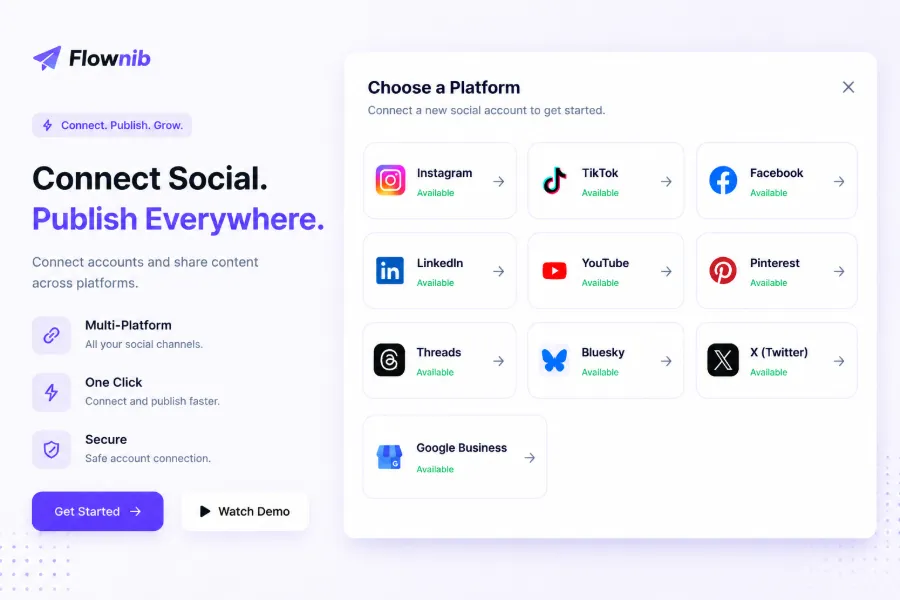
Connecting directly to each platform via official APIs guarantees stability and compliance. Platform API availability can reach 99.99 %, average onboarding takes about 2 minutes, and a single platform limit can be expanded to 10 social channels. Compared with third‑party scraper solutions, official APIs are more stable and less likely to trigger platform risk‑control mechanisms.
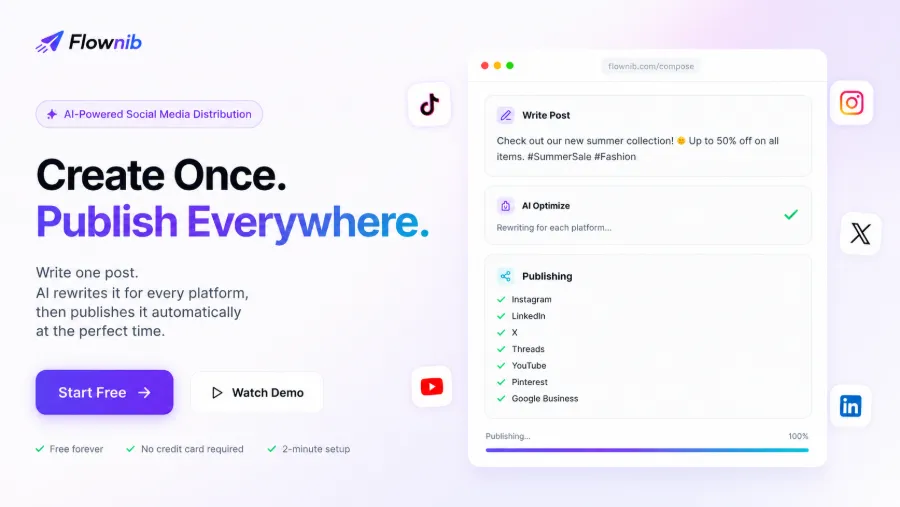
The manual methodology translates into tools and automation in a few steps: AI rewriting, one‑click distribution to each platform, scheduled publishing. AI rewriting handles the “rewrite each piece” burden; one‑click distribution eliminates inefficient tab switching; scheduling solves time‑zone mismatches. Checking Instagram’s scheduled posts lets you confirm that the plan is executing as expected.
Automation platforms like n8n, Zapier can handle many steps, but social‑media distribution is often the missing piece. Many teams use n8n to fetch data and generate content, then get stuck at “how to push the content to each platform.” The social‑media gap in n8n and Zapier users is precisely where such workflows need the most help.
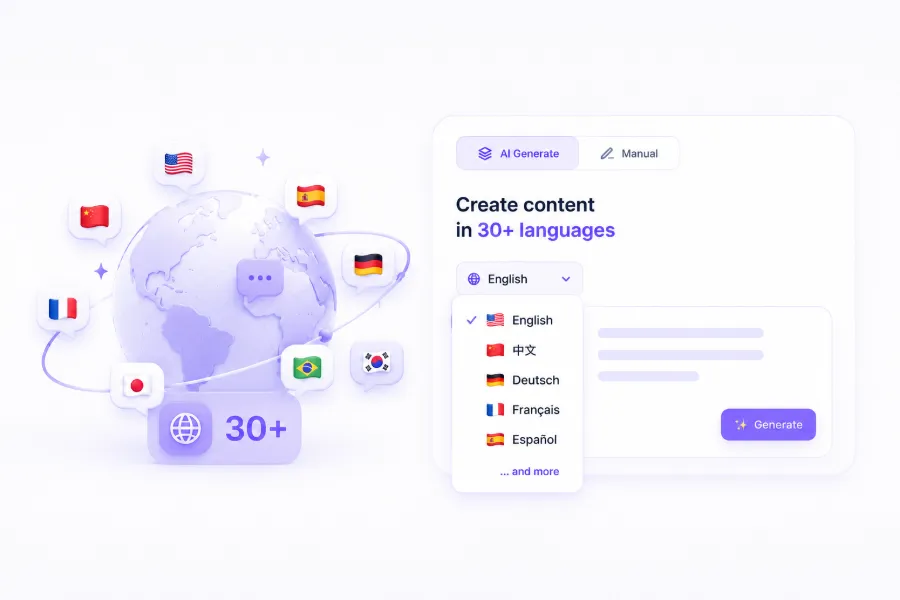
In this stage, tools like Flownib address workflow friction: write once, AI rewrites for each platform, then official APIs distribute to connected accounts. It doesn’t replace strategy; it compresses the “copy‑paste, switch tabs, edit repeatedly” process into a single operation. For cross‑border sellers, multilingual market adaptation can also be completed in the same workflow, without maintaining separate publishing processes for each market.
Automation isn’t a panacea. AI‑rewritten content still needs human preview, especially for brand tone and professional judgment. Tools reduce repetitive labor, but the judgment of “does each piece feel native” ultimately remains a human responsibility.
FAQ
Do I need a separate image for each platform when publishing cross‑platform?
Not necessarily, but it’s recommended to recrop for each platform’s specs. Instagram favors 1:1 or 4:5 vertical images; X and LinkedIn commonly use horizontal ratios; TikTok requires a 9:16 vertical video thumbnail. Using the same image across platforms without proper cropping often looks sloppy.
Can I use the same hashtags on different platforms?
Yes, but quantity and syntax should follow each platform. Instagram typically uses 5–10 hashtags; X is fine with 1–2; LinkedIn looks spammy with more than 3. Hashtag style also varies—Instagram can use long‑tail tags, while X prefers short, trending tags.
When cross‑border sellers publish in multiple languages, does machine‑translated content look like copy‑paste?
It does. Machine‑translated copy carries a noticeable “translation tone” in grammar and expression habits, which users can spot instantly. Multilingual adaptation should include at least one round of human polishing to adjust phrasing to the target market’s native level, rather than relying solely on raw machine translation.
If content is highly similar but posted on different platforms, will the platforms flag it as duplicate?
It depends on similarity. Pure text duplication is easily detected, but rewritten content usually avoids the flag. Image hashes and link redirect paths are also recorded; the same image or short link repeated across platforms is more likely to be marked. Rewriting text, swapping images, and using different links effectively reduce risk.
How should I prioritize keeping a unified brand feel while making each piece look native?
First preserve brand tone, then adapt platform‑specific voice. Core brand information, visual style, and values stay consistent, but the expression method follows the platform. In other words, a unified core with different shells—brand perception comes from the conveyed values, native feel comes from matching platform conventions.
Share Article