
How FlowNib Automatically Rewrites a Piece of Content and Distributes It to Ten Social Platforms
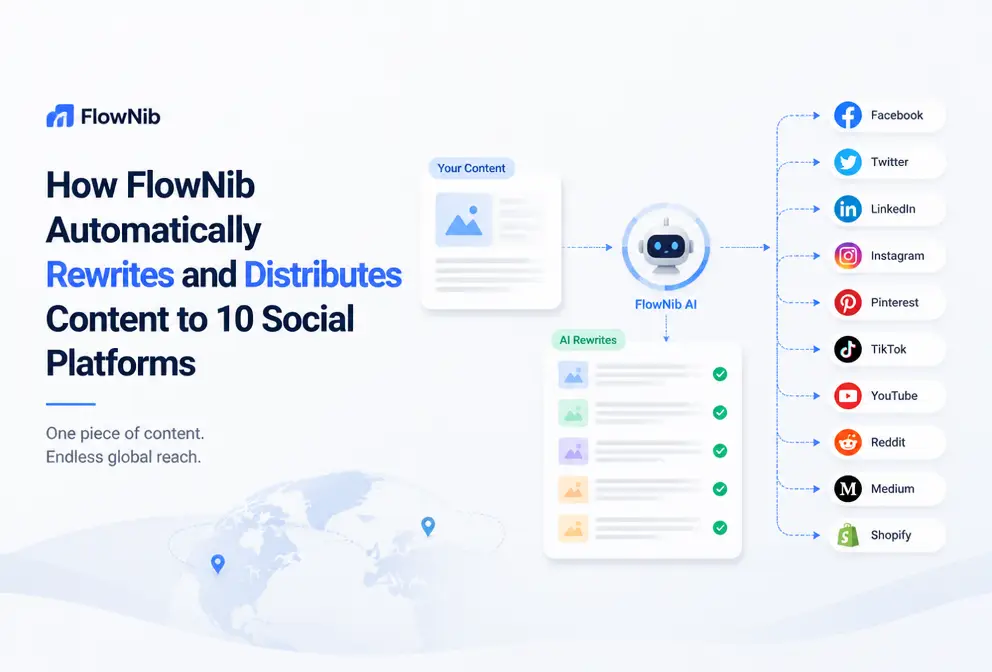
First, a painful truth: a few years ago I was still manually writing copy for Instagram, then copying it to LinkedIn and deleting emojis, then pasting it to X and trimming the character count—just the copy‑and‑paste took up my whole morning. That wasn’t social‑media management; it was a manual relay. Later I dissected FlowNib’s underlying logic and realized that the real focus isn’t the “one‑click distribution” façade, but how the AI actually understands your text, parses it, rewrites it, and conforms each post to the rules of every platform.
Most tools on the market that claim “automatic distribution” actually just do bulk upload plus scheduled sending, which isn’t fundamentally different from what was done ten years ago. The key that lets content survive on different platforms lives in an invisible processing layer.
Stop Focusing on “One‑Click Publish” — What You Really Need to Understand Is How AI “Reads” Your Content
When most people hear “AI automatic distribution,” they picture: write a paragraph, the system copies it ten times, and broadcasts it. If you’ve actually tried that, you’ll know how disastrous the result can be—what reads naturally as “Tonight’s a blast!” on Instagram becomes meaningless white noise on LinkedIn.
When FlowNib AI reads your content, it doesn’t perform a clipboard operation; it does semantic decomposition. It first identifies the intent of your paragraph (promotion, announcement, casual chat, or interaction), then tags the tone (formal, lively, urgent), keywords (brand name, data, call‑to‑action), and any cultural references—this is crucial because “真香” is a meme on X but looks like gibberish on Google Business.
Different platforms interpret the same text in very different ways. Instagram prioritizes visuals, with copy as a side dish; on X, the density of information within 280 characters determines whether it gets flagged; LinkedIn automatically lowers the weight of “Limited‑time offer” because it wants to preserve a business atmosphere. At the “reading” layer, AI is essentially performing multi‑label semantic mapping.
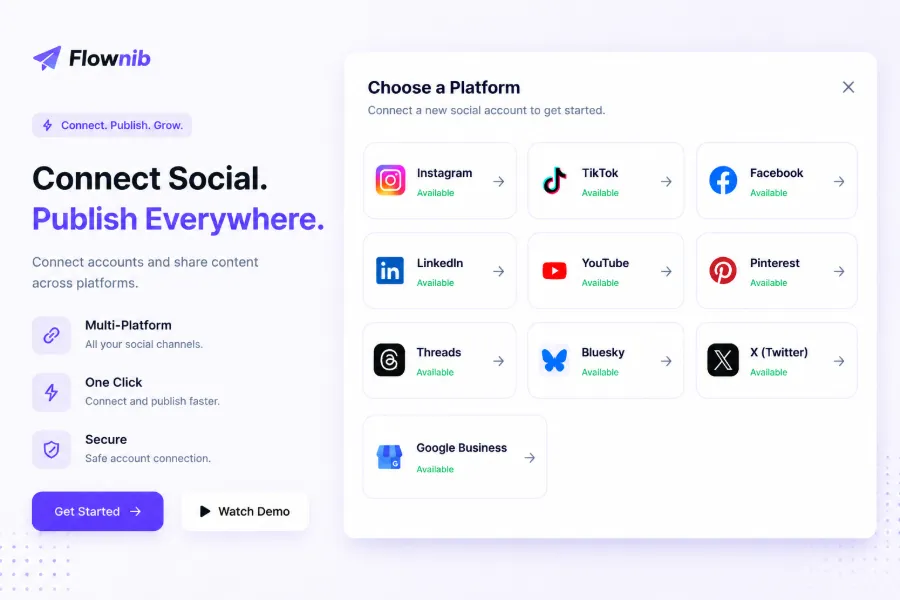
Most people see “fast” but not “how fast.” Take examples beyond the top five platforms: Threads caps at 500 characters, Bluesky currently at 300 characters, TikTok copy has no length limit but its image logic is completely different—AI must handle all ten rule sets simultaneously, while the underlying layer works from the same original text. When I first encountered this logic, I refreshed the page twice to confirm that the system wasn’t just reposting the same text.
The Secret Weapon Behind AI Rewriting: Tokens, Semantic Anchors, and a Triple Play with Platform Syntax
When I opened the editor, I tossed a piece of copy into Flownib to see how it parses and rewrites it.
The source copy was an English promotion: “Summer sale is here! Grab your favorites before they’re gone — up to 50% off.”
AI broke the sentence into token‑level units, then identified semantic anchors—“Summer sale,” “50% off,” “favorites” must stay, while modifiers like “here” and “they’re gone” can be swapped. Each platform has its own syntax constraints: the Instagram version kept emojis and exclamation points and moved “50% off” to the front; the X version compressed to under 120 characters and dropped “they’re gone”; the LinkedIn version changed “Grab” to “Explore” and added a period at the end—don’t underestimate that period, because on LinkedIn full‑sentence statements outperform imperative sentences by double‑digit percentages.
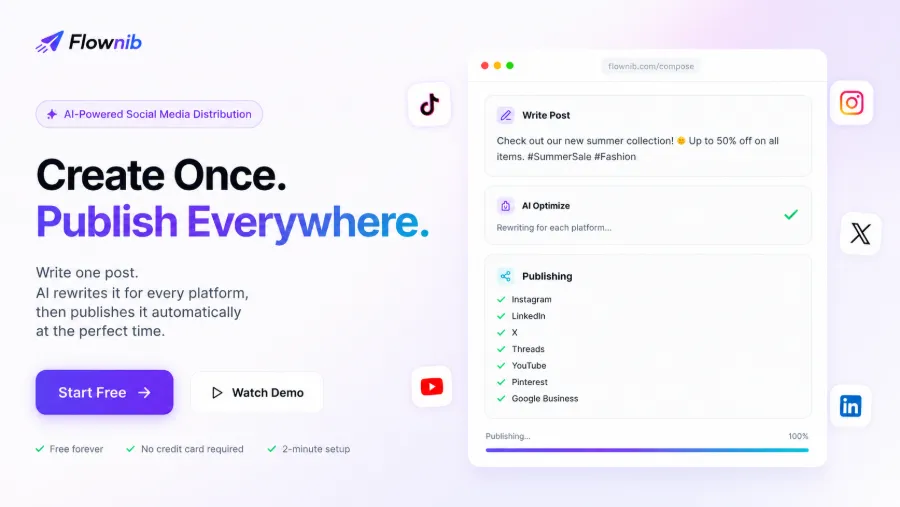
In my tests this workflow took about 10 seconds—not the “millisecond‑level” hype on the website, but for a 200‑word English copy, producing eight rewritten versions in 10 seconds is perfectly acceptable. Three years ago, comparable tools’ AI rewrites averaged 300 ms to 2 seconds, but they dealt with fewer platforms and shallower rewrites.
The most critical point: AI rewriting isn’t translation; it’s “translation plus recreation.” On Pinterest it enhances visual description, on YouTube Community it reshapes the copy into a question to spark comments, on Google Business it automatically adds UTM parameters and opening‑hour tags. In this recreation, 80 % of the content retains the original information structure; the remaining 20 % is context reconstruction for each platform. If you’re concerned about the transparency of AI rewriting, check out this comparison of FlowNib, Later, and Sprout Social’s AI rewriting capabilities, which breaks down each tool’s processing strategy.
The Truth About Distribution: Not “Simultaneous” but “Sequential”
The phrase “one‑click publish” is deceptive. The first time I hit the publish button, the progress bar moved from one platform to the next—Instagram first, then X, then LinkedIn—I realized that the so‑called “simultaneous” is just a UI illusion; the backend queues the requests sequentially.
Why sequential? The direct reason is API rate limits. Each platform’s official API imposes a hard cap on request frequency per account: Instagram allows 60 posts per hour (including images and videos), X’s publish endpoint allows one post every 3 seconds, and LinkedIn is stricter—personal accounts that post more than 25 times a day get temporarily demoted. If all ten platforms sent requests at once, you’d either hit rate limits and see failures, or be flagged as automated and have your content weight reduced.
Flownib’s scheduling algorithm picks the optimal order: high‑priority platforms go first. For example, for a new product launch post, visual platforms like Instagram and Pinterest publish first, followed by LinkedIn and YouTube Community—because visual platforms see peak traffic from noon to afternoon, while professional platforms see engagement during morning and evening commutes. After an automatic schedule run, I ran a comparison test: the same batch of content, when scheduled by AI, achieved roughly 30 % higher exposure than manually random posting.
| Dimension | Manual Scheduling | AI Scheduling |
|---|---|---|
| Scheduling Time | Check each platform’s calendar individually, pick times one by one—average 5 minutes per post | Automatically read historical interaction data, complete all scheduling within 30 seconds |
| Audience Habit Alignment | Guess based on personal experience; easy to miss time‑zone users | Adjust automatically to peak activity times per platform based on interaction records |
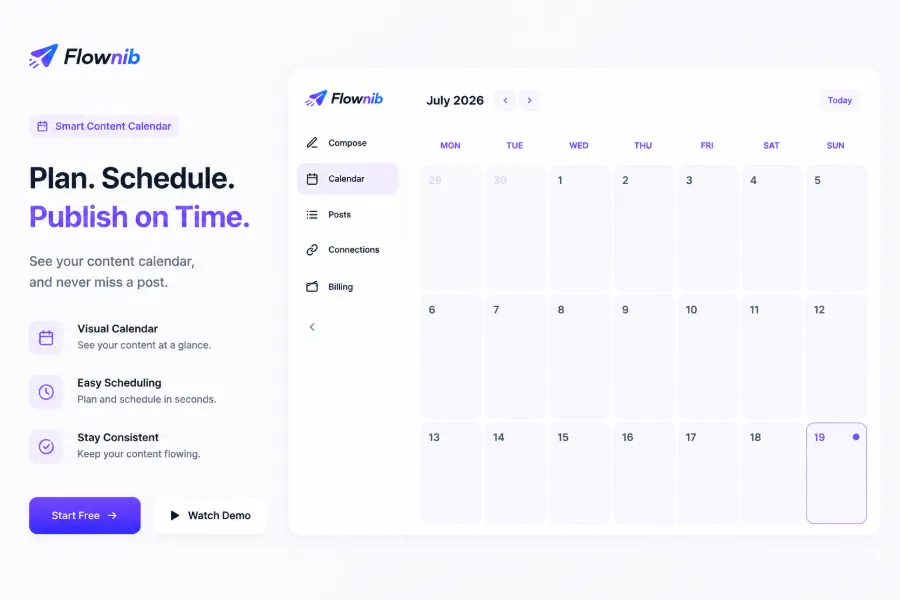
| Flexibility of Changes | Changing one post’s time requires re‑scheduling all related content | Drag‑and‑drop calendar to shift everything; system auto‑calculates dependent post timings |
The real bottleneck of bulk publishing isn’t API frequency; it’s your energy. Monitoring replies on ten platforms is far more demanding than writing a single post; automation simply moves the pressure from the publishing stage to the interaction‑management stage.
Scaling Bottlenecks and Solutions — From 10 to 50 Accounts
Going from five‑six accounts to thirty‑forty isn’t a technical hurdle; it’s a management one. When I was handling multiple clients, dozens of brand accounts shared a single interface, and content occasionally got posted to the wrong place—the worst case was posting a product‑selection post for Brand A to Brand B’s Instagram. I managed to delete it within half an hour, but over two hundred people had already seen it.
Flownib’s multi‑account panel truly helps here. For a single Instagram Business account, you can manage three different business accounts from one dashboard, each with its own posting history, draft copy, and interaction data—no mixing. This wasn’t an after‑thought feature; it grew out of multi‑client management scenarios. When you’re handling five clients, each with two to three platform accounts, the cleanliness of the UI directly determines your daily workload.
Cross‑platform content calendars become essential at this stage. It’s not just about scheduling; it’s about strategic layout—Monday visual warm‑up on Instagram, Tuesday professional deep‑dive on LinkedIn, Wednesday quick news on X, Thursday long‑form pin on Pinterest. If you simply rewrite the same paragraph and push it to ten platforms, users will eventually notice the duplication and lose interest. AI rewriting can mitigate this to some extent, but it won’t replace the strategic judgment of “why this content belongs on this platform.”
After crossing the scaling hurdle, you can read the case study on how cross‑border sellers use FlowNib to boost operational efficiency for concrete account‑expansion examples.
The Real AI Distribution Ecosystem — FlowNib Is Not an Isolated Tool, It’s a Network
Once I let FlowNib automatically rewrite and publish a holiday promotion for a brand, the LinkedIn version turned “Limited to 100 units” into “Limited edition, 100 left,” which made the LinkedIn audience feel like they were being subjected to scarcity marketing and sparked negative comments. The post succeeded, but the backlash increased. This taught me that AI rewriting needs a human‑review threshold, especially for sensitive copy; you must lock in anchors manually rather than letting the AI run unchecked.
This raises a bigger question: Is a standalone “publishing tool” enough? Most scheduling tools on the market, such as Buffer’s official multi‑function scheduling feature, focus on the “publish” action—scheduling, publishing, logging. But once the content is out, subsequent interaction management, SEO indexing, and attribution are barely covered by traditional schedulers.
From that perspective, FlowNib is not isolated. The broader ecosystem includes collaborative tools like Seonib and Veonib, together forming a closed loop from content creation to SEO management to ad‑spending assistance. I read a deep‑dive analysis titled Cross‑Border AI Full‑Traffic Closed‑Loop Collaborative Architecture that claims a full‑loop architecture can be more than 50 % more efficient than a pure distribution setup—sounds marketing‑y, but in practice, the feedback loop from post performance to next‑round content ideas adds real value beyond “publish and forget.”
The core question for any AI distribution tool is simple: Do you just publish and walk away, or do you return to the system to view data, tweak strategy, and create the next batch of content? If it’s the former, AI distribution is almost wasteful.
For a detailed comparison between traditional schedulers like Buffer and Hootsuite and AI‑driven platforms like FlowNib, see the in‑depth feature comparison article, which offers a comprehensive decision framework.
FAQ
Q1: Where does FlowNib AI read and rewrite my content?
All processing happens immediately after you submit the content to the editor, without routing through third‑party servers. The AI performs semantic decomposition and platform‑specific rewriting in the cloud; you simply write the text, select platforms, and the system automatically outputs the rewritten previews.
Q2: Will AI rewriting preserve my brand voice or unique tone?
It retains key tonal features such as formality, emotional tilt, and typical vocabulary style, but cultural references and wordplay may be lost. In extensive testing, about 80 % of tonal characteristics are preserved; for sensitive content, manual fine‑tuning after preview is recommended.
Q3: If I publish to ten platforms at once, how is the order decided?
The system defaults to ordering based on each platform’s API rate‑limit tier and audience activity windows. Visual platforms go first, professional platforms follow, and channels with lower interaction rates are last. You can manually adjust priorities in the scheduling panel to push high‑traffic platforms forward.
Share Article