More Platforms Won’t Help: Unadapted Content Is Just Wasted Effort

I used to be that kind of person—signing up for seven social platforms in one go: Instagram, X, LinkedIn, TikTok, YouTube, Pinterest, and Facebook, thinking I’d immediately make some noise. The result? After three months I became a full‑time content mover: opening seven tabs each morning, copy‑pasting the same copy line by line, tweaking the length, posting, and then clocking out. The data? Disastrous. The cute meme on LinkedIn got no likes, the serious data analysis on TikTok wasn’t watched to the end, and the 200‑word Instagram post was collapsed and never seen. I spent the most time doing the most boring work and got the worst results.
Many people share this illusion: more platforms equal more traffic. The truth is, if your content isn’t individually adapted for each platform, registering a hundred accounts is pointless.
You Think More Accounts = Explosive Reach? Look at This Common Mistake
My first mistake was especially foolish—I thought the content was the same, only the platform changed. So I wrote a piece of copy, copied it to Instagram, X, LinkedIn, and just tweaked the character limits. I thought that was efficient, but it was actually a slow self‑destruction.
Platform algorithms favor native content. Posting a flirty, emoji‑filled post on LinkedIn will automatically lower its recommendation weight; posting a text‑only, pure‑value video on TikTok will be swiped away after two seconds. Industry estimates suggest that the same piece of content, without any adaptation, sees interaction rates drop by more than 40 % on non‑native platforms. My own experience was even more extreme—copying a hashtag‑laden product‑marketing post from Instagram to LinkedIn dropped likes from hundreds to single digits.
Worse still is the time cost. I spent three months populating seven platforms, copying and pasting for two hours a day, not counting reformatting, resizing images, and re‑layout. The content quality plummeted—rushed posts became more perfunctory, and the data worsened. This created a vicious cycle: more accounts → more time spent moving content → poorer content → traffic falls instead of rises.
Eventually I realized the problem wasn’t the number of platforms, but that I was “moving” content instead of “adapting” it.
Traffic Secrets Aren’t About Platform Count, They’re About “Content Adaptation”
What is content adaptation? Many think it’s just adjusting length, but it’s far more. Each piece of content must be re‑crafted for a platform’s tone, format, visual language, and user expectations. On LinkedIn, the audience wants industry insights and professional judgments; a natural post might read, “Just read a report and noticed a trend worth watching.” On TikTok, you need to grab attention in the first three seconds with a visual hook and a one‑sentence teaser. On X, you have only 280 characters, so you compress the core idea into a shareable soundbite. Instagram thrives on visual storytelling, with a caption that drives clicks via a comment‑section link. Each platform demands a completely different expression style; forcing a single template across all channels is treated as low‑quality signal.
How exhausting is manual adaptation? Anyone who’s done it knows. A team typically spends about 10 hours per week on manual adaptation. I once managed five accounts alone, and by the weekend my back was sore and my brain refused to see any more copy.
That’s when I realized I needed a tool to handle the minutiae for me. After trying a few, I discovered Flownib. Its logic is simple: I write one piece of content, AI automatically generates platform‑specific versions, I preview and confirm, then publish with a single click—no tab‑switching. I was skeptical at first—could AI really grasp the tonal differences between LinkedIn and TikTok?
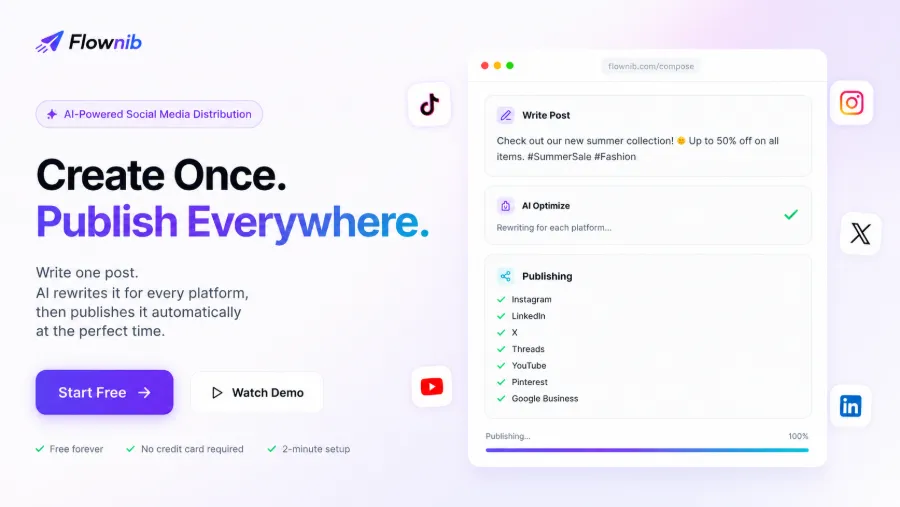
After a few attempts, the results were surprisingly good. The same strategy‑selection experience became a data‑rich industry note on LinkedIn, a concise viewpoint + poll link on X, and a carousel of images with brief copy on Instagram. Each version retained the original intent but presented it in a completely different format.
Tools like Later help schedule posts across platforms, but they don’t rewrite content—you still have to adapt each post manually. If you’re stuck at this step like I was, you need more than a scheduler; you need automatic rewriting.
How AI Automatic Adaptation Turns “Movers” Into “Publishers”
Let’s talk specifics. I wrote a ~300‑word piece on how to warm up social media before a product launch on Flownib. In under ten seconds, AI generated six platform versions: an X tweet compressed into a hashtag‑rich short sentence, a LinkedIn post turned into a three‑point list, an Instagram caption with visual cues, and a YouTube script structure. I previewed, made minor tweaks, set the publishing time, and clicked send. The whole process took less than five minutes.
Doing the same manually would have taken at least half an hour—pure mechanical labor with no strategic thinking.
Two key differences are worth noting. First, manual adaptation cost isn’t linear; it grows exponentially. One account takes five minutes per post; five accounts require five different versions per post, not just a few word changes. Second, AI adaptation isn’t merely translating a paragraph into another tone—it reconstructs structure and rhythm. The same topic on LinkedIn may follow a “data + conclusion + recommendation” flow, while TikTok needs a “hook + visual impact + quick cut” format. The information density and structure differ completely.
I ran a rough comparative test: ten pieces of content, manually adapted for each platform versus AI‑generated by Flownib. The manual group took nearly three hours, with two incidents of truncation due to character limits; the AI group took under thirty minutes total, including preview adjustments. The gap was so large I questioned what I’d been doing for six months.
If you’re torn between juggling multiple tools, check out this Flownib vs. Later vs. Sprout Social comparison. In my view, scheduling tools solve “when to post,” while content adaptation solves “what to post.” If the content itself isn’t platform‑appropriate, perfect timing won’t help.
Another point is setup cost. Registering and connecting all accounts on Flownib took me about two minutes. The API connections are direct, no third‑party redirects. After that, each post is simply: write one piece, AI generates six versions, preview, publish.
If you doubt how much time this saves, see the Manual vs. AI Distribution Time‑Saving Test with detailed operation logs and timing comparisons. The data is clear: manual adaptation of ten posts averages two hours and forty minutes; AI adaptation takes less than thirty minutes.
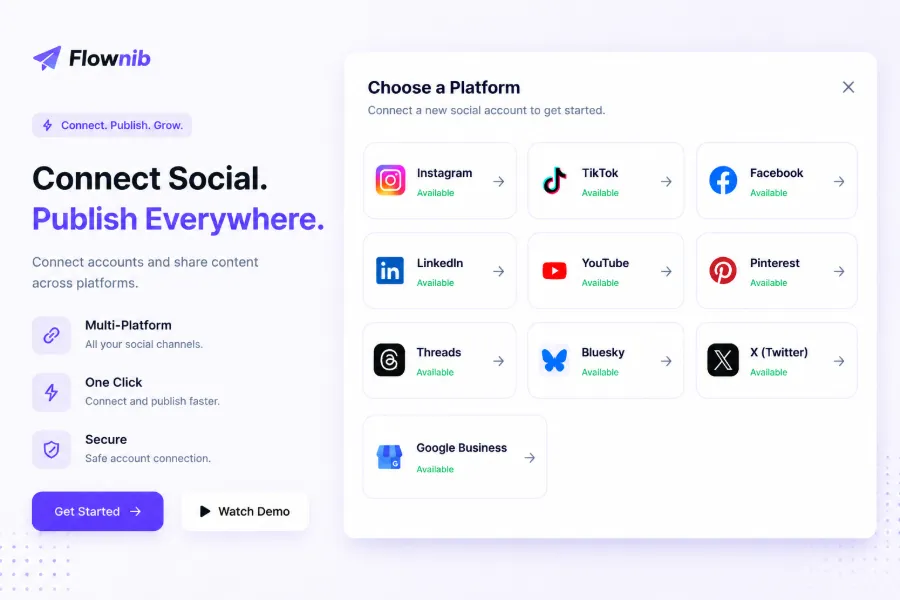
Supporting ten platforms is actually crucial. When you manage Instagram, X, LinkedIn, TikTok, Facebook, Threads, YouTube, Pinterest, Bluesky, and Google Business simultaneously, each has its own format, character limits, and visual guidelines. Human memory alone can’t avoid errors. AI at least guarantees correct formatting, controlled length, and tone appropriate for the target audience.
FAQ
Q1: Can the same content be rewritten by AI for every platform?
Yes, but with a prerequisite: your original content must have a clear core message. AI restructures the expression based on that message; it won’t invent viewpoints out of thin air. If the source is logically messy or vague, the AI‑generated versions will also feel awkward. Ensure each piece has a distinct conclusion or viewpoint before letting AI adapt it.
Q2: Is the performance gap between manual and AI adaptation really that big?
In my experience, the gap shows up in two dimensions. First, time: manually adapting ten cross‑platform posts takes about two and a half hours; AI adaptation does the same in twenty minutes. Second, engagement: adapted content sees a 30 %–60 % higher interaction rate than straight copies, depending on how the platform’s algorithm weights native content. Manual adaptation yields higher quality, but one person can’t realistically handle more than five accounts.
Q3: I only have two accounts—do I still need content adaptation?
Absolutely, and you should pay even more attention to it. If the two platforms differ greatly—say Instagram and LinkedIn—direct copy‑pasting makes both accounts look lazy. Small accounts already have low weight; poor content quality makes growth even harder.
Q4: Will AI rewriting strip my personal style?
I had that concern at first. In practice, if the original copy is yours, AI performs structural adjustments and tonal fine‑tuning without replacing your word choices or stylistic quirks. My LinkedIn posts still reflect my data‑driven writing style, while TikTok versions are more conversational, but the underlying voice stays consistent. The key is to review the AI output and manually tweak a few spots if needed.
Q5: What features are available in the free plan?
The free plan supports three social accounts and six posts without requiring a credit card. It’s sufficient for testing AI rewrite quality and the publishing workflow—I ran the free version for two weeks before upgrading. Try the free tier with a batch of content to see if the AI‑generated versions fit your industry and tone.
Share Article