
Building an Effective Social Media Marketing Plan from Scratch: A Practical Guide for Cross‑Border E‑Commerce

Many cross‑border sellers have experienced this scenario: they spend a whole morning writing a product copy, then manually copy it to Instagram, TikTok, Facebook, and Pinterest, only to discover that each platform has different character limits and formatting, forcing them to read‑tune each one. Even worse, this inefficient loop disrupts the publishing rhythm, causing the account’s growth to stall. If you’re plagued by these issues, this article is for you—I’ll break down a practical, actionable social‑media marketing plan framework from a hands‑on perspective and point out the operational pitfalls that tutorials never mention.
The first step in creating a social‑media marketing plan isn’t choosing platforms; it’s setting goals. Simply wanting more followers is a vague wish that means nothing. You need measurable metrics: brand exposure (impressions), website referrals (referral traffic), direct conversions (conversion rate). Only with clear goals can you make informed decisions about content and channel selection.
Step 1: Define Goals and Choose Core Platforms
Only after setting goals should you pick platforms. A common mistake among sellers is to chase the platform with the biggest traffic—seeing TikTok’s 1 billion daily active users and jumping in, only to find that no one watches their home‑goods products there. Distinguishing between “active platforms” and “effective platforms” is the first step to avoid pitfalls.
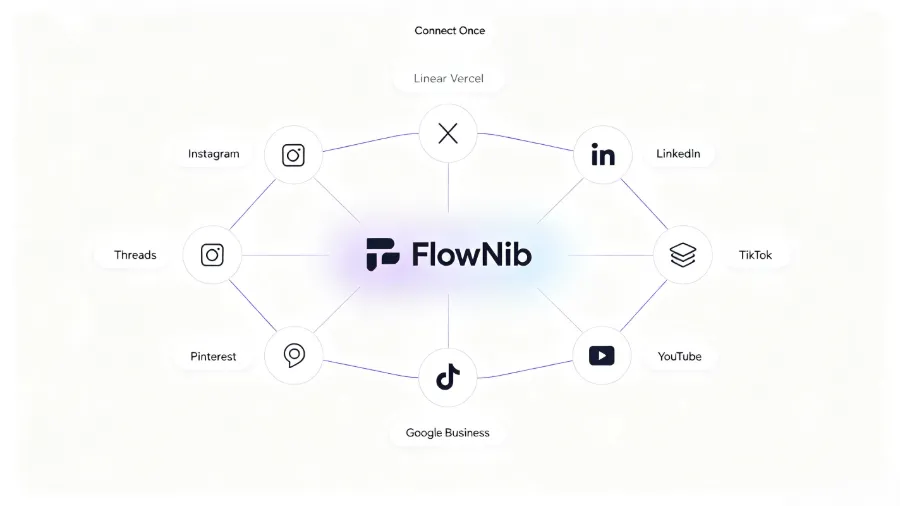
Based on product category and the geographic distribution of your target market, select 2–3 platforms from Instagram, TikTok, Pinterest, YouTube, and LinkedIn as your main bases. Home‑goods brands focus on Pinterest and Instagram; 3C accessories thrive on TikTok and YouTube Shorts; B2B services prioritize LinkedIn. Trying to be everywhere dilutes effort; brands that concentrate on 2–3 platforms and publish consistently see interaction rates on core channels that are on average 40 % higher than those that “cast a wide net.”
At this stage, the multi‑channel distribution capability offered by Flownib precisely solves the pain of manually switching between platforms. You no longer need to copy‑paste across four tabs; you write a single piece of content and the system automatically distributes it to connected accounts.
After understanding the platform‑selection logic, use a table to clearly compare the key differences of mainstream platforms:
| Platform | Primary Content Format | Target User Preference | Example Suitable Categories |
|---|---|---|---|
| Images, Reels, Carousel | 25–40‑year‑old consumers | Fashion apparel, home décor, personal care | |
| TikTok | Short videos, Live streams | 16–30‑year‑old youth | Novel gadgets, 3C accessories |
| Long‑form images, Boards | Predominantly female, purchase‑planning | Home décor, crafts, weddings | |
| YouTube | Long videos, Shorts | Deep‑content consumers | Tutorials, reviews, unboxings |
| Images + Articles | B2B decision‑makers, professionals | Enterprise services, SaaS tools |
After selecting platforms, don’t rush to create accounts; first confirm that your target customers are actually active there. I once saw a seller flood TikTok with high‑end furniture posts for two months and got zero conversions—because TikTok’s mainstream user base isn’t in the market for planned furniture purchases.
Step 2: Plan Content Structure and Publishing Rhythm
When I first started creating cross‑border content, the biggest headache was “what to post tomorrow.” Without a content plan, you end up with gaps, and those gaps hurt algorithmic weight far more than posting a low‑quality piece.
My solution is a three‑layer structure: Core Content + Secondary Adaptations + Platform‑Specific Versions. In practice: write a core selling point (e.g., a post about a new product), then derive platform‑tailored variants from it. For example, a 200‑character Instagram caption becomes more conversational and questioning for TikTok, while the LinkedIn version needs to be formal and professional. In the summer of 2023, I saw a seller who ignored character limits and tonal differences, pasting a 200‑character Instagram caption unchanged onto LinkedIn and Pinterest; all three accounts were demoted, and three months of growth nearly vanished. The cost was severe.
When setting weekly publishing frequency, avoid mindless daily posting. Optimal frequencies differ: Instagram 4–5 times per week, TikTok 1–2 times per day, Pinterest 5–10 pins per day. Brands that use a content calendar to schedule consistently enjoy 65 % higher content consistency than random posters.
Rotating content themes is also essential. I usually allocate: Product promotion (40 %), Education/Tutorials (30 %), User‑generated content/UGC (20 %), Brand story (10 %). This prevents the audience from feeling bombarded with ads while maintaining brand exposure. Pre‑scheduling a month’s editorial calendar avoids last‑minute rushes that degrade quality or cause gaps. If you want to learn how to efficiently adapt content formats for major platforms, check out the FlowNib “Top 10 Social Platform Adaptation Guide”, which details copy length, image dimensions, and hashtag requirements per platform.
Additionally, when crafting a dedicated strategy for YouTube Shorts, refer to the YouTube Creator Academy’s official guide to understand short‑video recommendation mechanisms and best practices.
Step 3: Deploy an Efficient Distribution and Monitoring System
The difference between manual publishing and using third‑party management tools isn’t just a modest efficiency gain. Marketing teams that automate scheduling and distribution save an average of 10–15 hours per week, time that can be reinvested in creative work and customer interaction.
Traditional tools like Buffer and Loomly mainly solve scheduling, but their biggest limitation is the inability to automatically rewrite content. The same copy varies dramatically across Instagram, LinkedIn, and TikTok; manual adjustments are inefficient and error‑prone. AI‑driven rewriting is crucial: it keeps brand tone consistent while adapting to each platform’s character limits and audience expectations.
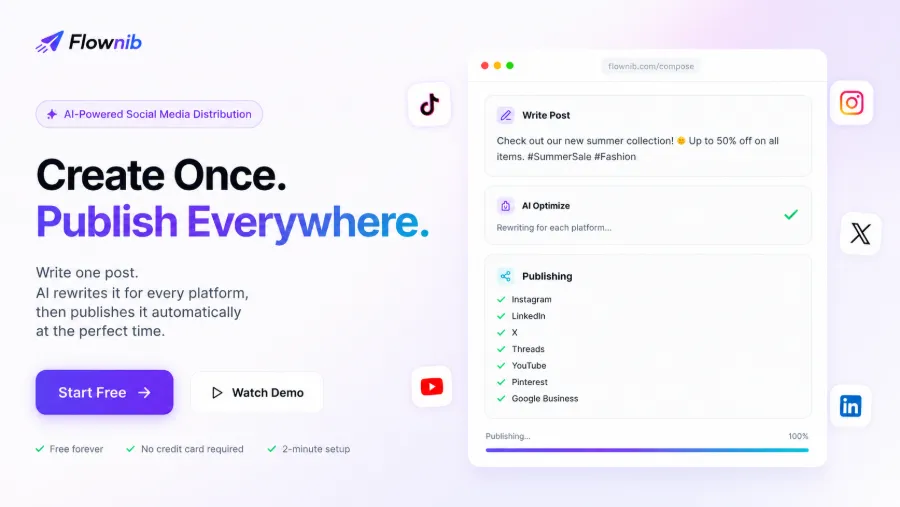
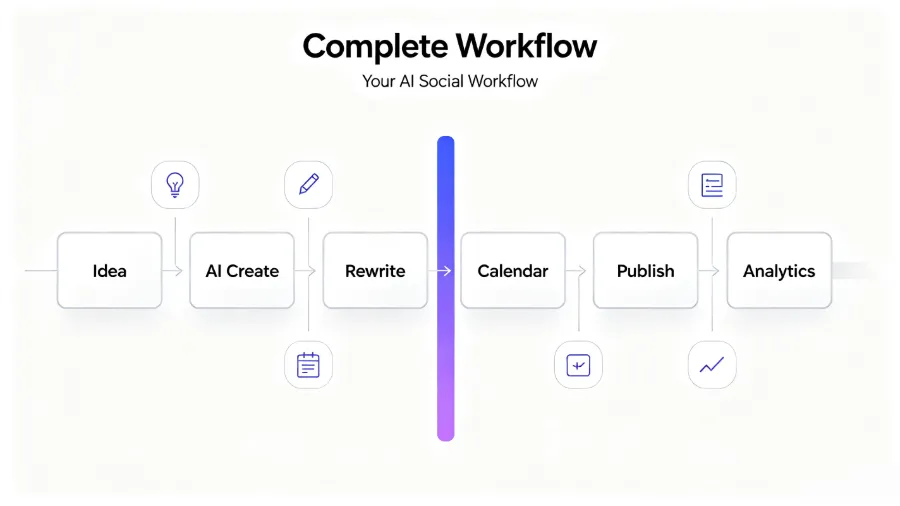
The workflow for “create once, publish everywhere” roughly follows: write → AI rewrite/optimize → preview → schedule → one‑click publish. I currently use Flownib for this process—it automatically rewrites a piece of content and distributes it to Instagram, X, LinkedIn, Threads, Pinterest, YouTube, etc., all within minutes. To see how this compares with traditional tools, read the in‑depth analysis “Buffer Alternatives Deep Dive,” which evaluates cost and efficiency.
After publishing, monitoring is indispensable. Track metrics such as impressions, click‑through rate, engagement rate, and conversion rate. Use these data to refine your content strategy. For example, if a post’s engagement spikes, analyze its common factors (topic, format, posting time) and replicate those elements in future content. Sellers aiming for end‑to‑end automation can consult the “AI‑Powered Full‑Stack for Cross‑Border E‑Commerce” for a complete workflow from content creation to distribution and monitoring.
When comparing business tools, the Loomly Social Media Management Platform is also a solid option, especially for slightly larger teams thanks to its calendar view and collaboration features.
Step 4: Iterate and Avoid Common Pitfalls
Publishing content is not the end; it’s the starting point for a new round of optimization. Establish a monthly review process to compare set goals with actual results, identifying the best‑performing and worst‑performing content traits. Accounts that regularly review and adjust their publishing strategy see a 28 % higher overall engagement rate within three months compared with those that don’t.
Cross‑border sellers frequently make three mistakes worth highlighting:
- Copy‑pasting content without adaptation, leading to platform‑weight penalties. The 2023 failure case mentioned earlier is a textbook example—unadapted content was flagged as low‑quality on three platforms and demoted.
- Ignoring time‑zone differences, causing posts to go live outside the target market’s active hours. If your main market is the U.S. East Coast but you schedule based on Beijing time, your content will appear at users’ midnight, resulting in dismal engagement.
- Posting without interaction, which platforms interpret as bot‑like behavior. Many sellers post and then disappear, neither replying to comments nor engaging with others’ posts. This signals low‑quality accounts to the algorithm, reducing exposure.
For deeper details on content distribution strategy optimization, see the “2026 Shopify Seller Multi‑Platform Bulk Seeding Guide,” which offers a complete workflow from product selection to distribution.
Another often‑overlooked point: the biggest pitfall of multi‑platform publishing isn’t time cost but the fatigue caused by identical tone across channels. Platforms penalize accounts that push the exact same content simultaneously across all channels. For instance, a 200‑character caption posted unchanged on Instagram, LinkedIn, and TikTok—identical wording, tone, and punctuation—appears as bulk automated publishing to the algorithm, resulting in reduced weight. Therefore, even with automation tools, let AI perform substantial rewrites and adaptations rather than simple copy‑pasting.
Frequently Asked Questions
Q1: How often should a social‑media marketing plan be updated?
At least once a month. Quarterly strategic adjustments combined with monthly data refinements are more realistic. If product lines or target markets change significantly, update the plan immediately. Too frequent updates exhaust the team; too infrequent updates cause the strategy to drift from reality.
Q2: For bootstrapped startups with limited budgets, which platforms should be prioritized?
Choose two free platforms that best match your category. Home‑goods and fashion → Instagram + Pinterest; 3C and novelty items → TikTok + YouTube Shorts. Don’t chase platform quantity; mastering two platforms yields far better results than dabbling across five.
Q3: My account is being throttled because the content is too similar. What should I do?
Stop bulk copying immediately. Review all published posts and delete exact duplicates. Then establish an adaptation workflow: each core piece should generate at least 2–3 distinct style variants for different platforms. AI rewriting tools can dramatically reduce manual adaptation effort.
Q4: How can I determine which platform is best for my product?
Run a small‑scale test: pick one platform, publish consistently for 30 days, then analyze impressions, engagement, and conversion rates. Compare across platforms to find the highest ROI, then make that your primary channel. My experience suggests allocating 70 % of resources to the top platform and 30 % to a secondary tester.
Q5: Should I publish to all platforms simultaneously?
No. Simultaneous, identical publishing is likely to be flagged as bot behavior. Adopt a “batch + adapt” strategy: start with 1–2 core platforms, adjust based on feedback, then roll out to other platforms a few days later. This avoids duplicate content while keeping each account independently active.
Share Article