
2026 Cross-Platform Social Media Content Publishing Time Optimization: Insights from 7 Million Posts

When cross‑border sellers manage multiple social‑media accounts, one of the most time‑consuming tasks isn’t creating content—it’s manually copying the same copy into five different back‑ends and then calculating time zones and setting publishing times one by one. I’ve seen a team spend three months polishing a video, only to have its first‑hour interaction rate drop to near zero because they scheduled it for 2 p.m. work‑day time—3 a.m. in the target market—so the algorithm flagged the content as irrelevant. Even worse, it’s hard to tell whether the problem lies in content quality or timing. After analyzing 7 million posts, Buffer concluded that while there is no universal “best time,” each platform does exhibit clear performance trends, and those trends can serve as a starting point—not an endpoint—for your content strategy.
Why Does Publishing Time Matter So Much for Your Posts?
Three years ago I helped an independent‑site brand with a social‑media audit. They stubbornly posted at 9 a.m. every Monday for six months. During a big promotion they worked overtime to produce five high‑quality videos but still posted at the same old time, and the ROI was less than a third of expectations. Data showed that their core audience—working women aged 25‑35—were not scrolling their phones at 9 a.m. on Mondays; they were in morning meetings. This real‑world failure illustrates a simple truth: the value of timing lies not in punctuality but in hitting the audience’s active window.
Algorithm‑driven platforms like TikTok and Instagram Reels use the early‑hour interaction signals (completion rate, likes, comments, shares) as the key trigger for amplification. Those early signals decide whether your content lands in the next tier of the For You Page traffic pool. Publishing during your audience’s most active periods dramatically raises the chance of early interaction, which in turn expands the base of organic reach.
That said, timing is only one factor, not a magic cure. A low‑quality piece with a weak first three seconds is meaningless even if posted at the “perfect” time. I’ve verified this across multiple projects— the same post published at two different times can see a 3‑to‑5× difference in interaction rates, but a poor post never gains traction regardless of timing.
If you’re unsure whether your content hits the active window, start with the comprehensive review of the “Top 10 AI Social Media Management Tools of 2026,” which compares each tool’s scheduling‑analysis capabilities. For more methodological references, see Buffer’s official resource center.
Best Times Within the Week and Daily Golden Windows
Buffer’s analysis of 7.1 million posts reveals several noteworthy patterns. Sunday at 9 a.m. is the overall best-performing publishing time, followed by Monday at 1 p.m. and Sunday at 1 a.m. This may surprise many—weekends are often seen as a “traffic low point,” but the data say the opposite.
Saturday has the highest interaction rate, then Monday and Sunday. The logic is simple: users are more relaxed and willing to interact on weekends, while Monday’s commute and lunch breaks cause a brief surge in phone usage. Conversely, 12 p.m.–5 p.m. is the lowest‑interaction window; users are typically at work or studying and can’t focus.
Evening (6 p.m.–11 p.m.) overall outperforms the afternoon, a pattern that holds on most weekdays. The midday lunch window (roughly 12 p.m.–1:30 p.m.) also offers a usable opportunity, especially for short content that doesn’t require deep viewing.
These suggestions are averages derived from big data and should be treated as a starting point, especially for cross‑border sellers. If you serve both Western and Southeast Asian markets, “Sunday 9 a.m.” could translate to “Monday 2 a.m.” for the target market. Use the data to find your own rhythm rather than copying it verbatim.
How to Find Your Own Optimal Publishing Time
Open TikTok Studio and look under the “Followers” tab for a 7‑day activity snapshot—this is the most direct, customized method. TikTok Studio Analytics includes a dedicated follower‑activity distribution chart that pinpoints when your followers are online. Instagram professional accounts have a similar “Audience” analysis that shows hourly follower activity.
But data is only the starting point. You need to A/B test the discovered windows. A practical methodology: set a two‑week test period, publish one piece of content during a high‑activity slot identified from your analytics, and publish another during Buffer’s suggested golden time. Compare interaction and completion rates. If you have multiple accounts, you can cross‑test across time slots and average the two‑week results.
A often‑overlooked detail: market differences heavily affect test outcomes. An independent seller serving both Western and Southeast Asian customers will have a “best time” that differs from a seller focused solely on Japan. Managing five accounts across five time zones manually is inefficient; you need a systematic approach to consolidate the data.
If you’re still unsure which platforms to prioritize, check the analysis article “Which Social Platforms Are Worth Prioritizing in 2026,” which outlines evaluation dimensions and methods.
Scaling Content Distribution: From Research to Automated Execution
Once you’ve mastered timing, the real challenge begins: scaling the distribution strategy. I’ve seen countless teams burn out on manual workflows—open TikTok to upload a video, copy the copy; switch to Instagram to reformat; then adjust tone and length for LinkedIn. Manual work can survive a few weeks, but efficiency inevitably collapses when you try to sustain it across multiple platforms and accounts.
An accessories‑site team that sold jewelry once told me they spent two weeks identifying optimal windows, but their manual publishing process limited them to just two posts per week, making it impossible to adjust timing and content direction based on monthly analytics. The result: a good timing strategy was severely weakened by low‑frequency execution. This leads to a less obvious conclusion—publishing frequency and consistency matter more than chasing a “precise hour.” Posting daily for a month can generate an order‑of‑magnitude more total interaction than posting only during golden hours for a single week.
Another counter‑intuitive observation: non‑peak windows can sometimes yield high interaction rates. For example, 2 p.m. on a workday may be when B2B buyers browse information; niche categories with little competition may benefit from posting during less‑crowded times, making it easier for the algorithm to recommend them. This depends on your product positioning and content style, so you’ll need to run a few rounds of tests with your own data.
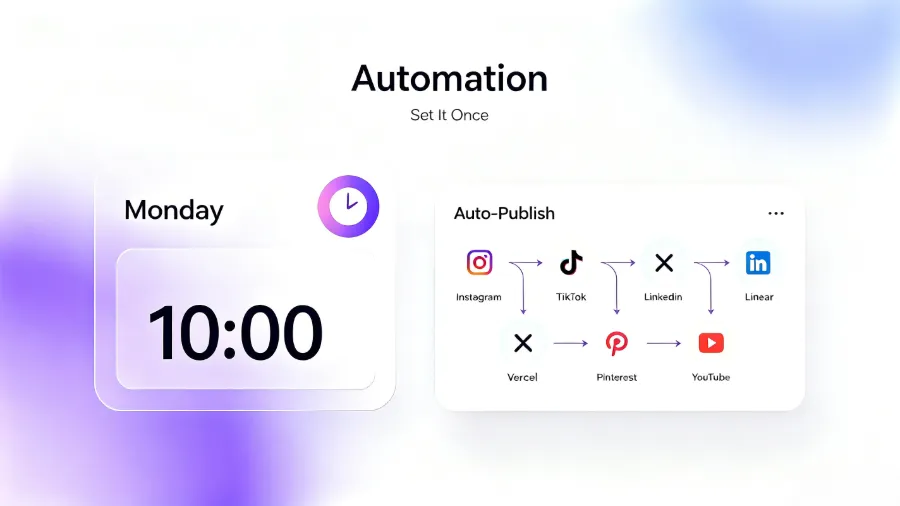
When manual multi‑platform, multi‑account management exceeds your team’s capacity, AI‑driven scaling tools become a natural choice. Flownib offers an end‑to‑end automated workflow: after you write a piece of content, the system automatically adapts format and tone for each platform—Instagram leans visual and short, LinkedIn leans professional and long, Threads leans lightweight and conversational—and then pushes it out at each platform’s optimal window. The core workflow can be summed up as “create once, AI rewrite, smart schedule, one‑click publish.”
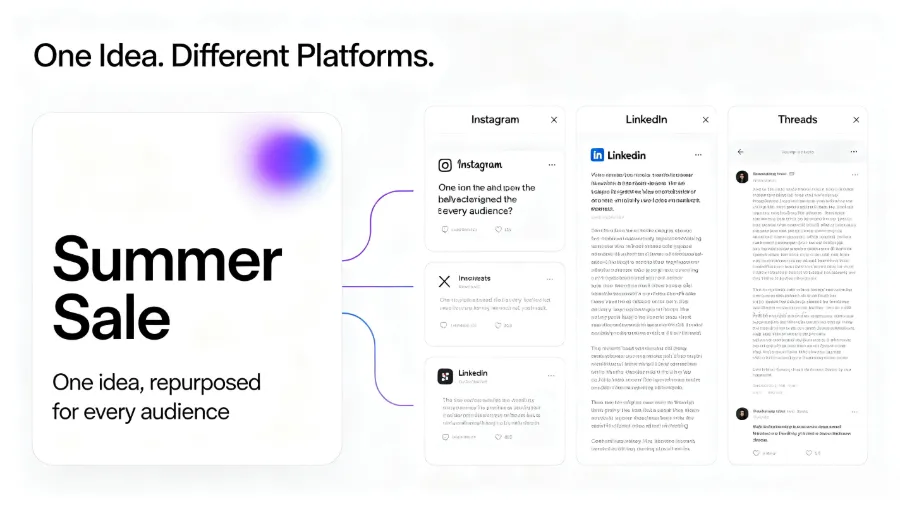
From a technical standpoint, tools that publish via the official APIs of Instagram, YouTube, LinkedIn, etc., are far more stable and reliable than browser‑simulation methods. Flownib supports direct API connections for ten major platforms, so it won’t suddenly break when a platform changes its protocol.
I’ve noticed a common pattern: many people spend a lot of time researching the best publishing time, but what they actually lack is execution power to implement the strategy. If you’re still manually scheduling and posting per platform, try a full‑funnel case study that compares efficiency before and after tool adoption. The article on a full‑funnel closed‑loop analysis for an independent shoe brand demonstrates the complete loop from content creation to cross‑platform publishing. For a more comprehensive cross‑border content tech stack, see the discussion on SEO, AI video, and automated distribution synergy.
FAQ
Should I use exactly the same post content and publishing time across different platforms?
No. Each platform has a different consumption logic—Instagram users expect visual impact, LinkedIn users expect professional insights, Threads users expect casual interaction. The content can stem from the same idea, but format and tone must be adjusted per platform. Publishing times should also differ because each platform’s audience may be active at different hours (often 2‑3 hours apart).
If I serve audiences in multiple time zones, how do I choose the best publishing time?
First, identify your primary target market’s time zone and use its golden window as the baseline. If your audience spans two very different zones (e.g., New York and Singapore), you can alternate publishing slots and test each one’s performance, then adopt the higher‑interaction slot as your main window. You can also split the content into two pieces and publish each in its respective time zone.
Is it a good strategy to only publish on weekends because weekend data looks strong?
No. Weekend data being strong is an average; audience behavior varies widely by category. Some B2B brands see weekday interaction rates three times higher than on weekends. Publishing only on weekends also creates gaps in brand presence, and algorithms may lower your content’s priority due to low frequency. Use weekends mainly for testing, but maintain regular weekday publishing.
Will automated publishing tools make my content look robotic or unnatural?
It depends on the tool’s capabilities. Low‑quality tools simply copy‑paste, while good tools rewrite for each platform, preserving brand voice while adapting to platform nuances. The key is to preview and confirm content before publishing rather than handing everything over blindly.
How often should the optimal publishing time data be refreshed?
At least quarterly. Audience routines shift with seasons—summer evenings may be an hour later than winter evenings—and platform algorithms continuously evolve, affecting browsing behavior. Review the past three months of publishing data each quarter and adjust based on the follower‑activity trends shown in your analytics tools.
Share Article