
Let AI Truly Understand Products, Audiences, and Goals to Generate More Effective Cross‑Border E‑commerce Content

When a cross‑border e‑commerce team prepares English, Chinese, Japanese, German, and French content for the same product, the common problem isn’t that the model can’t write—it’s that product data, audience personas, and marketing goals are scattered across product documents, sales spreadsheets, and marketing calendars. AI often receives only a line like “Target global consumers, promote a new product,” and ends up generating generic copy that any brand could use.
The effectiveness of AI‑generated cross‑border e‑commerce content depends on three things: whether the input contains verifiable product facts, whether the content is adapted to the specific market and platform, and whether post‑publication data is fed back into the next creation cycle. No matter how strong the model, it won’t automatically know a region’s return restrictions, buyers’ price concerns, or whether a high‑engagement piece actually drove purchases.
First, Organize Product, Audience, and Goal Information into AI‑Usable Input
A usable content input must capture three core pieces of information: product details, target audience, and marketing goals. If a cross‑border team only provides a product name, a few selling points, and a promotional slogan, AI can easily fill in plausible‑but‑non‑existent details. It won’t automatically determine whether a feature applies only to a specific model, nor will it know whether “next‑day delivery” covers all target markets.
Product information should be written like a product dossier used by sales, support, and content editors, not a marketing tagline. In addition to core selling points, record real usage scenarios, price or promotion details, applicable user groups, constraints, and differences from competitors. For example, a portable device may be suitable for small offices and mobile exhibitions but not for continuous high‑load use; such constraints affect educational content and advertising promises.
Audience personas should go beyond “global consumers.” The same product may face buyers in the U.S. who value delivery speed, while German buyers may first ask about warranty, material specs, and compliance. New customers care about “whether it’s worth buying,” whereas those who have compared competitors focus on differences. Market, language, purchase motivation, concerns, and content consumption platforms should each be separate fields in the persona.
Marketing goals need to be split out. Awareness focuses on reach and views; engagement on comments and shares; traffic on clicks; conversion on add‑to‑cart and purchase; repeat purchase involves revisits and repeat buying. Trying to chase five outcomes with a single piece of content usually produces a hybrid text that looks like an ad, a science article, and a request for comments all at once, making manual review harder.
A practical brand dossier can contain the following fields:
- Product selling points, usage scenarios, price, constraints, and competitor differences; target market, language, audience concerns, and purchase stage; this marketing goal, platform, call‑to‑action, and prohibited promises.
Once fields are defined, prompts don’t need to keep getting longer. Better results often come from re‑using the same set of product facts, audience motivations, and marketing goals across platforms, rather than re‑describing the brand each time. Teams can also tag which selling points to emphasize in a content brief, preventing AI from stuffing all material into a single short post.

In practice, a brand dossier should not be a one‑time, never‑changed document. New customer questions from support, competitor comparisons from sales, and recurring return reasons in a market may all need to be written back. Teams can follow the content closed‑loop method to keep input, output, and feedback in a single record, rather than having the content team dig through old spreadsheets.
Let AI Reconstruct Content for Different Audiences and Platforms, Not Just Translate
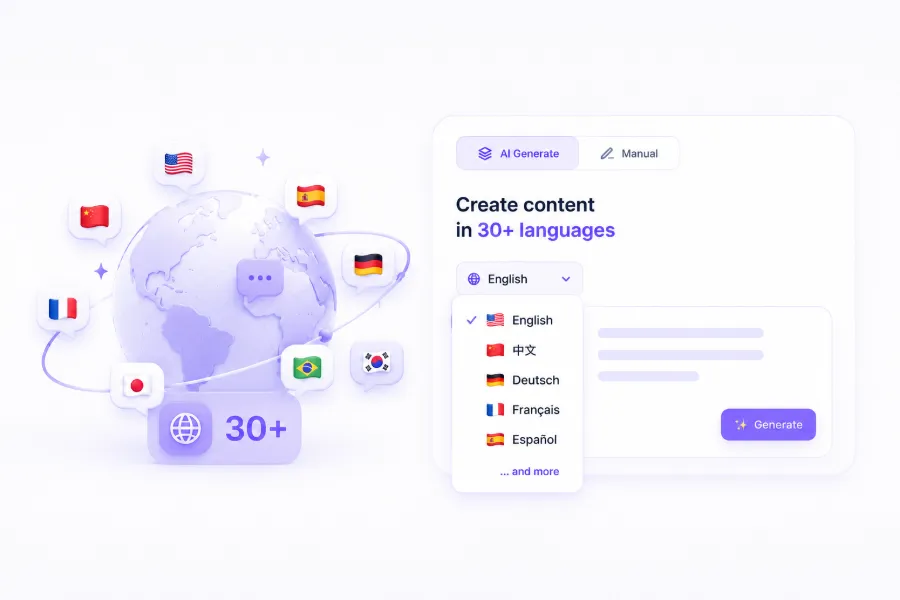
Multilingual content must distinguish translation, localization, and content rewriting. Translation preserves the original meaning; localization adjusts examples, units, tone, and calls‑to‑action; rewriting rearranges information order based on purchase stage and platform consumption habits. All three should retain brand facts but need not keep the same opening, paragraph length, or persuasive focus.
For example, a home storage product may first show usage scenarios to users who have just encountered the brand; for users who have already viewed the product page, it should answer size, material, shipping, and return questions. The Japanese version may require more restrained phrasing, English short‑video copy may jump into the scene faster, and German content may need to state specifications earlier. These differences are market adaptations, not changes to the product promise.
Platform context further amplifies these differences. Instagram favors images, Reels, and carousel content; TikTok and YouTube Shorts rely on the first few seconds of visual rhythm; X is better suited for short sentences and real‑time discussion; LinkedIn often needs clearer industry background; Pinterest relies on searchable topics and visual assets. Facebook, Threads, Bluesky, and Google Business each have their own interaction styles, content lengths, and publishing habits.
If a cross‑border brand serves ten platforms, it doesn’t copy one copy ten times; it must manage ten sets of content adaptation requirements. The broader the platform support, the faster the version count grows: a product announcement may need a short post, educational content, Q&A for comments, promotional reminder, and video explanation. Teams can establish a “uniform facts → market adaptation → platform rewrite → human review” workflow to avoid AI exaggerating effects just to fit platform style.
Human review is more than proofreading. Reviewers must verify price, inventory, shipping regions, product specs, and sensitive statements, and also check whether any language version introduced a new product promise. AI can change phrasing but should not turn “suitable for small spaces” into “suitable for every household,” nor expand a market‑specific limited‑time promotion into a global discount.
Instagram’s own business resources can help teams check platform content formats and account requirements. In practice, teams can break a single creation into a set of related pieces: a short post to grab attention, educational content to answer doubts, Q&A to handle comments, and a promotional reminder for users who have shown interest. This is easier to keep goals clear than synchronizing the same paragraph across Instagram, X, LinkedIn, TikTok, Facebook, Threads, Pinterest, YouTube, Bluesky, and Google Business.
Cross‑border sellers often first unify product facts, then let each market reorganize the opening and evidence. See the global distribution practice of cross‑border sellers. An unexpected result is that increasing rewrite cycles does not necessarily increase manual work; as long as fact fields stay stable, editors mainly review differences rather than rewriting ten pieces from scratch.
Integrate Content Generation into the Publishing Workflow to Reduce Redundant Work Across Platforms
After a content draft is finished, the time‑consuming part is usually not generation but the pre‑ and post‑publishing steps. A typical flow is: write a draft, hand it to AI for platform rewrites, preview each platform, schedule publishing, then record links and versions. In between, there’s copy‑pasting, switching tabs, logging into multiple accounts, and confirming asset dimensions.
In one cross‑border marketing cycle, a team copied the same product copy to multiple platforms. In the short term, the time saved from not rewriting was real, but later they faced mismatched platform contexts, unanswered audience concerns, confusing version names, and inconsistent publishing records. Editors had to reopen each platform to compare line by line, and the audit log couldn’t show which version actually went live. The problem didn’t appear as a single loss but accumulated as repeated rework and declining quality.
In such workflows, Flownib should be limited to publishing, scheduling, account management, and content logging. Data shows that account connections and basic setup average about 2 minutes, and the process can cover up to ten social platforms; these numbers describe configuration and distribution scope, not that content automatically fits every market.
At the operational level, platforms can handle AI content rewriting, format adaptation, preview, scheduled publishing, and record keeping. Teams still need to manage product facts, sensitive statements, regional compliance, and final review. Especially, official API publishing status cannot replace human confirmation: an API success does not guarantee correct image cropping, link preview, tag semantics, or language expression.
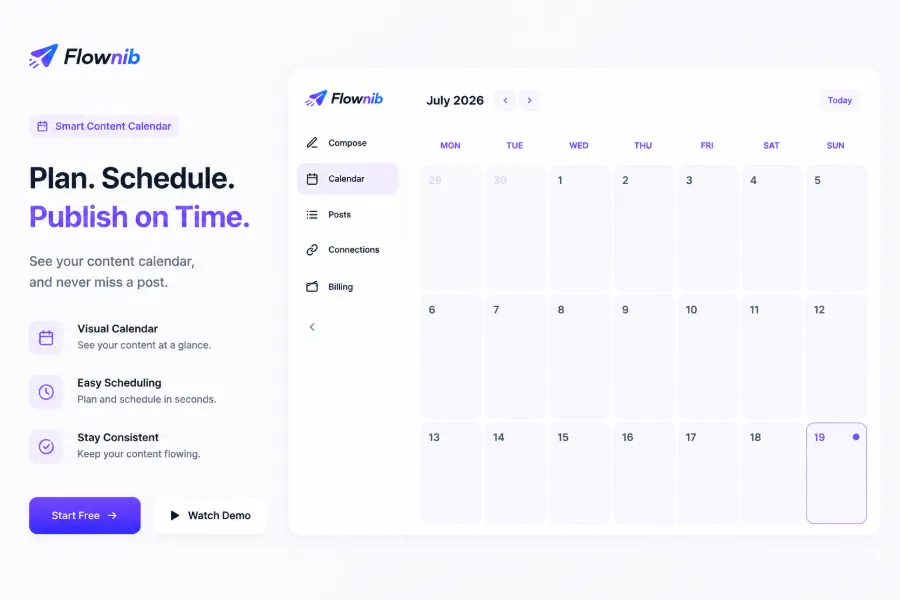
The marketing calendar here is more than a scheduling tool; it also serves as version control. It should answer specific questions: when does a promotion start in a given market, has another market already published the same angle, which account is responsible for review, and which version was finally published? Cross‑border teams often refresh the backend late at night and only then discover that a time‑zone’s publishing time followed the headquarters time zone. Writing market, platform, version, and review status into the publishing record reduces these low‑level errors.
A case study in the product data shows a B2B hardware brand reduced social‑media operation time by 75 %. This figure only reflects process efficiency, not a 75 % lift in content performance; saved time must be invested in audience research, comment analysis, and review, otherwise the team merely publishes ordinary content faster. The B2B brand saving 75 % of operation time case can serve as a workload‑management reference, not proof of content quality.
Use Feedback Data to Judge Whether Content Is Better and Feed It Back into the Next Generation
Judging AI content’s quality cannot rely solely on the number of likes a post receives. Awareness goals should track reach and views; engagement goals should track comments and shares; traffic goals should track click‑through rates; conversion goals should track add‑to‑cart and purchases; repeat‑purchase goals should track revisits and repeat buying. Metrics must align with the marketing goals set during generation; otherwise, high‑engagement content can be mistakenly classified as high‑intent.
When comparing across markets, teams need to look at language version, platform, content angle, and purchase stage simultaneously. A Chinese version with many comments might simply be because the topic sparks discussion; an English version with a high click‑through rate might benefit from a clearer call‑to‑action. Promotional content that generates many clicks within seven days does not automatically improve long‑term brand awareness. Because platform distribution volume, audience size, and content format differ, direct comparison of total likes is usually meaningless.
Post‑mortems should start from the publishing record, not just a summary report at the end of a marketing cycle. Teams can verify the actual published text per content version, compare target metrics per cycle, and feed back audience concerns, strong openings, common questions, and conversion paths into the brand dossier. For how multiple brand voices can be unified, see methods for managing multiple brand voices; however, each brand still needs its own fact and audience fields.
Another often‑overlooked area is storing the “failure reasons” of content. An opening that no one finishes may be too abstract; a piece that gets many comments but no clicks may have a discussion‑heavy tone and a weak action path; a market with high clicks but no purchases may have issues on the landing page, shipping fees, or checkout flow rather than the copy itself. If a team only keeps the best‑performing sentences, the next AI round will keep copying the surface format without understanding the underlying constraints.
In a multi‑platform environment, the value of automatic adaptation goes beyond a single publish. It should preserve content differences between Instagram, X, LinkedIn, etc., and feed each platform’s publishing results back into the content strategy. Teams can observe how different tools handle format differences via cross‑platform AI automatic adaptation comparison, but ultimately must rely on their own version records, click paths, and market feedback.
If an automatic rewrite changes the product promise for two consecutive rounds, the team should pause automatic publishing and revert to a unified fact template with human review. Waiting for a marketing cycle’s data is cheaper than letting erroneous versions continue to spread. A content closed‑loop is not “the faster the generation, the better,” but rather “let product, audience, and goal first form a stable input, then iteratively refine through generation, publishing, and feedback.”
FAQ
What is the minimum information needed before AI generates cross‑border e‑commerce content?
At least three categories of input: product information, target audience, and marketing goal. Product info should include selling points, usage scenarios, and constraints; audience info should cover market and purchase concerns; marketing goal must specify whether the focus is on clicks, purchases, or repeat purchases.
How can AI keep brand information consistent while rewriting content for different countries and platforms?
First lock in unified facts, then perform market adaptation and platform rewriting separately. Before each publish, verify price, specs, shipping, and promotion scope, and save each language version in the publishing record. Update the brand dossier before the next generation.
Can AI‑generated multilingual content be published directly?
It is not recommended to publish directly; at least one human review is required. Reviewers must check facts, cultural tone, and regional compliance. In practice, a batch of ten platform versions should be uniformly checked before scheduling.
Which metrics should be used to judge whether AI‑generated content is more effective?
Choose metrics based on marketing goals: awareness → reach and views; engagement → comments and shares; conversion → clicks, add‑to‑cart, purchases; repeat purchase → revisits and repeat buying. Compare across markets and content versions per marketing cycle rather than relying on a single post’s likes.
How to reduce duplicate editing and version errors in multi‑platform publishing?
Adopt a fixed workflow: draft → AI rewrite → preview & review → schedule → publishing record, and use a content calendar to log market, account, time zone, and final version. This reduces copy‑pasting and tab‑switching errors and makes it easier to locate the actual live content for the next generation.
Share Article