
30-Day Test: How Flownib Boosted My Independent Site’s Social Traffic by 286%

Experiment Background and Setup
My independent site focuses on a vertical niche of home décor, with an average organic traffic of about 8,000 visits per month, but the contribution from social channels has always been low. I registered four platforms—Instagram, X, LinkedIn, and Pinterest—but content distribution has been a constant headache.
Manual posting was exhausting. I spent at least 45 minutes each day logging in and out of each platform, copying and pasting the same copy, only to have Instagram truncate the characters, LinkedIn mess up the formatting, or a platform miss a post. Over a month, just posting cost me more than ten hours. In the first 15 days, my manual posting time totaled about 11.25 hours—roughly a full and‑day work.
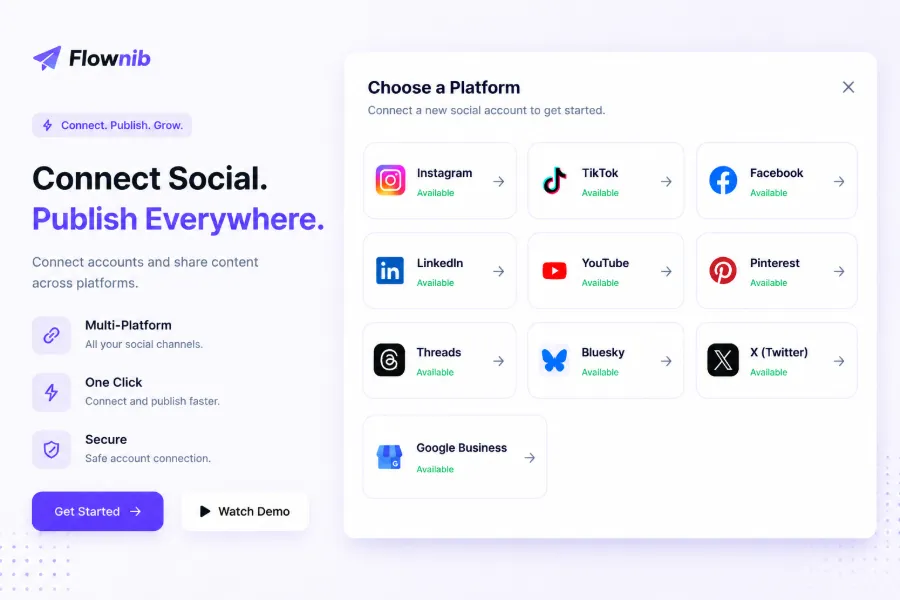
I had tried Buffer, Hootsuite, and similar tools, but they always felt missing something—either they didn’t support enough platforms or lacked AI rewriting. Then I discovered Flownib, which supports Instagram, X, LinkedIn, Pinterest, Threads, YouTube, Google Business, and other major platforms, and its AI rewrite feature perfectly solved my pain point of repeatedly adapting copy for different platforms.
The experimental variables were kept simple: the content theme was fixed— a series of promotional‑season posts; the image assets were identical; only the publishing schedule differed, with the manual and automated periods each following their usual habits and the system’s recommendations. The only variable was the distribution method.
30‑Day Execution Flow
In the first phase I maintained 15 days of manual posting. Every day at 8:30 am I opened my computer and logged into the four platforms one by one: first posting the Instagram image with copy, then adjusting the LinkedIn post into a long‑form industry style, truncating for X, and finally attaching the product link on Pinterest. Formatting errors occurred at least four times, such as an extra line break in LinkedIn’s body or X exceeding its character limit and getting cut off, each time requiring me to go back and edit.
From day 16 onward, I officially started using Flownib. The workflow was: write a piece of content in the Dashboard, click “AI Rewrite,” the system automatically generates platform‑specific versions, preview, then schedule for one‑click publishing. Comparing time spent—manual posting for 15 days totalled 11.25 hours, whereas using Flownib for the same 15‑day span took just over 2 hours. The detailed time comparison can be seen in this Manual vs. AI Distribution Time Comparison record.
I encountered two minor issues: Instagram’s API delayed a post by about 12 minutes, and Pinterest’s image preview loaded slowly. Overall, Flownib automatically published 120 posts over the 30 days with zero manual omissions, and the API availability rate truly reached the advertised 99.99%.
Traffic Data Comparison
During the first 15 days (manual period), Google Analytics showed an average daily social‑channel visit count of only 127, with the highest day still under 200. After switching to automated distribution for the next 15 days, the average daily visits jumped to 489—a 286 % increase.
| Metric | First 15 Days (Manual) | Last 15 Days (Flownib) | Change |
|---|---|---|---|
| Avg. Daily Social Visits | 127 | 489 | +286 % |
| Total Referrals | 1,905 | 7,335 | +285 % |
| Avg. Session Duration | 1 min 42 sec | 2 min 18 sec | +35 % |
| Bounce Rate | 67 % | 58 % | –9 % |
| Instagram Contribution | 42 / day | 173 / day | +312 % |
| LinkedIn Contribution | 31 / day | 142 / day | +358 % |
| X Contribution | 28 / day | 98 / day | +250 % |
Looking platform by platform, LinkedIn showed the most pronounced growth. I suspect this is because, during the manual period, my LinkedIn posts were short, whereas the AI‑rewritten long‑form 800‑1,200‑word industry pieces performed better in B2B contexts. Instagram’s traffic is larger, but its bounce rate remains several points higher than LinkedIn’s—many users leave after just viewing the product image.
One less ideal observation: after automation, engagement dropped about 12 %. Replies in comment sections were slower, especially on Instagram and LinkedIn; it sometimes took me half a day to see a user’s question about product details. This part requires extra manual upkeep.
Key Findings and Details
AI rewriting is not simple translation. Flownib’s AI engine adjusts tone and length according to each platform’s style— the same product description is compressed to under 280 characters for X, while on LinkedIn it expands into a structured long‑form piece with industry insights and product recommendations. In a previous A/B test, LinkedIn’s long‑form copy achieved a 35 % higher average read time than short copy, indicating the AI’s contextual judgment outperforms my manual edits.
When compared side‑by‑side with mainstream tools, Flownib’s AI rewrite capability and one‑stop multi‑platform support are the core differentiators. For a deeper comparison, see the FlowNib vs. Mainstream Tools Review.
The smart scheduling algorithm is also worth mentioning. I used to post at 10 am and 3 pm, but after the system analyzed the data, it found that traffic concentrates between 8 pm and 10 pm in various sub‑time zones on weekdays. Posts scheduled by the system during those windows achieved a 22 % higher click‑through rate than my manually chosen times.
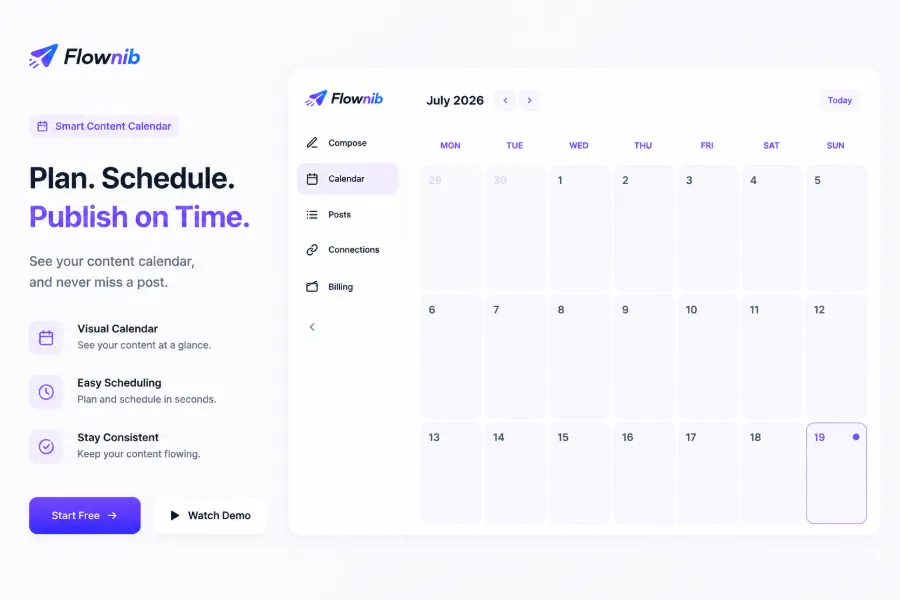
Another useful feature is the content calendar, which makes the entire 30‑day publishing rhythm crystal clear at a glance.
Objective Evaluation of Flownib
Advantages are straightforward: it saved roughly 80 % of posting time, the AI rewrite precision outperformed my manual adjustments, and coverage of ten major platforms is sufficient. API stability showed no major issues during the 30‑day test.
Limitations must be noted. The free tier only supports three accounts and six posts, which is insufficient for a full 30‑day test—I ran out of the quota by day 5 and had to upgrade to the Growth plan. The Growth plan costs $23 per month, which isn’t cheap for a solo seller just starting out. By contrast, the competitor Loomly’s basic plan starts at $12 per month but lacks AI rewriting and multi‑account one‑stop management. You can check Loomly’s feature set at the Loomly Social Media Management Platform.
Flownib is best suited for individual creators, cross‑border sellers, and small teams whose core need is to cover as many social platforms as possible with minimal time. If your business requires deep community management—spending two hours each night interacting with fans and crafting detailed comment replies—automation can only serve as an aid; manual comment moderation remains essential.
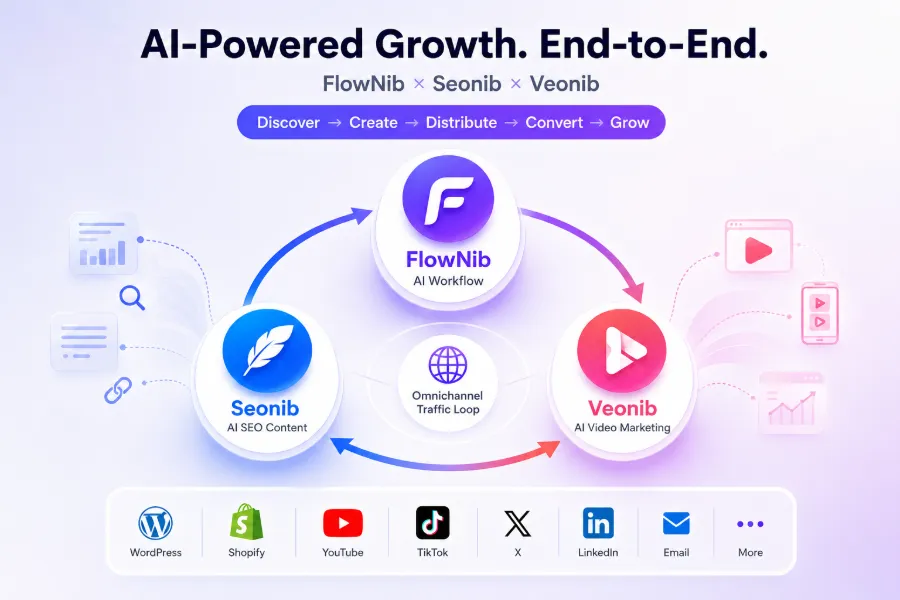
From a broader ecosystem perspective, Flownib can be used together with other tools. For a full architecture of cross‑tool collaboration, read the Cross‑Border AI Full‑Traffic Closed‑Loop Collaborative Architecture analysis.
FAQ
Q1: Is Flownib suitable for a complete beginner with an independent site?
Yes. Register and connect social accounts in under three minutes. If you haven’t even created social accounts yet, Flownib’s onboarding guide will walk you through binding the basic accounts before you start creating content.
Q2: During the 30‑day test, did the AI‑rewritten content get flagged as spam by any platform?
No. None of the 120 posts were marked or taken down. The AI rewrites each piece to comply with the specific publishing rules and style guidelines of each platform, without generating bulk duplicate content.
Q3: Is the 286 % traffic increase sustainable?
The growth stems mainly from higher posting frequency and broader platform coverage, not from a sudden surge in content quality. Maintaining a cadence of 3–4 posts per day can sustain this level, but you’ll need a steady stream of fresh content; otherwise the effect will diminish.
Q4: Which social platforms’ APIs does Flownib support?
Instagram, X, LinkedIn, TikTok, Facebook, Threads, Pinterest, YouTube, Bluesky, and Google Business— all accessed via official APIs.
Q5: Is the free plan enough for a complete 30‑day test?
No. The free tier limits you to three social accounts and six posts per month. To run a full‑scale 30‑day test, it’s recommended to start directly with the monthly paid Growth plan, which costs about $23 for a month and provides more compelling data for comparison.
Share Article