How a B2B Hardware Brand Cut Social Media Operations Time by 75%

A B2B thermal equipment manufacturer with annual revenue exceeding one hundred million dollars needed to maintain corporate accounts on LinkedIn, X, and Facebook simultaneously during peak periods. The operations specialist spent nearly four hours each day copying copy, adjusting formatting, and switching tabs, while genuine customer interaction and content‑strategy thinking were squeezed out. By unifying the distribution workflow, the company reduced weekly social‑media operating time from 20 hours to 5 hours while preserving content quality and consistency across platforms. Below are the detours, pitfalls, and final implementation steps they went through.
Pain Point: Why Social‑Media Operations “Burn Time” for a B2B Hardware Brand
The thermal equipment maker has more than 30 overseas distributors, covering data‑center cooling and industrial thermal‑management niches. The brand required all social‑media content to maintain technical depth on LinkedIn, highlight industry viewpoints on X, and blend product stories with customer cases on Facebook. Sounds reasonable, but execution became a nightmare.
The operations team’s workflow was as follows: On Monday morning, the manager wrote a technical post about a new liquid‑cooling heat sink, attaching three thermal‑curve charts. The specialist first posted the full version on LinkedIn (about 800 words, including heat‑dissipation data, installation parameters, and industry‑standard citations). Then they opened X’s posting box, compressed the content to under 280 characters, extracted the key parameters “thermal resistance 0.08 °C/W” and “compatible with 500 W+ server TDP,” and added the original link. Finally, they opened Facebook and rewrote the technical post into more lay‑friendly language, inserting a customer‑feedback excerpt.
One piece of content, three platforms, three manual edits. Each platform switch required re‑checking format compatibility, punctuation escaping, and multilingual character display. The specialist spent an average of 20 minutes per piece of content. Publishing 20 pieces per week totaled nearly 400 minutes.
Hidden costs were even more troublesome: team burnout leading to reduced posting frequency, which in turn caused traffic decay, and editing fatigue resulting in typos and omitted parameters. Once, the specialist mistakenly pasted “Noise level 28 dB(A)” as “Noise level 82 dB(A)” — the former is a normal meeting‑room level, the latter approaches city‑traffic noise. The post was discovered and deleted by a distributor two hours after publishing, but not before customers had already asked in the comments whether the product was noisy.
Exploring Solutions: From Tool Comparison to Process Re‑engineering
Initially, the team tried an internal solution. The operations manager created a detailed “Platform Posting Format Checklist” covering character limits, hashtag rules, image dimensions, link formats, etc. The specialist cross‑checked the checklist before each post. The result was a 20 % drop in publishing efficiency—each platform switch required consulting the document, and compliance fell to 68 %. After two months, social‑media engagement slipped 13 %. This approach was abandoned.
The team then looked for external tools, testing three categories: traditional scheduling tools, manual‑management plugins, and a more aggressive path—using AI to create once and automatically rewrite for distribution.
For traditional scheduling tools, they evaluated Later social‑media management tool and Loomly social‑media platform. Both shared the same issue: they essentially sync drafts between platforms, leaving the operator to prepare separate content versions for each. Later’s board shows all platform calendars, but clicking in reveals independent drafts for LinkedIn and X, each edited and published separately.
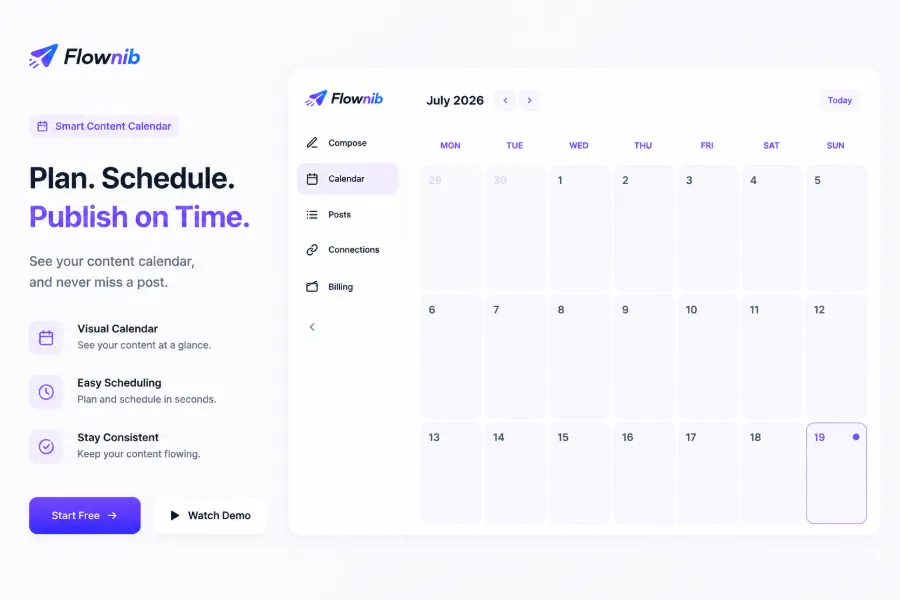
The turning point toward an integrated distribution approach was API stability. A B2B brand cannot tolerate scheduled‑post failures or truncated content. During selection, the team focused on three metrics: official API compatibility, multi‑account management capability, and technical‑parameter retention rate after rewriting. After two weeks of comparative testing, the chosen solution achieved a 99.99 % API availability rate. Interested readers can refer to the FlowNib vs. Publer vs. Planoly API support comparison, which offers useful insights for cross‑platform distribution scenarios.
Implementation: One Rewrite, Three‑Platform Publishing Real Workflow
After selecting the solution, the team spent three days redesigning the publishing process. The previous method was “write first, then adapt”; the new method is “write core content first, then auto‑distribute.”
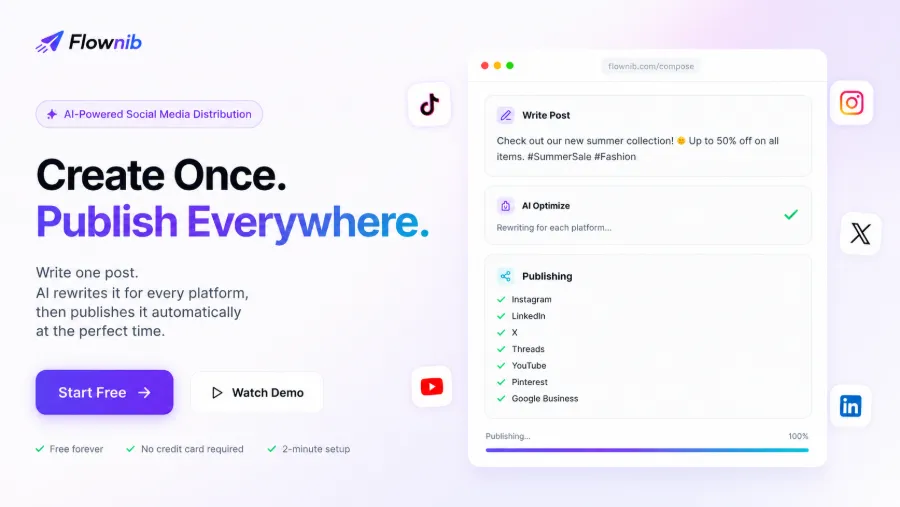
Each Monday morning, the operations manager spends 30 minutes drafting five core product posts and technical article summaries for the week. Each piece is 300–500 words, written once without platform‑specific adaptation. After writing, the content is pasted into the publishing system’s editor.
The system then automatically performs all the tasks that previously required manual effort: the LinkedIn version retains full technical data and industry insights—thermal performance curves, energy‑efficiency test results, applicable scenario analysis; the X version is distilled into 2–3 key parameters plus the original link, with character count automatically kept within platform limits; the Facebook version blends product stories and customer cases, using a tone more suitable for non‑technical readers.
The specialist now only spends five minutes previewing each platform’s draft, checking that technical parameters haven’t been altered, units are retained, and core data isn’t omitted. Once verified, a single “Publish” click sends the content via official APIs to all accounts on the three platforms.
The time per piece dropped from 20 minutes of manual work to about five minutes— a 75 % efficiency gain. The brand uses Flownib; the team writes content once, and the system handles all subsequent platform adaptations and publishing. For detailed steps, see the AI‑driven “write once, publish everywhere” workflow, which includes a full demonstration.
The first week revealed an expected issue: the AI‑rewritten LinkedIn version changed a phrase about “heat‑dissipation improvement of 32 %” to “significant heat‑performance improvement.” Engineers flagged that the specific “32 %” figure is a core selling point and must not be lost. The team spent half a day adding a rule to retain all numbers and percentages. This nuance is specific to B2B brands—consumer‑goods content can be vague, but hardware technical parameters must be exact.
Quantified Results: Hidden Benefits Beyond the 75 % Time Reduction
After the new workflow, weekly social‑media operating time fell from 20 hours to 5 hours. The raw time savings alone justify the decision, but the real interest lies in the ancillary changes.
The freed 15 hours per week were reallocated. Specialists no longer spent time copying and pasting; instead, they analyzed user activity windows across different countries for each platform. Previously, posting times were random—content was published immediately after writing, regardless of whether the target time zone was UTC+1 or UTC+8. Now, the team schedules posts according to each platform’s audience active periods, boosting post exposure by roughly 40 % within two months. The data come from the brand’s native LinkedIn and Facebook analytics dashboards, comparing 30‑day baseline periods before and after the strategy shift.
Content consistency also improved dramatically. Issues caused by manual editing—typos, formatting errors, missing parameters—disappeared. The pre‑publish preview now only checks that AI rewriting retained technical accuracy; there’s no need to proofread every sentence for voice or punctuation. Specialists report that weekly error rates are now virtually zero, whereas during manual periods there were almost always one or two posts per week requiring deletion or correction.
Team roles evolved as well. Specialists who previously handled copy‑pasting now engage in market analysis, compiling common pre‑sales FAQs from comment sections on each platform. Those FAQs feed the next week’s content creation, forming a virtuous cycle of publishing → interaction → analysis → re‑creation.
For real‑world feedback on this tool, see the Flownib user review of actual usage effects, which documents experiences of other cross‑border sellers in similar scenarios.
FAQ
Q1: Does AI rewriting cause loss of technical precision for B2B products?
There is a risk of numeric loss, but preset rules can prevent it. This brand added a directive to retain all numbers, percentages, and unit symbols, and introduced a dedicated technical‑parameter check during preview. After the first‑week incident where “32 %” was vague to “significant improvement,” the rule prevented any recurrence.
Q2: Did the brand try other automation tools before implementing this solution?
Yes. Initially they used a manual format checklist, which actually reduced publishing efficiency by 20 % and achieved only 68 % format compliance. Later they evaluated Later and Loomly; both excel at scheduling but not at content rewriting, leaving the need for separate platform‑specific versions. Ultimately they moved to the AI‑once‑create, auto‑distribute path.
Q3: After cutting social‑media operating time, how were team members re‑assigned?
Specialists freed from manual adaptation shifted to customer‑persona analysis and distributor community interaction. Specifically, they spend three hours weekly compiling FAQs from comment sections, two hours analyzing active user windows across countries to optimize publishing schedules, and the remaining time on content‑strategy planning and competitor analysis.
Q4: Will AI‑rewritten articles be flagged as low‑quality by platform algorithms?
So far, the brand has not experienced any content demotion on LinkedIn, X, or Facebook. The key is that rewriting preserves the original structure and technical density, merely adjusting expression. LinkedIn’s full technical posts align with industry users’ preference for long‑form content; X’s concise version fits short‑content scenarios; platform algorithms do not penalize content solely because it was rewritten.
Q5: Is this unified distribution approach suitable for multi‑account management across different countries with localized needs?
It works within language boundaries. The brand’s 30+ distributors span Europe, Southeast Asia, and the Middle East; each piece of content is first translated into an English core version, then fine‑tuned per regional distributor requirements. Unified distribution is effective for synchronizing multiple accounts in the same language. Cross‑language scenarios still require additional translation steps, which are not yet covered by the current workflow.
Share Article