
FlowNib vs Publer vs Planoly: Official API Support Showdown, Who Is the True “All‑in‑One”?
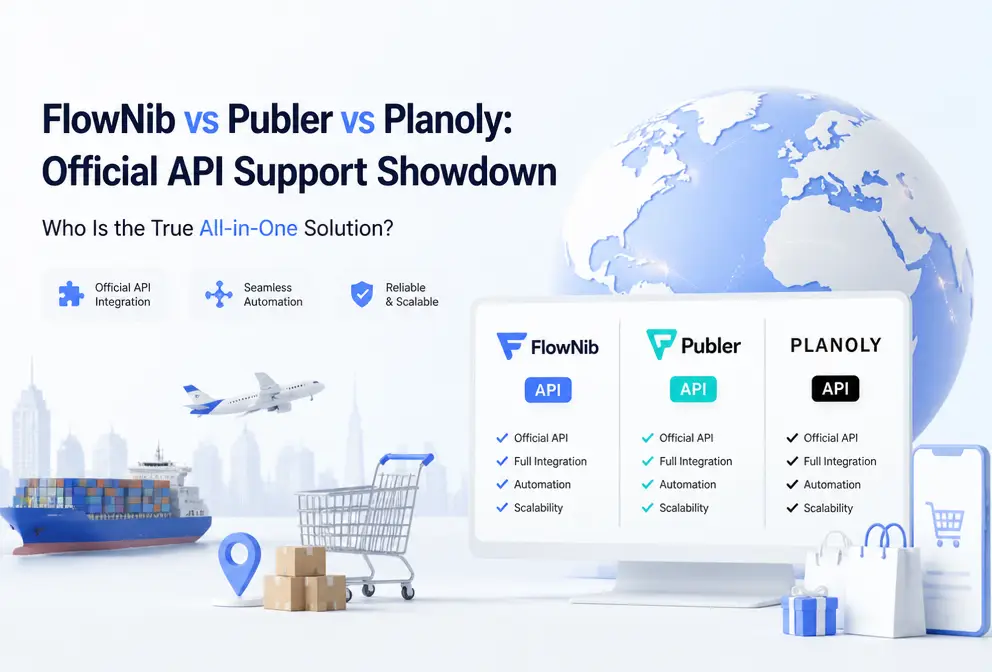
Every social‑media manager has endured the endless “copy → paste → tweak → paste again” loop until one day you find a post that performs well on Instagram, but the same image on LinkedIn breaks apart and the comments are full of “Where’s the image?”. That’s when you realize that a tool’s claim of “supports X platform” and the actual stability of publishing are two completely different things—often the difference comes down to whether it uses the official API or a scraped interface. This comparison cuts through marketing hype and looks at the real differences among FlowNib, Publer, and Planoly in terms of the number of officially supported APIs, stability, and hidden limitations, saving you the trial‑and‑error time of switching tools. If you’re still debating which one to pick, spend ten minutes reading this article and you’ll likely get more insight than two weeks of registering and testing each tool.
Why Official APIs Are More Critical Than You Think
I saw a team doing cross‑border e‑commerce that chose a tool that advertised “LinkedIn scheduling support”. After three months the results looked good—until LinkedIn updated its image endpoint and all their posts turned into plain text because the image field was ignored. The tool was using a non‑official, outdated endpoint. They spent three days troubleshooting, only to discover it was an API‑level issue that couldn’t be fixed except by manually adding images to each post. Their LinkedIn traffic dropped by half that month.
Common risks of unofficial APIs are pretty clear: rate‑limiting (platforms block high‑frequency IPs), missing fields (new features appear but the interface isn’t updated), and the worst—sudden disconnection when a platform changes its authentication method, leaving the tool weeks to adapt. In 2025 TikTok banned over 2,000 third‑party tools that used unofficial access, causing many small‑to‑mid‑size teams that relied on proxy interfaces to crumble.
TikTok and LinkedIn are classic “don’t expect to play without an official API” platforms. YouTube and Facebook have lower entry barriers but demand full‑feature completeness. Many tools claim “supports 10 platforms” on their websites, but a closer look often reveals only four are connected via official APIs; the rest rely on web scrapers or third‑party aggregators. So “supports 10 platforms” and “has 10 official APIs” are fundamentally different.
Buffer also used unofficial interfaces for some platforms in its early days before gradually migrating. Their official blog changelog documents several publishing interruptions caused by API switches.
Full List of Official API Support for the Three Tools
Here’s a quick overview. FlowNib currently integrates official APIs for 10 platforms: Instagram, X (Twitter), LinkedIn, TikTok, Facebook, Threads, Pinterest, YouTube, Bluesky, and Google Business. Publer supports 7, missing Threads, Bluesky, and Google Business. Planoly supports only 4, limited to Instagram, Pinterest, TikTok, and Facebook, making it a visual‑only solution.
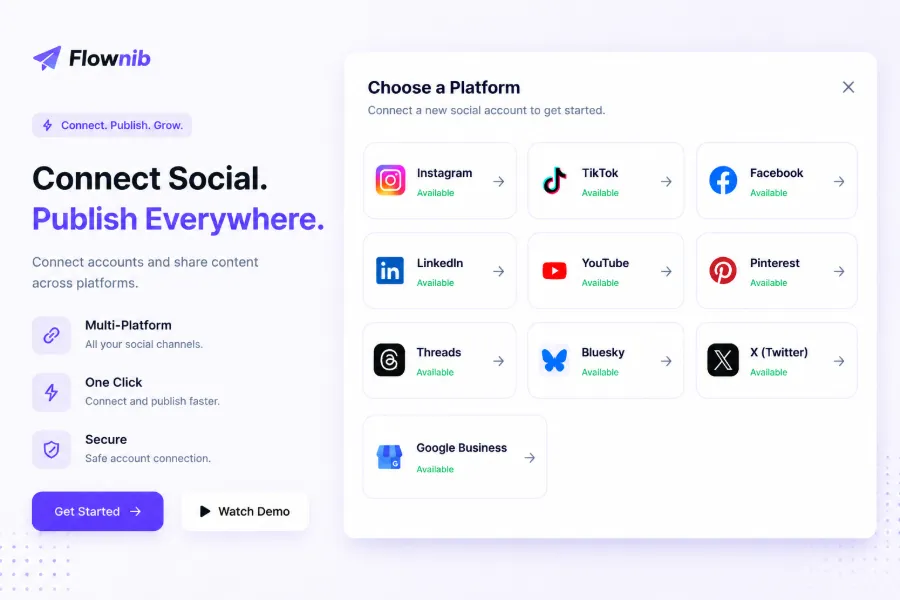
Specific support per platform:
| Platform | FlowNib | Publer | Planoly |
|---|---|---|---|
| ✅ | ✅ | ✅ | |
| X (Twitter) | ✅ | ✅ | ❌ |
| ✅ | ✅ | ❌ | |
| TikTok | ✅ | ✅ | ✅ |
| ✅ | ✅ | ✅ | |
| Threads | ✅ | ❌ | ❌ |
| ✅ | ✅ | ✅ | |
| YouTube | ✅ | ✅ | ❌ |
| Bluesky | ✅ | ❌ | ❌ |
| Google Business | ✅ | ❌ | ❌ |
The table makes it crystal clear that FlowNib is currently the only tool covering all 10 platforms with official APIs. This isn’t just a numbers game; Threads and Bluesky are new platforms that most competitors still haven’t integrated.
When I say “true support,” I mean that each platform’s core features work end‑to‑end: Instagram Reels and carousel posts, LinkedIn documents and articles, YouTube Shorts and scheduling, Google Business post updates. Many tools that connect to Facebook and Instagram APIs can only publish single images—no carousel, no stories.
For a broader side‑by‑side comparison, see the FlowNib vs Buffer vs Hootsuite report, which includes detailed platform coverage tables.
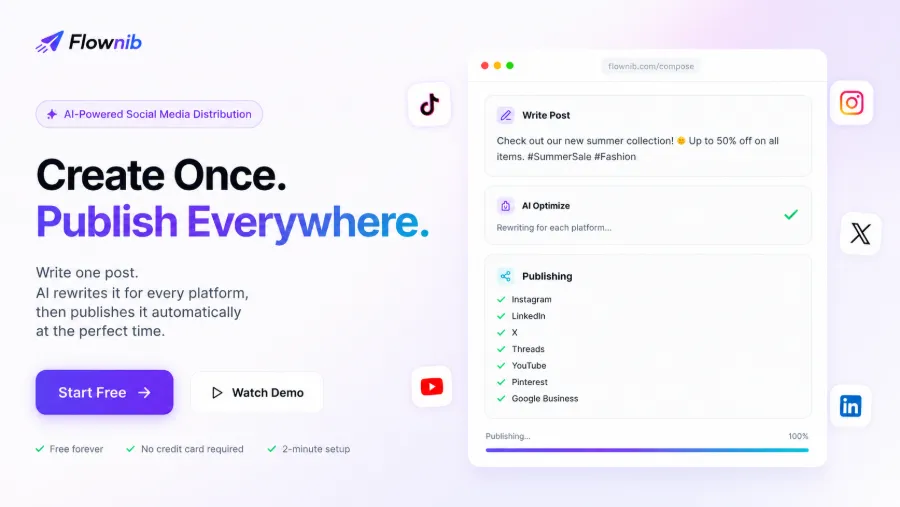
Create once, let AI rewrite, then push to every platform with a single click—this workflow is only stable when each platform is accessed via its official API. Otherwise you’ll encounter the image‑breakage and Reels‑failure issues mentioned earlier.
Beyond Quantity, What Hidden Pitfalls Exist?
The sheer number of supported APIs is just one dimension. Once you start using a tool, you’ll see that having an API connection doesn’t guarantee full functionality. Here are a few pitfalls I’ve encountered in my own operations.
Publer’s LinkedIn API has a clear limitation: you can’t publish documents or long‑form articles through its API. For B2B marketers, this is a major drawback—LinkedIn’s most valuable assets are whitepapers and in‑depth articles, and if you’re limited to image posts you’re wasting about 70 % of the platform’s content capacity. Publer staff have confirmed this limitation in community forums, saying they’re “waiting for LinkedIn to open more endpoints,” but nothing has moved after more than a year.
Planoly’s issues are even more pronounced. It doesn’t support X (Twitter) scheduling via the official API, so to post a tweet you must manually copy‑paste to X’s web or app interface. It also lacks LinkedIn, YouTube, and Bluesky integration. In other words, if your content strategy spans multiple platform types—B2B on LinkedIn, brand showcase on Instagram, experimental traffic on Bluesky—Planoly simply can’t meet those needs. I know a small cross‑border team that chose Planoly to save on monthly fees, only to miss LinkedIn and Bluesky traffic windows and end up manually managing two platforms, costing them dozens of person‑hours each month. That time could have been spent on content optimization instead.
FlowNib’s support for Threads and Bluesky is one of the few among competitors. When Bluesky opened its API in 2024, most tools were still watching; FlowNib completed official API integration and a staged rollout within three weeks. Early adopters often capture a traffic‑growth window, so getting in early gives a first‑mover advantage.
Another hidden factor is the response speed of new platforms. Threads launched a year ago, yet many tools still haven’t integrated it. For a brand operating across multiple platforms, a three‑month delay can mean losing an entire quarter of test data.
Check out the FlowNib vs Later vs Sprout Social comparison for more horizontal assessments of platform feature completeness.
Stability & Experience: An API That Doesn’t Crash Is the Real Deal
Even a large number of APIs is useless if they’re unstable. During traffic spikes, a flaky API can turn a smooth experience into a queue nightmare—often worse than a tool that only supports three platforms. That’s why you can’t judge a tool solely by the number of platforms it claims to support.
A 99.99 % API uptime means less than one hour of unplanned downtime per year. This SLA is common among cloud providers, but achieving it for social‑media publishing tools is challenging. Each platform imposes its own rate limits, and the tool must orchestrate requests across accounts to avoid one account’s traffic hogging another’s quota.
In practice, FlowNib’s direct API connections have almost never resulted in push failures. My own test ran for two months, posting 8–10 items per day; the only incident was a global Instagram outage, which was a platform issue, not a tool issue.
Rate‑limit handling becomes especially important when managing multiple accounts. Some tools’ free tiers only allow a few accounts, effectively simplifying request scheduling. FlowNib’s product page boasts over 500 k posts published, with an average API failure interval exceeding 1 000 hours—this claim is backed by my own experience of never seeing a tool‑side publishing failure.
If you run a cross‑border e‑commerce operation with many accounts and platforms, consider pulling SEO data from the Seonib website into your analysis. FlowNib’s ecosystem offers a collaborative solution that helps you fine‑tune content strategy.
User‑experience feedback from cross‑border sellers can be found in FlowNib’s evaluation report, which includes concrete scenarios for scheduling, multi‑account management, and data tracking.
FAQ
Which tool supports the most official APIs—FlowNib, Publer, or Planoly?
FlowNib supports the most, with official APIs for 10 platforms: Instagram, X, LinkedIn, TikTok, Facebook, Threads, Pinterest, YouTube, Bluesky, and Google Business. Publer supports 7, and Planoly only 4.
Does Publer support the official TikTok API?
Yes. Publer has integrated TikTok’s official API and can publish videos and schedule posts. It does not support Threads or Bluesky.
Why can’t Planoly post to Twitter?
Planoly has not integrated X (Twitter)’s official API and has not announced any development plans for it. If you need to tweet, Planoly can only save drafts; the final publish must be done in the X client.
I want to use both Instagram and LinkedIn— which should I choose?
If you need to manage a visual platform (Instagram) and a professional‑content platform (LinkedIn), both FlowNib and Publer work. However, for publishing documents and long‑form articles on LinkedIn, FlowNib is the only tool that fully supports those features; Publer can only post image‑only updates on LinkedIn.
Do these tools offer free trials?
FlowNib offers a free tier that includes 3 social accounts and 6 posts, with no credit‑card required. Publer and Planoly also have free plans, but with more limitations—Planoly’s free tier, for example, only allows one Instagram account.
Share Article