
Cross‑Border E‑Commerce Operations: How Many Hours Can Flownib Save You Each Week? Real‑World Time Calculations

Open your calendar and add up all the time you spent this week copying and pasting, switching tabs, and manually adjusting content formatting—you might be surprised yourself. This article breaks down weekly social‑media work hours using real operational scenarios, does the math, and shows exactly how much “repetitive labor” time automation can reclaim.
For cross‑border operators, repetitive social‑media tasks are often the most hidden time black holes. You have to move content between Instagram, LinkedIn, X, and Threads one by one, adjusting character counts, tweaking formats, checking tags, and finally clicking publish each time. Over a week, those tiny actions add up to far more than you’d imagine. Industry research shows a typical operator spends about 10–15 hours per week on content distribution—almost two full workdays.
Where Does the Weekly Social‑Media Ops Time Go? – First, Break Down Your Workload
Writing a piece of content is easy, but adapting it for six different platforms and publishing each one isn’t. I dissected my own weekly social‑media workflow and found that the real time loss isn’t just in “publishing” itself, but in the attention lost every time I “switch context.” Moving from one platform’s editor to another forces the brain to re‑adjust to a new layout, formatting rules, and visual preview—this fragmented rhythm drags down the entire afternoon’s efficiency.
A typical week’s time allocation looks roughly like this:
- Content creation – writing the main copy, making images, gathering assets; about 30 % of total time
- Format adaptation – adjusting for Instagram’s character limit, LinkedIn’s layout habits, YouTube description link format, Google Business post length, etc.; about 25 %
- Publishing execution – uploading per platform, filling tags, selecting categories; about 30 %
- Post‑publish checks – confirming each piece displays correctly on each platform, replying to comments and DMs; about 15 %
The hidden cost of manual processes goes far beyond the minutes listed. Because each platform has a different workflow, you’re likely to miss a post on one account or forget to add a related Pin on Pinterest. I saw a cross‑border team in the home‑improvement sector lose an Instagram story after hopping between five platforms, cutting the day’s promotional exposure in half. More importantly, such high‑repetition manual work is hard to sustain—most teams start to slip by the third week, dropping from three daily posts to one, and eventually giving up.
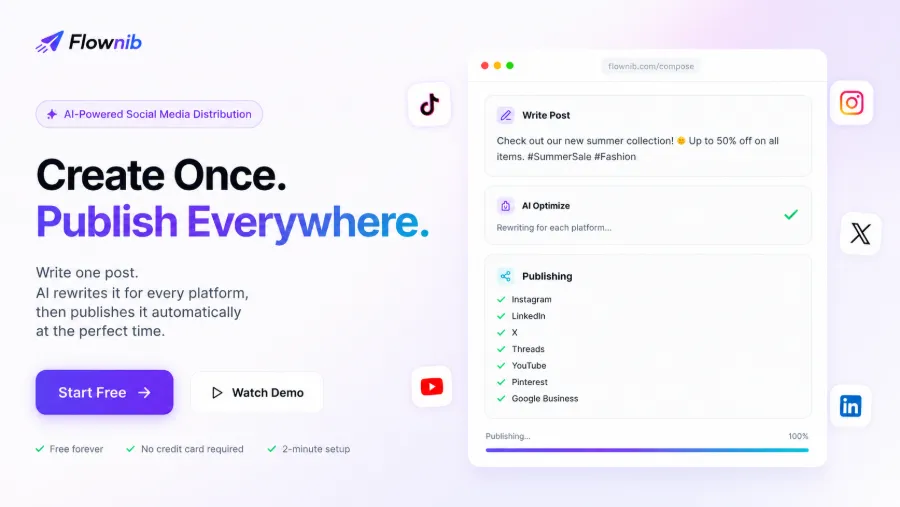
The truly efficient logic is: create once, let AI adapt automatically, and publish to all platforms with one click. No more opening a separate browser tab for each platform.
Manual vs. Automated Process: A Table Shows the Time Gap
The time spent on a single content distribution is much larger between manual and automated methods than most people imagine. I broke a full workflow of publishing the same content to five platforms (Instagram, LinkedIn, X, Threads, YouTube) into four stages and timed each, producing the comparison table below:
| Stage | Manual Time | Automated Time |
|---|---|---|
| Format adaptation | 8–12 minutes | AI‑handled |
| Platform‑by‑platform publishing | 6–10 minutes | One‑click distribution |
| Post‑publish check | 4–6 minutes | Platform feedback confirmation |
| Total per operation | 20–30 minutes | Within 5 minutes |
In the manual workflow, the most time‑consuming stage is “format adaptation,” not “content writing”—a surprising finding. When publishing across platforms, you must split a 200‑word LinkedIn article into a concise 280‑character X post, craft a punchy Instagram caption with emojis, and write a keyword‑rich YouTube description. Each platform requires a fresh round of formatting work.
Using a tool like Flownib, AI rewriting completes all adaptations in seconds. In a test, I entered a promotional copy; the system kept a professional tone for LinkedIn, compressed it into a tight short sentence for X, and generated a lively, emoji‑filled version for Instagram. I tweaked the wording during preview—adding only about 30 seconds—and then published with one click.
The same piece of content takes about 22 minutes manually, while the automated process can finish in as little as 4.5 minutes. Moreover, automation eliminates a manual‑only advantage: you no longer risk forgetting a sentence when switching tabs, which can cause inconsistencies between pre‑ and post‑publish content.
For a deeper dive into AI rewriting and cross‑platform adaptation, see my other article “FlowNib vs. Later, Sprout Social: AI Cross‑Platform Adaptation Comparison.”
Real Weekly Savings: From One Operation to Cumulative Workflow
Saving 15–25 minutes per operation may not sound huge, but multiplied by weekly publishing frequency, the total becomes substantial.
Assume a cross‑border team publishes 15–20 pieces of content per week, each covering 5–6 platforms. With 15 pieces per week, manual publishing alone costs 15 × 25 minutes ≈ 6.25 hours (only the publishing execution part). Adding format adaptation, post‑publish checks, etc., doubles that figure. From my own work logs, completing all content distribution and alignment checks manually takes roughly 10–12 hours per week.
Automation can compress weekly social‑media ops from 12 hours down to 3 hours. The difference? When you no longer need to copy‑paste and re‑format manually, the waiting time after each action disappears—you don’t wait for a platform’s upload button to finish before switching, and you don’t repeatedly refresh previews to verify formatting.
Based on this rhythm:
- Weekly savings: about 9 hours (nearly a full workday)
- Monthly savings: about 38–40 hours
- Annual savings: about 460–480 hours
These reclaimed hours can be redirected toward strategy, asset creation, or client communication—higher‑value tasks. I know a small‑appliance cross‑border seller who used the saved time for weekly competitor‑content reviews; after three months, their Instagram engagement rose 25 %. No groundbreaking optimization—just reallocating time from manual publishing to real analysis.
This “time arbitrage” logic is especially applicable to cross‑border operations. For how automated distribution fits into a complete traffic‑closed‑loop architecture, refer to “FlowNib’s Full Traffic Closed‑Loop Collaborative Architecture,” which includes a case study running the entire process.
What’s Needed to Achieve These Savings? – Matching Process and Tools
The next step is implementation. To consistently save nine hours per week, several prerequisites must be met.
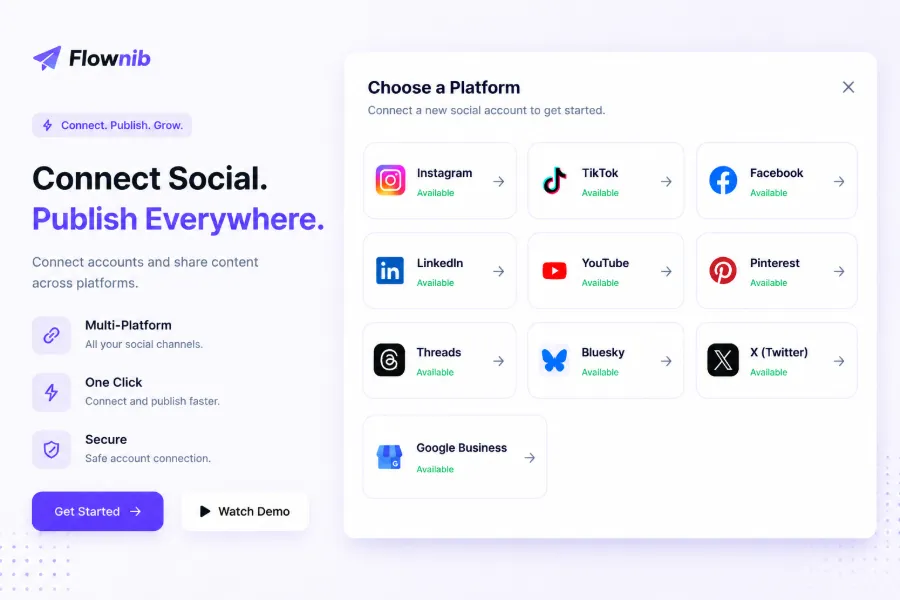
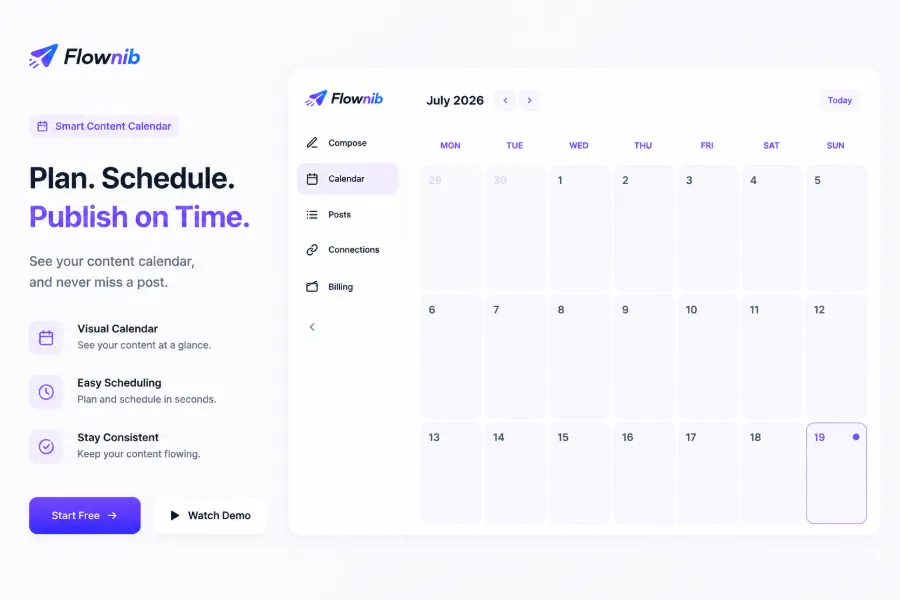
First, the tool must be built on official APIs. FlowNib covers ten major platforms—including Instagram, TikTok, Facebook, YouTube, Google Business, Bluesky—via direct official API connections. This avoids third‑party plugin restrictions and guarantees speed and stability. Second, AI rewriting must adapt to each platform’s language conventions—not just bluntly truncating characters, but truly understanding audience expectations. Finally, a visual scheduler and calendar are needed to manage the weekly content rhythm.
Automation isn’t a black box nor a perpetual motion machine that runs without oversight. Over‑reliance on AI rewriting can cause brand‑tone drift, especially with industry terminology. In 2022, an industrial‑parts cross‑border brand had its AI rewrite turn “CNC machining” into a consumer‑product phrasing, leading to partner misunderstanding on LinkedIn and requiring two days to correct each post. Therefore, every automated workflow must retain a human‑review step—previewing takes only a few seconds and doesn’t undermine overall efficiency.
Also, the most time‑consuming step in cross‑platform publishing is usually “format adaptation,” not “content writing.” This underestimated fact means AI rewriting’s value exceeds many expectations. If you’re still manually tweaking each platform’s title length and tag format, your time black hole is larger than you think.
Getting started is straightforward:
- Connect your Instagram, LinkedIn, Facebook, etc., accounts – about 2 minutes
- Write a piece of content in the editor
- Let AI automatically rewrite it for each platform
- Preview once to confirm everything looks right
- One‑click publish to all platforms
- Track all published pieces in the marketing calendar
Account connection and initial setup take roughly 2 minutes; subsequent operations usually finish within 3–5 minutes each. A note worth mentioning: platform policy changes and API stability are the biggest risks for automated ops. Keep an eye on official changelogs and periodically verify each platform’s publishing status.
For background on the “create once, publish everywhere” feature, see “Create Once, Publish Everywhere – An Introduction to FlowNib.”
A full demo of “FlowNib automatically rewrites and redistributes content to 10 platforms” can be found here: FlowNib How‑to‑Rewrite & Redistribute to 10 Social Platforms.
FAQ
How many pieces of content per week make an automation tool worthwhile?
If you publish more than five pieces weekly and cover three or more platforms, the ROI of automation becomes very attractive. Based on the earlier calculations, manual publishing of five pieces costs about 2.5 hours; automation can shrink that to 30–40 minutes.
Do AI‑rewritten pieces still need human edits?
A quick human review is required, especially for product specs, industry jargon, or promotional copy. The preview step usually takes only 15–30 seconds to make suggested tweaks, preserving overall efficiency. For highly sensitive content (pricing, compliance statements), retain manual authoring control.
Will automated distribution affect each platform’s organic reach?
No. Because the tool uses each platform’s official API, the publishing mechanism is identical to manual posting. Simultaneous multi‑platform publishing does not trigger any penalty—social platforms do not have a “duplicate content deduction” logic.
Is there a stability difference between using official APIs and third‑party tools?
Yes. Official APIs typically achieve a 99.9 % success rate, whereas tools that simulate browser actions or use unauthorized interfaces often fail after platform updates. FlowNib’s API availability is 99.99 %, which is why more cross‑border teams are opting for direct official API connections.
Share Article