
2026 AI Content Repurposing Playbook: How Cross‑Border E‑Commerce Can Create Once and Distribute Across All Platforms

Cross‑border e‑commerce operators have often spent an afternoon like this: after writing a new promotional copy, they switch tabs between Instagram, LinkedIn, X, Facebook, and TikTok, manually delete overly long paragraphs, reorder hashtag sequences, and then paste each version one by one. After finishing the five platform versions, an afternoon is gone, and the tone across platforms is not consistent—Instagram feels too formal, while LinkedIn lacks a professional feel.
Content repurposing does not mean copying the same post verbatim to every platform. It is a workflow that transforms a single creation into compliant, localized, and traceable multi‑platform publishing, relying on AI rewriting, language adaptation, and scheduling management rather than simple copy‑and‑paste. This process is far more valuable for cross‑border e‑commerce than most people imagine.
Why Cross‑Border E‑Commerce Must Re‑Examine Content Repurposing
The efficiency loss of manually copying and pasting across ten platforms is evident to anyone who has done it. Each publication requires reformatting, character‑count checks, and hashtag adjustments; these seemingly minor actions add up to a significant amount of work. A cross‑border e‑commerce team can save 10–15 hours per week of labor by manually adapting content for multiple platforms—time that is truly freed after removing duplicate work.
Differences between platforms go far beyond character limits. Instagram emphasizes visual presentation, LinkedIn needs a professional tone, X demands brevity, TikTok values rhythm, and Facebook’s audience prefers full storytelling. The same product faces completely different consumer decision‑making contexts on each platform. Cross‑border operations also carry the burden of language and localization: English market phrasing, Chinese wording preferences, Japanese honorific systems—none of which can be fully solved by translation software alone.
A more hidden risk is brand voice consistency. When content is repeatedly manually rewritten across platforms, the brand’s tone, word choice, and core messages gradually drift. One cross‑border e‑commerce team once used manual copy‑and‑paste to publish the same promotional post on five platforms; because they failed to adapt to each platform’s character limits and language habits, the copy was truncated and hashtags were missing, leading to overseas customer complaints and a two‑week delay in a new product launch to recover reputation. Such issues rarely appear in single‑platform operations but become the norm when scaling to multiple platforms.
For independent‑site sellers, this problem has another layer. Independent sites do not have built‑in traffic like marketplace stores; social media is a primary traffic source. If content quality varies across platforms, traffic performance is directly affected. To see how independent‑site sellers can systematically manage global social‑media distribution in 2026, refer to the 2026 AI Global Social Media Distribution Guide for Cross‑Border E‑Commerce Independent Site Sellers. Platform regulations are also tightening continuously; the official platform guidelines and operating tips are worth checking regularly, especially the sections on commercial content.
Core Workflow for One‑Time Creation and Multi‑Platform Distribution
From draft to publishing, the full pipeline is roughly: writing → AI optimization → preview → scheduling → one‑click distribution → logging & tracking. AI optimization is the most critical step—it rewrites content per platform style, character limits, and audience expectations, rather than simply copying the same paragraph five times.
Take a new product promotion as an example. After the original copy is written, AI generates a visual‑first version with hashtags for Instagram, a long‑form professional version with links for LinkedIn, a concise version under 280 characters for X, a short‑video‑friendly script for TikTok, and an SEO‑focused description for YouTube. Each version shares the same core information, but the expression and structure differ completely.
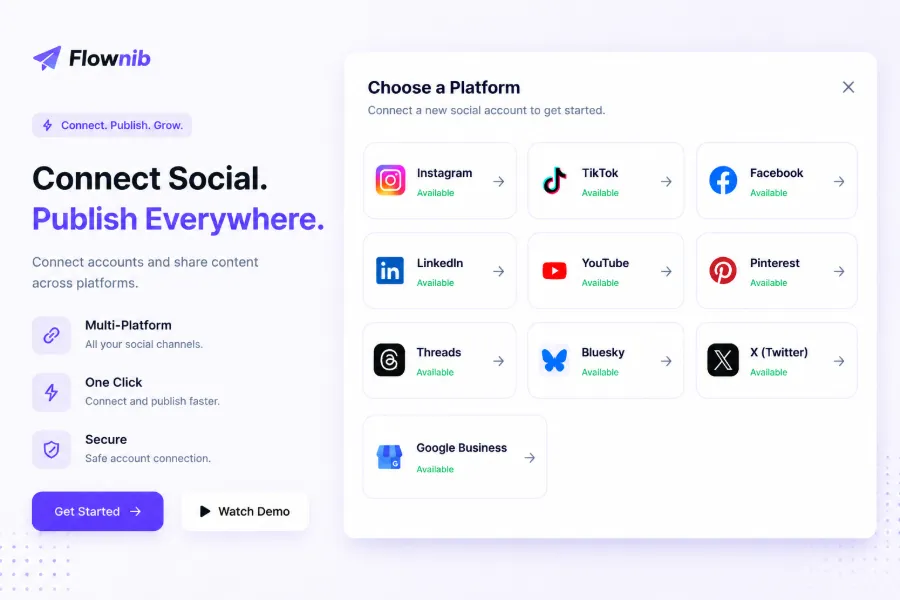
Preview and human review before publishing remain necessary. AI rewriting can miss details, especially hard information such as product specs, price, or promotion dates; a manual check prevents erroneous content from being synchronized across all platforms. Official platform APIs improve publishing stability because API‑posted content does not trigger platform risk controls and avoids throttling caused by simulated actions. A single workflow can cover ten major platforms, averaging about 2 minutes per setup, with API uptime reaching 99.99%.
Key adaptation points differ markedly across platforms:
| Platform | Content Format | Character / Length Limit | Adaptation Focus |
|---|---|---|---|
| Image / Reels / Carousel | ~2,200 characters | Visual‑first with hashtags | |
| Long post / Image + Text / Video | ~3,000 characters | Professional tone with links | |
| X | Short text | 280 characters | Concise and direct with hashtags |
| TikTok | Short video | Optional text | Fast rhythm, native music |
| YouTube | Video / Shorts | Description ~5,000 characters | SEO keywords and community engagement |
In this workflow, the tool chosen for the publishing and distribution step directly impacts efficiency. AI distribution tools like Flownib essentially compress “write once, rewrite five times, post to five platforms” into “write once, AI‑rewrite, one‑click post,” freeing human labor from repetitive tasks. For teams already using n8n or Zapier to build automation, the missing social‑media publishing step in automated workflows is a common bottleneck—automation handles content generation but breaks at the publishing stage.
Multilingual Localization: The Global Key to Content Repurposing
The biggest difference between domestic and cross‑border e‑commerce content repurposing lies in language. A single creation can be generated in multiple languages to suit different markets: English covers North America and most of Europe, Chinese covers Greater China, Japanese targets Japan, and German and French serve core European economies. Supporting generation and publishing in five or more major languages means the brand does not need to recreate content for each market.
Localization is more than translation. Character limits, hashtags, and expression habits must be adjusted in sync. German words are generally longer, so the same content may exceed character limits in German; Japanese hashtag conventions differ entirely from English; French consumers have specific expectations for formality. These details determine whether the content truly resonates with local audiences.
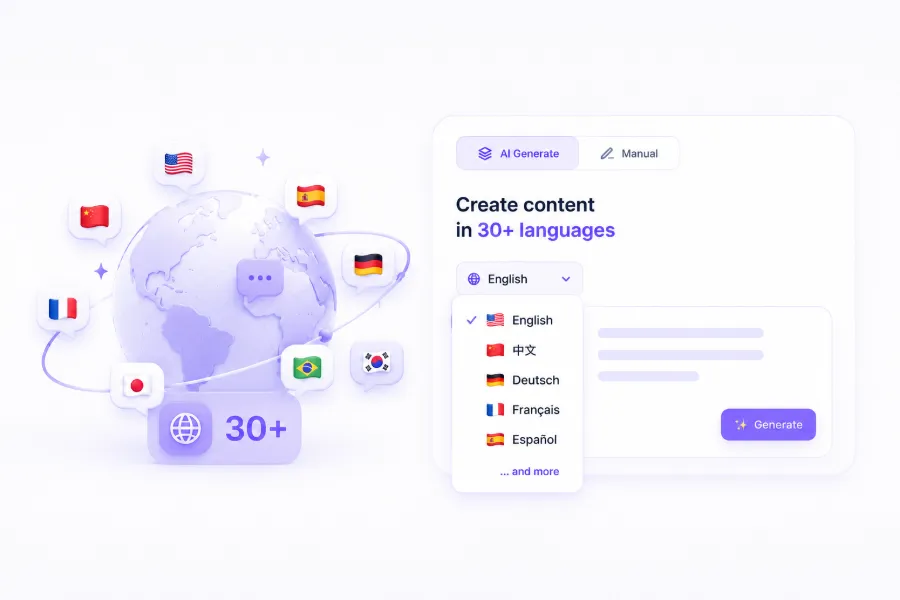
A common misconception is that “accurate translation is enough.” In reality, multilingual publishing’s core is presenting content in a way familiar to local audiences, not merely making it readable. The former is localization; the latter is translation. The value of content repurposing in the cross‑border e‑commerce context lies precisely in this market‑specific adaptation capability, which distinguishes it from ordinary duplicate posting.
From Trending Topics to Publishable Content: Solving Creative Dryness
Another hidden bottleneck of content repurposing is the source of ideas. Many teams can write but don’t know what to write. By feeding keywords into real‑time discussions on Reddit, YouTube, news sites, and Hacker News, and then spotting topics based on heat and momentum, high‑engagement content can be turned into publishable posts with a single click—addressing the upstream side of the content supply chain.
Heat scores for trending topics can be quantified. For example, 92% heat corresponds to Reddit discussions with strong momentum, 78% heat to YouTube search interest growth, and 64% heat to news articles undergoing industry debate. These scores help operators decide which topics merit creative resources and which are fleeting.
The amplification effect of topic inspiration on repurposing efficiency is that a single hot topic can spawn multiple platform versions, each backed by clear topical relevance. Flownib’s role in the topic‑to‑publication pipeline is evident here—discovering a topic, generating posts, and distributing them without switching tools compresses the path from trend to content to its shortest form.
Content Calendar, Scheduling, and Publishing Log Management
Once multi‑platform publishing is underway, a content calendar becomes essential. A visual calendar helps operators see at a glance what will be posted on each platform over the next week or month. With cumulative post counts reaching the 500,000‑post scale, such large‑scale operations quickly become unmanageable without a calendar and logging system.
Choosing between manual scheduling and AI‑driven optimal timing depends on the team’s operating rhythm. Manual scheduling suits teams with a clear publishing strategy; AI‑driven timing fits cross‑border operations that need to cover many time zones—after all, target markets may span a dozen zones, making human judgment impractical. For data on optimal publishing times, see the best posting times and scheduling strategy guide.
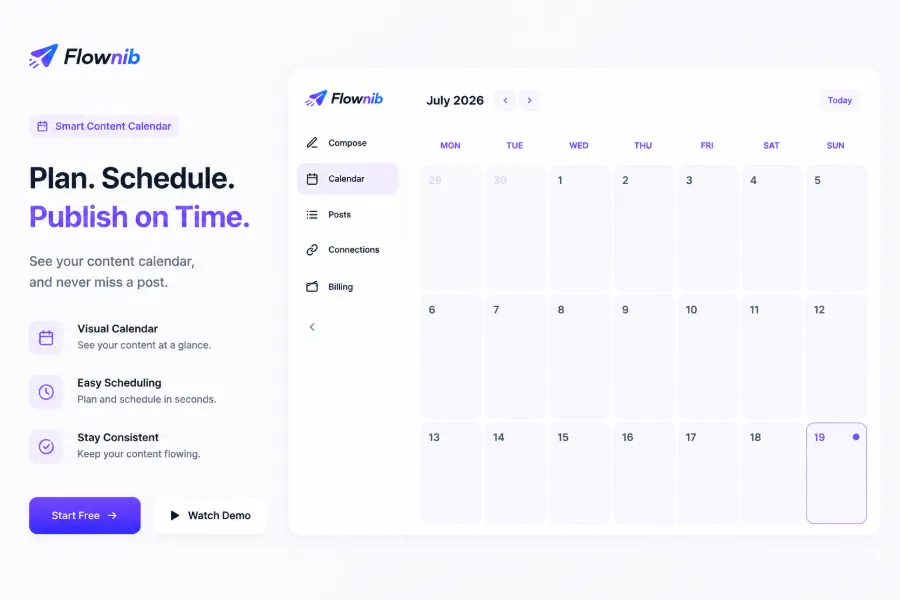
A unified dashboard for multiple accounts is often undervalued in team collaboration. When different members handle different platforms, a single dashboard prevents account confusion and publishing conflicts. Publishing logs are crucial for post‑mortem analysis and data tracking, allowing teams to trace the actual performance of each piece of content rather than relying on intuition. For tool selection, the 2026 Deep Evaluation of AI Distribution Tools compares major solutions and can serve as a decision reference.
FAQ
What’s the difference between content repurposing and direct copy‑and‑paste publishing?
Content repurposing rewrites each piece per platform characteristics before publishing, while copy‑and‑paste simply replicates the same text. The former ensures each version aligns with local audience reading habits and platform guidelines; the latter often leads to truncation, formatting errors, and ineffective hashtags. In practice, each repurposed version still needs an independent check for hard information accuracy.
Will simultaneous multi‑platform publishing affect brand consistency?
No, provided the core information remains consistent across versions. Brand consistency is reflected in product details, price, promotion wording, and tone, not in identical wording. AI rewriting presents the same information in each platform’s preferred style without altering the underlying message. Random spot checks across platforms can quickly catch any consistency drift.
Can AI automatic rewriting deviate from the brand’s established voice?
It can, which is why a pre‑publish human review is essential. AI typically retains the original core information and structure but may not fully match the brand’s tone and diction. The solution is to configure a brand guide so AI references the brand positioning and target audience while still allowing manual tweaks.
Do multilingual posts still require human review?
Yes, especially for product specs, pricing, and promotion terms. AI translation and localization are usable in most scenarios, but the accuracy of hard data must be verified manually. It’s recommended to check each new language version line‑by‑line on first release; after confirming correctness, bulk publishing can proceed with spot checks rather than full reviews each time.
Share Article