
Don't Let the Publishing Process Eat Up Your Content Production Power: Underrated Operational Costs

At 2 a.m., you finish a post that’s scheduled for tomorrow—three rounds of revisions for images, copy, and hashtags. Then you open Instagram and post once, switch to LinkedIn to reformat, go to X to adjust character count, rewrite the opening for Threads, crop the image for Facebook, and change the link format for Pinterest. After doing all that, an hour has passed. You stare at the screen, feeling like you haven’t done anything today, yet you’re exhausted.
Every content team has experienced this scenario. The problem is that most people treat it as an “inevitable operational cost,” assuming manual publishing is just how it is. But if you do the math, you’ll find that what you’re missing isn’t good content—it’s the system that gets good content out.
Content teams on average spend 6–8 hours per week on manual publishing and formatting—this figure comes from operational records of several content teams. It’s manageable for an individual who posts only two or three pieces a week, but if your team produces 10 or even 20 pieces a week, that time share quickly balloons to over 30 % of the workload. Even worse, you’re not just spending time; you’re also spending attention and creativity.
The Hidden Costs of the Publishing Process: Time, Energy, and Creative Drain
Suppose your content team publishes 10 pieces per week. Each piece must be manually posted to five platforms: Instagram, LinkedIn, X, Threads, and YouTube. From copying copy, adjusting image sizes, tweaking hashtags, to final confirmation, each piece takes an average of 12–15 minutes. Ten pieces equal two hours. It doesn’t sound like much, but it’s pure “lift‑and‑shift” work—no improvement to content quality, just shoving the same thing into different format boxes.
What really wears you out isn’t the actions themselves, but the constant platform switching that fragments attention. While writing for Instagram, you wonder whether the image will look too casual on LinkedIn; while formatting for X, you have to recall whether Threads’ character limits differ. Every switch forces the brain to readapt to a new UI layout, button placement, and publishing rules. It’s not a massive cognitive load, but it’s a continuous series of “micro‑interruptions”—each piece, each platform, each login drains the already limited attention reserve.
When this drain accumulates, “publishing procrastination” appears. Many content operators feel a strange reluctance: the copy and images are ready, yet they don’t want to open the backend. They know the next step is a long chain of copy‑paste, adjust, and confirm. This psychological resistance is harder to quantify than time cost, but its erosion of team creativity is real. When the team’s energy is exhausted by the publishing process, originality naturally declines—you can’t stay enthusiastic about polishing the next piece after blasting out to five platforms in one go.
Why Is Manual Publishing So Inefficient? – Platform Differences and the Truth About Repetitive Work
The root cause of low manual publishing efficiency is platform variance. An obvious yet often ignored fact is that each platform has completely different content format requirements.
Instagram enforces strict image aspect ratios, LinkedIn prefers horizontal long images, Pinterest works best with vertical high‑resolution graphics. X has a character limit, Threads allows more characters but formats differently, and Facebook’s link preview has its own image size rules. When you publish a piece of content, you’re essentially: writing a generic copy version, then tailoring tone, trimming characters, swapping image versions, and replacing hashtags for each platform. It sounds “personalized,” but in practice most teams can’t achieve true personalization—they merely adapt formats mechanically.
Even worse, repetitive work invites errors. Forgetting to change a hashtag, pasting a link from the previous platform, or using the wrong image size that gets cropped—these mistakes are common. I once saw a brand’s LinkedIn post with “automated reply from Instagram” underneath; a tiny detail, but it already affected users’ perception of the brand’s professionalism.
Inconsistent cross‑platform content also harms brand trust. When a user sees a promotion on Instagram, then goes to X and finds nothing, then sees a different message on LinkedIn, the information gap makes the brand seem careless.
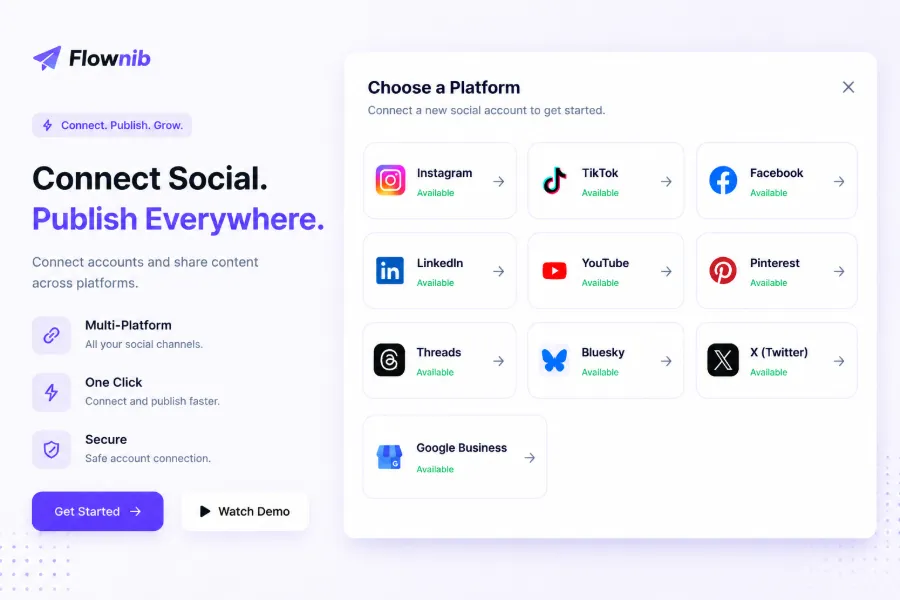
Systematizing the Publishing Process: From “Manual Lifting” to “One Creation, All‑Platform Distribution”
To break this loop, the core idea is to separate content creation from distribution. When you write, you shouldn’t think about how it will look on each platform. The value of content lies in the information itself, not the interface it appears on.
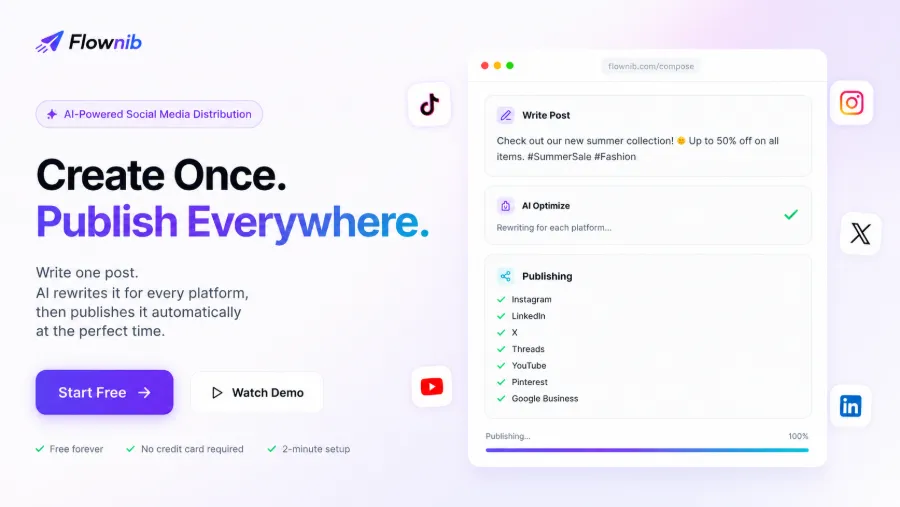
The starting point for systematic publishing is a simple principle: create once, adapt everywhere. Instead of copying the same text five times and manually tweaking each, let a system automatically transform the format according to each platform’s specs. AI‑driven rewriting is indeed useful here—not as a “copy generator” but as a “format adapter.” You write the core copy, then AI adjusts character limits, language style, and audience conventions for each platform, rather than rewriting from scratch each time.
Here’s an example: Flownib (https://flownib.com). Its approach lets users write content once, and AI automatically rewrites it into platform‑specific versions, then publishes with a single click. This is far more efficient than manual copy‑paste—you retain control over the core message while the system handles repetitive formatting.
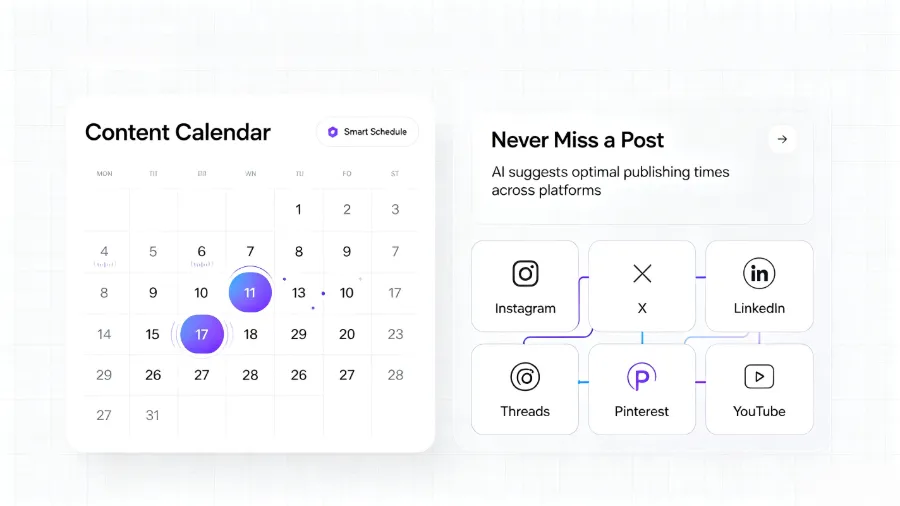
Another often‑overlooked element is calendar visibility. When publishing tasks are scattered across different backends, you can never see next week’s schedule on a single sheet. Systematic publishing consolidates all pending content from Instagram, LinkedIn, X, Threads, YouTube, Pinterest, Google Business, etc., onto one timeline. The team no longer needs to log into five backends to check for missed posts—just open the calendar once.
After adopting systematic publishing, content teams can save 10–15 hours per week on average. It sounds exaggerated, but the source is simple: time formerly spent logging in, copying, adjusting, confirming, and switching is now compressed into “write a piece → preview → schedule → click publish.” The process shortens, steps reduce, and error probability drops.
If you want a deeper dive into workflow design, check out this article on Why Social Media Automation Workflows Are Indispensable (https://flownib.com/p/local/en/why-n8n-zapier-users-need-flownib/index), which discusses the limitations of manual distribution at scale. For broader strategic planning, Buffer’s Content Strategy Resources (https://buffer.com/resources/) provide practical frameworks and templates.
From Publishing Fatigue to Content Leverage: Measuring the ROI of the Publishing Process
Many think systematic publishing is only for large companies. But if you calculate the costs, small teams actually need it more.
A three‑person content team spends 7 hours per week each on manual publishing. Assuming a monthly salary of ¥15,000 per person, the pure labor cost of publishing amounts to roughly ¥66,000 per year. With systematic publishing, that time can be reduced to 1–2 hours per person per week. Over a year, the team saves more than 1,500 hours—time that can be redirected to topic planning, data analysis, and user interaction, all of which directly contribute to content growth.
LinkedIn’s best‑practice publishing frequency data (https://flownib.com/p/local/en/automatically-post-on-x/index) shows that regular posting positively influences platform algorithms. Manual‑publishing teams often abandon consistency due to fatigue, whereas systematic publishing guarantees steady output—stability is far more valuable than perfection.
Flownib’s automatic rewriting and scheduling features help you strike a balance between “personalization” and “consistency.” They don’t strip your brand’s tone because the rewriting is based on the original copy you provide—AI handles format adaptation, not content creation.
A three‑person small team using systematic publishing can save over 1,500 hours annually. Those hours can be spent on user research, content strategy, and creative testing—the true lever for content impact. Teams that cling to manual publishing tend to overvalue the “personalization” of manual work while underestimating the long‑term impact of consistency on brand trust. When your content maintains the same visual style and information structure across platforms, users develop a coherent impression across touchpoints—a trust that fragmented publishing can’t build.
If you want concrete industry examples, read this case study on How Pet Product Sellers Build Loyal Audiences with Automated Social Media (https://flownib.com/blogs/how-pet-product-sellers-use-automated-social-media-to-build-loyal-fans), which shows how a small team used automation to compensate for limited manpower. Additionally, best‑practice data from LinkedIn Marketing Solutions (https://business.linkedin.com/) can help you calibrate platform‑specific publishing frequencies and goals.
FAQ
What exactly are the hidden costs of the publishing process?
They are the time and attention spent on repetitive tasks like copying, pasting, adjusting formats, and switching platforms. These costs are hard to quantify but have a huge impact—content teams average 6–8 hours per week on manual publishing, time that could be used for strategy or user engagement.
How can I tell if my content team is suffering from publishing fatigue?
Look for signs: team members resist opening the backend; weekly publishing volume declines; frequent format errors or inconsistencies appear after publishing; writers start “cutting corners” to reduce publishing workload, leading to lower output frequency.
Will AI rewriting make the content lose its brand personality?
It depends on how you use it. AI rewriting isn’t generating content from scratch; it adapts your core copy to each platform’s format. Your original content determines tone and style; AI only handles character limits, headline tweaks, and platform‑specific phrasing. With clear brand guidelines, AI‑adjusted content usually stays on brand.
Are systematic publishing tools suitable for small teams or large teams?
Small teams benefit proportionally more because manual publishing time is fixed—regardless of team size, each piece requires the same steps. A 2‑ to‑person team saving 10+ hours per week sees a huge efficiency boost. Large teams save more absolute time, and the ROI of the system is still worthwhile for both.
How long does it take to switch from manual to systematic publishing?
Most tools can connect accounts and set up basics within 30 minutes. After the new workflow is live, it’s recommended to run a one‑week “parallel publishing” phase—systematic and manual publishing side by side—to ensure platform presentation meets expectations. By the second week, you can fully transition to systematic publishing.
Share Article