
Home & Garden Independent Site Social Media Strategy: How AI Rewriting Boosts Short Video Seed-to-Conversion
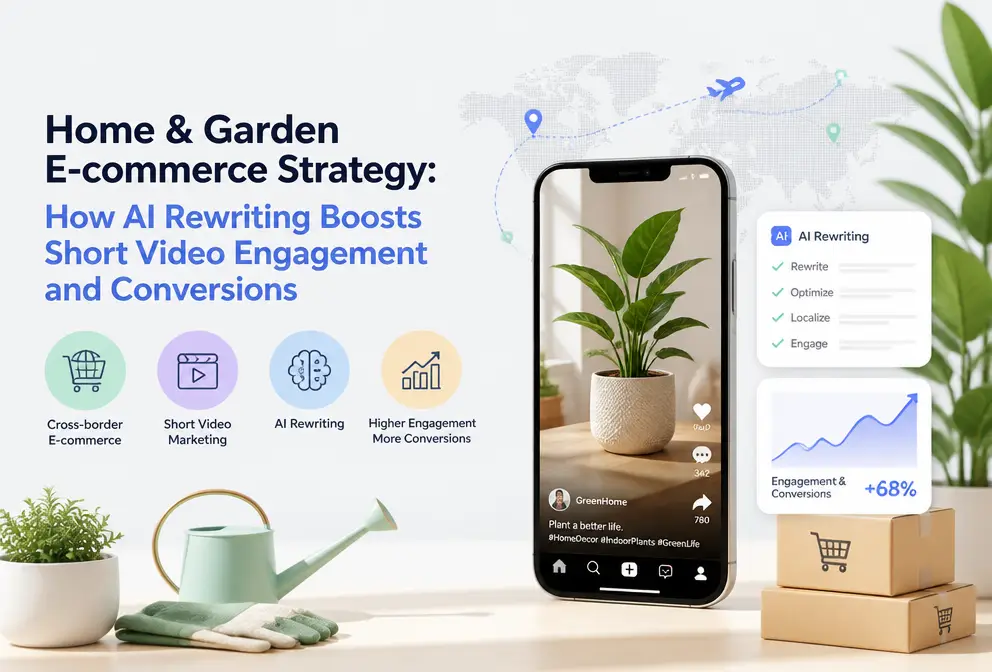
Home & garden brands often fall into an inefficient loop in social media operations: after shooting a set of product footage, they have to create separate copy for each platform. Instagram needs refined, atmospheric copy, TikTok demands a hook within the first three seconds, and YouTube requires a scenario‑based product explanation. Teams spend time manually tweaking the same description, neglecting the delivery of core brand messages. Research shows that home‑brand operation teams spend an average of 12 hours per week manually adjusting social media content — almost half of a full‑time position.
Content Adaptation Challenges for Home & Garden Brands
Social media content for the home & garden category has distinct characteristics: strong visual drive, high tutorial nature, and clear seasonality. A product video of a garden trellis requires four different caption sets: Xiaohongshu emphasizes atmosphere — “Afternoon sunshine spills onto the trellis, adding a healing touch to a home corner”; TikTok needs a fast‑paced hook — “Assemble this trellis in three minutes and turn your balcony into a mini garden instantly”; YouTube calls for detailed description — “Load‑bearing test, material comparison, installation pitfalls guide”; Pinterest requires a layout that combines images and text.
Conflicts in cross‑platform adaptation occur daily. Xiaohongshu users expect refined lifestyle aesthetics; a copy longer than 150 characters collapses. TikTok’s algorithm relies on completion rate, and without a hook in the first three seconds, viewers scroll away. YouTube viewers are willing to spend five minutes on a tutorial but need clear steps and visual information. The same product and footage must become four completely different language versions. Teams repeatedly switch between copy, paste, adjust, and format, leading to a high error rate — for example, pasting TikTok’s hook sentence onto Instagram, causing users to leave immediately when they realize it’s not what they expected.
Your browser does not support the video tag.
AI Rewriting: One Creation, All‑Platform Adaptation
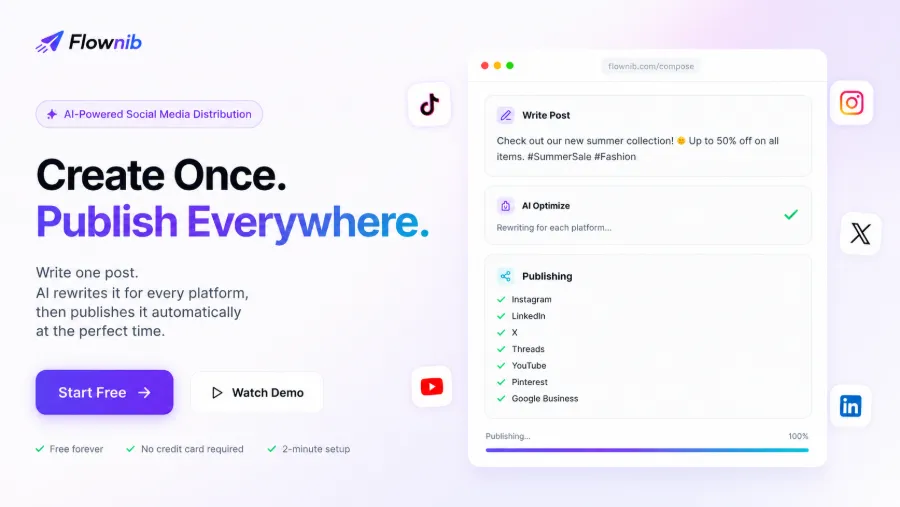
Flownib’s AI rewriting feature directly addresses this core pain point. Its logic is not a simple text translation or synonym replacement; instead, it automatically adjusts copy length, tone, and format according to each platform’s style characteristics, character limits, and audience expectations, while keeping the brand’s core message and visual style unchanged.
Specifically, a seed‑content piece about a sofa appears on Instagram as “Lazy weekend afternoon, curled up on this cloud‑like sofa reading a book,” becomes on TikTok “How soft is this sofa really? Smash it down and see the rebound,” and expands on YouTube into “Fabric feel, fill density, support structure – evaluating this sofa from three dimensions.” All copy shares the same product selling points, but the expression varies completely.
The workflow is straightforward: write a draft, AI automatically generates platform‑specific versions, preview and confirm, then publish with one click. No tool switching or manual layout adjustments are required. Currently, Flownib’s AI rewriting feature covers ten major platforms, including Instagram, X, LinkedIn, TikTok, Facebook, Threads, Pinterest, YouTube, Bluesky, and Google Business; connecting accounts takes about two minutes.
For detailed operational steps, refer to Flownib’s One‑Creation‑All‑Platform Publishing Workflow Analysis for more details.
Short‑Video Seed‑to‑Conversion Path: From Adaptation to Monetization
The key to monetizing short videos in the home & garden category is “scene recreation.” Users aren’t buying a trellis; they’re buying the possibility of making their balcony beautiful. AI rewriting optimizes conversion copy by precisely matching platform characteristics.
TikTok users are accustomed to seeing discount information in the comment section — a voice‑over saying “Grab a coupon in the comments for ¥20 off” paired with an on‑screen discount code creates the shortest conversion path. Instagram Reels users prefer to explore the brand story via the profile link, so copy should guide them with “Tap the profile link to see the full styling guide.” YouTube Shorts users focus more on product links within the tutorial, so a direct cue like “The trellis from the video is in the cart” works well.
A set of real data supports this logic: after a home‑brand independent site adopted AI rewriting, TikTok short‑video click‑through rates rose by 30%, and Instagram Reels link click‑through rates increased by 22%. The improvement isn’t because the copy itself got better, but because each platform’s copy said the right things.
A hidden detail to watch: the “call‑to‑action” in short‑video seed copy must be adjusted to platform user habits. TikTok users expect instant interaction during consumption, and coupon comments are a common purchase entry point; Instagram users tend to browse first, then think, and finally go to the profile to purchase. The same “purchase link” expressed differently across platforms directly impacts conversion efficiency.
Content Calendar and Multi‑Account Management: Maintaining Publishing Rhythm
Seasonality in the home & garden category is more pronounced than in fast‑moving consumer goods; content planning should be managed monthly rather than weekly. Spring garden makeovers, summer terrace setups, autumn succulent care, winter Christmas decorations — each season’s product selection and content direction differ drastically. Waiting until the season arrives to start creation reduces content quality, publishing frequency, and rhythm.
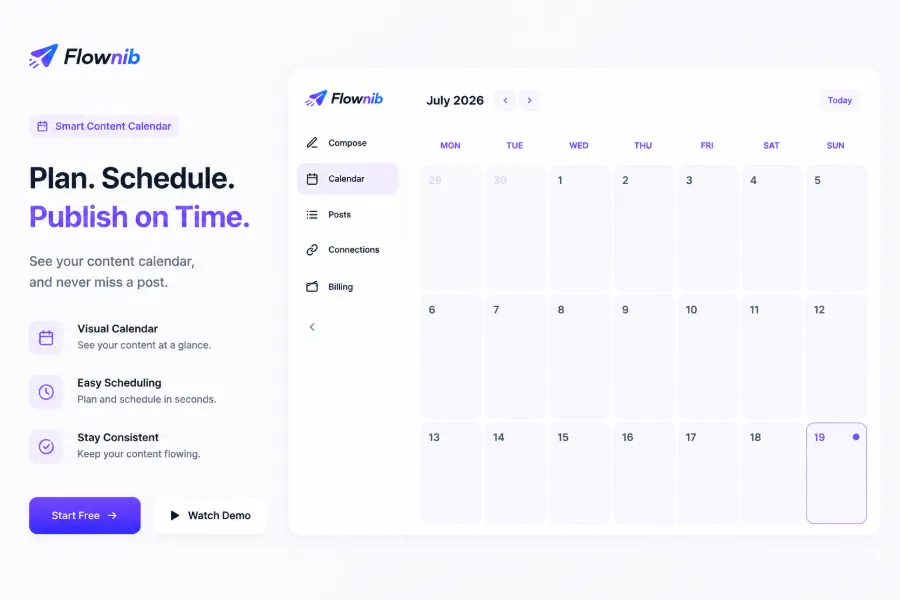
A content calendar is practical in these scenarios. Flownib’s content calendar lets you preview published and pending posts, allowing the operations team to plan each holiday’s publishing schedule two months in advance, avoiding weight loss from gaps. Image assets, copy versions, publishing times, platform choices — all information is centralized in a calendar view, reducing communication overhead during team collaboration.
Multi‑account management also deserves attention. Many home brands operate domestic and overseas social accounts simultaneously, or have multiple sub‑brand accounts on a single platform. Flownib’s multi‑account dashboard can manage multiple accounts under the same platform in a unified view, eliminating repeated log‑outs and log‑ins.
Tool Collaboration: Flownib + SEO + Independent Site Operations
Social media distribution and independent‑site SEO are not isolated. Continuously publishing short‑video content rewritten by AI not only drives direct social media traffic conversion but also accumulates off‑site signals for the independent site. Google’s search algorithm assigns weight to a brand’s social signals; high‑frequency, high‑quality social content distribution can indirectly boost organic search rankings.
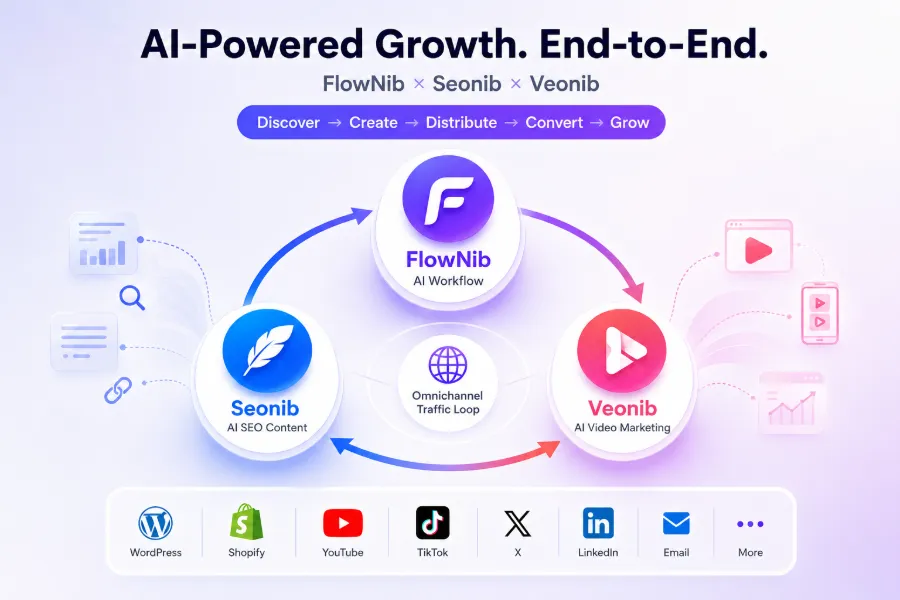
The concept of a “content stack” has been repeatedly highlighted in 2026 cross‑border practice: SEO content captures search traffic, AI video handles platform coverage, and automatic distribution ensures sustained exposure, forming a positive loop. Social media distribution can increase an independent site’s organic search traffic by about 30%, according to industry feedback.
Compared with traditional social media tools, the AI rewriting plus automatic distribution model is clearly better suited for visually driven categories like home & garden. Tools like Hootsuite excel at scheduling and planning but lack intelligent content adaptation. For a detailed functional comparison, read Flownib’s Buffer vs. Hootsuite Comparison Review.
For the full practical logic of the content stack, refer to the 2026 Cross‑Border Content Stack Deep Dive.
FAQ
Which platforms are most effective for home & garden brands to invest in short videos?
TikTok and Instagram Reels currently have the highest conversion efficiency. TikTok is suitable for fast‑paced showcases of product usage scenarios and pain‑point solutions, while Instagram Reels is good for building brand tone and lifestyle association. If a brand has a library of tutorial content, YouTube Shorts can also deliver decent long‑tail traffic returns.
How to determine if AI‑rewritten copy maintains brand tone?
During the preview stage, check the rewritten results per platform. Core selling points and brand‑specific language (e.g., specific product names, pricing strategy) should remain unchanged; only expression and rhythm may vary. If a piece of copy’s tone deviates too much from the brand’s usual style, you can manually fine‑tune it before saving.
How far in advance should the content calendar be planned?
It is recommended to plan quarterly and execute monthly. The seasonal rhythm for home & garden (spring, Mid‑Autumn, Christmas) and care cycles (repotting, fertilizing, pruning) have fixed windows. Organize topics three months in advance, finalize assets and copy one month ahead, and avoid last‑minute rushes that compromise quality.
Does social media distribution really help independent‑site SEO?
Yes, but the effect is indirect. High‑frequency social media distribution boosts brand search volume, increases external mentions and social signals, which over time positively influence organic search rankings. The direct conversions and brand exposure generated by social media traffic are also valuable sources beyond SEO optimization.
Share Article