The Profit Dilemma of Managed Operations: Labor Costs Devour Profits, How One Operator Can Scale from Managing 3 Clients to 10

Open any managed‑operations profit‑and‑loss statement, and the labor‑cost line always stands out more than all other costs combined. The real trouble for most agencies is: each new client requires an additional staff member, and profit margins are steadily squeezed. This article does not discuss grand theories; it directly breaks down a proven six‑step workflow whose core goal is to let a single operator jump from handling 3‑4 clients to 8‑10, lower labor costs, and boost profits.
Managed operations may look like simply managing client accounts, but it is actually a war of labor efficiency. If you hire an operator with a $2,000 monthly salary, they can serve at most 3‑4 clients because each client’s social‑media operations involve copywriting, platform adaptation, scheduling, comment replies, and monthly reporting—all manual tasks that lock a person’s capacity. If you take on 8 clients, you need 2‑3 operators, labor costs double, but client budgets cannot keep up with that pace.
The Real Enemy of Profit Is Not Customer Acquisition, but Linear Labor Growth
The business model of managed operations has an inherent flaw: revenue can grow linearly, labor costs also grow linearly, but client‑budget growth is far slower than labor‑cost inflation. Hootsuite’s 2026 social‑media industry report makes it clear: 67 % of agencies say labor cost is the biggest operating pressure; labor costs rise 15‑20 % annually, while client social‑media budgets only grow 8‑12 %. This “scissor gap” means the more clients you take, the lower the profit margin.
Let’s do a concrete calculation. Assume an operator earns $2,000 per month and manages 3 clients, each billed at $1,500 per month. Gross profit is only $2,500—after rent, tools, and management costs, net profit is almost zero. If the same operator can handle 8 clients, gross profit jumps to $10,000. The question returns to the start: how can one person go from 3 to 8 clients? Not by overtime, but by redesigning the workflow.
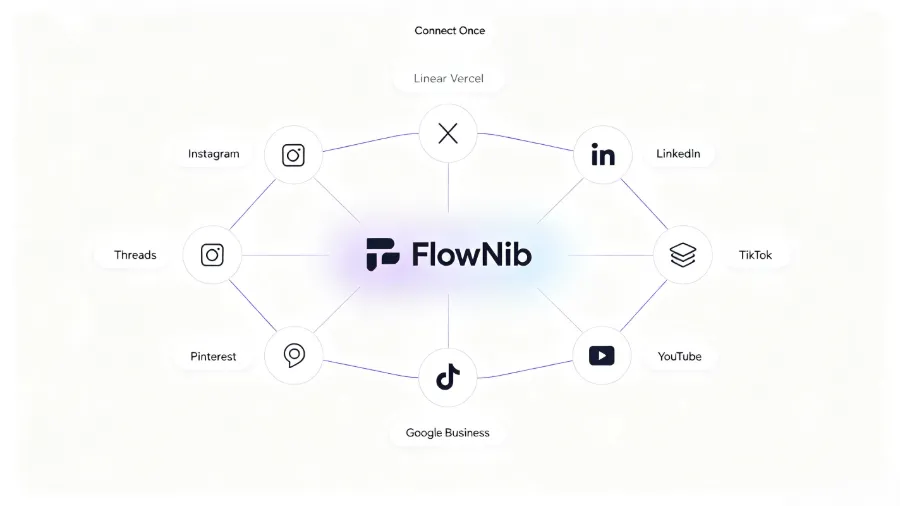
In the traditional model, an operator’s time is eaten up by four steps: copywriting, platform adaptation, manual scheduling, and monthly reporting. The most time‑consuming part isn’t writing but reformatting and adjusting tone for each platform. Instagram needs short, snappy posts; LinkedIn demands professional rigor; TikTok requires strong rhythm—each platform forces the operator to re‑adjust the content. This can be visualized as a central hub radiating to multiple platforms, requiring a unified nexus in the middle.
Algorithm Upgrades Make “One‑Size‑Fits‑All Content” Completely Obsolete, Doubling Workload
Before 2026, many agencies simply copied and pasted the same content across all platforms, with the operator making minor word‑count tweaks. That approach no longer works. Instagram, TikTok, and LinkedIn have overhauled their algorithms to penalize cross‑platform copy‑pasting—penalties include reduced recommendation weight, lower exposure, and even low‑quality flags. Consequently, each piece of content must be re‑adapted before publishing on a different platform.
According to the Hootsuite 2026 social‑media industry report, 78 % of consumers expect brands to stay active on multiple platforms. Clients clearly demand full‑platform coverage. Full coverage means full adaptation, doubling the operator’s workload. What used to be “write one, post three,” now becomes “write one, adapt three”—the adaptation time exceeds the original writing time.
This creates a counter‑intuitive phenomenon: the platform’s penalty targets not the content duplication itself but the lazy act of “cross‑platform copy‑pasting.” Native‑adapted content actually receives more exposure under platform recommendation algorithms. In other words, proper adaptation not only avoids penalties but also directly drives traffic. The problem is that manual adaptation is too costly.
Transforming the Workflow: Four Steps from “Labor Stacking” to “System‑Driven”
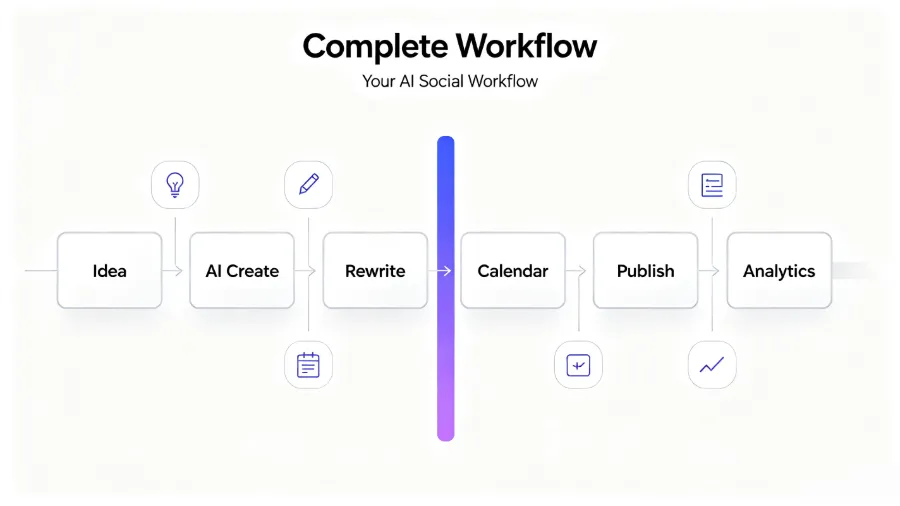
The real solution isn’t hiring more people; it’s switching the process from “labor‑driven” to “system‑driven.” Below is a validated six‑step workflow, each stage producing concrete deliverables.
1. Bulk Onboard Client Accounts
The first step is to gather all client social‑media accounts into a single management dashboard. Using Flownib’s multi‑account management feature, you can handle Instagram, TikTok, LinkedIn, Facebook, X, Pinterest, and 10 other platforms. Group accounts by client and view all statuses from one dashboard. This solves the “searching for accounts everywhere” problem—operators no longer need to log into each platform separately; everything is centralized.
2. Build a Client Content Template Library
Create a brand‑specific content template for each client. Set tone, visual guidelines, hashtag strategy, and posting frequency in advance. When a new client joins, you simply apply the template without building a framework from scratch. Once this SOP is established, every subsequent content creation follows the template, eliminating repeated decision‑making.
3. AI‑Powered One‑Click Multi‑Platform Adaptation
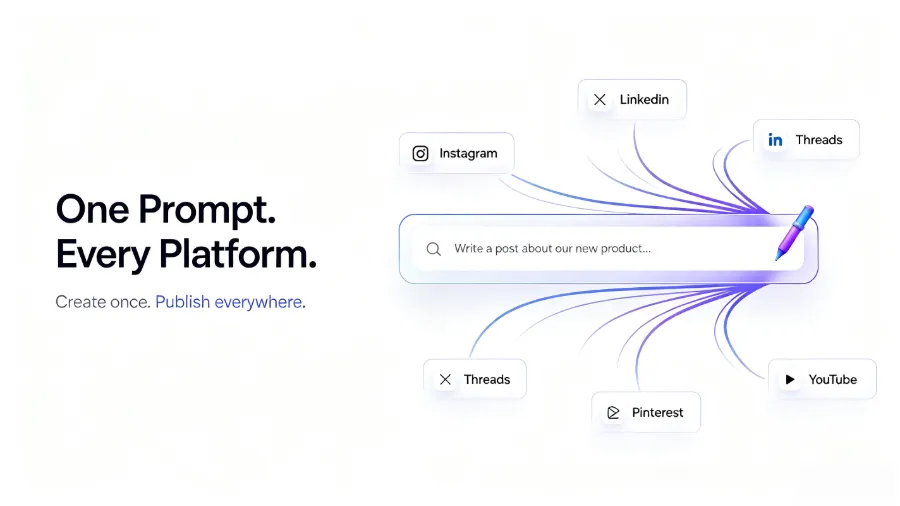
This is the core efficiency step. The operator writes a core copy (the master draft); AI automatically rewrites it into native versions for each platform. For example, a product launch announcement is shortened to under 200 characters with emojis for Instagram, expanded to 800 characters with professional phrasing for LinkedIn, and turned into a video‑description script for TikTok. One operator can reliably produce daily content for 8‑10 clients in a day, instead of being stuck on the adaptation stage.
The efficiency gap between the traditional and system‑driven approaches is evident in the following comparison:
| Stage | Traditional Method | System‑Driven Method | Efficiency Gain |
|---|---|---|---|
| Copywriting | Write a version for each platform | Write master draft, AI rewrites | 5× |
| Format adaptation | Manual adjustment of length and tone | Automatic adaptation | 10× |
| Scheduling | Log into each platform separately | One‑click batch scheduling | 8× |
| Monthly reporting | Manual data export | Auto‑generated reports | 3× |
Data shows weekly content creation time per client drops from 3.5 hours to 1.2 hours—a 66 % reduction. For the technical logic behind AI rewriting, see this in‑depth article: How FlowNib Automatically Rewrites Content and Distributes It Across 10 Social Platforms.
4. Batch Scheduling and Staggered Publishing
Put all client content into a unified calendar; the system automatically staggers publishing times to avoid cross‑platform fingerprint conflicts. Each platform’s prime time differs—LinkedIn in the morning, Instagram in the evening, TikTok during lunch breaks. The system follows preset rules to schedule accordingly. If you’re unsure about tool selection, refer to this 2026 Deep Comparison of Social‑Media Scheduling Tools.
Real‑World Results After Doubling Efficiency: Six‑Month Performance of 15 Agencies
From January to June 2026, 15 agencies using FlowNib showed that the number of clients a single operator could manage rose from 3‑4 to 8‑10, a 150 % increase. More importantly, client satisfaction climbed from 72 % to 89 %, and renewal rates rose from 65 % to 84 %.
| Metric | Traditional Agency | FlowNib Agency | Difference |
|---|---|---|---|
| Clients per operator | 3‑4 | 8‑10 | +150 % |
| Content creation time per client | 3.5 hrs/week | 1.2 hrs/week | –66 % |
| Monthly labor cost (10 clients) | $6,000 | $2,047 | –66 % |
| Avg. client satisfaction | 72 % | 89 % | +17 % |
| Client renewal rate | 65 % | 84 % | +19 % |
The 30 % engagement boost stems from FlowNib’s AI rewriting, which ensures each platform receives native‑adapted content rather than low‑quality copy‑pasting. When clients see engagement rise, they naturally continue to pay. A quick ROI calculation: an agency package at $47/month plus two operators at $4,000 total monthly salary equals $4,047/month. Managing 20 clients at $1,500 each yields $30,000/month revenue and an 86.5 % gross margin. In the traditional model, three operators handling 10 clients achieve only a 58 % gross margin.
2026 Comparison of Agency Social‑Media Management Tools: Traditional Scheduling Tools Are No Longer Sufficient
Before 2026, social‑media tools competed mainly on scheduling features and team collaboration. The competitive logic has shifted—content adaptation and multi‑client efficiency are now the real pain points.
- Buffer focuses on small‑team scheduling, lacks AI rewriting, and offers limited multi‑client management; Team plan $120/month.
- Hootsuite supports multi‑client management but requires external tools for rewriting; Team plan $249/month.
- Later specializes in Instagram; Agency plan $80/month, but multi‑platform support is limited.
- SocialBee provides basic assisted rewriting; Pro plan $99/month.
- Flownib natively supports AI rewriting and unlimited account management; Agency plan $47/month, only 15 % of Hootsuite Team’s price.
Industry trends are also evolving. HubSpot’s marketing blog repeatedly discusses cross‑platform content consistency challenges, and LinkedIn’s marketing solutions highlight the value of native adaptation for B2B brands. Traditional tools still solve “distribution,” but the 2026 challenge is “adaptation”—the key dimension that separates tools. For a deeper API‑support comparison, see the Flownib vs. Publer vs. Planoly Official API Battle.
The labor bottleneck in managed operations isn’t a shortage of good operators; it’s a physical limit on how much content one person can produce each day. The core value of efficiency tools isn’t to replace people but to amplify each person’s capacity, allowing the same resources to generate more client value. When labor cost ceases to be the profit ceiling, agencies can focus on client growth and service quality rather than constantly calculating how many more clients they can take on.
FAQ
Why are managed‑operations agencies’ profits shrinking?
The core reason is linear labor‑cost growth—each new client requires an additional operator, while client‑budget growth lags behind labor‑cost inflation. An operator can only handle 3‑4 social‑media accounts, severely compressing profit margins. After the 2026 algorithm upgrades, operators also need to adapt content individually for each platform, further increasing workload.
Will using AI tools to manage multiple client accounts trigger platform throttling?
No. As long as the AI ensures each platform’s content is a native‑adapted version, there is no cross‑platform copy‑pasting issue. Real data shows that after AI adaptation, client account engagement rates rise on average by 30 % because the content is higher quality and aligns better with platform algorithm preferences.
What does FlowNib’s Agency package include?
Unlimited social‑media accounts, up to 1,000 posts per month, and 1,000 AI credits. All client accounts can be connected to a single dashboard for unified management and publishing, without separate fees per client. Starting price $47/month.
Can clients accept AI‑assisted content?
The core copy is still created by the operator team; AI only rewrites a master draft into native versions for each platform. The final content delivered to clients is higher quality and generates better engagement—clients care about results, not the underlying tool.
Is this tool suitable for newly launched agencies?
Absolutely. The biggest challenge for new agencies is having few staff and many clients. A system‑driven approach lets 1‑2 people efficiently manage 10 clients, dramatically reducing early‑stage labor‑cost pressure. You can start with the free tier to validate the workflow.
Share Article