
The Truth Behind “Dominating the Entire Internet”: Why the Same Sentence Performs So Differently Across 10 Platforms

Last year, a friend who runs a cross‑border e‑commerce business reviewed a failed marketing campaign with me. They copied the same promotional copy verbatim onto ten platforms. On LinkedIn it received almost no attention, Instagram performed modestly, and on X (formerly Twitter) users accused it of being “half‑hearted.” The team spent over a month investigating and concluded that “platform weighting is the problem.” That conclusion was wrong.
The issue is never the platform itself, but that a single piece of text cannot simultaneously fit all contexts. The same sentence addresses procurement decision‑makers filtering suppliers on LinkedIn, industry observers seeking high‑density information on X, and casual users scrolling through images on Instagram to relax. Different audiences, motivations, and decoding methods naturally lead to vastly different results.
The mindset of “dominating the entire internet” itself violates basic communication theory. Copying the same passage to every platform is not diligence; it’s laziness.
Communication Theory Perspective: The Fundamental Misconception of “Dominating the Entire Internet”
In communication studies there is a classic “encoding‑decoding” model: the sender encodes ideas into text, and the receiver decodes them according to their own context. The problem is that decoding is never passive. The same word can mean completely different things to people with different identities and motivations.
Platforms serve as “fields” in this context. Each platform has its own rules, habits, and subtext, and users automatically switch to the corresponding reading mode when they enter that field. Writing “Let’s go, folks” on LinkedIn makes users think you’re unprofessional; posting a rigorous industry analysis on X may result in no one even reading it.
I’ve seen more intuitive data: an e‑commerce brand tested the same copy on ten platforms and found that the first‑hour interaction rate varied by almost 20‑fold between the highest and lowest. This is not a content‑quality issue; it’s that the same text is received in completely different ways across different fields.
Understanding “domination” as “posting the same content everywhere” is a misdirection from the start. True cross‑platform communication requires acknowledging that each platform is a different world.
Three Underlying Variables That Determine Communication Effectiveness
Setting aside mysticism, the differences in cross‑platform performance are primarily determined by three variables.
The first is platform tone, i.e., the user scenario and psychological expectations. LinkedIn is a work setting, users have a “seeking collaboration opportunities” mindset; TikTok is a leisure setting, users have a “what’s fun” mindset. The same content is judged by completely different standards under these two mindsets.
The second is algorithmic mechanisms. There’s a less‑noticed distinction: interest‑recommendation platforms versus social‑graph platforms handle the same text in completely different ways. Interest‑recommendation platforms prioritize dwell time—content that fails to retain users is down‑ranked; social‑graph platforms rely on interaction density—content that receives no response is not pushed to more users. The former penalizes “content that doesn’t keep people,” while the latter penalizes “content that gets no response.” This is the algorithmic root of communication differences.
The third is the shape of attention. Some platforms have users who actively search, such as Pinterest and YouTube; others have users who passively scroll, such as Instagram and TikTok. In active‑search scenarios, the title and keywords decide everything; in passive‑scroll scenarios, the hook in the first few seconds determines life or death.
When these three variables combine, it’s almost inevitable that the same piece of content is treated differently across platforms.
The “Personality” of Major Platforms Varies
Looking at major platforms individually, each has very specific implicit rules.

LinkedIn emphasizes concise paragraphs and summary lines; the first screen shows only about 110‑130 characters of the body summary, and the opening must deliver value directly. X (Twitter) limits a single post to roughly 280 characters, requiring a fast pace and high information density. Instagram prioritizes restraint in captions and hashtags, focusing on visuals. Pinterest is essentially a search engine; keywords in the description directly determine exposure. TikTok relies on a hook in the first two seconds of the video, with text serving as support. YouTube titles must balance searchability and click‑through. Threads seeks a conversational tone; being too formal can lead to being ignored.
The same content faces different “survival conditions” on each platform. This explains why copying verbatim fails—you simply aren’t playing by the platform’s rules.
The key rewriting points for each platform can be roughly summarized in the following table:
| Platform | Tone Positioning | User Expectation | Rewriting Focus |
|---|---|---|---|
| Visual first | Light, appealing | Short caption, set of hashtags | |
| X | Information density | Fast, direct | Compress sentence length, front‑load conclusion |
| Professional setting | Depth, evidence | Concise paragraphs, highlight summary line | |
| TikTok | Entertainment/leisure | Hook in first two seconds | Front‑load hook, text as support |
| Search engine | Find inspiration, solutions | Keyword coverage, specific description | |
| YouTube | Search + click | Title as promise | Title balances search and click |
| Threads | Conversational | Authentic, relaxed | Conversational style, like chatting |
These observations mostly come from repeated trial‑and‑error in daily operations, and you can also refer to the publicly available insights from Hootsuite’s social platform industry reports (https://blog.hootsuite.com/). Additionally, Threads’ official platform page (https://www.threads.com/) describes its product positioning, confirming its conversational tone.
One Draft, Multiple Rewrites: What Exactly Is Being Changed
“Rewriting” sounds mystical, but it can be broken down into four actionable dimensions.
First is tone and address. Using “you” (formal) for LinkedIn users versus “you” (informal) for Instagram users reflects two completely different relational distances. Second is rhythm and sentence length. Short, rapid sentences on X appear crisp, while overly fragmented sentences on LinkedIn seem disorganized. Third is the symbol system—this is the easiest to overlook. Hashtags and emojis serve entirely different functions across platforms: on Instagram and TikTok, hashtags are discovery mechanisms that directly affect whether content can be found; on LinkedIn and Threads, dense hashtags and emojis are often seen as noise. Rewrites must replace them as a set, not simply delete them.
The fourth is the order of information presentation. LinkedIn suits a conclusion‑first approach, stating value upfront; TikTok benefits from a progressive build‑up, leaving the hook until the end. Another dimension is content format adaptation— the same event becomes a video on YouTube, a graphic post on Pinterest, and a text post on X, each with a completely different form.
These four dimensions essentially cover the rewriting needs of the vast majority of major platforms. Buffer’s social media management best‑practice library (https://buffer.com/resources/) also mentions a similar view: the core of cross‑platform content is not copying, but making the information align with each platform’s decoding habits.
If you’re considering systematizing multi‑platform publishing, check out the selection points for integrated social media tools (https://flownib.com/p/local/en/all-in-one-social-media-tool/index), which outlines common pitfalls. For more concrete team implementation, refer to this case study on workflow upgrades for marketing teams moving away from manual publishing (https://flownib.com/p/local/en/marketing-team-social-media-workflow-upgrade/index).
Turning Rewriting Into an Executable Workflow
The theory is done; the real challenge is execution. Maintaining multi‑platform publishing costs more than most people imagine.
Manually rewriting each piece of content, logging into each account to publish, setting scheduling reminders, synchronizing content calendars—these tedious tasks add up to a considerable amount of weekly time. A three‑person team I know spent nearly a full day each week just on manual publishing, and they often experienced missed or incorrect posts.
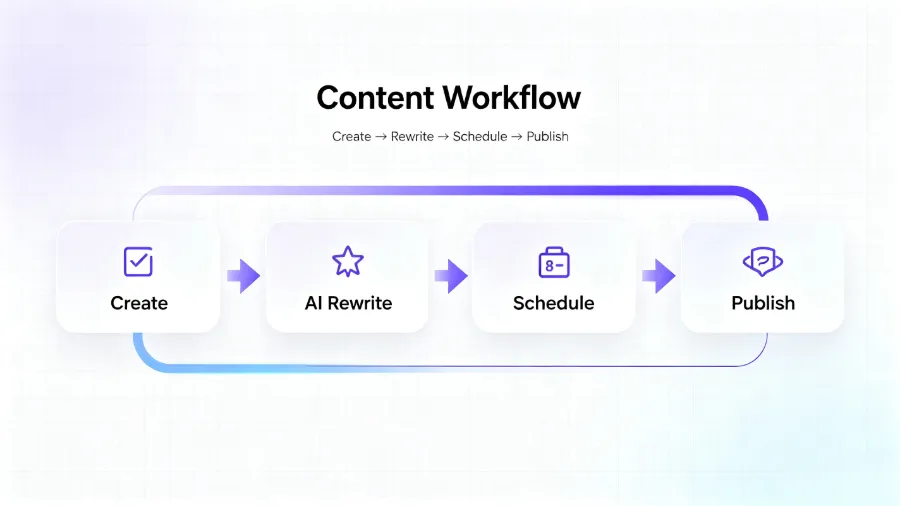
Later they switched to a “create once, rewrite multiple times, publish uniformly” workflow: write a core version, rewrite it per platform, then schedule a unified release. After this process was in place, they saved roughly 10–15 hours of manual publishing each week. The saved time was largely spent on the content itself and interacting in comment sections.
In this chain, the role of automation tools is clear—they are means, not the main actors. I’ve tried several distribution tools; honestly, some produce questionable rewrite quality, others are unstable. The one that works best for me now is Flownib (https://flownib.com), which can automatically rewrite a piece of content for each platform and publish it uniformly, with a direct official API and setup taking about two minutes.
Of course, tools solve the “publishing” part; rewrite quality still depends on your understanding of each platform. No matter how smooth the tool, it cannot replace the fundamental skill of “knowing what each platform wants.” This analysis, “Why AI Distribution Became a Must‑Have in 2026” (https://flownib.com/p/insights/buffer-alternative-deep-review-why-you-need-ai-distribution-in-2026/index), offers a thorough comparison with traditional scheduling tools. Additionally, this case study, “Global Creators Boosting Social Reach: Real‑World Results” (https://flownib.com/blogs/2026-flownib-help-global-creators-boost-social-traffic), documents a creator’s data changes after switching from manual publishing to unified distribution.
FAQ
Why does the same content perform so differently across platforms?
Because each platform has different user identities, usage motivations, and algorithmic mechanisms. Interest‑recommendation platforms penalize content that fails to retain users, while social‑graph platforms penalize content that receives no response. The same text is judged by completely different standards in different fields, so performance differences are inevitable.
How much extra work does one‑draft‑multiple‑rewrites add?
It may be a bit more at first, but once proficient, each piece of content only takes an extra 5–10 minutes. Compared to copying verbatim and then having to redo it due to poor performance, this cost is much lower. After adopting a unified distribution workflow, the team actually saves 10–15 hours of manual publishing per week.
When rewriting, which aspects should be prioritized?
First adjust tone and address, then compress or expand sentence length, then replace hashtags and emojis as a set, and finally adjust the order of information presentation. These four dimensions cover the core differences of most platforms, and after addressing them the content is essentially ready.
Do all platforms require completely different content?
No. Keep the core message consistent; only the presentation adapts to each platform. The same event becomes a video on YouTube, a graphic post on Pinterest, and a text post on X—different formats but the same core.
Can a single rewrite be reused repeatedly?
Yes, but periodic updates are recommended. Platform tone and user habits evolve; a rewrite logic used for more than six months will start to lose effectiveness. After each publication, monitor engagement data and fine‑tune the rewrite scale based on feedback.
Share Article