Automation of Social Media Content Creation: A Practical Roadmap from Manual Copy‑Paste to Seamless Multi‑Platform Publishing

A day in the life of a cross‑border e‑commerce operator usually starts with copy‑pasting. The launch copy for a single product must first be adapted to Instagram’s visual style, then rewritten in LinkedIn’s professional tone, and finally compressed into a short X (Twitter) post under 280 characters. Switching tabs, adjusting formatting, checking character counts, and then logging into each backend to click “publish”—this workflow repeats several times a day, consuming two to three hours. With multiple versions, missed edits, wrong posts, and brand‑voice drift become almost inevitable.
One piece of content, distributed across all platforms—sounds like a slogan, but in practice it requires a complete workflow redesign: where the content comes from, how it’s adapted for each platform, when it’s posted, and how it’s tracked after publishing. Automation’s value isn’t just saving a few mouse clicks; it’s freeing operators from repetitive tasks so they can focus on strategy and engagement. This article breaks down an executable automation roadmap into five stages: creation, adaptation, scheduling, publishing, and review.
Why Manual Operations Have Become the Biggest Bottleneck in Cross‑Platform Management
Content specifications vary dramatically across platforms. Instagram centers on images and short videos, with copy that’s concise and emotive; LinkedIn demands a professional tone, suited to long‑form posts and thought leadership; X has strict character limits, requiring terse expression; Facebook audiences prefer storytelling. The same product information theoretically needs four to five different versions. Manual handling means most of an operator’s time is spent on format conversion rather than on the content itself.
A more hidden issue is version chaos. When a team manages multiple accounts, the same post can end up with inconsistent tone across platforms. Colleague A edits the opening today, colleague B tweaks the ending tomorrow, and the final published version no longer matches the brand’s positioning. This brand‑voice drift is almost unavoidable in a manual workflow because each platform’s editing actions are isolated.
Managing multiple accounts also fragments time. Logging in, switching tabs, checking, publishing—each action takes only a few seconds, but they add up and prevent deep work. The probability of publishing errors rises as well—posting to the wrong account, missing a platform, miscalculating time zones—these mistakes become a matter of when, not if, in a manual process.
Switching from manual to automated requires a clear ROI calculation. The upfront effort includes learning tools, organizing accounts, and building content templates—real learning costs. However, industry averages estimate that a single operator spends about 2–3 hours per day manually adapting and publishing content. An automated workflow can shrink that to 20–30 minutes. The saved time, if invested in comment‑section interaction and strategic planning, yields returns far exceeding the subscription cost of the tools. Professional social‑media management platforms (e.g., Loomly) confirm this—manual stacking can no longer sustain the complexity of multi‑platform management.
Four Core Stages of an Automated Workflow: Creation, Adaptation, Scheduling, Publishing
When you dissect automation, it’s essentially a chain of four independent stages: content creation, platform adaptation, scheduling, and publishing/recording. Each stage solves a different problem and maps to distinct tool capabilities.
Content Creation addresses the “what to post” dilemma and topic fatigue. AI‑assisted draft generation and trend scanning turn hot discussions from Reddit, YouTube, etc., into publishable content. The value here lies in continuous output, not occasional inspiration.
Platform Adaptation is the heart of automation. The same brand message is output in different versions that respect each platform’s character limits, format, and audience tone—rather than simple truncation. Instagram versions highlight visuals and emotion, LinkedIn versions emphasize professional value, and X versions distill the core message. AI rewriting here ensures all platform versions stem from a single source, making it easier to maintain a unified tone than having multiple people edit manually.
Scheduling solves the timing issue. Manual scheduling fits launch releases, holiday campaigns, and other scenarios that need precise exposure windows; AI‑recommended times suit routine content maintenance, automatically arranging posts based on audience activity patterns.
Publishing & Recording closes the loop. One‑click distribution to all connected accounts, with a calendar entry that logs each post. For a cross‑border e‑commerce launch, a product’s content can go from AI‑generated draft, adapted for ten platforms, to one‑click publishing in minutes. Free plans support three social accounts and six posts, ideal for small teams to validate the workflow; official API connections to the top ten platforms cover the vast majority of audience channels. Tools like Flownib turn the entire process—writing once, AI adapting, one‑click publishing to all platforms—into a standard workflow.
For more detailed posting‑frequency strategies, see our guide “What Is the Best Posting Frequency for LinkedIn? (2026 Data)”.
| Workflow Stage | Manual Time (Estimated) | Automated Time (Estimated) | Main Risk Points |
|---|---|---|---|
| Content Creation | 30–60 minutes per item | 5–10 minutes per item | Topic fatigue, reliance on inspiration |
| Platform Adaptation | 20–40 minutes per item | Seconds per item | Version chaos, tone drift |
| Scheduling | 10–20 minutes per day | 1–5 minutes per day | Time‑zone errors, missed posts |
| Publishing | 15–30 minutes per day | 1–3 minutes per day | Wrong account, duplicate publishing |
How AI Solves Multi‑Platform Adaptation and Creative Fatigue
The core of platform differences isn’t just character limits and formats; it’s also audience expectations. Instagram users expect lifestyle‑oriented expression, LinkedIn users look for industry insights, TikTok users want rhythm and entertainment. AI rewriting’s logic is to let the same brand message be output in platform‑specific versions, not merely truncated.
Trend discovery is a vital AI supplement for content creation. Input a keyword, and the system scans real‑time discussions on Reddit, YouTube, News, Hacker News, etc., identifies hot angles, and instantly converts them into publishable content. For cross‑border e‑commerce, this means quickly capturing market‑specific hot topics without relying on manual social‑media browsing.
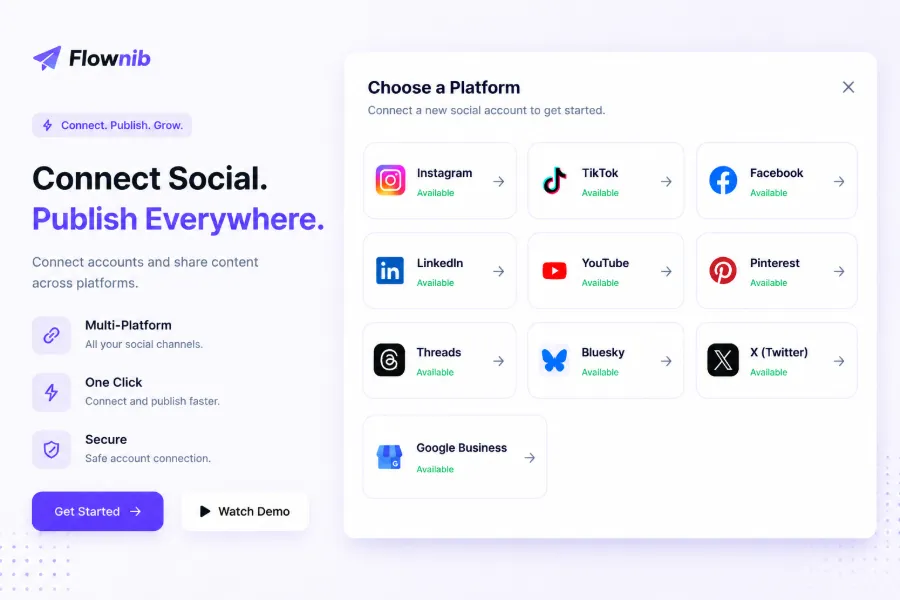
A brand dossier is another often‑overlooked element. By consolidating product information, brand positioning, and marketing goals into a unified file, AI‑generated content automatically aligns with those constraints. AI platform‑optimization can handle format adaptation for ten platforms simultaneously; a single piece of content can be rewritten for multiple platforms in seconds. For cross‑border e‑commerce, multilingual and multicultural market adaptation relies heavily on this mechanism—selling the same product in Europe, the U.S., and Southeast Asia requires completely different expressions, yet the core brand message must stay consistent.
For tactics on making product launches go viral everywhere, see “Make Your Product Launch Go Viral Everywhere”.
Scheduling Strategies and Practical Details for Synchronous Multi‑Platform Publishing
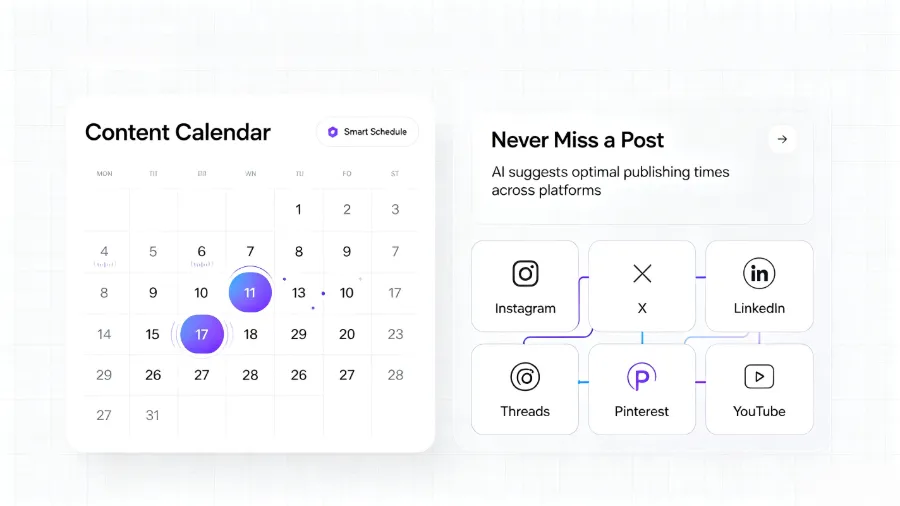
Manual scheduling and AI‑driven timing each have suitable scenarios. Launches and holiday promotions that need precise exposure windows should be scheduled manually; routine content can be auto‑scheduled based on audience activity patterns. A pragmatic approach: manually schedule critical milestones, auto‑schedule daily content—both run in parallel without conflict.
The role of a content calendar in team collaboration is often underestimated. Visualizing all platform plans and histories prevents duplicate posts and omissions. One team relied entirely on manual publishing; during a simultaneous multi‑platform launch, a time‑zone miscalculation delayed core‑market posts by several hours, missing the optimal exposure window. After that, they handed scheduling to an automation tool—timed publishing depends on the stability of official APIs, which typically achieve 99.99 % uptime, the foundation for reliable scheduled posts.
Cross‑border e‑commerce faces global time zones, so publishing strategy must be clear: prioritize target‑market time zones or distribute evenly? In practice, most teams prioritize the active periods of core markets, while other markets are managed uniformly through the content calendar. When a piece of content is published across ten platforms simultaneously, rhythm control and preview checks become essential habits—even with AI adaptation, a quick glance at each platform version before publishing avoids basic errors. Tools like Flownib add value by consolidating multi‑platform timing into a single calendar view, reducing coordination overhead.
Post‑Publishing Tracking and Continuous Workflow Optimization
Publishing isn’t the end. Consolidated data in a unified calendar lets operators compare platform performance: which platforms convert better, which time slots generate higher engagement. These insights feed the next round of scheduling and content direction. The content calendar tracks each platform’s historical posts, providing a data foundation for monthly retrospectives.
Automation’s boundaries must be recognized. Comment interaction, crisis PR, KOL communication still require human involvement. Automation excels at standardized publishing processes, not at judgment‑heavy, empathetic interactions. As teams scale, multi‑account management and permission delegation become new challenges—different members handle different platforms, requiring granular permissions to avoid mishaps.
An often‑overlooked benefit is where the freed time goes. If saved time simply leads operators to do more of the same tasks, value is limited; if it’s redirected to strategic planning and user interaction, the impact is dramatically different. This is why automation should be seen as the starting point for iteration, not the endpoint. Once the workflow stabilizes, teams can explore collaborative workflows that enable platform‑wide, copyright‑risk‑free publishing, extending the content production‑distribution chain even further.
FAQ
Is automated social‑media content creation suitable for small teams or individual creators?
Yes. Free plans support three social accounts and six posts, enough for small teams or solo creators to test whether the workflow fits their needs. The initial investment is mainly learning the tool and organizing accounts, which can be done in one to two days.
Will AI‑rewritten content lose the brand’s original style?
It depends on how complete the brand dossier is. If you pre‑load brand positioning, product details, and target audience, AI will generate content based on those constraints, and all platform versions will stem from the same source—often easier to keep a unified tone than multiple humans manually adapting. The more complete the dossier, the more stable the output.
How do I choose between manual scheduling and letting the tool pick a publishing time?
For launches and holiday campaigns, manual scheduling is recommended to control exposure windows precisely; routine content can be handed to AI, which selects times based on audience activity. Both modes can run in parallel—critical nodes manually overridden, daily content auto‑scheduled.
Is there a risk of accounts being throttled or flagged when publishing synchronously across platforms?
Content published via official APIs is fundamentally the same as manual posting, so throttling risk comes from content quality, not the publishing method. Official APIs typically achieve 99.99 % uptime, ensuring stable publishing. What must be avoided is high‑frequency duplicate posting of the same content in a short period.
After adopting an automation tool suite, how should operators shift their daily focus?
Shift from execution to strategy. In manual workflows, most time is spent on copy‑pasting and formatting; after automation, that time can be invested in comment interaction, content direction planning, competitor analysis, and data retrospectives. Tools handle execution; humans handle judgment.
Share Article