
Local Businesses 2026 Customer Acquisition: The Power Combo of Google Business Profile and Social Content Automation
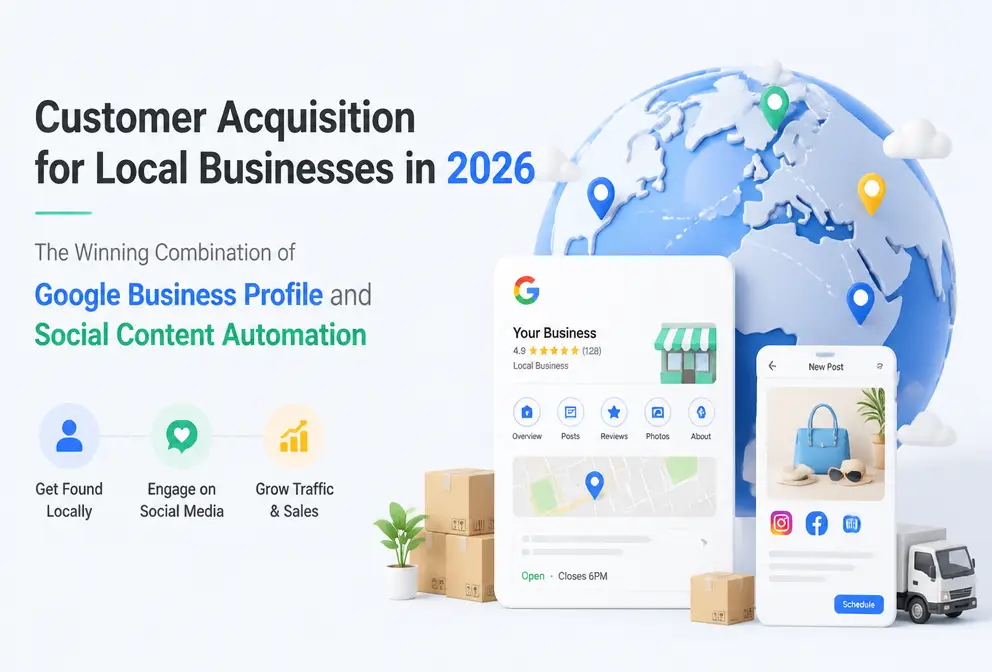
Before opening each day, you probably do the same thing: open Google Business Profile to check for new user reviews, quickly adjust holiday hours, and post a “new product in store” update. After that, you switch to Instagram and Facebook, re‑phrase the same information, and post again. One piece of content, three platforms, copy‑and‑paste over and over, and the morning is gone.
This repetitive work is the daily routine for almost every local‑business operator. Store information must be maintained, social accounts must be updated, and neither can be neglected, but there’s only so much time. In 2026, the real differentiator in local customer acquisition is no longer “who fills out the Google Business Profile more completely,” but who can connect the production and distribution workflow of store content and social content, using automation to cut maintenance costs and let local search and social recommendations amplify each other.
Why Local Businesses Must Prioritize Google Business Profile in 2026
First, a point many overlook: Google Business Profile is not just a “store business card”; it is the primary entry point for local search and Google Maps exposure. When users search on their phone for “nearby bakery” or “24‑hour pharmacy,” the listings that appear at the top are always those with complete, continuously updated, and actively reviewed information.
Address, hours, photos, user reviews—these basic details directly affect local search rankings. Inconsistent information has immediate consequences: a customer follows the map, arrives, and finds the store has moved or is closed today; that one loss may mean they never return. Yet most businesses only complete the basic setup and then ignore ongoing content updates, missing the value of continuous freshness.
A frequently missed detail: Google Business Profile posts (Posts) can occupy additional real space in local search results. This placement is underused by many competitors; posting gives you extra real estate in the results. Like social platforms, it requires regular updates—not just an occasional bulletin board poster.
How Social Content Automation Feeds Local Customer Acquisition
The biggest obstacle for local businesses creating social content isn’t the ability to write, it’s the lack of time to write continuously. Instagram is visual, Facebook is event‑driven, Threads is casual conversation—each platform has a different tone. Adapting one piece of content manually for three platforms takes half an hour.
Automation tools solve this step. With AI rewriting and automatic scheduling, a single store content piece can be distributed to multiple platforms in one or two minutes—AI adjusts wording based on each platform’s style, character limits, and audience expectations; you just preview and confirm, and the scheduler handles the rest.
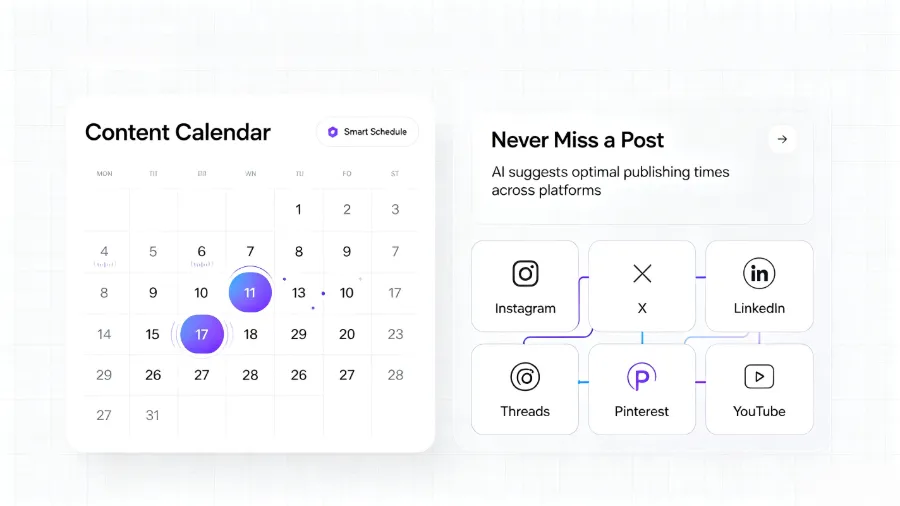
Consistent publishing is a prerequisite for a local brand to stay in users’ view. Social platforms favor active accounts; posting once a month gives the system almost no chance to surface you. The value of automation is turning “publish” from a daily mandatory task into a one‑time setup that works long‑term. The difference between manual and automated publishing isn’t a few minutes saved; it’s whether you can sustain the habit—manual relies on willpower, automation relies on a system.
A side note: many businesses that built automation with n8n or Zapier often miss the social‑media publishing step in their workflow. The missing social‑media publishing step in automation workflows is precisely the part local acquisition needs most.
How One Piece of Content Can Feed Both Google and Social Platforms
Store basics—new arrivals, limited‑time offers, in‑store events—are essentially a handful of categories. The problem is that the same information looks completely different on Google Business Profile and Instagram. Google posts suit short, punchy promos; Instagram needs images plus short copy; Facebook can have detailed event descriptions; Threads works best with a relaxed conversational tone.
AI rewriting solves this adaptation problem. One store content piece can be rewritten for at least five platform formats (Google, Instagram, Facebook, Threads, LinkedIn), each preserving the same information but using language that fits the platform’s characteristics.
Take “This week’s special” as an example and see how each platform expresses it:
| Platform | Content Focus | Format Limits | Suggested Posting Frequency |
|---|---|---|---|
| Google Business | Local promotion, in‑store info | Short text, optional image | 1‑2 times per week |
| Visual‑driven, vibe | Image + short copy | Daily or every other day | |
| Event notice + details | Longer text possible | 2‑3 times per week | |
| Threads | Casual conversation | Short text | Once daily |
This “produce once, reuse many times” mindset is the core of local‑business content operations. Write a store content piece, let AI rewrite it for each platform, then schedule a unified release. For a detailed breakdown of the mechanism, see the article on “One content piece automatically rewritten and distributed to ten platforms.”
Practical Steps and Tool Stack for Store Content Automation
From creation to multi‑platform distribution, the full workflow is roughly: write → AI rewrite → preview → schedule → publish → log. Each step is simple, but doing it manually consumes time at every stage. The “log” step—tracking where and when you posted—is especially error‑prone when done by copy‑and‑paste.
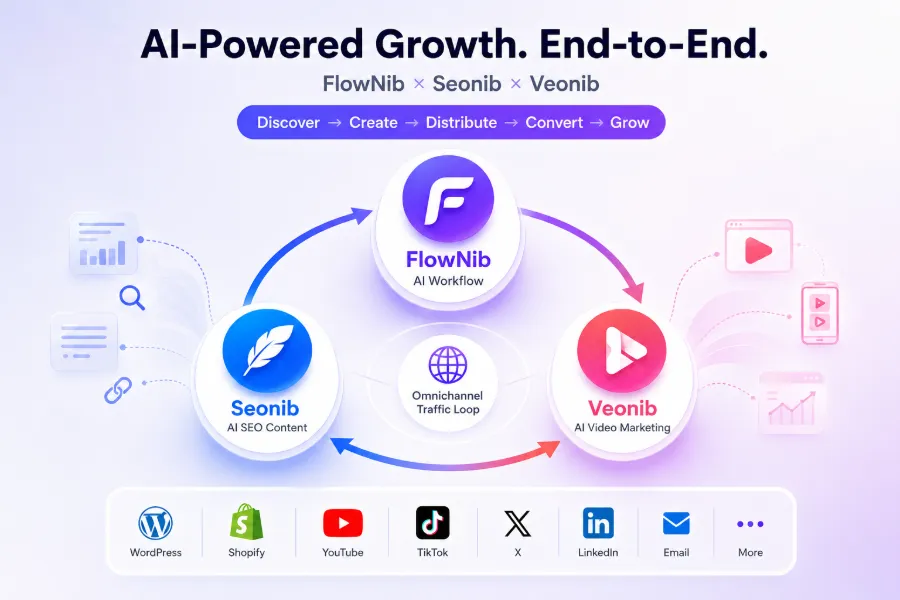
Bringing Google Business Profile and social accounts into a single publishing workflow is the key to efficiency. Few tools cover both types of platforms; one of them is Flownib, which supports official API publishing for Google Business and nine other major social platforms. Account connection and setup take about two minutes. In a store scenario, the usage is straightforward: write one piece of content, AI rewrites it for each platform, preview, then click publish; the publishing record is saved automatically.
It’s important to distinguish official API publishing from third‑party plugins. Official APIs provide more stable, less‑restricted publishing, whereas many third‑party plugins frequently fail due to API changes. Refer to each platform’s official developer documentation for integration requirements and verify which tools have proper access versus work‑arounds.
For chains or businesses with many locations, multi‑account management and publishing logs become even more valuable. Headquarters can write content centrally, each branch posts from its own account, and all records are consolidated on a single dashboard for clear operational visibility. To learn how to choose such tools, see the guide on “Managing Multi‑Platform Social Accounts with AI Tools.”
Common Operational Pitfalls and Considerations
Automation isn’t a panacea, especially for store scenarios. One local restaurant handed all content over to automatic publishing; a limited‑time offer post went to the wrong platform without human review, and the promotional details didn’t match the actual store activity, causing customer confusion. The team switched to a semi‑automatic model—automatic distribution plus manual preview—and avoided further incidents.
This case illustrates two points. First, content automation cannot replace the local, human touch and authenticity—customers want to see the real state of the store, not templated marketing copy. Second, automated publishing still needs human preview and verification, especially for price, time, or address information where AI rewrites may err on details.
The trade‑off between “fully automated” and “semi‑automated” in store settings is clear: AI can assist content creation, but pre‑publish preview and confirmation cannot be skipped. Automation’s value lies in reducing repetitive labor, not eliminating human judgment.
Another common trap is inconsistent information. If the hours and address on Google Business Profile differ from those on the Facebook page or Instagram bio, customers lose trust instantly. After automating the publishing workflow, this problem can become even more likely—content is distributed so quickly that update rhythms across platforms become misaligned.
For guidance on content calendars and publishing cadence, see the practical advice on “Social Media Content Scheduling and Publishing.” The core principle is: produce once, distribute continuously across channels, but tailor each platform’s update frequency to its nature—no one‑size‑fits‑all.
The combined approach to local acquisition is essentially “produce once, distribute continuously across multiple channels.” Google Business Profile guarantees deterministic exposure in local search, while social platforms provide ongoing brand awareness. Automation links the two, allowing limited staff to maintain a steady stream of content. Businesses that treat automation as a “lazy‑tool” often miss its true value—not to reduce work, but to free up time for higher‑impact tasks like responding to reviews, refining menus, and serving in‑store guests. A full‑scale case study of this approach can be found in the article on “Closed‑Loop Practice for Full‑Funnel Multi‑Channel Operations on Independent Sites.”
FAQ
How important is Google Business Profile for local businesses?
Extremely important. It is the primary entry point for local search and Google Maps exposure, directly affecting whether customers can find you. Complete, continuously updated listings rank higher and get better placement in local search results. Aim to post at least once a week to keep the account active.
Is content automation suitable for a single‑store local business?
Yes. Single‑store owners often have even less time—there’s no dedicated marketer, and all content must be squeezed into a busy schedule. Automation can push one piece of content to multiple platforms, saving at least half an hour each day. Free plans are usually sufficient; you don’t need to pay immediately.
Will automated publishing affect content quality or account weight?
No, as long as you perform preview and verification. AI‑rewritten copy may need minor tweaks, but the publishing mechanism itself doesn’t impact account weight. What does affect weight are posting frequency and content quality—automation simply helps you maintain consistent updates; the quality still depends on the material you provide.
Do I need to prepare separate content for each platform?
Not completely separate, but you can’t just copy‑paste everything. AI rewriting can adapt a single piece of content to each platform’s style and character limits; you only need to preview and confirm. The key is keeping the information consistent while tailoring the expression to each platform’s characteristics.
How often should store content be updated?
Google Business Profile recommends 1‑2 times per week; Instagram can be daily or every other day; Facebook 2‑3 times per week; Threads once daily. The goal is steady, regular posting—not a burst of many posts in a month followed by silence. Automated scheduling helps you maintain this rhythm.
Share Article


