How to Build an AI Social Media Agent: From Architecture Design to Multi-Platform Deployment

Operators of cross‑border brands have often experienced mornings like this: opening six browser tabs, switching back and forth among Instagram, X, LinkedIn, Threads, manually copying, rewriting, and adjusting hashtags for the same product copy, then pasting it into each platform’s posting box. When a promotion deadline hits, a whole morning can be spent on this, and the optimal posting window is often already missed.
An AI social media agent is not a single model but a closed‑loop pipeline consisting of content generation, platform adaptation, scheduling, publishing, and data feedback. Most teams fail to build it not because of model capability but because of workflow orchestration—if the steps are not well linked, the agent cannot run. This article breaks down each step of the pipeline from an architectural perspective and discusses the operational issues to handle after launch.
Clarify the Scope and Overall Architecture of the AI Social Media Agent
A usable agent’s core loop contains five stages: the AI content engine generates a draft, the platform adaptation layer rewrites it according to each platform’s rules, the scheduler decides the posting time, the publishing layer pushes the content, and finally the posting record is fed back for future optimization. All five stages are essential, but the real success factor is the boundary between automation and human review.
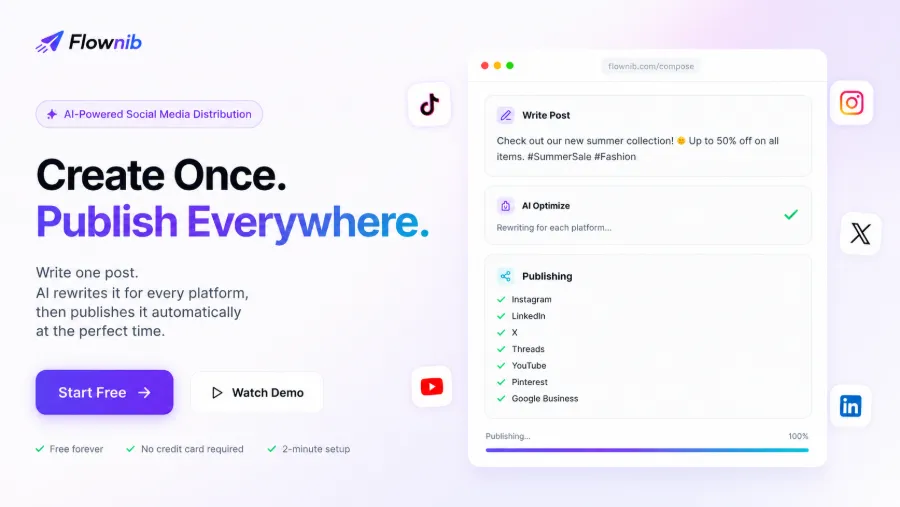
Content generation and platform rewriting can be fully automated, but the pre‑publish preview/confirmation step should not be skipped. Especially for copy involving discounts, prices, or event times, machine translation and rewriting can make mistakes; a single erroneous message propagated to all platforms is far more costly to retract than a quick human glance. A prudent approach is: daily content is auto‑published, while promotional and brand‑statement content retains a human‑confirmation step.
Breaking down the responsibilities of the five components makes it clearer:
- AI Content Engine – generate drafts, handle multilingual rewrites
- Platform Adaptation Layer – rewrite according to each platform’s character limits and content formats
- Publishing Layer – interface with each platform’s official API to push content
- Scheduler – manage posting times, support scheduled and auto‑selected times
- Calendar & Records – visualize publishing history and pending plans across all platforms
The publishing layer is the part most teams underestimate. Building it yourself means integrating each platform’s official API, handling authentication, rate limiting, and content‑format validation—maintenance costs are high. A more practical approach is to connect the publishing layer directly to an existing unified distribution service, such as Flownib, which provides cross‑platform publishing APIs and eliminates the work of wiring each API from scratch. Account connection and initial configuration take on average only 2 minutes, meaning a small team can have the entire pipeline running the same day. Different‑size teams have varying functional needs; you can refer to the Feature & Pricing Analysis for Different‑Size Teams to evaluate a suitable configuration.
Platform Adaptation Layer: How AI Rewrites Fit Each Platform’s Nuances
Posting the same text verbatim on every platform is the most common lazy shortcut when building an agent. Instagram is visual, X demands brevity, LinkedIn expects a professional tone, Threads is lightweight conversation, and YouTube relies on keyword‑rich titles and descriptions. The purpose of the platform adaptation layer is to have AI rewrite content according to each platform’s rules rather than mechanically copy it.
The core of the rewriting logic is to preserve the information skeleton while adjusting the expression. A promotional message might be compressed into a single sentence with hashtags on X, expanded into a short article with background on LinkedIn, and turned into a Pin description with keywords on Pinterest. Hashtags, calls‑to‑action, and tone must be handled per platform. When dealing with official API integration, the Meta Developer Documentation provides content format constraints for Instagram and Facebook, with different submission parameters for images, Reels, and carousels.
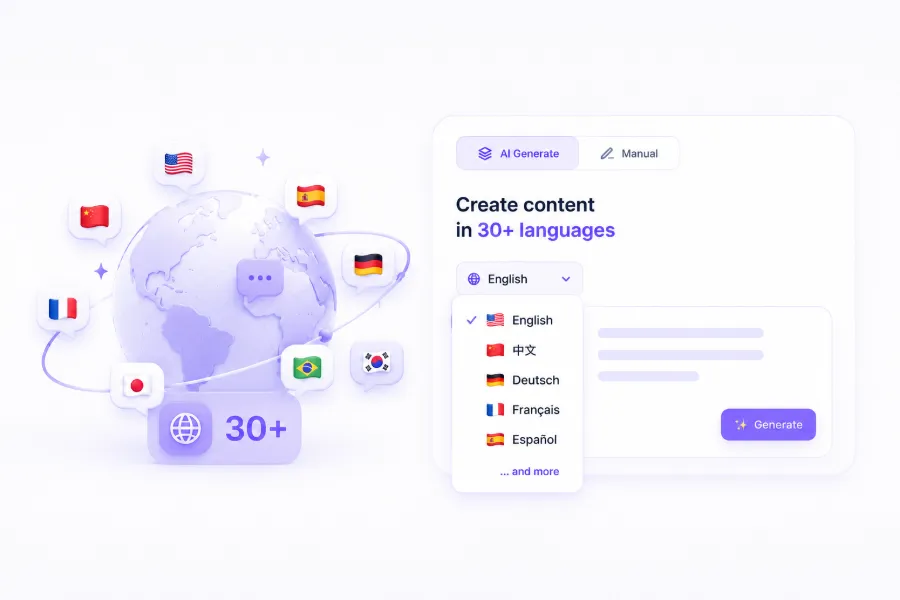
LinkedIn’s content format leans toward articles and image‑text posts; the LinkedIn Marketing Solutions Official Guide details formatting requirements for professional content. For global markets, multilingual rewriting is an extension of the adaptation layer—not word‑for‑word translation, but reorganizing the content according to the target market’s linguistic habits. An automated multilingual distribution workflow can dramatically reduce repetitive work across markets; see the Multilingual Content Automated Distribution Process for implementation details.
The adaptation layer currently covers the ten major social platforms, each with distinct adaptation points:
| Platform | Typical Content Form | Length Limit | Adaptation Highlights |
|---|---|---|---|
| Image/Reels/Carousel | 2,200 characters | Visual‑first, high hashtag density | |
| X | Short text/hashtags | 280 characters | Concise expression, embedded hashtags |
| Article/Image‑text | 3,000 characters | Professional tone, industry keywords | |
| YouTube | Video/Shorts | 5,000 characters | Title keywords, structured description |
Scheduling, Content Calendar, and Unified Management of Multiple Accounts
The scheduler solves the “when to post” problem. Manual scheduling works for teams with a clear rhythm, while AI‑driven time selection recommends posting times based on audience activity data. The two approaches can be mixed: AI selects times for routine content, while event nodes are manually set.
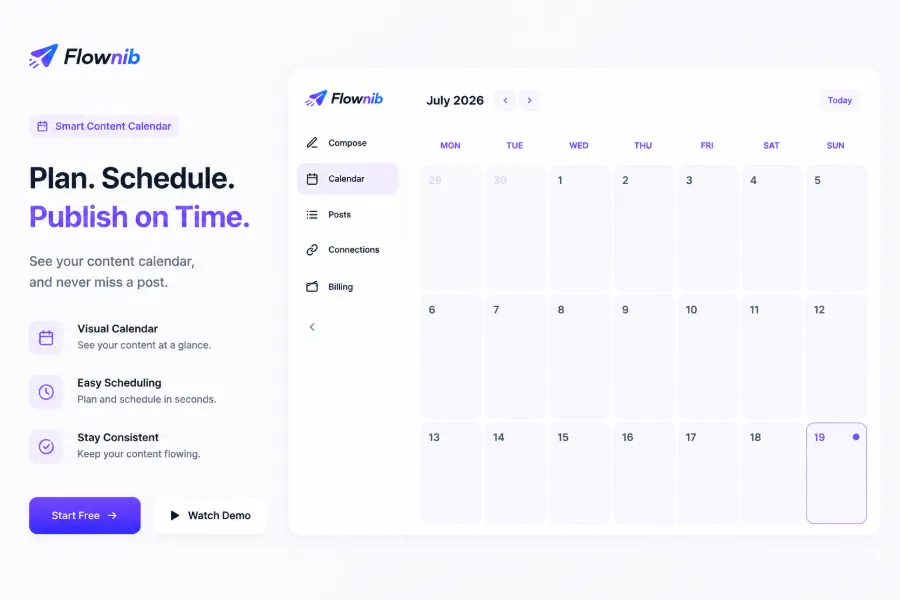
The value of a content calendar lies in visualization. All platforms’ publishing history and pending plans are consolidated into a single view, allowing operators to instantly see which accounts have gaps and which time slots are over‑scheduled. Facebook’s scheduled publishing has a concrete workflow; the Complete Steps for Facebook Scheduled Publishing can serve as a reference for scheduler configuration. For calendar planning, the Later Blog’s Content Calendar Practices offers many actionable scheduling methods.
Multiple‑account management is another often‑overlooked step. A brand may run a main account, sub‑brand accounts, and regional accounts on Instagram, each with a different content focus. A unified dashboard lets operators see all account statuses without repeatedly switching logins. In multi‑account scenarios, Flownib’s content calendar records all published and pending posts, eliminating cross‑platform verification time. Over 500,000 posts have been published through this unified scheduling process, and a 24‑hour automated operation mechanism keeps the posting rhythm even during rest periods.
From Trend Discovery to Content Generation: An Automated Closed Loop
Creative fatigue is the most common break point in the pipeline. No matter how powerful the model, without input signals it cannot generate valuable content. The trend‑discovery mechanism solves the idea‑supply problem: given keywords, the agent scans Reddit, YouTube, news sites, Hacker News, etc., for real‑time discussions and identifies topics that are heating up.
Heat determination follows a logic; for example, “92 % discussion heat” represents the intensity of a topic’s discussion on the target channel—computed from comments, likes, and a decay curve over time. Topics exceeding the threshold are marked as usable content material; after the operator selects an angle, the agent directly generates a publishable post.
Brand profiles act as constraints during generation. Product information, target audience, brand positioning, and marketing goals are stored in the profile, and the AI references these when generating to, avoiding off‑brand output. Combining trend signals with brand constraints yields content that is timely yet on‑brand. For teams with high content volume requirements, trend discovery is a prerequisite for maintaining steady output and complements the publishing side in a closed loop.
Post‑Launch Operations, Monitoring, and Iteration
Once the agent is running, the real challenges begin. Publishing failures and API rate limits are the two most common issues. The troubleshooting path is usually: check the error code in the publishing record, distinguish whether it is an authentication expiration, content‑format violation, or rate‑limit issue; re‑authorize for auth problems, verify platform content constraints for format violations, and adjust posting cadence or add inter‑account intervals for rate limits.
Stability monitoring focuses on API uptime. Using a 99.99 % uptime benchmark translates to roughly 4 minutes of downtime per month. While this seems high, third‑party service fluctuations and platform API changes can affect success rates. Monitoring alerts should cover publishing failure rate, authentication failure count, and queue backlog volume.
Scaling introduces new problems: after expanding to many accounts, the number of accounts surges, team collaboration requires permission tiers, and cross‑market expansion must handle time‑zone and language differences. Tool selection becomes critical at this stage; the 2026 Deep Comparison of Mainstream Social Media Scheduling Tools outlines suitable scenarios for different tools and can guide pre‑scaling decisions.
Data feedback is the foundation of iteration. Publishing records contain timestamps, platforms, and content types; feeding this back enables reverse calibration of posting times and content direction. A notable observation is that the optimal posting time should not be a single global point—cross‑time‑zone audiences need platform‑specific calibration. Post‑feedback per‑platform optimization is more valuable than a one‑size‑fits‑all setting. The true cost of building an agent lies in the publishing connection layer rather than the large model itself; the agent’s capability boundary depends on the stability of its connectors—hence why choosing the publishing layer is more time‑consuming than selecting the model.
FAQ
What technical capabilities are required to build an AI social media agent from scratch?
You need to know how to call content‑generation APIs, integrate each platform’s official API, implement scheduling queues, and handle basic data storage. If you reuse an existing unified distribution service, the technical barrier drops dramatically; the main work becomes configuring connectors and writing trigger logic rather than implementing every platform’s API from the ground up.
How does AI rewriting keep content consistent across platforms without sounding redundant?
The rewriting logic preserves the core information skeleton while adjusting the expression. X compresses it into a short text with hashtags, LinkedIn expands it into a professional short article, Instagram pairs it with images and carousels. In multilingual scenarios, the content is reorganized according to the target market’s linguistic habits rather than literal translation.
How should the optimal time for scheduled publishing be determined?
Do not set a single global time. Cross‑time‑zone audiences need platform‑specific calibration; first observe interaction peaks from feedback data for each platform, then adjust posting times accordingly. AI‑selected times can serve as a starting point, with continuous refinement based on actual data.
How can errors be avoided when managing content for multiple accounts and platforms?
Use a unified dashboard to manage all accounts and retain a preview‑confirmation step before publishing. Copy involving discounts or prices must be manually reviewed; routine content can be auto‑published. Centralized publishing records facilitate traceability.
How to continuously optimize publishing performance after the agent goes live?
Harvest data from publishing records, analyze interaction performance per platform, and adjust posting times and content direction accordingly. Monitor publishing failure rate, authentication failures, and queue backlog, and promptly address API rate limits and interface changes.
Share Article