
How many hours a day are spent on “copy‑paste” in an 8‑hour operation?

Arriving at the desk in the morning, opening six social‑media back‑ends, copying the same copy, adjusting formatting, swapping images, pasting, and publishing. This process repeats every day, looks “busy,” but the output is minimal. This article isn’t about “working harder,” but about “escaping repetitive labor and giving time back to truly valuable strategic work.”
First, do the math: how much of your time is actually spent on “copy‑paste”?
Manually publishing a piece of content to a social platform looks like a matter of minutes on the surface. But if you operate 5–8 platforms each day and run through the full workflow for each—opening the back‑end, copying the copy, adjusting formatting, checking links, uploading images, clicking publish—each platform takes at least 3–5 minutes. Assuming you manage 5 platforms and post 3 pieces of content daily, manual publishing consumes at least 45–75 minutes, which is 10%–15% of a full workday.
That number may not sound huge, but the problem is that those 45–75 minutes are fragmented. You can’t post everything at once because each platform’s audience is active at different times. So every one or two hours you have to stop, switch to another back‑end, and repeat the same steps. By the end of the day, your attention is split into seven or eight pieces, and the time you could actually spend thinking about content strategy or analyzing data gets squeezed into after‑hours.
I’ve seen many ops teams that spend the entire morning “posting stuff” and only start “thinking about stuff” in the afternoon. More commonly, the afternoon is filled with meetings and ad‑hoc tasks, and strategic thinking never gets priority. Manual publishing isn’t “busy”; it’s “busy with no output.”
The hidden cost of manual publishing is higher than you think
Manual publishing isn’t just about “spending time.” The real headache is the errors hidden in the gaps between actions.
One time, a colleague manually posted a promotion and forgot to update the landing‑page link on one platform. As a result, during the whole campaign users were redirected to an expired error page. By the time the mistake was discovered, three days of traffic had been lost. This error isn’t accidental—human brains can’t stay stable under high‑frequency repetitive tasks. A survey of social‑media operators showed that about 40% admit to having made format or link errors while publishing manually.
Different platforms also have their own character limits and stylistic requirements. LinkedIn favors long posts, X has a 280‑character limit, Instagram copy must be concise, and Threads can be more casual. Manual adjustments mean each piece of content must be re‑adapted, often resulting in either inconsistent content across platforms or a single copy used everywhere, which dramatically reduces effectiveness.
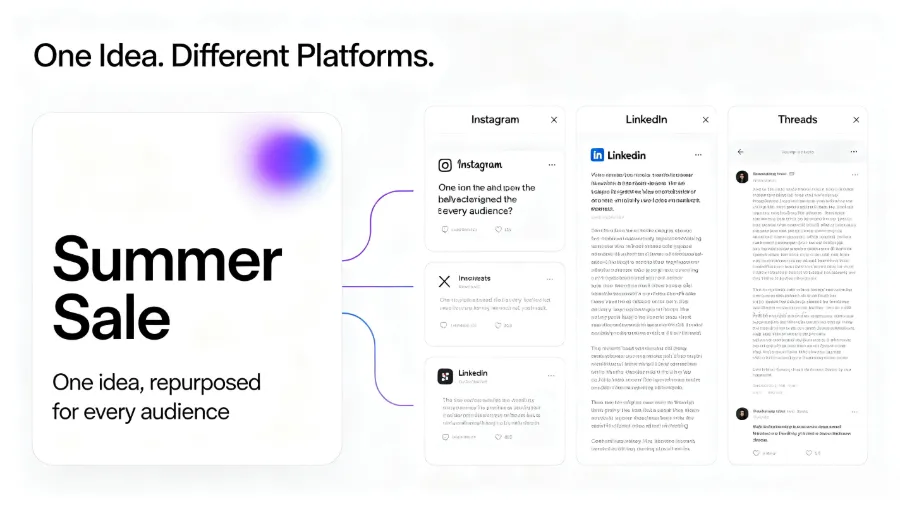
Another often‑overlooked issue is “scheduled publishing.” Manual publishing forces you to stay at the computer at specific times. If you miss the 5 PM peak user activity, the content’s exposure can drop dramatically. Data is scattered across six back‑ends, and consolidating publishing records and performance requires manual aggregation—another round of copy‑paste.
Optimizing the workflow: from “copy‑paste” to “create once, publish automatically”
Since the cost of manual publishing is so high, can we eliminate the “repetitive labor” from the workflow? The answer is yes. The core idea is simple: create once → AI rewrites → one‑click distribution.
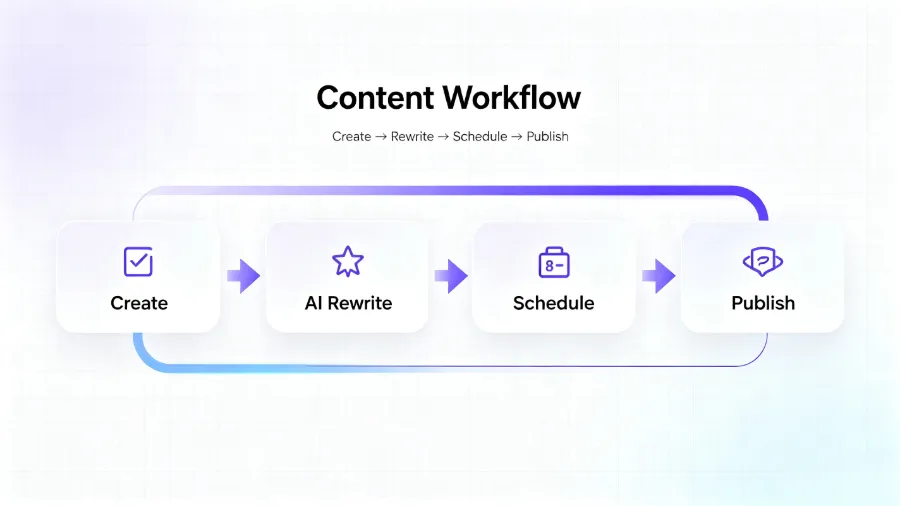
The concrete workflow is: you write a piece of content in a centralized platform, and the system automatically adjusts formatting and length for each platform—shortening Instagram copy, keeping full paragraphs for LinkedIn, compressing to under 280 characters for X. After previewing and confirming, you set the publish time, and the rest is handled by the system. All actions happen within a single dashboard, no tab‑switching required. The content calendar unifies all published and scheduled posts, giving you a clear view of next week’s lineup.
This workflow isn’t theoretical. In my own tests, after adopting automated publishing, the team saved 10–15 hours of manual work each week. Tools like Flownib are built around this workflow—write once, AI adapts automatically, then publish to all platforms in one go.
Below is a simple comparison that shows the gap between manual publishing and an automated workflow:
| Comparison Dimension | Manual Publishing | Automated Workflow |
|---|---|---|
| Time spent publishing (per day) | 45–75 minutes | 5–10 minutes |
| Error rate | ~40% have experienced format or link errors | Near zero |
| Scheduled publishing ability | Requires manual timing | Supports precise scheduling |
| Data unification | Scattered across platform back‑ends | Unified dashboard |
| Multi‑platform adaptation | Manual, error‑prone | AI rewrites automatically |
For detailed steps on “create once, publish everywhere,” I previously compiled a guide: One‑Click Multi‑Platform Publishing Workflow Explained, which contains a complete set of instructions.
Building a sustainable publishing system, not just “saving time”
The Hootsuite blog, which has long focused on efficiency in social‑media management, repeatedly notes that the stability of content publishing is more important than a single viral hit. Automation brings not only time savings but also strategic stability.
You can plan a week or a month’s worth of content in advance and set all publish times at once. The content calendar makes every pending post visible, eliminating the “what to post today” anxiety. Multi‑platform data visualizations simplify retrospectives and strategy adjustments—seeing at a glance which content performs well on Instagram versus LinkedIn.
In team collaboration scenarios, multi‑account management lets different members own different platforms while all data aggregates in one dashboard. Even if someone leaves, the publishing system continues uninterrupted. After adopting automated scheduling, a brand’s publishing frequency typically rises 2–3×, not because they work harder, but because they no longer have to start from scratch each time.
For long‑term strategy, I wrote an article titled How Independent‑Store Sellers Can Use AI for Global Social Distribution in 2026, which discusses automation at larger scales.
For small teams, Flownib’s free plan (3 accounts, 6 posts) is enough to test whether this system fits your team.
Shifting from “executor” to “strategist”
When manual publishing is replaced by automation, operators can reallocate their time. Instead of spending 2 hours daily on publishing, they might spend 30 minutes on strategy, 1 hour on engagement, and 30 minutes on analysis. This shift isn’t about “saving time”; it’s about “spending time on higher‑value activities.”
Specifically, you can focus on: content strategy planning—researching competitors, analyzing trends, mapping theme matrices; data analysis and retrospectives—identifying which content truly drives interaction and conversion, not just likes; user engagement and community management—replying to comments, participating in discussions, building relationships; A/B testing different content styles—trying varied copy and visuals for the same theme.
LinkedIn’s official marketing solution emphasizes that high‑quality engagement matters more than pure posting frequency. Moving time from “copy‑paste” to “strategic thinking” lifts average engagement rates by 20%–30%. This boost comes not from “posting more,” but from “posting smarter.”
If you’re interested in the future of the ops role, see the article Connecting AI Agents to Social‑Media Automation Systems, which discusses how automation can further transform operational work.
Don’t let repetitive publishing consume the time that truly adds value. The value of operations lies not in the act of “publishing” but in “what to publish, when to publish, and how to optimize after publishing”—tasks that require human judgment.
Frequently Asked Questions
Q1: If I’m the only person operating the team, do I still need an automation tool?
Yes. Solo operators are actually more vulnerable to being overwhelmed by manual publishing because there’s no one to share the load. Automation can compress the 45–75 minutes of daily publishing into 5–10 minutes, freeing the remaining time for content creation and user interaction.
Q2: What’s the biggest risk of manual publishing?
The biggest risk isn’t the time spent; it’s the errors. Human brains can’t stay stable under high‑frequency repetition, leading to broken links, lost formatting, or forgotten updates. These mistakes are almost inevitable in manual workflows. A single promotional link error can cost several days of traffic.
Q3: Will automated publishing make my content feel mechanical or impersonal?
It depends on how you configure it. Good automation tools don’t “uniformly generate” content; they adapt formatting and length to each platform while preserving your tone. You still control the core quality and direction of the content.
Q4: Do I need to maintain the same publishing frequency across all platforms?
No. Different platforms have different audience activity levels and content consumption speeds. Adjust frequencies based on data—for example, LinkedIn 3–4 posts per week, X 2–3 posts per day, Instagram 1–2 posts per day.
Q5: When starting with automation, which platforms should I begin with?
Start with 2–3 of the highest‑traffic platforms, such as Instagram and LinkedIn, or X and Facebook. Get the workflow running smoothly, then gradually expand to other platforms. Trying to integrate all platforms at once makes later adjustments cumbersome.
Share Article