One-time Writing, Global Publishing: A 10x Content Distribution Workflow for Small Teams

At 3 p.m., a three‑person e‑commerce team just launched a new product. The operator casually wrote an Instagram caption and attached three product images. The next half hour was broken into five small tasks: copy the caption to X, cut the length in half and rewrite the tone; log into LinkedIn and change it to a professional tone; go to the YouTube backend and fill in the description field; finally, return to Instagram to check for missing hashtags. By the time everything was posted, night had fallen, and the content’s expression across the four platforms was actually inconsistent.
This problem is common. Small teams lack dedicated social‑media operators, so content distribution relies on a manual loop of copying, rewriting, logging in, and pasting. By treating a single caption as the sole input and letting AI automatically rewrite and distribute it according to each platform’s style, character limits, and audience habits, the entire process can be compressed into one writing action. This article explains how to turn that into a reusable workflow.
The Real Gap from One Instagram Caption to Five Platforms
First, calculate the time cost. Manually handling a single piece of content across 4–5 platforms usually takes 15–30 minutes. That’s only under smooth conditions—if a post requires a video thumbnail, size adjustments, or new hashtags, half an hour is simply insufficient.
The issue isn’t just time. The differences among Instagram, X, LinkedIn, and YouTube are structural: X’s short posts demand highly compressed information, LinkedIn favors expanded viewpoints, YouTube’s description field resembles a narrative, and Instagram relies on hashtags and visual rhythm. The same message effectively needs to be rewritten for each platform.
A more hidden cost is the instability of publishing frequency. When a manual process meets a busy season, multi‑platform distribution is the first to be cut—today only Instagram, tomorrow only LinkedIn—so the update rhythm across platforms becomes completely out of sync. Over time, account activity levels become uneven, and growth lags naturally. Cross‑border teams feel this pain especially strongly; the evolution direction of content tech stacks is moving toward automatic distribution. The 2026 cross‑border content stack evolution article notes that multi‑platform synchronization is becoming the default configuration for content operations, not a bonus.
I have seen many teams try to tough it out with “copy‑paste + manual rewrite,” resulting in posts on every platform but each of them being subpar.
AI Rewriting: Giving the Same Message Different Forms
The principle behind AI rewriting isn’t mysterious: it analyzes the core information of the original text, then reconstructs the expression according to each platform’s style, character limits, and audience expectations. The information stays consistent, while the format adapts.
For example, an Instagram post saying “Summer new arrivals, all items 50% off” would be rewritten by AI for an X short post to fit within 280 characters, removing excess modifiers; for LinkedIn it would expand into a paragraph with viewpoints and background suitable for a professional audience; for a YouTube description it would add keywords and link information. Character differences are typical: Instagram about 2,200 characters, X about 280 characters, LinkedIn can be longer.
| Platform | Primary Content Format | Typical Length | Audience Expectation |
|---|---|---|---|
| Images + text, Reels, hashtags | Medium | Visual‑first, casual | |
| X | Short posts, hashtags | Very short | High information density, immediate |
| Long posts, opinion pieces | Relatively long | Professional, opinionated | |
| YouTube | Description field, narrative | Medium‑long | Supplemental info, keywords |
Even among rewriting tools, capabilities vary greatly. Some tools merely perform mechanical synonym replacement, while others truly understand platform context. The Flownib vs. other tools capability comparison article breaks down this difference—the key is whether the AI grasps each platform’s audience expectations, not just character counts. Platform‑specific operational guidelines also matter; Instagram’s official business account guidelines have clear requirements for content format and account behavior, which must not be violated when rewriting.
But finishing the rewrite does not mean you can post immediately. AI‑generated copy needs a human preview and confirmation; this step cannot be skipped. We’ll discuss why later.
One‑Time Writing and Publishing Workflow for Small Teams: From Draft to Calendar
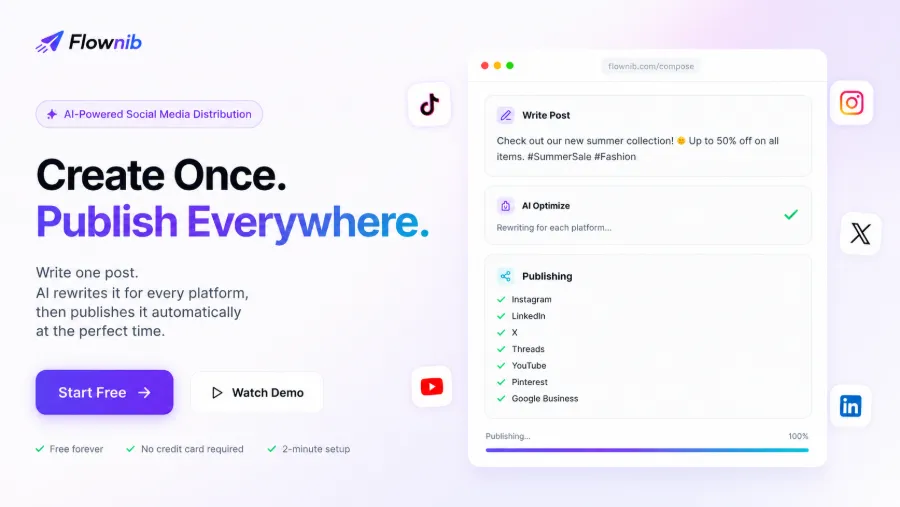
When you break the whole process down, it’s actually only six steps: write a draft → AI rewrites per platform → preview and confirm → choose publishing time → one‑click publish to all connected accounts → track each post in a content calendar.
The onboarding cost is low. Connecting an account takes about 2 minutes; the free plan provides 3 accounts and 6 posts, which is enough for a small team just testing the waters. Any post can be compressed from writing to publishing in a few minutes, not half an hour.
The key is the “one‑click publish” step. All connected accounts receive the rewritten version simultaneously, without logging into each backend individually. After publishing, the content calendar records each post’s platform, time, and status. I place particular emphasis on this stage—manual scheduling across platforms leads to fragmented backends and makes tracking account status difficult; a unified content calendar can avoid this issue.
Intelligent scheduling is another often‑underestimated feature. Audience activity curves differ greatly across platforms, and “uniform global publishing time” sacrifices peak exposure on some platforms. For example, Instagram’s activity peak differs completely from LinkedIn’s work hours. The Instagram best‑posting time analysis, based on 9.6 million posts, shows that publishing time has a tangible impact on engagement. Intelligent scheduling should select times per platform, not a one‑size‑fits‑all approach.
Standardized team content management is equally important. HubSpot’s experience with multi‑platform content distribution repeatedly emphasizes that a content calendar is not optional; it is the foundation of multi‑platform operations. Without a calendar, you have no idea what was posted on which platforms last week.
From my own experience, the first time I used Flownib for publishing, going from finished draft to posting on four platforms took about 6 minutes, with most of the time spent on preview and confirmation. For a three‑person team, this speed means you can publish two to three additional pieces of content per day.
Pitfalls to Avoid Before Implementation: Platform Review, Accounts, and Automation
This workflow isn’t without cost. The most immediate pitfall is platform review and publishing frequency limits. Each platform imposes constraints on third‑party tool request rates and content formats; image, video, and Reel size requirements differ across platforms, and sloppy handling of copyright or watermarks can trigger throttling.
The stability difference between direct official API connections and third‑party plugins is significant. Plugins rely on browser sessions, which silently fail when the session expires; official APIs are far more stable. A real lesson: a team published directly after AI rewriting without preview; as a result, one platform’s copy lost hashtags and sounded too dry, causing a noticeable drop in engagement. The fix is to enforce a manual preview step in the workflow.
There is an inherent tension between brand voice consistency and platform adaptation. AI rewriting handles the “morphology,” but the “unchanging core” must be preserved by the human during preview. AI may drop platform‑specific tone or details—such as Instagram’s hashtag culture or X’s meme‑style expressions—which can only be restored by a person.
There is another common gap in automated workflows. Many teams have automated content production using tools like n8n or Zapier, but the social‑media distribution step still relies on manual effort, breaking the process here. The article “Why automation workflows can’t skip social media distribution” discusses exactly this issue—production is automated, but distribution remains in the Stone Age, rendering the automation meaningless.
Account security is also worth mentioning. Flownib uses official APIs with 99.99% uptime, and account permissions are controllable; it doesn’t require storing passwords like some plugins. This is especially important for teams managing multiple accounts—if an account gets banned, the loss isn’t just publishing capability but also accumulated followers and content assets.
FAQ
Will AI rewriting make my tone sound different from how I wrote it?
Possibly. AI is good at adjusting format and length, but brand‑specific tone may not be fully retained. The solution is to always preview before publishing and restore any key tone words that AI altered. In practice, spending an extra minute or two on the preview step avoids the vast majority of “not sounding like me” issues.
Which platforms can a single post be published to simultaneously?
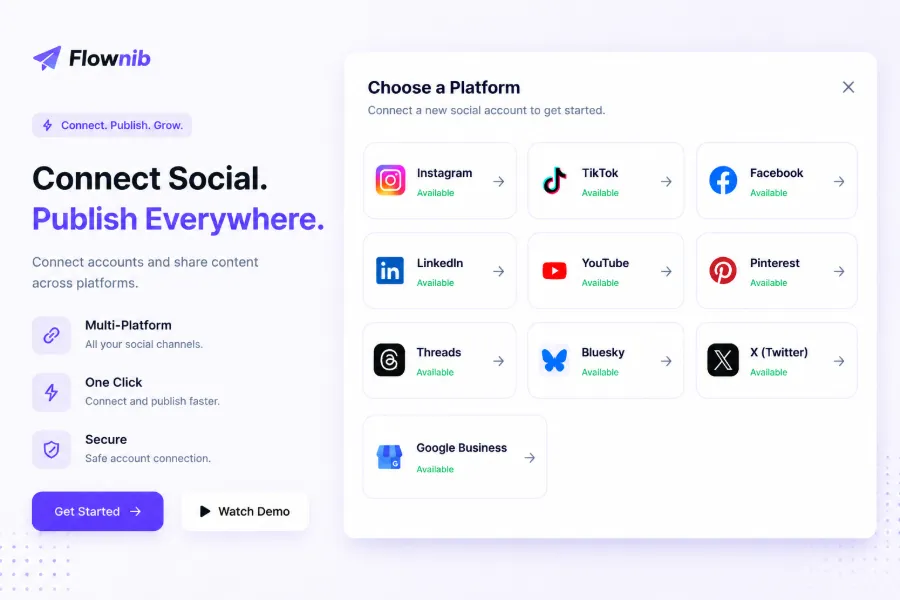
Supports Instagram, X, LinkedIn, TikTok, Facebook, Threads, Pinterest, YouTube, Bluesky, and Google Business—ten platforms in total. You publish to as many platforms as you have connected accounts; the free plan limits you to 3 accounts, which covers the main channels.
How is the “optimal time” for scheduled publishing determined?
It’s calculated separately based on each platform’s audience activity curve, not a single uniform time. Peak periods differ greatly across platforms, and intelligent scheduling picks times per platform. You can also manually specify a time to override AI’s suggestion.
Do the same pieces of content need to be posted at the same frequency across platforms?
No, and it’s not recommended. Audience activity cycles differ across platforms, and a uniform frequency sacrifices exposure on some platforms. A more sensible approach is to schedule per platform, letting each piece of content go live during the active period of its respective platform.
Is the free tier suitable for small teams just starting out?
Yes. The allowance of 3 accounts and 6 posts is enough to validate whether the workflow works. Run the free tier for two weeks, confirm AI rewriting quality and publishing stability meet expectations, then consider upgrading.
Share Article