
How Cross‑Border E‑Commerce Brands Maintain Consistent Brand Voice in AI‑Generated Content

A cross‑border e‑commerce product launch is usually not finished after writing a single copy. Product pages, Instagram, LinkedIn, X, and Threads may all need to go live in the same release cycle, and the English, Chinese, Japanese, or German versions must be synchronized. When the team hands product information to AI, the first problem that often appears is not typos but that the same brand is operated by different companies across channels: one version is restrained, another exaggerates discounts, and a third becomes overly casual.
Brand‑voice consistency cannot rely on marketers repeatedly tweaking prompts. A practical approach is to first create a brand‑voice dossier that turns the brand’s personality, audience, vocabulary, sentence patterns, and prohibited expressions into rules usable by authors, translators, AI, and reviewers; then lock down product facts and promises, allowing AI to only rewrite the platform‑specific format; after publishing, review deviations by market, language, and channel.
During one product‑launch cycle, the team asked AI to generate content for multiple platforms and languages. The product facts were generally consistent, but the certainty of “limited‑time offer,” the strength of discount promises, and the call‑to‑action phrasing changed, and reviewers ended up reworking each item manually. The issue was not that AI couldn’t write, but that the team didn’t give it a verifiable source of content and clear responsibility boundaries.
First, Turn “Brand Voice” into Actionable Rules
Brand voice is not the theme of a single piece of content, nor is it Instagram’s breezy tone or LinkedIn’s formal format. Themes change with new products, promotions, and seasons; formats change with platforms; platform tone also adjusts to audience and content goals. Brand voice, however, should stay stable over a longer period. It determines whether the brand sounds cautious, professional, friendly, or direct, and how much responsibility it takes for uncertain matters.
Cross‑border teams can start by creating a brand‑voice dossier with a minimum structure of five core dimensions: brand personality, target audience, vocabulary, sentence patterns, and prohibited expressions. Each dimension must have a verifiable description, not just adjectives like “young, trustworthy, warm.” For example, “trustworthy” can become “do not use absolute efficacy claims; do not turn expected delivery into guaranteed delivery”; “direct” can become “state the product’s purpose in the first sentence; do not build suspense over two sentences.”
The dossier should also record brand positioning, product benefit points, common and forbidden words, and indicate tone intensity. Benefit points must distinguish “facts,” “verifiable results,” and “marketing claims.” For instance, “supports multi‑region shipping” and “fastest worldwide delivery” should not be placed at the same level. Discount information, after‑sale promises, return conditions, and risk statements also need a unified wording to prevent AI from independently expanding discount scope or service commitments.
Rules must be usable by different roles. Authors use them to write core content, translators use them for localization, AI tools use them to generate content variants, and reviewers follow a content‑review checklist to confirm each item. If the rules can only be understood by the brand manager, the release will still be sent back for “experience‑based judgment.”
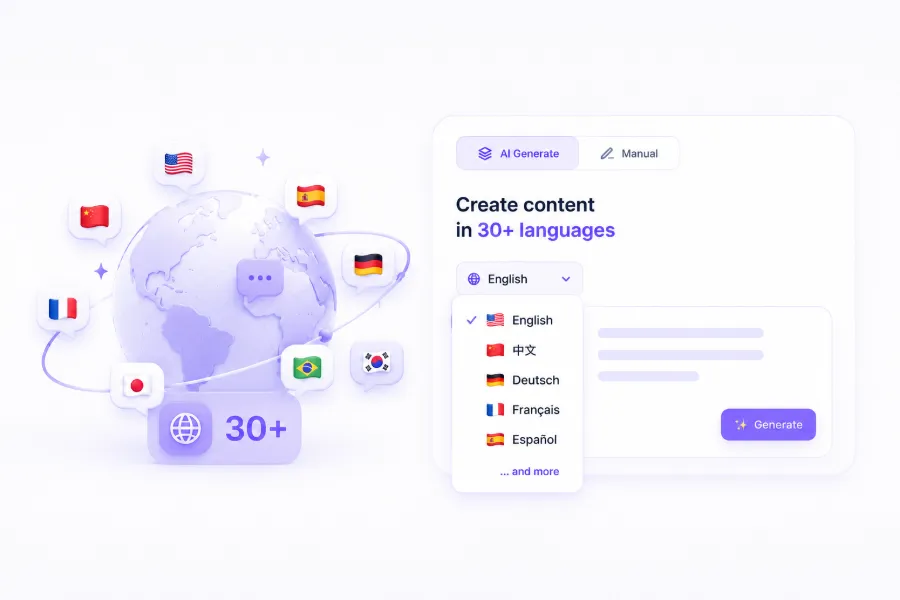
Localization also needs to be split. Product model numbers, specifications, ingredients, price, return conditions, and legal requirements usually must stay accurate and cannot be casually rephrased for naturalness; humor, metaphors, holiday expressions, and calls‑to‑action may need to be rewritten according to market culture. The translated text should retain the original for comparison, especially for certainty terms: changing English “may help” to “can solve” already alters the brand promise.
For teams operating in multiple markets, the cross‑market content distribution method offers an often‑overlooked entry point: the distribution workflow is not only about speed but also about placing market rules, language versions, and the brand dossier in the same pipeline. This way, voice consistency no longer depends on a brand‑familiar editor’s ad‑hoc gatekeeping.
Control AI with a Unified Content Source, Not by Letting Each Platform Go Its Own Way
Before multi‑platform publishing, keep a single, reviewed master version of the content. It is not meant to be copied verbatim to every channel, but to serve as the sole source of facts and stance. Each cross‑platform piece should retain at least two layers of version: the brand‑approved core version and the platform‑ and market‑specific adapted version. Without these two layers, it is hard for the team to decide whether a translation is a reasonable rewrite or has already deviated from the original promise.
The master version can be split into immutable information and mutable expression. Brand promises, product facts, price, inventory, shipping policy, and after‑sale conditions belong to the immutable layer; opening lines, length, paragraph structure, tags, visual descriptions, and interaction methods belong to the mutable layer. Locking facts first and then allowing expression changes is easier to execute than “making AI sound more like the brand.”
Prompt templates should not be just “please keep the brand tone.” A practical template must require AI to read the brand‑voice dossier, target market, platform constraints, and current content goal, and explicitly state which fields are prohibited from alteration. After generation, AI should also return which product facts were used, making it easy for reviewers to compare, rather than hunting for a changed price or promise in a long copy.
This creates version‑management overhead. Content calendars, version records, and brand terminology tables must correspond. When product prices change, old versions should not be regenerated. The team can number core content, e.g., “Summer‑Launch‑EN‑01,” and have platform variants reuse the same number with a channel suffix. This way, when a complaint or data anomaly occurs, you can trace back to the exact version instead of guessing which prompt was used at the time.
Centralized management does not mean abandoning manual checks. The value of a centralized social‑media management approach lies mainly in reducing copy‑pasting, tab‑switching, and missed‑version opportunities; it cannot replace the team’s judgment on whether “improve immediately” exceeds the original product data. For content calendars and platform differences, you can also refer to social‑media operation references, but external processes cannot replace a brand’s own review fields.
Multilingual content also needs back‑translation or bilingual side‑by‑side comparison. Back‑translation does not have to be word‑for‑word; the focus is on confirming three things: product facts are retained, promise intensity is consistent, and responsibility boundaries are not hidden. A less obvious issue is that brand‑voice drift often comes not from vocabulary changes but from certainty changes such as “may,” “usually,” or “guarantee.” Reviewers who only look at common words can easily miss these problems.
Let Platform Adaptation Change Form, Not Brand Stance

Instagram relies heavily on visual description and a strong opening hook; LinkedIn usually needs a fuller background; X is strongly limited by character count; Threads allows a more conversational flow. The team can check the Threads platform content environment, but should not treat the platform’s popular tone as the brand tone. Adaptation concerns length, rhythm, and interaction style, not brand stance.
Each rewrite can be split into two layers. The immutable layer includes brand stance, product facts, core promises, and risk statements; the mutable layer includes headline, opening line, paragraph structure, tags, visual description, and call‑to‑action. According to platform rules, a regular X post is limited to 280 characters—this is a form change; changing “expected shipping in 3‑5 business days” to “receive immediately after ordering” is a fact and promise change.
Different platform publishing interfaces also cause friction. Once the team uses official APIs, scheduled publishing, and multi‑account management, they encounter issues with image ratios, video formats, permission expirations, character limits, and unsynchronized publish times. Meta’s developer API documentation can help operators verify interface behavior, but a successful API call does not guarantee copy approval; the two must be recorded separately.
In one cross‑border new‑product launch, the team did not create a master content version first; instead, they let AI generate English Instagram, German LinkedIn, Japanese X, and Chinese Threads content separately. Over a two‑day review cycle, product specifications had no obvious errors, but the English version turned “up to 20% discount” into a flat 20% site‑wide discount, the Japanese version added a stronger “buy now” tone, and the LinkedIn version turned after‑sale support into a permanent regional service. Reviewers had to rework each item, the publishing schedule was delayed, and some markets missed the planned launch window.
This failure was not solved by a longer prompt. Later, the team locked discount, timing, shipping, and after‑sale fields into the core content and required each variant to answer the following before publishing:
- Does it change product efficacy, price, or service conditions?
- Does it add unverified guaranteed promises?
- Does it delete brand terminology or use forbidden words?
- Does it contain expressions unsuitable for the target market?
- Does it conflict with other market information in the content calendar?
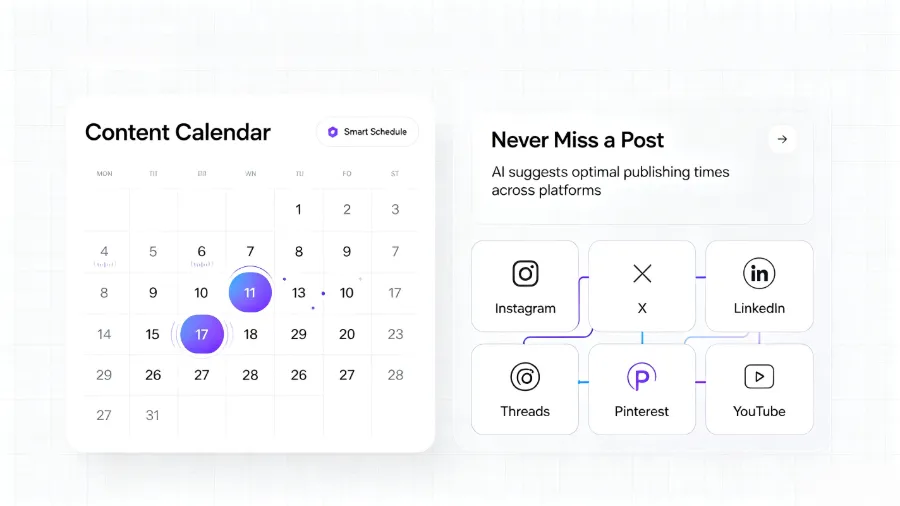
Publishing, scheduling, and recording can be centralized in a single workflow. For example, when using Flownib, the team first keeps the core version in a unified content source, then views variants for Instagram, LinkedIn, X, Threads, YouTube, Pinterest, etc., and finally checks scheduled‑publish status and records. It reduces manual switching and repeated pasting but does not eliminate the need for platform‑by‑platform review; after product data updates, already scheduled old versions still need manual checking.
Platform adaptation can cover the ten social platforms listed on the product page, but “generate once, approve all” is an idealized workflow. Video titles and subtitles, Pinterest’s search‑oriented descriptions, YouTube community posts, and LinkedIn long‑form text each have different review focal points. If a team forces the same opening line for the sake of uniformity, readability often suffers; if they allow each platform to amplify tone without limit for interaction rates, the brand’s boundaries will gradually erode.
The content calendar here is more than a publishing schedule. It can also show whether different markets are delivering contradictory messages in the same cycle: the US market says inventory is abundant, the European market says pre‑sales have ended; one language version emphasizes free returns, another does not mention limits. Viewing scheduling records together with the content calendar often reveals issues more easily than reviewing a single copy in isolation. For concrete scheduling actions, see the Facebook scheduled‑post workflow as an operational reference.
Use Post‑Publish Review and Feedback to Continuously Calibrate Brand Voice
Pre‑publish review can only catch known issues; post‑publish data and feedback expose another type of deviation. Teams should sample published content by language, market, and platform to verify that the displayed headline, line breaks, tags, image captions, and call‑to‑action match the preview. Some platforms truncate text or change link display; reviewers who only look at the unified backend preview may miss what users actually see.
Voice consistency can be tracked with a few ongoing metrics: forbidden‑word occurrence count, manual rework rate, fact‑error count, core‑promise deviation count, and approval rate. Conduct one voice audit per week and sample at least three markets or language versions; this is enough for a small team to spot recurring errors. Metrics don’t need to be complex at first; simply recording “what type of issue, on which platform, caused by which version” is more useful than just looking at likes and conversions.
Platform performance sometimes conflicts with brand consistency. A more aggressive opening line may boost CTR, but if it changes “suitable for some users” to “suitable for everyone,” short‑term engagement does not mean higher content quality. Teams can compare the performance of opening lines, tags, and calls‑to‑action individually, but should not test exaggerated versions of product efficacy, after‑sale guarantees, or shipping promises.
Tool evaluation should also include operational burden, not just account count and publishing speed. Teams can break down social‑tool features and costs to see which steps truly reduce rework and which just push errors faster across multiple platforms. One automatic‑publish failure, one permission expiration, or one old‑version mis‑schedule can offset weeks of accumulated efficiency gains.
Review responsibility should be split into three time points: pre‑publish, the content owner confirms facts and promises; during publishing, the operations staff confirms platform status and version; post‑publish, the market or data lead gathers feedback and updates rules. AI‑generated content does not eliminate responsibility; if no one has final confirmation authority, problems usually surface only in comments or support tickets.
High‑quality content, common edits, and typical errors should be distilled into a examples library. The brand‑voice dossier and prompt templates don’t need daily updates, but every time repeated rework, market misunderstanding, or promise deviation occurs, the team should assess whether to add a rule. Continuous calibration may not make every platform look identical; it ensures that different expressions still come from the same brand judgment.
FAQ
What exactly does “brand‑voice consistency for AI‑generated content” mean?
Brand‑voice consistency means that, despite changes in format across languages, markets, and platforms, the brand’s personality, promise intensity, and responsibility boundaries remain the same. Teams can sample three market versions each week, focusing on product facts, certainty words, and after‑sale statements rather than merely checking for identical adjectives.
What should a brand‑voice rule contain?
At minimum, it should cover five dimensions: brand personality, target audience, vocabulary, sentence patterns, and prohibited expressions. In practice, it should also include product benefit points, discount wording, after‑sale promises, risk statements, and localization rules, allowing reviewers to verify each item within minutes.
When the same content is adapted for different countries and social platforms, which information must not change?
Product facts, price, inventory, shipping conditions, after‑sale policy, brand stance, and core promises cannot be rewritten per platform. Titles, opening lines, length, tags, paragraph structure, and interaction methods can be adjusted, but each variant must trace back to the same reviewed master content version.
How to check whether AI changed a brand promise or product fact?
First, create a bilingual side‑by‑side comparison of the core version and platform variant, then examine efficacy, price, timing, conditions, and certainty words. Keep version records before publishing and sample the actual displayed content within 24‑48 hours after publishing; record fact errors and forbidden‑word occurrences separately.
How often should the brand‑voice dossier and prompt templates be updated?
It is recommended to review errors weekly and consolidate rules monthly; major product, price, or after‑sale policy changes should trigger immediate updates. If the same type of rework occurs for two consecutive weeks, it indicates that the dossier or template lacks enforceable constraints rather than simply needing a longer prompt.
Share Article