
How to Turn a Blog Post into 10 Social Media Posts
After a blog is published, most people stop there. The remaining time is actually spent manually copying the body text, adjusting font sizes per platform, deleting incompatible formatting, and coming up with a new opening line—two hours of work for just one post. After doing it a few times, you realize the real bottleneck isn’t writing, but the repetitive work before publishing.
This guide breaks down a repeatable workflow: treat a blog as raw material and systematically produce 10 social‑media posts with varied styles and rhythms, instead of relying on ad‑hoc improvisation. The core idea is simple—first extract the material, then adapt it per platform, and finally schedule it in a calendar. Each step includes concrete tactics and common pitfalls.
Start with Subtraction: Extract the Real “Content Points” from a Blog
A blog isn’t a finished product; it’s raw material. Only at the moment of publishing does it become ready for deconstruction. Many marketers simply copy paragraphs to each platform, resulting in posts that look like truncated versions of the same article, which readers instantly recognize.
The correct approach is to read the whole piece and mark the core arguments, data, quotes, and case studies separately. A 1,500‑word blog typically yields 12–18 independent content fragments. These fragments are categorized by angle: educational, opinionated, actionable tips, data‑driven, Q&A. The purpose of categorization is that different types of material suit different platforms and tones, saving a lot of work later.

The criterion for whether a fragment deserves its own post isn’t length but “Would a reader find this information useful on its own?” A specific figure, a discussion‑provoking viewpoint, or a step‑by‑step guide is stronger than a generic transition sentence. The goal is to gather more than 10 candidate pieces—extra ones are kept for future iterations to avoid running out of material later.
If the extraction isn’t thorough, the remaining nine posts will be forced to filler. This is the foundation of the whole pipeline, worth an extra half hour.
One Draft, Ten Rewrites: Adapt Separately for Each Platform’s Rules and Tone
Each platform differs greatly in format, character limits, content style, and tone. X (formerly Twitter) limits posts to 280 characters, Instagram captions up to about 2,200 characters, LinkedIn articles up to 3,000 characters. You can’t just truncate the text; you must rewrite the opening and closing according to each platform’s conventions.
| Platform | Main Content Form | Suggested Length per Post | Tone Preference | Blog Material Types That Fit |
|---|---|---|---|---|
| X | Short text, hashtags | 100–280 characters | Direct, bold opinions | Quote nuggets, data slices |
| Images, Reels, carousel | 300–800 characters | Visual, light | Case studies, step breakdowns | |
| Long articles, industry insights | 500–1500 characters | Professional, experience‑sharing | Core arguments, methodology | |
| Images, community discussion | 200–600 characters | Conversational, down‑to‑earth | Q&A, storytelling material |
Platform‑native formatting takes precedence over “faithful reposting.” The same data point becomes a hashtagged assertion on X, a background‑rich explanation on LinkedIn, and an image with three lines of caption on Instagram. This isn’t rewriting; it’s deciding how the same information should be presented on each platform.

When adapting per platform, brand tone consistency comes from a unified brand dossier—not copy‑pasting. The dossier contains product info, target audience, and brand positioning, providing a reference for every rewrite. Instagram’s official merchant guidelines also stress that account content should continuously align with brand positioning rather than being scattered.
The “single creation, multi‑platform adaptation” concept is detailed in this complete tutorial for adapting one creation to ten platforms, which walks through the full workflow from draft to final posts for each platform.
Batch Scheduling: Slot the 10 Posts into a Calendar
The ten posts aren’t published all at once. Spread them over a 5–7‑day cadence, posting 1–2 per day, which works far better than dumping all ten in one day. Timing matters too—different platforms have different peak activity windows, and weekday vs. weekend traffic curves differ.
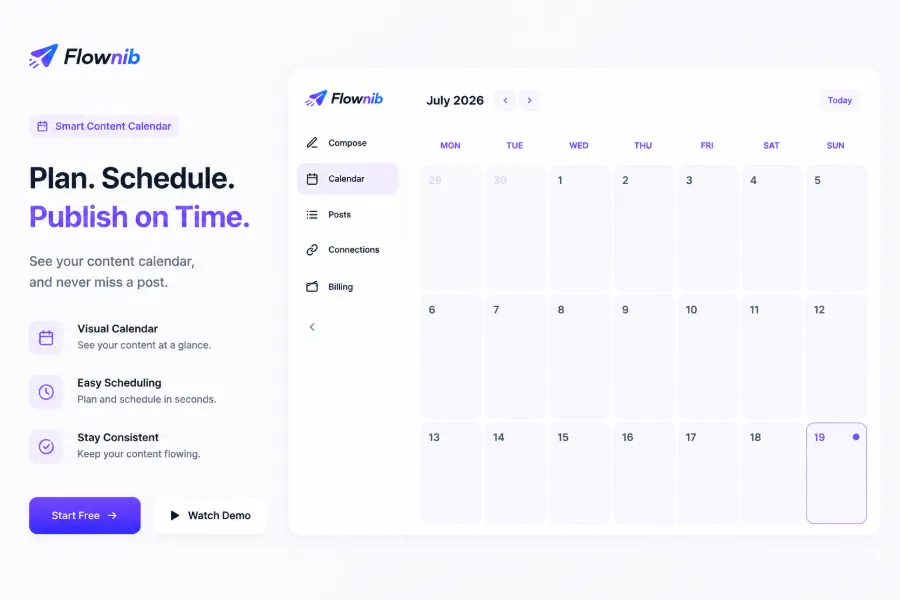
A visual calendar prevents missed posts and collisions. As the number of accounts grows, manual scheduling becomes cumbersome: you must remember each platform’s optimal posting time, which posts have already gone live, and which remain drafts. The more accounts, the higher the maintenance cost. At this point many people look for automation—tools like Flownib handle this stage: one creation, AI rewrites per platform rules, and automatic distribution to all connected accounts, with scheduling and publishing all in one interface.
The real cost of high‑frequency updates isn’t writing; it’s maintenance, scheduling, and synchronization. Ten posts covering a 5–7‑day cycle can save 10–15 hours of manual work per week—provided the scheduling step is automated. Buffer’s official scheduling and cadence recommendations also note that a fixed rhythm of timed posts maintains account activity better than random posting.
For a solo operator running an entire cross‑border business, scheduling automation is just one piece. This full‑process guide on a solo AI‑driven cross‑border operation ties content distribution with e‑commerce automation and can be referenced.
Build a Reuse Loop: Keep Generating Content from Each Blog
Splitting should not be a one‑off action; it should be a continuous loop. After each blog is published, extract ten posts, publish them, then track each post’s performance—engagement rate, clicks, shares—and feed high‑engagement points back into the next batch of topics. One round of extraction plus a quarter’s worth of reuse can accumulate 30–60 publishable pieces.
But reuse has limits. Forcing every blog into ten posts leads to quantity over quality: the first two weeks see a drop in interaction, and the third week’s engagement plummets—this has happened in reality. A team doubled daily posting volume, but engagement fell because content became repetitive and posting frequency diluted value. The key to reuse is reshuffling value points, not stacking quantity. The same information can be presented on a different platform, from a different angle, or in a different style, rather than reposted verbatim.
Data tracking and synchronization become tedious at this stage: each platform’s engagement metrics have different formats, requiring manual aggregation and calendar updates. Tools like Flownib shine here—multiple account data converge on a single dashboard, eliminating cross‑platform checking. For teams managing many client brand accounts, this centralized management is especially crucial. This article on managing 50 client brand voices simultaneously discusses version‑management strategies for multi‑brand scenarios, emphasizing a unified process with separate execution.
FAQ
Is every blog suitable for splitting into ten posts?
No. Low‑density blogs can’t yield ten independent, valuable posts; forcing it only adds filler. The rule of thumb is material count: if you can identify 12 or more distinct content points, it’s worth splitting; otherwise, add more material or merge with the next blog.
Will posting the same content point on different platforms feel repetitive?
Yes, if you only change the length. Avoid repetition by re‑processing the information per platform: a one‑sentence opinion on X, an analytical paragraph on LinkedIn, an image with caption on Instagram. The core point is the same, but the presentation and added information differ, so it’s not duplicate.
What if there isn’t enough material to reach ten posts?
Scale down to six or seven, or supplement with comments, reader questions, and industry trends. You can also slice a single data point into multiple posts, each with a different interpretation.
Should the ten posts be published all at once or staggered?
Staggered. Schedule them over a 5–7‑day calendar, 1–2 per day, which is more algorithm‑friendly and avoids overwhelming followers.
When rewriting per platform, how do I keep the brand tone consistent?
Create a brand dossier that captures positioning, target audience, and typical phrasing. Refer to it for every rewrite. Consistency comes from this reference, not from on‑the‑fly memory.
Share Article