
How to Spot Emerging Cross‑Border E‑Commerce Topics Before Competitors

When a product suddenly generates a lot of discussion on overseas platforms, cross‑border e‑commerce teams are usually already a step behind. The team first sees a hot post on Reddit, then goes through internal approval, manual rewriting, translation, and multi‑account publishing; by that time, competitors have already turned the same topic into short videos, review articles, and email content. Once the content goes live, the team can only follow the narrative set by others.
To find cross‑border e‑commerce trends earlier than competitors, you can’t just chase hot lists. Teams need to monitor discussion growth speed, audience intent, target‑market relevance, and content publishability simultaneously, and then filter weak signals into topics through a fixed process. High interaction on a single platform only shows that people are talking; it doesn’t mean users are ready to buy, nor that the brand can publish accurately within the window.
First Define “Trend”: Don’t Only Look at Topics Already on Hot Lists
When cross‑border teams judge a trend, they must first separate several metrics that are often mixed together. Search interest reflects how actively users look for something; discussion growth speed reflects how a topic is spreading; social interaction volume reflects how content is being responded to and shared; commercial relevance involves product demand, purchase questions, and conversion paths. These four metrics may rise together or be completely out of sync.
For example, a foreign influencer’s review video may get very high interaction on YouTube, but the comments focus on “how well the video was shot,” not on how to choose the product. A Reddit post with modest interaction may repeatedly raise questions like “Can it be shipped to Germany?”, “Do the batteries meet local regulations?”, “Are there alternative models?”—which are far more useful for cross‑border e‑commerce teams. The highest interaction volume is not necessarily the most leading signal; specific audience questions that appear across multiple sources with different wording are usually more worth pursuing.
In product trend scanning, teams can first look at product demand, use cases, competitor alternatives, purchase questions, logistics experience, and regional differences, rather than dumping all entertainment disputes into the topic pool. A topic must meet four initial screening conditions: it has just emerged, is still heating up, is relevant to the target market, and can form a clear content angle. If any one is missing, keep it in the observation zone and don’t rush it to the content team.
Hot lists on a single platform tend to lag. Lists usually favor topics that have already accumulated interaction and diffusion speed, while cross‑border brands need to discover demand that isn’t fully saturated yet. Reddit may surface usage obstacles first, YouTube may bring search‑type reviews first, news platforms bring industry changes, and Hacker News may reflect early discussions of tech products and developer tools. Looking at these sources together is closer to the trend‑formation process than staring at a single “hot” tag.
| Signal Source | What It Can Reveal | Lead Time | Main Misjudgment Risk |
|---|---|---|---|
| Community Discussion | User problems, usage obstacles, alternative needs | High | Small‑group voices mistaken for mass demand |
| Video Content | Search‑type questions, reviews and demos | Medium‑High | Short‑term traffic from top accounts |
| News Reports | Industry events, policies, supply changes | Medium | Media republishing causing duplicate growth |
| Search Trends | Active search interest and regional differences | Low‑Medium | Peak lag, cannot indicate purchase intent |
Teams can convert different signals into relative scores, e.g., a topic’s discussion momentum 92 %, search interest 78 %, industry dialogue 64 %. These scores are only suitable for ranking and filtering; they cannot alone decide a topic. Google Trends’ 0‑100 score is a normalized index relative to the selected time‑frame and region peak, not actual search counts; without recording the time range and target market, the scores are easy to misinterpret. For audience and commercial use cases on different social platforms, you can also refer to LinkedIn marketing scenarios, but it cannot replace manual judgment of specific comments.
Validate Trends with Keywords and Audience Context, Not Just Feelings
After a signal is found, the team should not publish immediately. The validation stage must answer: who is asking, why now, whether the question relates to the target market, and whether the brand has a non‑forced product‑association scenario. Many teams treat “someone shared” as “demand appears,” ending up with content that’s lively but lacks audience intent.
Keyword expansion can start from five categories: product type, specific pain points, use cases, competitor alternatives, and regional expressions. When combining, teams can cross core product terms with question words, comparison words, time words, and region words, e.g., “portable freezer + power outage”, “running shoes + wide feet + Canada”, “wireless keyboard alternative + Mac”. The same idea may be expressed completely differently in different regions; a delivery phrase used by UK users may never appear in US posts.
A keyword should be scanned across four information sources: Reddit, YouTube, news, and Hacker News. This is valuable not just for enlarging the sample but for observing whether semantics shift. “Why does it get hot?” on Reddit may become “long‑term usage test” on YouTube, a supply‑chain topic on news platforms, and a technical spec discussion on Hacker News. Same keyword clusters do not guarantee the same audience intent.
During validation, the team should record the topic’s first appearance time, the most recent growth sign, main participants, recurring questions, and feasible content angles. Also check whether growth comes from real users, media reposts, marketing accounts, or a one‑off controversy. If the top 20 results are just the same news article copied by different accounts, the apparent discussion growth is not as reliable as imagined.
Reference social‑media content resources can help teams compare content formats across platforms, but platform data should only serve as contextual reference. Before entering content production, there must be at least one clear audience question and a verifiable product‑association scenario. For example, if users keep asking about the wear‑and‑tear of a certain outdoor device after rainy‑season delivery, the brand has reason to create content around protection, packaging, and after‑sales processes, rather than simply borrowing the word “rainy season”.
At this stage, manual organization is the biggest bottleneck. Teams need to copy post links, original sentences, regions, timestamps, and candidate angles into a spreadsheet, then pass it to editors, marketers, and compliance for review. Using a multi‑platform social‑media tool can reduce some tab‑switching between trend records and subsequent publishing; however, the tool cannot judge whether a comment is representative, nor can it confirm that a product promise holds locally. Flownib in this workflow acts more as a friction‑reduction layer for organization and publishing, not as the trend‑judgment engine itself.
Turn Trends into Multi‑Platform Content While Preserving Original Context
After a trend is confirmed, content should not be copied verbatim to all platforms. TikTok and Instagram are better for turning questions into demos, comparisons, or short scenes; LinkedIn needs industry background and business impact; Reddit cares about concrete answers and whether the reply truly addresses the original post’s question; X (formerly Twitter) suits concise viewpoints or threaded replies. Facebook, Threads, Pinterest, YouTube, Bluesky, and Google Business each have their own reading rhythms and format constraints.
Cross‑border teams usually retain the original user question, evidence, and wording from the discussion, then rewrite them into explanatory, comparative, case‑study, or response‑type content. This order is crucial. If copywriters start by “making it more brand‑like,” the details most important to users are often the first to be cut, leaving only a vague trend statement.
One team once discovered an overseas discussion about a home‑product heating up on Monday morning. By the afternoon, the content was approved; in the evening, operators manually switched the Instagram, X, LinkedIn, and Facebook accounts, rewrote titles, recalculated prices, and verified shipping regions. When it went live Tuesday morning, a competitor had already posted a response, forcing the team to follow the competitor’s question framework. Moreover, during copying, one post still displayed a US‑dollar price, another applied a Canadian shipping promise to a UK page, requiring deletion and republishing later.
These problems become more pronounced at scale. Suppose a team supports ten platforms; a single piece of content isn’t just copied ten times, it also requires ten tone adjustments, image‑size checks, link verifications, account‑permission confirmations, and schedule records. The more platforms, the riskier full automation becomes, because the earliest topics often need human judgment to retain; but fully manual operation makes the hot window disappear during approvals and account switching.
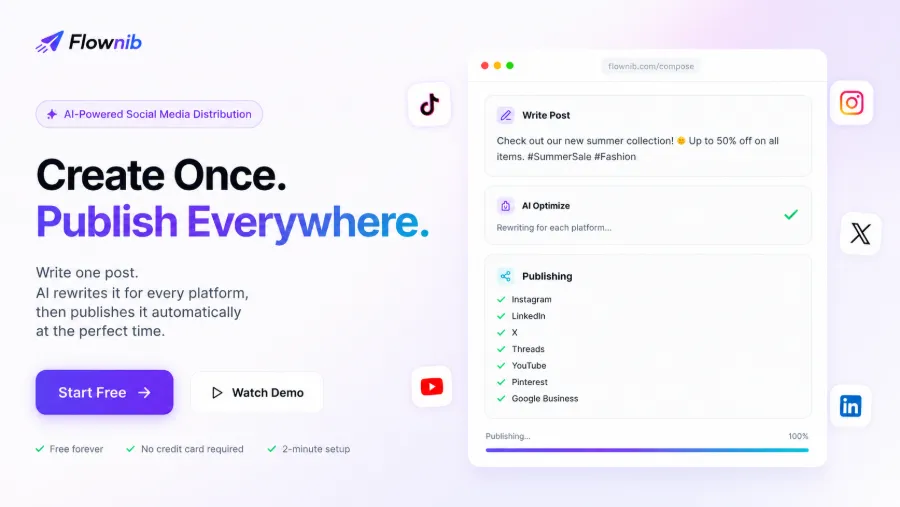
In multi‑account operation, Flownib’s synchronization friction mainly appears between rewritten results, scheduled times, and publishing records. Operators still need to check each region, currency, fact, and brand tone, especially to ensure AI rewrites haven’t turned “might” or “usually” into definitive promises. Teams can maintain a content calendar, recording original sources, rewritten versions, accounts, publish times, and exception statuses; reducing the “copy‑paste” problem discussed in social‑media silo to one‑stop solutions often reveals the most vulnerable spots during hot‑topic publishing.
Pre‑publish checks should not be a formal checklist. Accuracy is the first layer; then verify region and currency matching, avoid over‑promising, ensure the content answers real questions, and preserve brand tone. If using official APIs for synchronized publishing, also check whether account authorizations have expired, whether image formats are accepted, and whether link parameters are intact. A content calendar reduces omissions but cannot guarantee every platform’s version fits the local audience; for concrete cases of multi‑platform operational time savings, see Shortening Social‑Media Ops Time.
Use Small‑Scale Tests to Decide Whether a Topic Is Worth Further Investment
In the first 24 hours after publishing, the team doesn’t need to jump to conclusions based on exposure metrics. A more useful observation order is early clicks, comment quality, saves or shares, new questions appearing in comments, regional feedback, and actual conversion paths. High click‑through but comments full of “where to buy” may be less valuable than moderate click‑through with many specific usage questions; the latter may be better suited for continued product education.
Comment quality is closer to audience intent than comment quantity. Brands can record whether comments come from the target market, mention specs, price, shipping, after‑sales, or alternatives, and check if users share the content with actual purchase decision‑makers. Save and share rates reflect reference value but still don’t directly equal conversion; some content is good for bookmarking but won’t instantly generate orders.
Teams can categorize outcomes into continue, adjust, or pause. “Continue” means expanding new use‑case or regional angles; “adjust” usually involves rewriting the intro, adding evidence, or correcting phrasing; “pause” means stopping pursuit of the topic and feeding new questions back into the keyword pool, awaiting later signals. This creates a loop of discovery, validation, publishing, and review, rather than restarting from hot lists every week.
Cross‑border operations must also log time zones, holidays, inventory, shipping promises, and local cultural context in the review. The same content may get feedback in the US evening but miss the active window in Australia; a holiday‑promotion topic with only two days of inventory may generate customer‑service pressure if exposure is increased. Operators should keep observing for 24 hours, marking each change with scheduled publishing and publishing records, not just checking total exposure the the next day.
A heavily liked topic may simply be a popular format; a topic repeatedly asked by a few target users is more likely to become the next round of product content. Teams need to retain original questions, regional phrasing, and post‑publish feedback, allowing the keyword pool to evolve with user language rather than with platform hot lists. This process doesn’t guarantee beating competitors every time, but it reduces the passive situation where topics are only acted on after they’re already mature.
FAQ
How often should cross‑border e‑commerce teams check for potential trends?
Perform a short scan daily and a focused review weekly. Daily scans only log newly appearing keywords and discussion changes; the weekly review compares 7‑day discussion growth, regional feedback, and content performance, avoiding mistaking a single‑day controversy for a trend.
How to tell if a topic is truly growing rather than a fleeting controversy?
Observe for at least 24 hours and compare repeated questions across four source types. If growth comes only from one news article or a few marketing accounts, it’s usually echo; if real users on Reddit, YouTube comments, and search queries raise similar questions with different wording, the growth credibility is higher.
What conditions must a trend meet to be suitable for marketing content?
It should simultaneously have relevance to the target market, a clear audience question, and a verifiable product‑association scenario. The team must also confirm that inventory, price, shipping, and after‑sales information are valid at publish time; otherwise, clicks may not translate into conversions within hours.
Why can’t the same hot topic be directly copied to all platforms?
Because audience intent and content formats differ per platform. TikTok may need a demo, LinkedIn needs industry background, Reddit requires direct answers; full copying looks mechanical, while over‑rewriting loses the original discussion’s context.
How to validate a new topic when there’s limited data?
Run a small‑scale test, recording click‑through, comment quality, save rate, share rate, and regional feedback rather than chasing massive exposure. If multiple target users pose specific questions within 24 hours, the team has enough basis to adjust the angle or expand the test.
Share Article