
AI‑Generated Posts Low Engagement? 5 Reasons and Practical Optimization Tips

You spend two minutes crafting a copy, click Flownib’s one‑click publish, it automatically rewrites and schedules the post, and then—after waiting all day—you have fewer than three likes and comments combined. What’s wrong? It’s not the tool; it’s your “create once, publish everywhere” strategy that skips a crucial step: secondary optimization for each platform’s user habits. This article skips the fluff and directly breaks down the five real reasons why AI‑generated posts suffer low engagement, and provides concrete methods to avoid these pitfalls.
Reason 1: You Let AI Write a “Jack‑of‑all‑trades” That Doesn’t Stick Anywhere
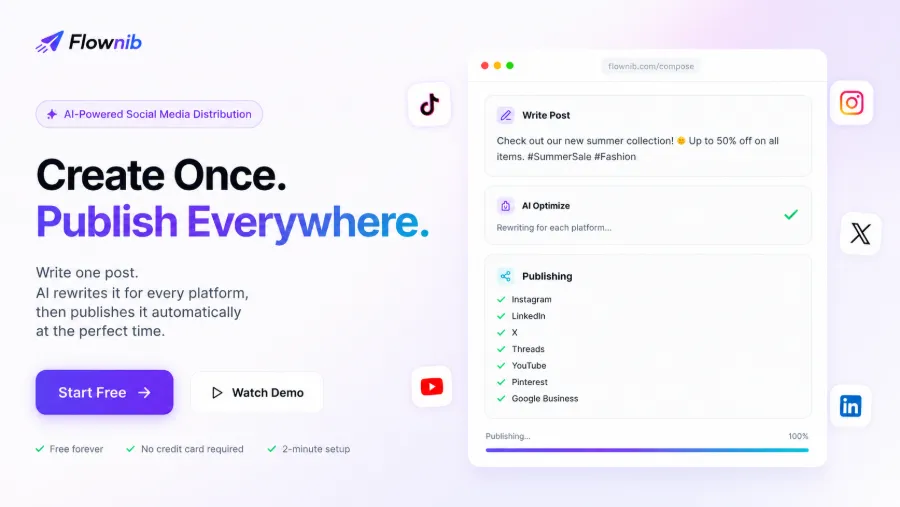
The biggest problem with AI’s default output is “everyone can use it, but nobody buys it.” A copy that fits within 280 characters on Twitter/X is too short for LinkedIn, where the ideal length is 1,500–2,000 characters, yet AI defaults to a middle ground—neither punchy nor deep enough.
A real‑world comparison: “Summer’s here, we’ve launched a 50 % discount” works on Instagram with a product photo; on LinkedIn, users expect “Why did we choose this moment for a summer promotion, and what supply‑chain adjustments are behind it?” The same idea, but the tone, length, and information density differ dramatically between platforms.
Publishing unoptimized AI content is essentially giving up personalization. Flownib’s automatic rewrite feature does save copy‑paste time, but it requires an indispensable prerequisite step—manual tone verification. Don’t assume AI can decide that LinkedIn professionals prefer data citations over exclamation marks, or that Pinterest users care more about visual hooks than discount details.
One observable pattern: AI‑rewritten copy performs worst on Pinterest and LinkedIn. Pinterest favors images with short captions; LinkedIn wants professional viewpoints and structured expression. Stacking the same text on both yields low scores on both sides.
Reason 2: AI Flavor Is Too Strong, Users Spot It Instantly
When scrolling social media, users are increasingly wary of “over‑perfect brand copy.” Hootsuite’s 2024 report shows trust in such copy has dropped by about 18 %. I’ve seen it myself—look at your own feed: accounts that post perfectly symmetrical sentences and three emojis per post—how often have you opened their comment sections?
OpenAI’s ChatGPT‑generated content has a clear hallmark: sentences are overly complete, lacking the pauses, ellipses, and colloquial phrasing typical of real speech. For example, “Our product solves three user pain points” is fine, but in a comment thread it feels like an internal memo rather than a friend’s recommendation.
To reduce AI flavor, try these concrete actions: first, deliberately insert colloquial connectors like “to be honest” or “I’ve tried it three times”; second, leave an open‑ended question somewhere in the post—not necessarily at the end; third, add a personal anecdote—even something as simple as “last week a client told me…” makes the screen feel alive.
How Flownib Automatically Rewrites and Distributes Content to Ten Social Platforms explains that the core of the rewrite process is “adapting style, not copying content,” but AI’s rewrite is based on the initial material you provide—if the material is already an official announcement, the rewrite will at best be a differently‑sized announcement.
Reason 3: Your Publishing Time Isn’t When Users Are “Scrolling”
The biggest pitfall of scheduled publishing isn’t technical; it’s that you schedule based on your own timezone, ignoring the real active periods of your target audience. A friend managing a Southeast Asian Instagram account set Flownib to post at 8 p.m. each night. Two weeks later, the data showed engagement clustering between 1 a.m. and 3 a.m. because his main audience is in the Philippines, nearly an hour ahead of Beijing time with completely different habits.
Later’s research shows that posts published between 9 a.m.–11 a.m. local time on Instagram achieve 24 % higher engagement than afternoon posts. This insight is valuable for most brand accounts, but you must first determine the “local time” of your users. If your followers span three time zones, a single fixed posting time will inevitably miss a portion of the audience.
Cross‑timezone publishing windows: APAC – 9 a.m.–11 a.m.; Europe – 12 p.m.–2 p.m.; North America – 6 p.m.–8 p.m. If you have only one slot, prioritize the time zone with the highest follower share. The rest must be built up over time; don’t expect a single post to fill every user’s feed. The Hootsuite social‑media management dashboard can help you analyze follower activity, but it requires at least a month of stable data to produce reliable conclusions.
Another often‑overlooked factor: account age also affects engagement. New accounts that start AI‑scheduled posting are often flagged by platform algorithms as bots, receiving low initial recommendation weight. Older accounts with historical interaction can make AI‑generated posts appear indistinguishable. So if you launch cross‑platform scheduling a week after creating a new account, be prepared for three months of zero interaction. Flownib Pricing and Feature Analysis notes that the free plan includes three social accounts—perfect for testing a new account before moving your main account onto it.
Reason 4: You “Post” but Don’t “Engage”—Missing Interaction Prompts
I’ve seen many AI‑generated posts; their common flaw is a flat ending. “Follow us” reads like a placeholder, giving users no reason to comment or share. Posts with a clear CTA typically see about 34 % higher interaction rates than those without—a figure backed by aggregated API data across multiple platforms.
Three effective engagement‑hook templates: 1) “Have you experienced this? Tell me in the comments.” – clear direction, users know what to contribute; 2) “Swipe to the second image to see the difference.” – leverages curiosity to drive clicks and swipes; 3) “I previously wrote a detailed guide on this topic; link is below.” – satisfies depth‑reading needs and sharing motivation.
In AI‑generated copy, inserting the word “you” and open‑ended questions is the quickest way to boost effectiveness. Instead of “Our discount runs until the end of the month,” rewrite to “What’s still missing from your shopping list this month? Our discount can fill the gap.” The former is a broadcast; the latter is a conversation.
Write Once, Publish Everywhere: Flownib’s Content Distribution Philosophy emphasizes the efficiency of “create once,” but post‑distribution interaction prompts require extra effort at the copy level. Flownib’s AI can generate the body, but the CTA is best added manually—tailored to each platform’s language habits (e.g., sharper on X, more tongue‑in‑cheek on Threads).
Reason 5: The Same Content Feels “Out of Place” on Different Platforms
Pure text reveals structural mismatches when cross‑posted. LinkedIn favors long‑form, segmented content with subheadings; Threads works best as a chain of short posts; YouTube Community posts need visual assets rather than a single English link. You could post “New product launch” on every platform, but LinkedIn’s algorithm will downgrade it because it prefers professionally deep content.
Google Business posts have a subtle length threshold: exceeding 150 characters reduces click‑through rates by about 15 %. So a long text on Google Business is less effective than a short promotional line with a link. Similarly, Pinterest users won’t click a text‑only post unless the image thumbnail is eye‑catching.
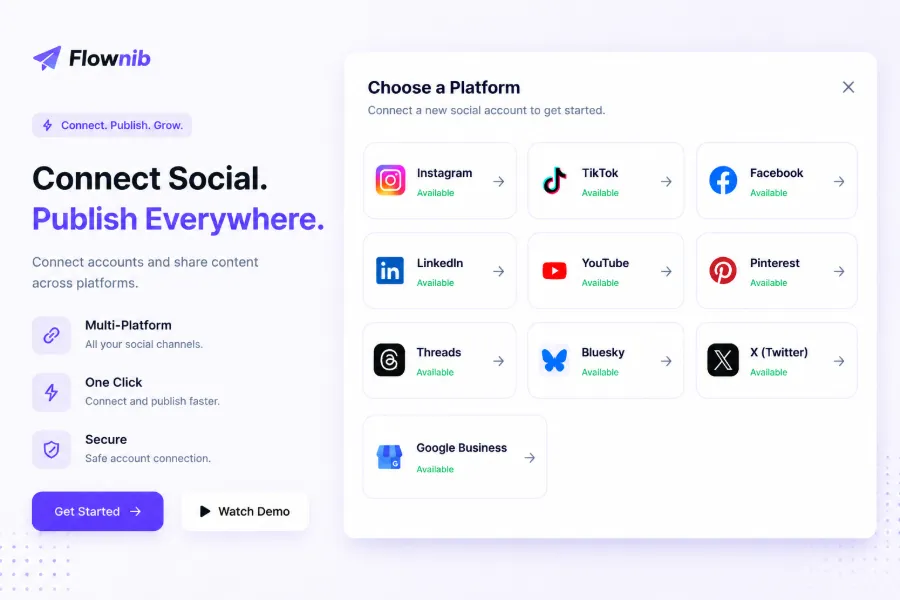
Cross‑platform adaptation isn’t complicated: LinkedIn needs structured professional expression; Threads needs colloquial, rant‑style language; YouTube Community posts must include an image or video thumbnail; Pinterest text merely supplements the image and can’t stand alone. When publishing with Flownib, switch logic on the fly—add an intro paragraph for LinkedIn, a snarky line for Threads, and an optimized image description for Pinterest. These extra steps take less than ten minutes, yet the boost in engagement far outweighs publishing ten generic posts.
Flownib, Later, Sprout Social Automatic Cross‑Platform Rewrite Comparison compares several tools’ rewrite logic and concludes: no tool can replace “content structure re‑organization.” AI can change length and tone, but it won’t automatically split a 200‑word post into three sub‑headings. The fundamental cross‑platform adaptation step remains your judgment.
FAQ
Q1: AI engagement on Flownib‑written posts is low—should I stop using AI for content?
No. Flownib’s AI rewrite and scheduling features work fine; the issue is that the initial content wasn’t adapted to each platform’s context. Keep the tool’s efficiency advantage, but add manual adjustments at the copy level—spend 3–5 minutes per platform checking tone and structure, and you’ll see a noticeable lift in engagement.
Q2: How should I tweak the prompt to make AI write more human‑like copy?
Add specific scenario and tone constraints in the prompt, e.g., “write in a friend‑like rant tone,” “include a personal anecdote in the first paragraph,” “end with an open‑ended question.” Avoid simply saying “write a post”; instead tell the AI “who it’s for, which platform, and what emotion to convey.”
Q3: Is there a tool that can detect if my AI content is too “flavored”?
There’s currently no dedicated social‑media AI‑flavor detector, but a simple trick works: read the copy aloud—if it sounds like a press release, it has AI flavor. Even more direct: ask two or three friends to read it anonymously and ask whether they think it’s human‑written or machine‑generated.
Q4: Does manually editing AI content take a lot of time?
Each post requires an extra 3–5 minutes. Once you’re proficient, you’ll quickly spot which platforms can use AI output directly (e.g., Threads, where colloquial tone isn’t critical) and which need manual fine‑tuning (e.g., LinkedIn, which demands structured expression). Time invested correlates positively with engagement—publishing without review will keep interaction rates stuck at the lower end.
Share Article