
How Small Teams Can Use AI to Build Smarter Content Engines

Cross‑border e‑commerce teams often have to manage the U.S., Europe, and Southeast Asian markets simultaneously, while also handling Instagram, TikTok, LinkedIn, and other social platforms. In practice, content scheduling still relies on spreadsheets, copy‑pasting, and chat‑app reminders: the product page is updated but the social copy isn’t; a time‑zone miscalculation leads to a promotion being posted too early or too late; a platform fails to publish and the team only discovers it the next day when they look at the data.
A smarter content engine isn’t just about generating more AI‑written copy; it’s about turning topic selection, brand constraints, platform rewrites, review, publishing, and post‑mortem into a repeatable operational workflow. AI reduces repetitive work, but product facts, market context, and final judgments still need human oversight.
Small teams should first fix content inputs, review responsibilities, and publishing records, then let AI handle rewrites, scheduling, and cross‑posting. The result isn’t necessarily more daily posts, but a clear view of where each piece of content came from, what was changed, who reviewed it, and whether a poor result is due to the content itself or the publishing process.
Break the Content Engine into a Repeatable Operational Process
In cross‑border e‑commerce, a content engine isn’t a “write‑article” button. It should ingest inputs from product pages, customer reviews, support queries, search terms, and promotion plans, then continuously produce, distribute, record, and optimize content. For a team of three to five operators, a stable process is often more important than a single piece of copy being perfect.
A workable process can be broken into seven steps: topic input, brand assets, core content, platform adaptation, human review, scheduled publishing, and data post‑mortem. Topic input decides what to write; the brand asset library constraints what can be said; core content stores product facts; platform adaptation handles format differences for Instagram, TikTok, LinkedIn, etc.; review catches errors; publishing deals with accounts and time zones; post‑mortem feeds results back into the next topic round.
If a content engine covers ten major social platforms, manually switching pages and copying text won’t just be ten times harder. Each platform also has its own image ratios, video specs, character limits, link handling, and account permissions. Teams usually start feeling the chaos after the sixth platform: it’s not that there’s no content, but that they can’t tell which version has been edited or which version fits which market.

Therefore, the automation boundary should be defined early. AI‑generated content is suitable for drafts, headline variants, platform tone, and content reuse; humans still need to decide product specs, discount conditions, local holidays, logistics promises, and sensitive phrasing. For example, the same pair of shoes is priced in euros in Germany and dollars in the U.S.; inventory and delivery times may also differ. Such information should not be guessed by the model from context.
Teams also need to assign responsibility boundaries: who maintains brand assets, who confirms price and inventory, who reviews localization, who handles publishing failures, who records results. Content production, distribution, and post‑mortem should ideally reside on a single traceable chain. The discussion on building a content distribution closed loop explains how these processes connect.
A often‑underestimated bottleneck: generating the first draft takes only a few seconds; the real time sink is outdated brand assets, platform‑specific rework, and scattered publishing records. When AI doesn’t solve the data‑maintenance problem, faster generation simply spreads wrong versions faster.
Use One Core Content Piece to Support Different Markets and Platforms
Small teams should not write a separate piece for each platform first; they should create a “core content” that includes product facts, target market, key selling points, promotion conditions, prohibited language, and call‑to‑action. For example, the core content might describe a new product’s material, target audience, price range, launch date, and the user action the campaign wants to achieve.

AI can handle content repurposing based on platform length, audience, tone, and format, but that doesn’t mean copying the same paragraph verbatim to every channel. Instagram needs stronger visual explanations; TikTok may require a short video intro and conversational script; LinkedIn suits industry background explanations; Reddit’s discussion context isn’t suitable for direct promotional copy.
Trend discovery should also happen at the ideation stage. A practical approach: after entering a keyword, scan four discussion sources—Reddit, YouTube, news, and Hacker News—and then select angles related to product, user problems, and commercial intent. Trending signals can enter the topic pool but not the publishing queue directly, otherwise the team will chase hot topics and lose brand voice.
Platform differences keep evolving. Threads is good for short opinions and continuous dialogue, but its audience interaction differs from Instagram’s. Teams can check the actual content shape on the Threads platform before deciding whether to reuse the same theme. Character limits are superficial; real rework often occurs when tone, context, or call‑to‑action don’t match.
Localization checks must go beyond translation proofreading. Before publishing, re‑verify currency, logistics promises, inventory, holiday context, language expression, and compliance risk. For example, “next‑day delivery” may only apply to a specific warehouse region, and “limited‑time discount” may become invalid if the market’s start time differs. One creation can share facts and direction, but platform rewrites and human review cannot be skipped.
In cross‑border footwear, product selling points, social media content, and downstream traffic paths often influence each other. Teams can refer to a cross‑border footwear e‑commerce case study to understand how distribution and business feedback connect. In practice, one creation is not one copy; it’s a fact‑gathering exercise followed by multiple bounded adaptations.
Integrate AI into Publishing, Review, and Scheduling, Not Just Writing
The publishing workflow can be ordered as “write core draft → AI rewrite → preview → human review → schedule → publish → record.” This seemingly ordinary sequence prevents teams from generating dozens of posts in bulk only to discover that brand assets or promotion rules have changed.
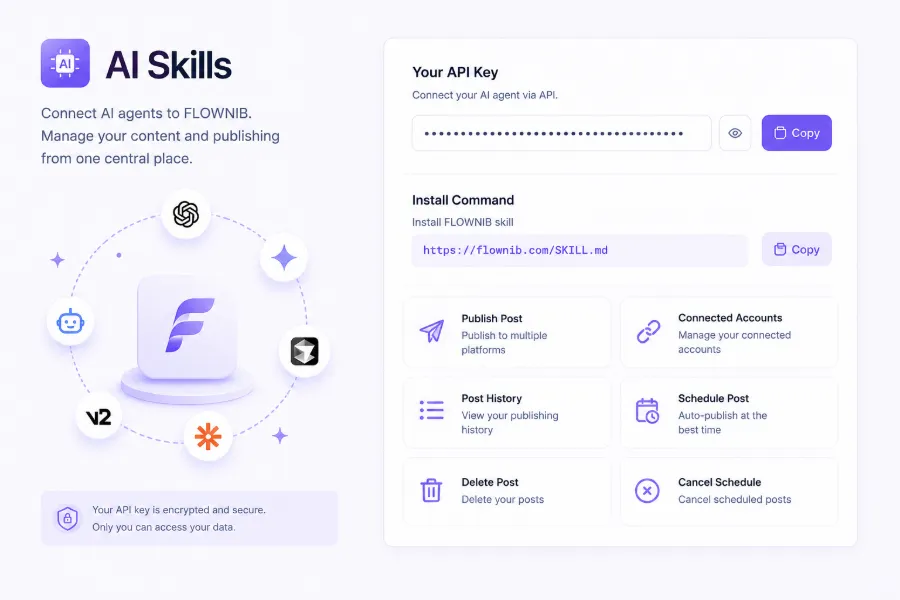
For account connection and unified scheduling, Flownib can be placed in the actual workflow to manage accounts, rewrite content, preview versions, schedule publishing, and view records. The integration start point can be done in about two minutes for account connection, but that does not mean content goes live after two minutes; human review still needs dedicated time.
The value of batch scheduling isn’t just fewer tab switches. It reduces repeated logins, manual copy‑pasting errors, and mistakes like posting a UK version to a US account. Teams still need to confirm account ownership, official API permissions, publishing times, media formats, and failure‑retry logs; any missing step makes troubleshooting revert to chat logs and personal memory.
When viewing scheduled content, the content calendar should display platform, account, market, planned time, and status—not just a string of titles. For Instagram scheduling checks, see view Instagram scheduled posts; the focus is not on page layout but on whether the team can confirm version and timing before publishing.
Cross‑border AI’s full‑traffic closed loop also involves product pages, social media, search, and data feedback. The related cross‑border AI content closed‑loop architecture can serve as an external reference when designing processes. Operators need to distinguish two failure types: content problems (facts, tone, or selling points) and publishing problems (API permissions, media format, account status, or time‑zone configuration).
| Method | Main Manual Operations | Suitable Scenarios | Typical Risks | Traceability |
|---|---|---|---|---|
| Manual per‑platform publishing | Login, rewrite, upload, confirm time | Few platforms, few posts | Missed posts, wrong posts, timing errors | Low |
| Spreadsheet + manual copy | Organize versions, copy‑paste, fill status | Limited budget trial run | Version confusion, delayed records | Medium‑low |
| AI adaptation + unified scheduling | Review core draft, confirm adaptation, handle exceptions | Multi‑market, multi‑account ops | API failures, erroneous batch propagation | Medium‑high |
During one promotion cycle, a team manually copied the same promotion copy to multiple platforms. The Canadian price had been updated, the UK wording had been changed, but the spreadsheet still held the old version. Hours later, some content was scheduled, some remained in drafts, and after publishing price inconsistencies appeared. The team spent two days reworking; the real problem wasn’t copy quality but the lack of a complete publishing record, making it impossible to quickly identify which account used which version.
This incident shows that automation also needs a rollback mechanism. Before bulk publishing, retain the core content version, market version, and reviewer. If an error occurs, pause unpublished tasks, retract or correct already published content, then record the affected platforms and accounts. Teams without stable permission management or failure logs should not connect all markets and accounts to automated scheduling from the start.
Use a Few Metrics to Judge Whether the Content Engine Is Truly Smarter
Small teams don’t need a complex data warehouse for the first post‑mortem. A pilot can be limited to up to three social accounts and six posts, checking whether the content calendar, review records, publishing status, and post‑mortem fields can be consistently filled. This scale is enough to expose process issues without overwhelming the team with large‑scale errors before automation runs smoothly.
Publishing success rate and on‑time publishing rate are efficiency metrics; rework count and content production cycle reflect process friction; engagement, clicks, product page visits, and conversion are business metrics. Looking only at publishing volume creates an illusion: a team may post 20 more items per day, but if they target the wrong market, use expired offers, or adopt an unsuitable tone, product page traffic may actually drop.
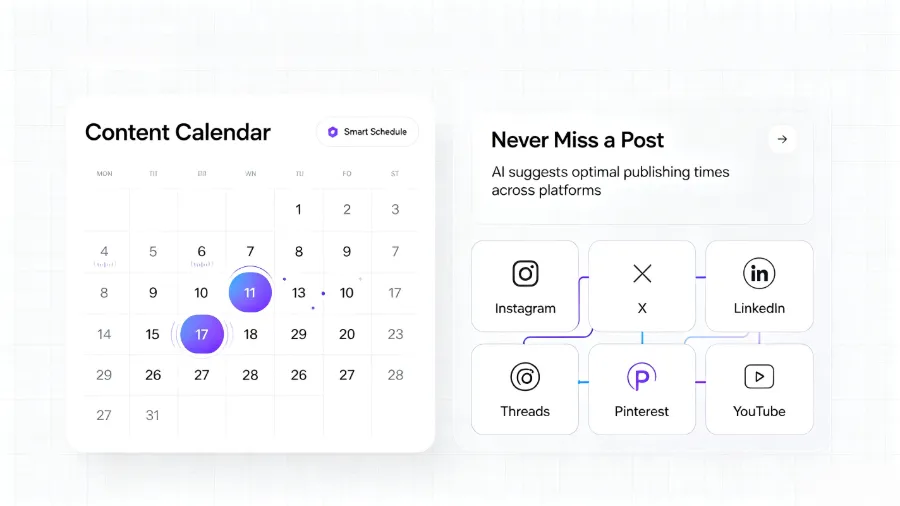
When recording results, at least segment by market, platform, content theme, and format. The same theme’s video intro may work on TikTok but get no clicks in a long LinkedIn text; a high interaction rate in one market doesn’t guarantee more conversions. Teams can refer to the evaluation dimensions in the compare AI social media management tools article to check whether a tool provides publishing records, account permissions, failure status, and content audit—not just generation speed.
Content audit should trace back to brand assets and review nodes. If AI generates wrong specs, expired prices, or off‑brand phrasing, the team must determine whether the asset library was outdated, constraints were missing, platform adaptation overstepped boundaries, or human review missed it. A high publishing success rate does not guarantee a healthy content engine; erroneous content can still be consistently published.
Another often‑overlooked phenomenon: “not published” versus “published but ineffective” leads the team down completely different optimization paths. The former requires checking official APIs, permissions, assets, and scheduling; the latter triggers analysis of topics, formats, and audience feedback. If the content calendar only records plans without failure reasons, the team will easily misinterpret technical faults as content fatigue.
The maintenance order of the content engine can stay disciplined: first freeze brand assets and market rules, then lock the core content template; next test platform adaptation, human review, and publishing records; finally expand account numbers and automation scope. This won’t eliminate all rework, but it will keep rework occurring before publishing and preserve enough evidence to decide whether to tweak the process or the content.
For small teams, “smarter” usually means the model isn’t just writing more human‑like sentences, but operators no longer have to stay up late re‑checking spreadsheets and can still locate each piece of content’s source, version, and result. As long as this chain can be maintained, AI has a chance to become a controllable part of the content operation rather than just a drafting tool.
FAQ
Should a small team let AI handle topic selection, writing, or publishing first?
Let AI handle core draft rewriting and format adaptation first, then gradually bring in scheduling and publishing. Topic selection should combine product, market, and user problems; start with four discussion sources to generate candidates, then have humans filter them. Automation should be enabled after at least one pilot round of six posts.
Can cross‑border e‑commerce content be directly synced to all social platforms?
No. Sync product facts and direction, not the original copy. Instagram, TikTok, and LinkedIn have different character limits, media expectations, and audience habits, so each platform should receive at least one AI rewrite and human preview.
After AI rewrites, what still needs human review?
Human review must check price, currency, inventory, logistics promises, product specs, holiday context, and compliance phrasing. When a promotion lasts less than seven days, data changes more frequently, so it’s best to reconfirm core content and market version before publishing.
How to avoid multiple markets using outdated price, inventory, or logistics info?
Treat price, inventory, and logistics conditions as brand assets with update timestamps, not as static prompt text. Re‑confirm them before each promotion, keep reviewer and version numbers, and if an error is found, pause unpublished tasks and then address already published content.
Which content‑operation metrics should a small team prioritize tracking?
Start with publishing success rate, on‑time publishing rate, rework count, content production cycle, and product page visits. Record the first four weekly; business metrics should be observed per market and platform for at least two to four weeks to avoid premature process changes based on a single post’s fluctuation.
Share Article