
“No AI” Tag Becomes a Selling Point, but Can a Small Team Really Operate All Ten Platforms Manually?

At eight in the morning you post a product picture on Instagram and quickly reply to two direct messages. At ten, your LinkedIn B2B post isn’t finished yet because someone asked for parameters in the comment section of yesterday’s post. At two in the afternoon, someone mentions you on Threads about shipping time; while typing you remember that Pinterest hasn’t been updated for three days. At ten at night you open the backend and find that the assets for YouTube Shorts and TikTok are still sitting in your phone’s gallery. This is the daily routine of many three‑to‑five‑person cross‑border teams: go through ten platforms and the day is gone.
The “No AI” label is becoming a marketing tag for some brands, emphasizing pure manual work, warmth, and human creation. For a small team that also has to handle product selection, customer service, and logistics, doing everything manually means a cliff‑like drop in publishing frequency and a gradual loss of account activity. This article dissects an alternative path: AI drafts, human polishing, and tool‑based distribution, rather than choosing between “all‑manual” and “AI‑only”.
“No AI” Tag Is Just Marketing Talk, or Is It a Real Need?
Since 2025, AI‑generated content has been estimated to account for over 20 % of mainstream platforms, and the complaint about homogenization has risen sharply. Seeing the same formulaic copy across three screens makes users wary; some brands respond by flashing a “No AI” label to distance themselves from the AI flood.
The tag works on the consumer side. Consumers’ concerns about AI content are specific: distortion, lack of soul, and sameness. Especially in communities like Xiaohongshu and Instagram that stress “authenticity,” labeling something as “human‑created” can earn a trust premium. For B2side operators, however, the tag is more a narrative strategy than a promise about production methods.
What you should really care about isn’t “whether to use AI,” but “whether the content feels human.” An counter‑intuitive observation is that consumers dislike not AI itself but soulless, mass‑produced content. Using AI to draft and then adding real data and experience manually often feels more “human” than a purely manual but perfunctory post. Manual work isn’t synonymous with care, and AI isn’t synonymous with coldness; the key lies in the polishing step in between.
Have You Calculated the Time Cost of Fully Manual Operation Across Ten Platforms?
Let’s do the math. One piece of content per platform per day equals 300 pieces a month across ten platforms. If each piece takes 30 minutes from concept, shooting, copywriting to publishing, that’s 150 hours a month. A full‑time operator working 160 hours a month would barely have enough time to do content creation alone.
The problem is that each platform has its own specifications. Instagram is visual, X limits to 280 characters, LinkedIn requires a professional tone, Pinterest relies on long images, YouTube needs click‑bait titles, TikTok demands rhythm, Facebook suits long text, Google Business leans local, and Bluesky and Threads are still experimental. The same piece of news must be written in ten versions, not counting comment replies and DMs.

In a small team, operations, customer service, and product selection already fill the schedule; content creation is pushed to the bottom. In a fully manual mode, the content ceiling is very low—not because you don’t want to post, but because you have no time. Moreover, platform algorithms weight publishing frequency higher than the quality of a single post. Consistent, stable publishing (even 7‑minute posts) maintains account weight better than occasional hits (four 9‑minute posts a month). Miss two weeks and the algorithm will penalize you.
Putting the three models side by side makes the gap even clearer:
| Model | Content Production Speed | Brand Voice Consistency | Labor Investment | Content Quality Risk | Suitable Team Size |
|---|---|---|---|---|---|
| Fully Manual | 30 minutes per piece | High | Extremely High | Low but easy to break | >5 full‑time staff |
| AI‑Only | 2 minutes per piece | Low | Extremely Low | High (high failure risk) | Not recommended |
| AI Draft + Human Polish + Tool Distribution | 5‑8 minutes per piece | Medium‑High | Medium | Controllable | 3‑5 person small team |
Breakthrough: AI Draft, Human Polish, Tool Distribution – Three Layers of Division
The core of the three‑layer division is: AI handles speed, humans handle warmth, tools handle delivery. Each layer solves a specific problem.
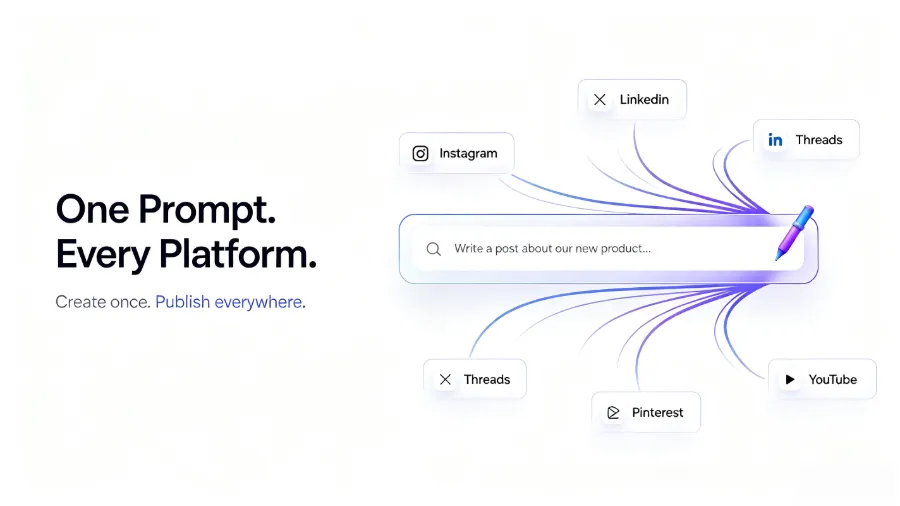
AI Draft tackles the “blank‑page” stage. Input product info and selling points; AI quickly generates a first draft that respects each platform’s character limits and style differences. The value isn’t a perfect copy, but eliminating the time spent staring at an empty document. One input box, a product description, and a few seconds later you have drafts for ten platforms ready to edit.
Human Polish is absolutely indispensable. Adjust brand tone, verify facts, add real experiences and opinions—things AI can’t do. For example, you might insert “We tested this batch for 72 hours water resistance” or “Last week a customer said the packaging was too tight; we’ve fixed it this week.” Those details are the source of “human feel.” Platform‑specific adaptation can also be done here, using official guidance to tailor each piece to the platform’s context.
Tool Distribution solves the “publishing” action. After polishing, a distribution tool syncs the content to multiple platforms at once, eliminating copy‑paste and tab‑switching. Note that tool distribution is not the same as an AI‑only pipeline—the tool doesn’t write content; it simply delivers the already polished copy to the right places. Tools like Flownib focus on official API integration for stable publishing, multi‑account management, and calendar‑based scheduling; they don’t create content, they just deliver it.
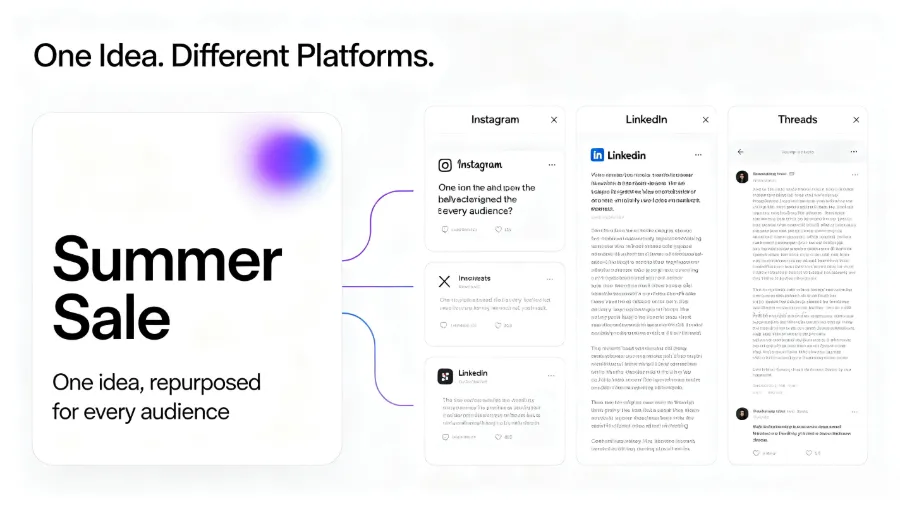
Running this workflow reduces the production time per piece to 5‑8 minutes, a clear efficiency gain over the 30‑minute manual process. The saved time isn’t for rest; it’s reinvested in content strategy and community interaction. For a full multi‑platform account management solution, see the linked overview.
Tool Distribution Is Not “AI‑Only,” It’s Just Automating Copy‑Paste
Many people hear “tool distribution” and imagine an “AI‑generated + auto‑publish” disaster. That misconception needs clarification: distribution tools sit in the middle, handling the “publish” step, not the “create” step.
A qualified Social Management SaaS should have three capabilities: official API integration for stable publishing (e.g., Flownib supports Instagram, X, LinkedIn, TikTok, Facebook, Threads, Pinterest, YouTube, Bluesky, Google Business with 99.99 % uptime), multi‑account management from a single dashboard, and a content calendar with scheduled publishing that visualizes all posted and pending posts. Connecting a new account to its first post takes about two minutes.
This is fundamentally different from an AI‑only pipeline, which is “generate‑then‑publish” with no human review—failure is inevitable. I’ve seen a brand rely entirely on AI for generation and publishing without human oversight; after three months, engagement plummeted and the comment section filled with negative feedback like “Are you robots?” and “The copy is getting lazy.” They had to pause publishing and spent two weeks rebuilding the content process. The lesson: tools can automate publishing, but they cannot automate quality control.
A small team’s implementation path should start with three core platforms (e.g., Instagram, LinkedIn, X), master the workflow, then gradually expand to ten. Consistent publishing rhythm matters more than perfect individual posts—three stable pieces a day beat one “perfect” piece a week. For a deeper dive into how an AI‑driven distribution system supports lightweight matrix operations for small teams, see the detailed article. If you’re on Instagram, the best‑time‑to‑post analysis based on 9.6 million posts is worth checking out; it helps you schedule during traffic peaks.
In an “Anti‑AI” Context, How to Stay Efficient Without Crashing?
In markets where consumers are sensitive to AI content, transparent and efficient AI use is feasible. The key is a solid checklist for the polishing stage.
Polishing should at least cover four tasks: add real data (e.g., “tested 72 hours water resistance”), add personal experience (e.g., “We changed the packaging after last week’s customer feedback”), add industry observation (e.g., “Q3 logistics times are generally 2 days slower”), and calibrate brand tone (so every piece sounds like it’s written by the same person). Posts that include specific data or case studies see on average a 30 % boost in interaction rates—this is a tested figure, not just theory.
Post‑publish interaction and comment management are parts AI cannot replace. Every specific user question and genuine feedback requires a real‑person response. That’s the most direct expression of “human feel”—users sense they’re dealing with a living person.
Regarding how to explain your production method to the audience: you don’t need to loudly proclaim “AI‑generated,” nor do you have to hide the assistance of tools. Users care about value, not the tools used. In the long run, reinvesting the time saved by AI into strategy and community interaction creates a positive efficiency loop. The Later blog contains many case studies on content planning and scheduling. If you haven’t chosen a tool yet, the 2026 Top 10 AI Social Media Management Tools comparison can help narrow your options.
FAQ
Will using AI to draft content get my posts throttled or flagged by platforms?
Most mainstream platforms have no explicit “AI‑content throttling” policy, but low‑quality content gets demoted. Platforms flag “no interaction, no value” content, not “AI‑generated” per se. As long as the content is human‑polished, contains real information, and generates interaction, AI‑drafted posts are treated the same as any other.
Is the “No AI” label really useful for cross‑border e‑commerce sellers?
It has some effect for consumer‑facing brands, especially on platforms that emphasize authenticity like Xiaohongshu and Instagram. For B2B clients, they care more about product specs, delivery capability, and after‑sales response than the tool used to write copy. Don’t make “No AI” a core selling point; it’s just one part of trust building.
How much time does human polishing actually take? Which steps are non‑negotiable?
Polishing a single piece takes about 3‑5 minutes. Non‑negotiable steps are fact‑checking (parameters, price, logistics), brand tone calibration, and adding real data or case studies. Skipping these brings you back to an AI‑only pipeline.
Will a multi‑platform distribution tool make all my posts look identical?
It depends on the tool’s capabilities. Good tools adapt to each platform’s character limits and style, but the “identical look” risk still exists. The solution is to use different cover images, opening lines, and comment‑engagement tactics per platform. The tool handles publishing; differentiation is the human’s responsibility.
How many platforms should a small team start with, and which ones?
Start with three core platforms: Instagram (visual commerce), LinkedIn (B2B leads), and X (industry topics and customer service). Master the workflow and establish a stable publishing rhythm, then gradually expand to TikTok, Pinterest, YouTube, etc. Trying to launch on ten platforms at once usually leads to poor performance across the board.
Share Article