
Using AI to Discover What People Are Discussing: Real‑Time Topic Workflow for Cross‑Border Marketing Teams

Cross‑border e‑commerce teams often encounter an uncomfortable situation: the volume of discussion in a particular market suddenly spikes, and related content appears everywhere on Reddit, YouTube, or news platforms, but the team cannot tell whether this is a genuine trend, short‑term noise, or a topic suitable for brand participation. By the time marketers finish verification, translation, and approval, the discussion window may already be closed.
AI’s role is not to automatically generate a post for marketers, but to consolidate real‑time conversations scattered across platforms into verifiable content opportunities: which viewpoints recur, who is discussing, whether the discussion momentum continues to grow, and what users are actually asking. Marketers then make the final judgment based on brand relevance, factual accuracy, and target market.
A practical workflow usually looks like this: input business‑related keywords, let AI scan Reddit, YouTube, news platforms, and Hacker News simultaneously, summarize hot angles by discussion intensity, publication time, audience questions, and platform context, then have marketers verify the original content and decide whether to localize, rewrite, and publish. Popularity is only a filtering signal, not a publishing permission.
Break “Real‑Time Hotspots” into Actionable Topic Signals
“What people are discussing” is not the same as opening a trending page and picking the highest‑ranked term. For cross‑border marketing teams, truly useful topic signals must answer four questions: what is the discussion about, who is the audience, is the discussion growing, and can the brand participate with real experience.
Different types of real‑time discussions have different lifecycles. A conversation that keeps heating up may come from users repeatedly sharing usage methods; breaking news spreads quickly within a few hours; platform‑specific search interest reflects users actively seeking answers; niche community discussions may be small in scale but contain very specific purchase barriers and product feedback. Mixing these signals into a single “hot” score can easily mislead the team.
AI can first scan multiple sources by keyword, then merge repeated viewpoints, questions, and expressions. For example, “AI productivity” may correspond to small teams using AI, creators saving time, enterprises willing to pay, or industry debates about automation. The same keyword does not guarantee the same content angle.
During actual filtering, AI needs to retain sources and context rather than just providing a one‑sentence summary. A Reddit user might be complaining about a tool, a YouTube viewer could be searching for a tutorial, and a news article’s focus might be policy or financing. The same keyword appearing in three places can have completely different user intent.
Cross‑border marketers must also assess the relevance of the topic to the brand, product, and target market. A highly energetic discussion that only concerns the US developer community, if directly rewritten into an e‑commerce post for German consumers, will likely result in low‑relevance interaction rather than effective reach.
How AI Filters Rising Topics Across Platforms
A stable discovery process can advance through four stages: input keywords, scan real‑time discussions, identify high‑frequency angles, and finally assess growth signals. This simple order prevents the team from immediately arguing about “what to post” and instead first checks where the data comes from and what users are saying.
The first step is not a broad industry term but a keyword set related to the product, target market, and customer problems. Cross‑border e‑commerce teams can combine product categories, usage scenarios, competitor names, purchase barriers, and seasonal demands. Keyword matching is just the entry point; later you must also consider platform, publication time, and user questions for consistency.
AI adapts content to multiple languages and publishes to a global market
For example, the same “portable espresso maker” may appear in four completely different hot angles: users comparing usage methods, creators discussing efficiency changes, consumers expressing purchase intent, and industry media debating material safety. AI can summarize these as hot angles, but marketers still need to open the original discussions to confirm the summary hasn’t omitted dissenting opinions or constraints.
Like counts cannot directly represent topic value. Reddit comment threads more easily expose user doubts and objections; YouTube view counts may continue to accumulate weeks after video release; news value lies in timeliness and event background; Hacker News discussions often focus on technical feasibility, privacy, or industry impact. Different audience and interaction mechanisms mean that looking at a single platform’s numbers loses important context.
| Source | Easier‑to‑Spot Signals | Suitable Validation Questions | Main Limitations |
|---|---|---|---|
| Repeated questions, user debates, real usage feedback | Where exactly are users getting stuck? | Strong community context; external brands entering abruptly can lose focus | |
| YouTube | Tutorial demand, search interest, creator demos | What does the user want to learn or compare? | View count doesn’t always equal recent growth |
| News | Breaking events, policy changes, industry dialogue | Does the topic have a real‑world background? | News buzz may end quickly |
| Hacker News | Technical controversy, developer opinions, tool discussion | Does the technical narrative stand up to scrutiny? | Narrow audience; not representative of mass purchase intent |
In a real filtering UI, 92 % can serve as examples of strong discussion momentum, 78 % indicate growing search interest, and 64 % show timely industry dialogue. These numbers are suitable for ranking candidate topics but should not be treated as universal performance benchmarks. The team also needs to record the discovery time for each signal; otherwise, a week later it’s easy to mistake a waning topic for a rising one.
Between discovery and scheduling, the content calendar serves as a record‑and‑decision tool, not just a display of publication dates. Teams can keep the original keyword, hot angle, target market, approval status, and planned platform in a single record. The related social‑media scheduling tool comparison should be evaluated for support of these processes, not just for the number of accounts it can connect.
Planning Real‑Time Topics and Cross‑Platform Publishing in the Content Calendar
From Hotspot to Cross‑Border Content Angle: Relevance, Timeliness, and Localization
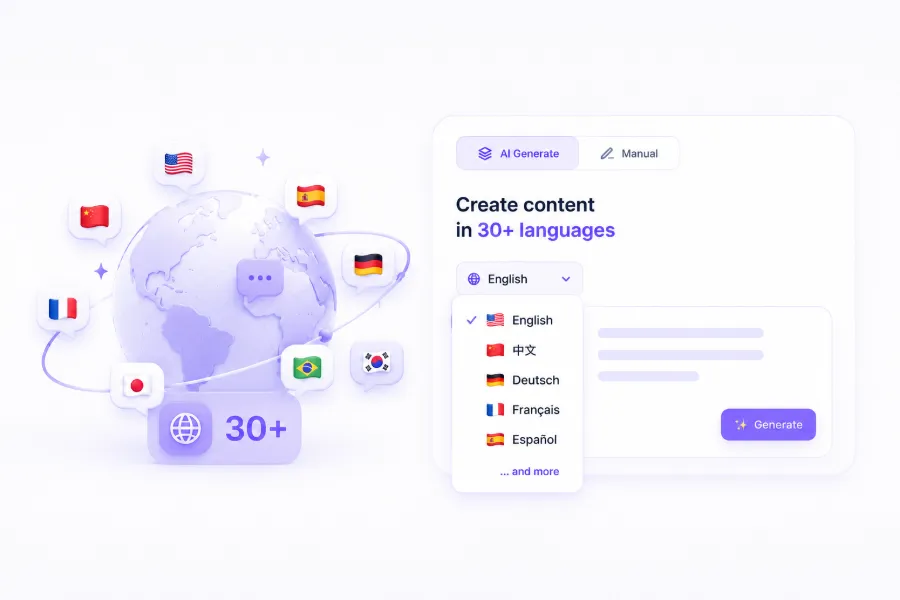
Cross‑border marketers can evaluate candidate topics through three consecutive questions: first, is it relevant to the target market; second, does the brand have genuine viewpoints, product experience, or verifiable information; third, is the discussion window still open? If any of these cannot be answered, the topic is unsuitable for immediate automated publishing.
The same trend often manifests differently across countries. Localization is more than swapping a Chinese sentence for an English one; cultural context, purchase motivation, platform audience, and expression taboos all alter the content outcome. US users may care about time savings, German users about data handling, Japanese users about politeness and specific usage steps. Even if the core viewpoint is the same, titles, examples, and calls‑to‑action cannot be copied verbatim.
Platform context also changes content format. Real‑time discussions on X prioritize response speed and idea density; Instagram relies heavily on visual context; LinkedIn audiences usually expect industry impact or work‑method insights; TikTok favors demos and short narratives. Marketers can consult the X Business Marketing Resources to understand platform content environments, but platform docs cannot replace direct audience observation.
AI is well‑suited to rewrite a core idea into multiple languages and formats. It can retain facts, product limits, and goals, then generate drafts for different countries, reducing duplicate effort. However, facts, tone, and cultural meaning must be reviewed by marketers, especially when pricing, regulations, health, safety, or social issues are involved. Machine translation may appear fluent but could turn “might improve” into “guarantees improvement,” or convert community sarcasm into a brand stance.
This is the trade‑off between rapid participation and hasty trend‑following. The closer to real time, the more the team must compress review time, but it cannot skip source verification. Cross‑border teams can start with a small release on one market and one platform, then decide whether to expand to other channels based on new questions in the comments, rather than launching synchronously across all countries from the start.
The same workflow can be adapted and distributed to ten social platforms, but “adaptation” does not equal copying the same paragraph. The core idea should stay consistent; title length, media format, hashtag count, call‑to‑action, and publishing time should be handled per platform. For multi‑market content adaptation, teams can refer to Low‑Cost Global Social Media Operations, but evergreen content and real‑time content should still be managed separately.
Real‑time topics should occupy a portion of the content calendar, not consume the entire plan. Evergreen content provides search coverage, product education, and stable conversion; hot topics provide timely response and market observation. Mixing them together makes it hard for the team to determine whether a traffic spike comes from long‑term demand or a few‑hour event buzz.
Connect Real‑Time Discovery to the Publishing Process, Not Just an Idea List
After a topic is discovered, the team needs to feed it into a continuous pipeline: discover topic → choose angle → generate draft → rewrite per platform → human preview → schedule → record actual results. Any step that stays in a spreadsheet or chat window forces marketers to copy‑paste, switch tabs, and eventually forget whether a market has already been published.
Flownib presents in this stage a path from keyword discovery to AI‑platform rewriting, then to preview, scheduled publishing, and multi‑platform distribution. The page lists an average setup time of 2 minutes; this is only an example for tool‑deployment flow and does not imply that content review or market judgment can be completed in 2 minutes.
When a real‑time topic enters the draft stage, marketers should first lock a non‑changeable core message, then let AI adjust title, length, format, and call‑to‑action separately. Instagram may need stronger visual explanation, X requires concise ideas, LinkedIn benefits from added industry background, and TikTok may need the idea turned into a demo intro. Platform rewrites reduce mechanical editing but do not eliminate brand trade‑offs.
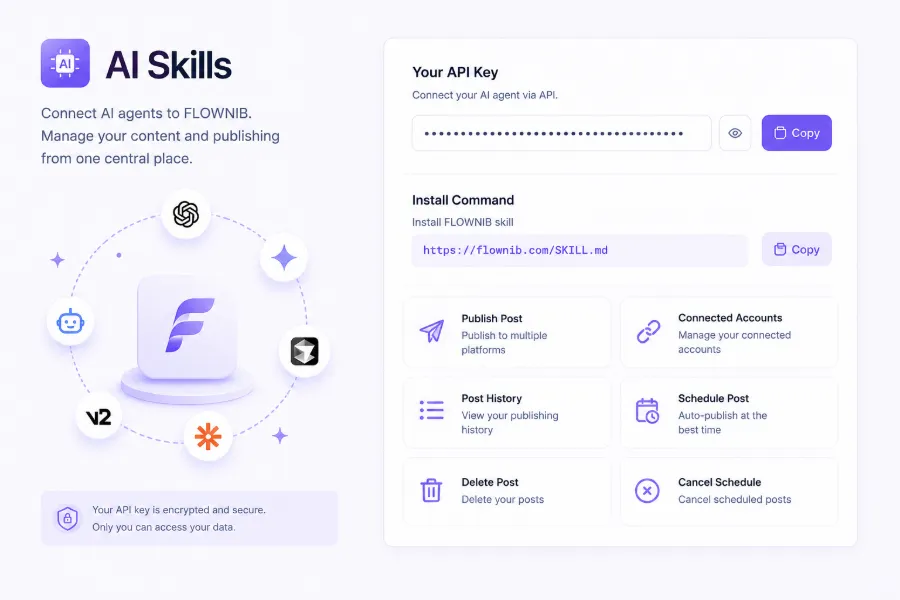
When an AI Agent connects to Codex, Claude Code, Cursor, and other development environments via Skills, automation can get even closer to the content‑operations flow—reading pending topics, generating multiple platform versions, checking publishing records, or setting scheduled tasks. The more automated the connection, the clearer the permissions and review boundaries must be: which accounts may publish, which content must be previewed, which topics can only be saved as drafts.
After reducing copy‑pasting and tab‑switching, the process indeed becomes shorter, but new friction points appear. Expired API permissions, mismatched image ratios, platform rejections of certain link formats can turn “one‑click publish” into partial success. Multi‑platform management should not only check whether a publish button is available but also confirm that each platform actually generated a record.
Around the goal of reducing manual scheduling, teams can explore AI‑Driven Social Media Distribution. If there are many accounts, publishing records should indicate country, language, platform, content version, and reviewer; otherwise, after a hotspot is rewritten three times, the team may not know which version is live.
For platforms like Instagram, the post‑scheduling status should also be spot‑checked on the platform side, especially for Reels, carousel posts, or content with product links. Teams can follow the workflow of Viewing Scheduled Instagram Posts to ensure that “scheduled” in the tool is not mistakenly interpreted as “already successfully published on the platform.”
Real‑time content should not be published automatically without review. News, controversial events, health, and safety topics all require human fact‑checking and context verification; when the original discussion contains sarcasm, rumors, or unconfirmed information, AI may present uncertain statements as overly certain. Leaving a few minutes for a final check before publishing is usually cheaper than deleting, explaining, and rebuilding brand tone after the fact.
Use a Review Mechanism to Judge Whether Hotspot Discoveries Were Truly Effective
After each hotspot release, the team should review four categories of results: reach, interaction, new questions in comments, and differences across markets and platforms. Increased reach does not equal correct topic judgment; many comments may indicate users questioning the brand. Conversion leads need separate tracking, otherwise the team may mistake high exposure for high commercial value.
The review sheet should preserve both “signals seen at discovery” and “actual performance after publishing.” For example, record Reddit comment growth, YouTube publication time, news event background, target market, and AI‑identified hot angles before publishing; after publishing, add each platform’s reach, interaction, comment topics, and conversion leads. This prevents the team from only retroactively inferring AI’s judgment from outcomes.
One real‑time topic workflow once failed this way: the team saw a high‑heat signal in a market, completed summary and cross‑language rewriting that morning, and simultaneously published to multiple accounts in the afternoon. The next day, reach was decent but comments mainly corrected the brand’s misunderstanding of the original discussion; one version turned a community question into a purchase recommendation, while another market’s wording seemed overly promising. The team removed the problematic versions and re‑examined the original thread, by which the discussion window had closed.
In that case, the problem wasn’t that AI didn’t find a topic, but that it found a topic with insufficient brand relevance and unstable context. Another common scenario is a topic heating up quickly but shifting before review is finished; hasty publishing then yields low‑relevance interaction. Cross‑language rewriting distortion doesn’t always manifest as obvious errors; sometimes the brand tone becomes stiff, causing users to stop asking follow‑up questions.
Review outcomes can be distilled into evergreen content, FAQs, product education material, or market‑research leads. Repeated questions within a hotspot may have more long‑term value than the hotspot itself. Teams can add these questions to the keyword library, update target‑market tags and judgment criteria, instead of chasing a new high‑heat term every day.
Scheduling and review can adopt a 24‑hour automatic‑operation rhythm: complete the first data capture within 24 hours of publishing, then monitor slower platforms afterward. This does not mean every hotspot must be published within 24 hours, nor that 24‑hour data is sufficient to judge conversion. For metric tracking and content‑operation cadence, see Social Media Operations Resources, but teams still need to retain raw data according to their own platforms and markets.
The final loop should be: discover → validate → localize → publish → review → update keywords and judgment criteria. AI reduces friction in information consolidation and content rewriting; marketers decide whether the brand should appear, in which market, and when to stop following up.
When the team stores the original context, market differences, and publishing outcomes in a single record, real‑time topics become more than an inspiration list. They become a repeatable, failure‑tolerant, and gradually improvable content workflow.
FAQ
When AI discovers a real‑time topic, what should marketers check first?
Check the original discussion context before looking at popularity scores. Marketers should verify source, publication time, user intent, and brand relevance before publishing, keeping at least one manual verification step; if the topic involves news or controversy, a few minutes of fact‑checking cannot be skipped.
How to decide whether a hot discussion is suitable for a cross‑border e‑commerce brand to first confirm whether it relates to the target market’s user problems or purchase needs, then assess whether the brand has genuine viewpoints and verifiable information. If relevance is clear, the team must also check whether the discussion window is still open and observe comments and search interest for at least one publishing cycle.
Can AI automatically understand the differences in how users from different countries perceive the same topic?
AI can generate different versions based on language and platform, but it cannot reliably replace market judgment. Marketers need to verify cultural context, tone, and factual meaning, especially by comparing post‑publication comments and interaction quality across countries within 24 hours.
Should real‑time hotspot content be published immediately, or first added to the content calendar?
For ordinary product‑usage topics, it can go into a short‑term schedule with a human preview; for health, safety, policy, or controversial events, verification should be completed first. The content calendar can record candidate topics, approval status, and expiration time to prevent the team from treating a closed window as a new opportunity.
How to avoid AI mistaking short‑term noise for a long‑term trend?
Do not rely on a single platform’s spike; compare sources, timing, and user questions across Reddit, YouTube, News, and Hacker News. After publishing, record discovery signals alongside actual reach, interaction, and comments; after several review cycles, decide whether to elevate the topic to evergreen content.
Share Article


